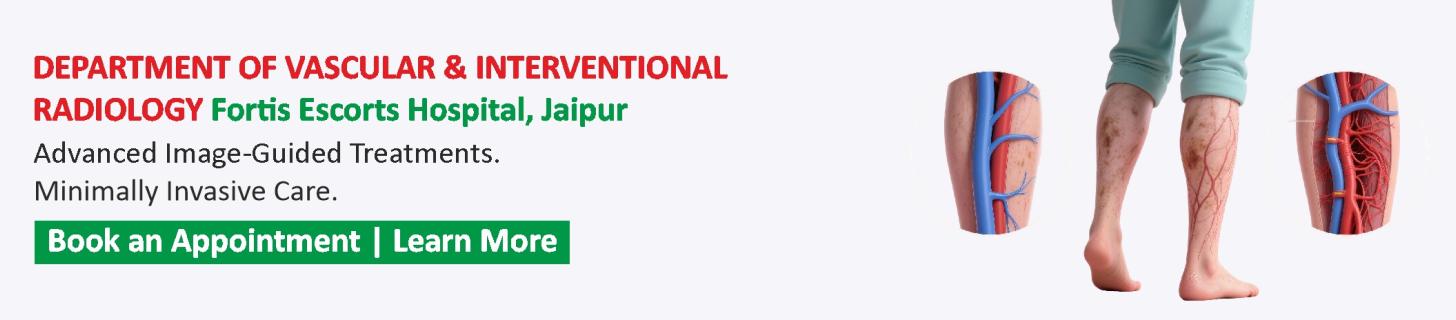
Interventional Radiology (IR) is a rapidly evolving specialty that combines advanced imaging technology with minimally invasive treatment techniques. At the Department of Vascular & Interventional Radiology, Fortis Escorts Hospital, Jaipur, patients have access to image-guided procedures designed to diagnose and treat a wide range of vascular, oncological, women's health, men's health, and pain-related conditions.
Our team of experienced interventional radiologists uses advanced imaging guidance—including ultrasound, CT, fluoroscopy, and other image-guidance technologies—to perform precise procedures through small needle punctures or catheter-based approaches.
With a focus on precision, safety, personalised treatment, and faster recovery, our department provides minimally invasive alternatives to selected conventional surgical procedures wherever clinically appropriate.
Cancer Care Image-guided procedures for the diagnosis and treatment of tumours, including TACE, radioembolization, microwave ablation, cryoablation, PEI, and irreversible electroporation (IRE).
Vascular & Endovascular Care Minimally invasive treatment for arterial, venous, and vascular conditions, including angioplasty and stenting, atherectomy, aneurysm repair (EVAR), venous access, and varicose vein treatments.
Women’s Health Advanced image-guided procedures including uterine fibroid embolization, ovarian vein embolization, fallopian tube recanalization, and selected treatments for heavy menstrual bleeding.
Men’s Health Minimally invasive solutions including prostate artery embolization (PAE), varicocele embolization, and other image-guided vascular procedures.
Interventional Pain Management Targeted procedures for chronic and complex pain, including spinal injections, nerve root blocks, facet joint injections, radiofrequency ablation, joint injections, and sympathetic nerve blocks.
Interventional radiology is a medical speciality that uses imaging guidance to perform minimally invasive diagnostic and therapeutic procedures. Many procedures can be performed through a small needle puncture or catheter rather than conventional open surgery.
Is interventional radiology safe?
Image-guided procedures are designed to improve precision and minimise unnecessary tissue injury. However, every procedure has potential risks. Your interventional radiologist will explain the specific benefits, risks and alternatives before treatment.
Will I need surgery?
Not necessarily. Some conditions that traditionally required surgery may have minimally invasive treatment options through interventional radiology. Whether you are a candidate depends on your diagnosis, anatomy, overall health and previous treatment.
How long does an interventional radiology procedure take?
Procedure duration varies significantly depending on the treatment. Some procedures may take less than an hour, while more complex interventions can take several hours. Your doctor will explain the expected duration before the procedure.
Will I be awake during the procedure?
The type of anaesthesia or sedation depends on the procedure and your medical condition. Many interventions are performed with local anaesthesia and sedation, while others may require deeper sedation or general anaesthesia.
How quickly can I return to normal activities?
Recovery varies by procedure and individual patient. Some minimally invasive procedures allow patients to return home the same day or after a short observation period, while others may require hospitalisation.
Can interventional radiology treat cancer?
Yes. Interventional oncology includes several image-guided treatments for selected cancers, including tumour ablation and arterial therapies such as TACE and radioembolization. Suitability depends on the type, size, location and stage of the tumour and the patient's overall health.
Is interventional radiology an alternative to surgery?
For selected conditions, yes. However, it is not a replacement for surgery in every situation. The appropriate treatment is determined after evaluation by the relevant specialists.