

Surgery for fibroids and the uterus — through cuts smaller than a fingertip
Robotic gynae surgery treats fibroids, heavy bleeding, endometriosis and more through a few keyhole incisions instead of one large cut — so most women have less pain, smaller scars and get home sooner than with traditional open surgery.
- Da Vinci Xi robot
- Uterus-preserving options
- Experienced women's surgeons
What is robotic gynae surgery?
Robotic gynae surgery is keyhole (minimally invasive) surgery performed with the Da Vinci Xi system. Your surgeon sits at a console beside you and controls slim robotic instruments through a few small incisions, guided by a magnified, high-definition 3D view inside your body.
It builds on ordinary laparoscopy, but the instruments bend and rotate like a human wrist — only steadier — which helps in the tight, delicate spaces of the female pelvis.
The surgeon is in full control
The robot never moves on its own. Every motion is made by your surgeon in real time — the system simply translates their hands into finer, steadier movements. No autopilot, no AI deciding anything: an experienced surgeon, with extra precision.
Why women choose the robotic approach
Robotic vs traditional open surgery
Traditional open gynae surgery means one large cut across the abdomen. The robotic approach does the same operation through a few tiny incisions — and that single difference changes almost everything about the experience and recovery.
Robotic · Da Vinci Xi — keyhole precision
- A few incisions, each under a centimetre
- Magnified 3D HD view for the surgeon
- Typically less blood loss and less pain
- Often home in 1–2 days
- Tiny, barely-visible scars
Traditional open surgery — one large incision
- A single long cut across the abdomen
- Direct eye view, standard instruments
- Typically more blood loss and more pain
- Often 5–7 days in hospital
- A larger, lasting scar
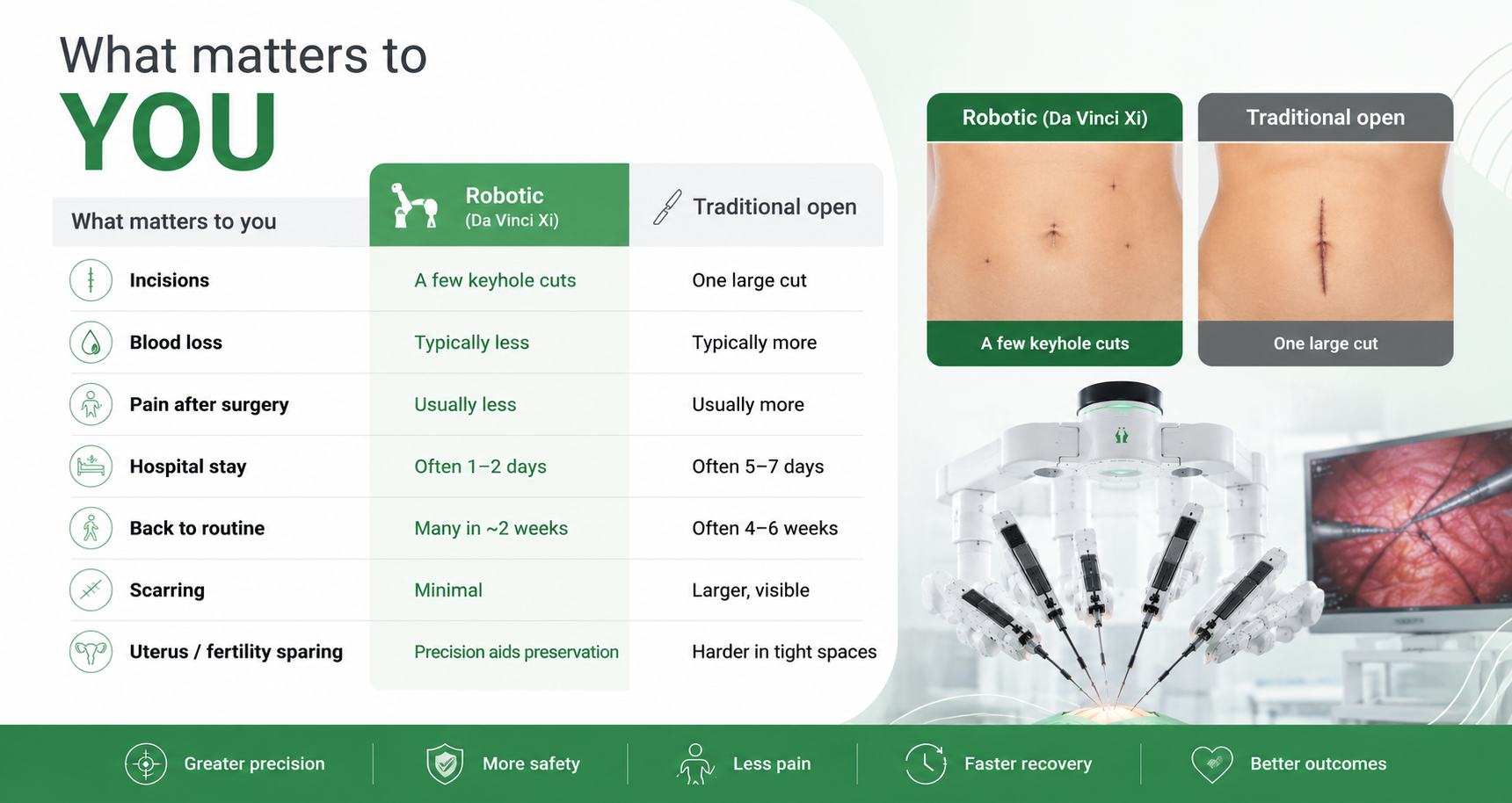
Recovery figures are typical ranges and vary from person to person. Robotic surgery is not suitable for every case — your surgeon will recommend the safest approach for you.
What we treat robotically
Conditions & procedures
Robotic hysterectomy
Removal of the uterus through tiny incisions — for fibroids, heavy bleeding or other conditions — with a faster, gentler recovery.
Fibroid surgery (myomectomy)
Removes fibroids while preserving the uterus — keeping the option of pregnancy open for women who want it.
Endometriosis surgery
Precise excision of disease near the bowel, bladder and nerves — for women living with long-term pelvic pain.
Ovarian cyst surgery
Removes the cyst while sparing the healthy ovary where possible — protecting hormones and fertility.
Pelvic organ prolapse
Robotic sacrocolpopexy lifts and secures prolapsed organs with durable support and an easier recovery.
Gynae-cancer surgery
Precise removal and staging for cervical, uterine and ovarian cancers — helping you get to further treatment sooner.
The difference robotic surgery can make
Why it helps
Smaller scars
A few tiny marks instead of one long incision.
Less pain & blood loss
Smaller wounds usually mean a gentler recovery.
Shorter hospital stay
Many women go home within a day or two.
Back to life sooner
A quicker return to family, work and routine.
Fertility-preserving precision
Careful surgery that can spare the uterus and ovaries.
Lower wound-infection risk
Smaller incisions give infection less chance.
Book a consultation
Talk to a robotic gynae specialist at Fortis Hospital, Mohali. Bring your reports if you have them — we'll walk you through your options, honestly.
Visit us
Fortis Hospital, Sector 62, Phase VIII, Mohali, Punjab — serving Punjab, Chandigarh, Haryana & Himachal Pradesh.
OPD & appointments
+91 72728 72728 · Mon–Sat, 9 AM–5 PM
Insurance & cashless
Cashless treatment available with empanelled insurers — ask our team to check your cover.
Why Choose Us
Our Team of Experts
-
 Dr. Swapna MisraSenior Director Obstetrics & GynaecologyObstetrics and Gynaecology
 -
 Dr. Divya AwasthiAdditional Director Obstetrics & GynaecologyObstetrics and Gynaecology
FAQs
-
Can the uterus be removed without open surgery?Yes. A robotic hysterectomy removes the uterus through a few small keyhole incisions rather than one large cut. For most women that means less pain, a shorter hospital stay and a smaller scar. Your surgeon will confirm if it suits your case.
-
Will I be able to keep my uterus if I have fibroids?Often, yes. A robotic myomectomy removes the fibroids while preserving the uterus — keeping the option of pregnancy open. Whether it's right for you depends on the size, number and position of your fibroids.
-
How soon can I get back to normal life?Many women go home within 1–2 days and return to routine in around two weeks, compared with four to six weeks after open surgery. Recovery varies from person to person and with the procedure.
-
Is robotic surgery safe — is a robot operating on me?The robot never operates on its own. Your surgeon controls every movement in real time from a console beside you; the system simply makes their movements finer and steadier. It's an experienced surgeon, with added precision.
-
Will robotic surgery cost a lot more?The technology is an investment, but a shorter hospital stay and faster recovery offset part of the difference. The exact cost depends on your procedure and insurance — our team will explain it clearly before you decide. Cashless insurance is accepted.
-
What does uterus or fibroid surgery cost at Fortis Mohali?Cost depends on the exact procedure, your stay and your insurance cover. Share your details and our team will give you a clear, transparent estimate — no surprises.