


Technology at Fortis
 MAKO Robotic-Arm Assisted TechnologyRead More
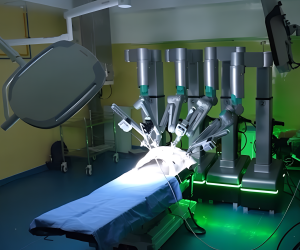
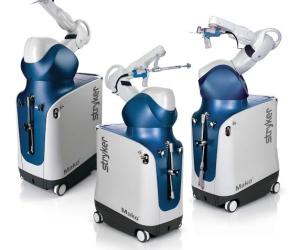
Advanced MAKO Robotic-Arm Assisted Technology is transforming knee and hip replacement surgery with greater precision and personalised treatment planning. Based on the patient’s CT scan, anatomy, physical condition and diagnosis, a customised 3D surgical plan is created. Under the guidance of an experienced orthopaedic surgeon, the robotic arm assists in precisely removing damaged bone and cartilage and accurately positioning the implant.
Key Benefits of MAKO Robotic-Assisted Surgery:
- Personalised 3D pre-operative planning based on the patient’s CT scan
- Greater surgical precision and implant positioning
- Helps preserve surrounding healthy bone and soft tissue
- Real-time, procedure-specific surgical data
- Minimally invasive approach with less post-operative pain
- Reduced blood loss and faster recovery
- Designed to support better long-term functional outcomes
- Enables robotic-assisted total knee and total hip replacement
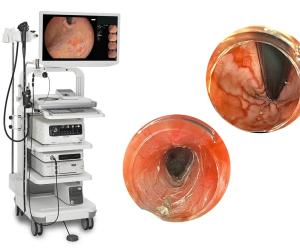 ELUXEO 8000 with CAD EYE AI Aided EndoscopyRead More
The Region’s First AI-Aided Endoscopy
Experience the next generation of gastrointestinal diagnosis with ELUXEO 8000 integrated with CAD EYE, combining advanced 4K imaging with AI-assisted lesion detection and characterization.
From WLI for an overall mucosal view, to LCI for enhanced colour contrast, CAD EYE for real-time detection, and BLI for detailed surface and microvascular assessment, the system supports clinicians throughout the journey from visualization → detection → assessment → clinical decision-making.
Key Benefits:
- AI-assisted detection of suspected precancerous lesions at an early stage
- Enhanced precision and clinical confidence
- Ultra-HD 4K imaging with up to 200× optical zoom
- Advanced lesion characterization for more accurate assessment
- WLI, LCI & BLI visualization modes for comprehensive examination
- Supports physicians with additional real-time information—not a replacement for clinical expertise
ELUXEO 8000 with CAD EYE — Advanced imaging. AI-assisted detection. Greater confidence in every examination.
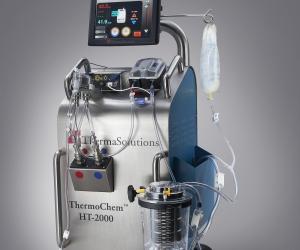 Hyperthermic Intraperitoneal Chemotherapy (HIPEC)Read More
Hyperthermic Intraperitoneal Chemotherapy (HIPEC) is an advanced cancer treatment that combines tumor-removal surgery with heated chemotherapy to target cancer cells remaining within the abdominal cavity. After successful tumor debulking, heated chemotherapy is circulated inside the abdomen for approximately 90–120 minutes. The heat enhances the effectiveness of chemotherapy while limiting exposure to the rest of the body.
HIPEC may be considered for selected cancers that have spread to the peritoneum, including colorectal, ovarian, stomach, appendix and bladder cancers, as well as peritoneal mesothelioma and pseudomyxoma peritonei.
Key Benefits: Improved survival and reduced recurrence in carefully selected patients.
Recovery: HIPEC is a complex procedure that may involve significant complications, with a typical hospital stay of approximately 2–3 weeks, depending on the patient's condition and recovery.
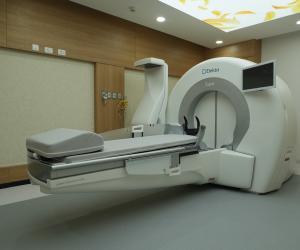 Gamma knifeRead More
When it comes to treating conditions affecting the brain, precision matters. Gamma Knife Surgery is an advanced, non-invasive radiosurgery technology designed to deliver highly focused radiation to targeted areas of the brain while minimising exposure to surrounding healthy tissue.
At Fortis Hospital, Gamma Knife treatment is supported by advanced technology and a multidisciplinary team of specialists, including neurosurgeons, radiation oncologists, neurologists, medical physicists and other clinical experts. This collaborative approach helps doctors evaluate each patient's condition and develop an individualised treatment plan.
What is Gamma Knife Surgery?
Despite its name, Gamma Knife is not a conventional surgical knife. It is a form of stereotactic radiosurgery that uses multiple precisely focused beams of gamma radiation. These beams converge on the targeted area, delivering a highly accurate dose while limiting radiation to nearby healthy brain tissue.
Depending on the condition, treatment may be completed in a single session or through multiple sessions, based on the patient's medical assessment and treatment plan.
Conditions That May Be Treated
Gamma Knife radiosurgery can be considered for selected patients with various brain and neurological conditions, including:
- Brain tumours, including certain metastatic and benign tumours
- Arteriovenous malformations (AVMs)
- Trigeminal neuralgia
- Certain meningiomas
- Vestibular schwannomas and other selected skull-base tumours
- Other appropriately selected intracranial conditions
The suitability of Gamma Knife depends on several factors, including the size, location and type of the lesion, previous treatments and the patient's overall health.
Key Benefits of Gamma Knife
Gamma Knife offers several potential advantages compared with conventional open brain surgery in appropriately selected cases:
Non-invasive approach: No traditional surgical incision is required.
High precision: Radiation beams are focused on the intended target, helping protect surrounding healthy tissue.
Minimal recovery time: Many patients can return to their normal routine relatively quickly, depending on their condition and treatment plan.
No conventional surgical blood loss: As there is no traditional incision, the procedure does not involve the blood loss associated with open surgery.
Suitable for difficult-to-reach lesions: Gamma Knife may provide a treatment option for certain lesions located in areas where conventional surgery can be challenging.
A Multidisciplinary Approach at Fortis
At Fortis, patients undergoing evaluation for Gamma Knife treatment are assessed by a team of specialists. Advanced imaging and treatment-planning techniques help the team precisely identify the treatment target and determine the appropriate radiation dose.
Every patient's treatment journey is different. The medical team discusses the diagnosis, available treatment options, expected outcomes, potential risks and follow-up plan before proceeding.
Moving Towards Advanced Brain Care
Gamma Knife represents an important advancement in the management of selected brain conditions, offering highly precise radiosurgical treatment without conventional open surgery.
If you or your family member has been diagnosed with a brain tumour, AVM, trigeminal neuralgia or another condition that may be suitable for stereotactic radiosurgery, consult a qualified specialist to understand whether Gamma Knife treatment is appropriate.
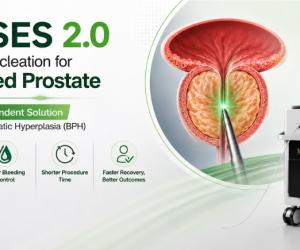 BOSTON MOSES 2 LaserRead More
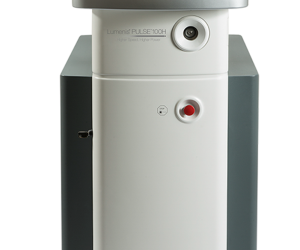
At Fortis Hospital, Mohali, we are committed to providing advanced urological care through modern technology and minimally invasive treatment options. MOSES™ 2.0 Technology, integrated with the Lumenis Pulse™ 120H Holmium Laser System, is an advanced laser platform designed to optimize energy delivery during urinary stone treatment.
This technology can be used for the treatment of kidney, ureteral, and bladder stones, helping urologists fragment stones into smaller pieces or dust them for removal through endoscopic procedures.
How Does MOSES™ 2.0 Work?
MOSES™ 2.0 uses patented pulse-modulation technology to optimize the delivery of Holmium laser energy. The laser pulse is designed to improve energy transmission to the stone, even as the working distance changes.
This helps the urologist perform stone fragmentation, dusting, and popcorning with greater control. The technology also aims to reduce stone retropulsion—the movement of a stone away from the laser during treatment—supporting more efficient stone management.
Key Advantages of MOSES™ 2.0
Optimized Energy Delivery
Advanced pulse modulation helps deliver laser energy more efficiently to the stone across different working distances.
Effective Stone Fragmentation and Dusting
Supports multiple laser lithotripsy techniques, including stone dusting, fragmentation, and popcorning, depending on the stone and treatment plan.
Minimally Invasive Treatment
The technology is used with endoscopic stone procedures, allowing treatment through the urinary tract without a conventional surgical incision.
Designed for Different Stone Types
MOSES™ 2.0 is intended to support the treatment of urinary stones of varying densities, locations, and compositions.
 MR-LINACRead More
MR-LINAC at Fortis Hospital, Gurugram: Advancing Precision Cancer Care
Fortis Hospital, Gurugram has introduced the Elekta Unity MR-Linac, an advanced technology that combines high-field Magnetic Resonance Imaging (MRI) with radiation therapy. Introduced in September 2024, it was the first MR-Linac in North India and the second in India, representing an important advancement in image-guided radiation therapy.
What is MR-LINAC?
MR-Linac is a hybrid radiation therapy system that integrates a 1.5 Tesla MRI scanner with a high-energy linear accelerator. Unlike conventional radiation therapy systems that primarily rely on CT-based imaging for treatment guidance, MR-Linac enables clinicians to visualise tumours and surrounding soft tissues with the enhanced contrast provided by MRI.
This capability is particularly valuable when tumours are located near critical organs or in parts of the body where the tumour may change position or shape during treatment.
Real-Time Tumour Visualisation
One of the key advantages of MR-Linac technology is the ability to obtain MRI images during the treatment process. This allows the radiation oncology team to monitor the tumour and nearby organs while radiation is being delivered.
Tumours can move because of breathing, digestion or changes in the body's internal anatomy. MR-Linac technology can help the clinical team account for these changes and make appropriate treatment adaptations based on the latest imaging information.
Personalised Radiation Therapy
MR-Linac supports a more adaptive approach to radiation treatment. At Fortis Hospital, Gurugram, each treatment session can begin with a fresh MRI scan. The latest images can then be used to assess the tumour's current position and anatomy before treatment delivery.
This approach can help clinicians plan radiation more precisely and reduce uncertainty associated with changes in tumour position or surrounding organs. Treatment decisions are individualised according to the patient's cancer type, anatomy and clinical requirements.
Cancers That May Benefit
Fortis Healthcare lists several tumour types for which MR-guided radiation therapy may be considered, including prostate, liver, pancreatic, rectal, breast, lung, and head and neck cancers. The technology can be particularly useful for selected tumours that are difficult to clearly visualise with conventional imaging or that may move during treatment.
Advanced Technology, Expert Care
The MR-Linac programme at Fortis Hospital, Gurugram brings together advanced imaging, radiation delivery and specialised clinical expertise. The hospital's Radiation Oncology team includes radiation oncologists, medical physicists and technologists who work together to plan and deliver personalised treatment.
For eligible patients, MR-guided radiation therapy may offer the ability to visualise the tumour more clearly, adapt treatment to anatomical changes and deliver radiation with greater precision. However, whether MR-Linac is appropriate depends on the patient's specific diagnosis and clinical condition and should be determined by the treating oncology team.