

Fortis Cancer Institute at Fortis Hospital, Mohali
Cancer Care Has Changed. We Changed With It.
Cancer treatment is no longer one-size-fits-all. A decade ago, two patients with the same type and stage of cancer received the same chemotherapy, the same radiation, and the same surgical approach. Today, we know that every cancer is as unique as the person it affects — driven by specific genetic mutations, molecular pathways, and biological behaviours that determine not only how aggressive the disease is, but which treatments will work and which will not.
This is precision oncology — the principle that every diagnosis deserves molecular understanding, every treatment plan deserves personalisation, and every patient deserves access to the full spectrum of modern cancer care. It is the philosophy that drives everything we do at the Fortis Cancer Institute, Mohali.
Since its inauguration in 2014, FCI Mohali has evolved from a comprehensive cancer centre into a true precision oncology ecosystem — integrating genomic medicine, targeted medical therapy, organ-specific robotic surgery, and the most advanced radiation platform north of Delhi into a single, seamless continuum of care. Every patient is reviewed by a multidisciplinary tumour board before treatment begins. No decision is made in isolation.
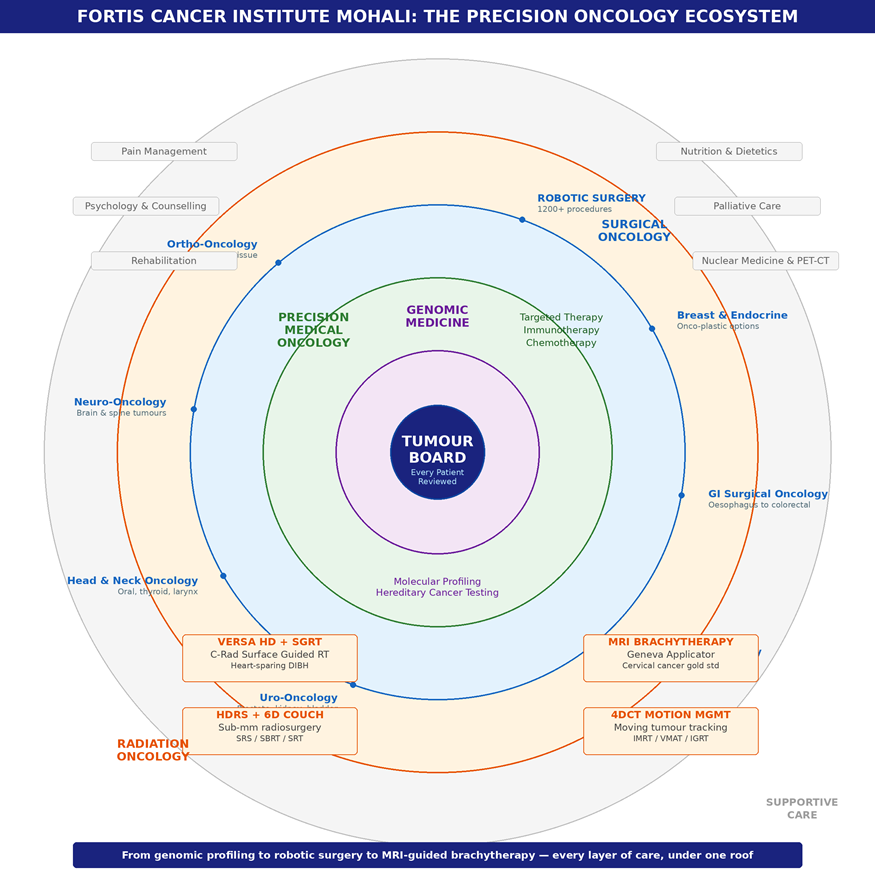
The Tumour Board: Where Every Decision Begins
At the heart of FCI Mohali is the multidisciplinary Tumour Board — a panel of medical oncologists, surgical oncologists, radiation oncologists, onco-pathologists, radiologists, nuclear medicine specialists, and now medical geneticists, who review every cancer case before a treatment plan is finalised. This is not a formality. It is the mechanism that ensures every patient receives the right treatment, in the right sequence, from the right specialist.
The Tumour Board approach means a breast cancer patient is not seen only by a surgeon or only by a chemotherapist. She is evaluated by a breast surgical oncologist, a medical oncologist, a radiation oncologist, and — where relevant — a geneticist who can determine whether her cancer
carries a hereditary BRCA mutation that changes both treatment and screening for her entire family. This integrated review is the foundation of precision oncology.
Ring 1: Genomic Medicine — Understanding Cancer at the Molecular Level
With the launch of the Fortis Institute of Genomic Medicine in 2025, FCI Mohali became one of the few cancer centres in North India to offer comprehensive genomic services as an integral part of cancer care — not as an afterthought.
Led by Dr Ravneet Kaur (Associate Consultant, Medical Genetics; DM Medical Genetics, AIIMS New Delhi), the Institute offers:
Next-generation sequencing (NGS) and molecular profiling of tumours — identifying the specific genetic mutations driving each cancer, so targeted therapies can be matched to the biology of the disease.
Hereditary cancer risk assessment — testing for BRCA1/2, Lynch syndrome, Li-Fraumeni, and other inherited cancer predisposition syndromes. When a hereditary mutation is found, it changes surveillance and prevention strategies for the entire family.
Liquid biopsy — detecting circulating tumour DNA in the blood for treatment monitoring and early detection of recurrence.
Pharmacogenomics — understanding how a patient’s genetic makeup affects their response to specific cancer drugs, enabling dose optimisation and toxicity reduction.
Genomic medicine is no longer the future of cancer care — it is the present. At FCI Mohali, it sits at the innermost ring of the precision oncology ecosystem because it informs every layer that follows.
Ring 2: Precision Medical Oncology — The Right Drug for the Right Cancer
The Department of Medical Oncology at FCI Mohali, led by Dr Rajeev Bedi (Director, Medical Oncology), delivers the full spectrum of systemic anti-cancer therapy — but increasingly, the focus has shifted from empirical treatment to molecularly guided therapy.
Targeted therapy uses drugs designed to attack specific molecular targets on cancer cells — the mutations identified by genomic profiling. A lung cancer driven by an EGFR mutation receives a different targeted drug than one driven by an ALK fusion. A breast cancer that is HER2-positive receives trastuzumab; one that is triple-negative receives immunotherapy. The treatment is matched to the tumour’s biology, not just its location.
Immunotherapy harnesses the patient’s own immune system to recognise and destroy cancer cells. Checkpoint inhibitors, CAR-T cell referrals, and combination immunotherapy protocols are available for eligible patients with melanoma, lung, kidney, bladder, head-and-neck, and other cancers.
Alongside targeted and immune therapies, conventional chemotherapy, hormonal therapy, and regional chemotherapy remain essential tools in the oncologist’s arsenal. The key is choosing the right combination for each individual patient — guided by genomic data, tumour board consensus, and clinical expertise.
Ring 3: Organ-Specific Surgical Oncology — Precision in the Operating Theatre
Cancer surgery at FCI Mohali is not performed by general surgeons who operate on cancer cases. It is performed by organ-specific, fellowship-trained surgical oncologists who dedicate their entire practice to one tumour type or body system. This depth of specialisation is what separates a comprehensive cancer centre from a hospital that merely treats cancer.
Robotic Oncosurgery: 3,200+ Procedures and 5 Certified Proctors
Fortis Mohali is the largest-volume da Vinci robotic surgery centre in the private sector in North India, with over 3,200 robotic procedures completed and 5 certified proctors on a single campus. Robotic surgery is now the gold standard for prostate cancer and is increasingly used for gynaecological, colorectal, head-and-neck, and thoracic oncology cases — offering enhanced precision, smaller incisions, less blood loss, and faster recovery.
Body-Part Specialised Cancer Surgeons
Breast and Endocrine Oncology: Breast conservation surgery, sentinel lymph node biopsy, onco-plastic reconstruction, and complete thyroid and parathyroid cancer management. Every breast cancer case is reviewed by the Tumour Board before surgical planning begins.
GI Surgical Oncology: Complex resections for oesophageal, gastric, pancreatic, hepatobiliary, and colorectal cancers. Advanced laparoscopic and robotic approaches for minimally invasive radical surgery.
Gynaecological Oncology: Radical hysterectomy, staging surgeries, debulking procedures, and fertility-preserving approaches for cervical, ovarian, uterine, and vulvar cancers. Robotic-assisted gynaecological oncosurgery available.
Uro-Oncology: Robotic radical prostatectomy (the gold standard), radical cystectomy, nephrectomy for kidney cancer, and TURBT for bladder cancers.
Head and Neck Oncology: Composite resections, microvascular reconstruction, transoral robotic surgery, and management of oral cavity, thyroid, laryngeal, and pharyngeal cancers — with a focus on functional preservation and quality of life.
Neuro-Oncology: Microsurgical resection of brain and spinal cord tumours, supported by advanced neuronavigation, intraoperative monitoring, and coordination with SRS/SBRT for post-operative or inoperable cases.
Haemato-Oncology: Management of leukaemias, lymphomas, myelomas, and myeloproliferative disorders with chemotherapy, targeted therapy, immunotherapy, and referral coordination for bone marrow transplantation.
Orthopaedic Oncology: Bone and soft tissue tumour resections, limb salvage surgery, and prosthetic reconstruction for musculoskeletal malignancies.
Ring 4: The Most Advanced Radiation Platform North of Delhi
The Department of Radiation Oncology at FCI Mohali, led by Dr Narendra Kumar Bhalla (Director, Radiation Oncology), operates the Elekta Versa HD linear accelerator augmented with a suite of exclusive technologies that are currently unavailable in the same combination at any other centre in the Tricity region or, indeed, anywhere between Delhi and Mohali.
Surface Guided Radiotherapy (SGRT) with the C-Rad system tracks the patient’s surface in real time during treatment. When paired with Deep Inspiration Breath Hold (DIBH) for left-breast cancer, it reduces radiation dose to the heart by up to 40–50 percent. If the patient moves even a millimetre, the beam stops instantly.
MRI-based intracavitary brachytherapy with the Geneva applicator is the international gold standard for cervical cancer treatment. MRI provides superior soft-tissue contrast compared to CT, allowing the team to see exact tumour boundaries and sculpt radiation dose around the bladder and bowel with unmatched precision.
High Definition Dynamic Radiosurgery (HDRS) with a 6-degree robotic couch enables sub-millimetre accuracy for stereotactic radiosurgery (SRS) and stereotactic body radiotherapy (SBRT) — treating brain metastases, spine lesions, and small lung tumours in just 1 to 5 sessions instead of 30 days of conventional radiation.
4-Dimensional CT (4DCT) motion management captures the tumour’s breathing cycle and designs the treatment plan around that motion — ensuring the beam follows lung and liver tumours as they move with respiration.
Supportive Services: Onco-pathology | Pain management | Nutrition & dietetics | Psychology & counselling | Palliative care | Rehabilitation
-
Our Strengths & UPSs
- State-of-the-art 20 bedded chemotherapy day care
- World's most advanced surgical robot - Da Vinci Xi for minimally invasive robotic cancer surgery
- High end radiation therapy technology - Versa HD Electa LINAC -2
- Advanced Monaco treatment planning system – SYNERGY
- Latest PET CT & Gamma Camera
- Advanced cancer diagnostics like 3 Tesla Digital MRI & Onco Pathology
- Neuro Navigation systems for management of Neuro Cancers
- Tumour board approach
- Organ specific cancer management approach
- Psycho oncology programs including support groups and expressive therapies
-
Our Support Groups
- SAARTHAK
- UMANG - Breast Cancer Support Group
Our Team of Experts
View all Dr. Rajeev BediDirector Oncology







Other Hospitals
 Fortis Hospital Manesar, Gurugram
4.7


 Fortis Hospital, Mohali
4.6
 Fortis Hospital, Noida
 Fortis Memorial Research Institute, Gurgaon
4.6
 Fortis Hospital, Shalimar Bagh, New Delhi
4.6
 Fortis Escorts Hospital, Faridabad
4.7
 Fortis Flt. Lt. Rajan Dhall Hospital, Vasant Kunj
4.5
 Fortis Hospital, Mulund, Mumbai
4.6