
The Fortis Contribution: Setting the Benchmark in Clinical Research
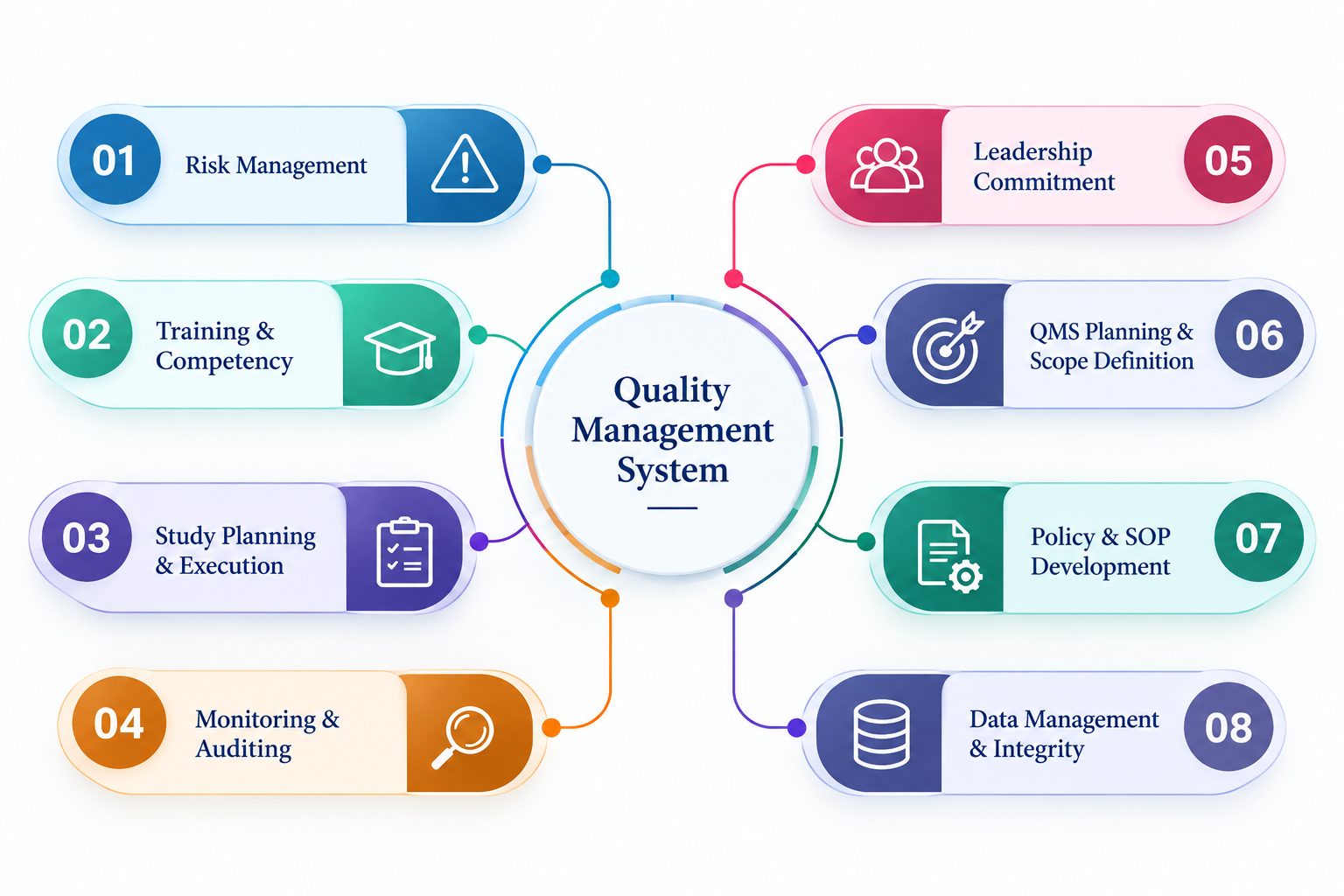
Quality Management System
Quality by Design. Consistency by System. Improvement by Practice.
As clinical research continues to expand across Fortis Healthcare, a robust and harmonized Quality Management System (QMS) provides the foundation for conducting research with consistency, accountability, scientific integrity, and a strong focus on participant safety and data reliability.
The Fortis ClinicalQuality Management System
Quality by Design. Consistency by System. Improvement by Practice.
As clinical research continues to expand across Fortis Healthcare, a robust and harmonized Quality Management System (QMS) provides the foundation for conducting research with consistency, accountability, scientific integrity, and a strong focus on participant safety and data reliability.
The Fortis Clinical Research QMS is designed to establish a standardized, centralized, and risk-based approach to research operations across sites. It brings together defined processes, controlled documentation, trained personnel, quality oversight, monitoring, audit mechanisms, and continual improvement within a common quality framework.
A Centralized and Harmonized Quality Framework
Operating clinical research across multiple hospitals requires consistency in how research activities are planned, reviewed, conducted, documented, monitored, and improved. Fortis therefore emphasizes a centralized approach to quality management, supported by harmonized processes and standardized Standard Operating Procedures (SOPs), templates, workflows, and quality practices.
This approach helps minimize variation between sites, strengthens oversight, facilitates knowledge sharing, and enables research teams to work within a common quality framework while addressing site-specific operational requirements.
Key Elements of the Fortis Clinical Research QMS
1. Standardized Processes and SOPs
Clearly defined and harmonized SOPs establish consistent expectations for clinical research activities across Fortis sites. Controlled processes, standardized templates, defined responsibilities, and document management practices support consistency and traceability throughout the research lifecycle.
2. Risk-Based Quality Management
Quality oversight is proportionate to the risks associated with research activities. Critical processes, participant safety, data integrity, regulatory requirements, and other critical-to-quality factors are identified and prioritized to ensure that quality resources and oversight are focused where they have the greatest impact.
3. Training and Competency
Research quality depends on competent and appropriately trained personnel. Fortis supports structured, role-specific training for clinical research and ethics committee teams, with emphasis on research processes, regulatory and ethical requirements, SOP implementation, documentation, data integrity, and quality practices. Training effectiveness and competency are reinforced through ongoing assessment and continuous learning.
4. Quality Oversight and Monitoring
Structured monitoring and quality oversight help assess adherence to approved protocols, SOPs, ethical requirements, and applicable regulatory expectations. Monitoring activities support early identification of gaps, timely intervention, and sustained compliance throughout the research lifecycle.
5. Documentation and Data Integrity
Accurate, complete, traceable, and reliable documentation is fundamental to credible clinical research. Fortis promotes robust documentation practices and appropriate controls for research records and data to support transparency, accountability, traceability, and inspection readiness.
6. Internal Quality Reviews and Audits
Periodic quality reviews and risk-based audits provide an independent assessment of process implementation and effectiveness. Findings are evaluated systematically to identify opportunities for improvement and strengthen the overall research quality framework.
7. Deviation Management and CAPA
Quality events, deviations, nonconformities, and identified gaps are documented, assessed, and addressed through a structured corrective and preventive action process. Root-cause analysis is used to identify underlying causes and implement sustainable solutions rather than addressing only the immediate issue.
8. Continuous Improvement
Quality management at Fortis is an ongoing process. Information generated through monitoring, audits, quality reviews, training assessments, CAPA, stakeholder feedback, and operational performance is used to identify improvement opportunities and strengthen research processes.
Quality Across the Research Lifecycle
The QMS supports quality at every stage of clinical research from study feasibility and initiation through ethics and regulatory processes, participant recruitment and informed consent, study conduct, documentation and data management, safety reporting, monitoring, study close-out, and archival.
By embedding quality into routine research operations rather than treating it solely as an inspection or compliance activity, Fortis aims to build a culture in which quality is owned by every individual involved in clinical research.
Impact of QMS approach
A centralized and harmonized quality framework enables Fortis to:
• Drive consistency across research sites through standardized processes and controlled documentation.
• Strengthen regulatory and ethical compliance through defined responsibilities, oversight, and systematic quality checks.
• Enhance participant protection by embedding quality and risk management into research operations.
• Protect data integrity and reliability through consistent documentation and quality practices.
• Improve operational efficiency by reducing process variation, duplication, and avoidable rework.
• Strengthen inspection and audit readiness through continuous quality oversight and documented evidence of compliance.
• Enable organization-wide learning by identifying recurring issues, sharing best practices, and implementing corrective actions across sites.
• Support continual improvement through a structured, measurable, and sustainable quality management approach.