
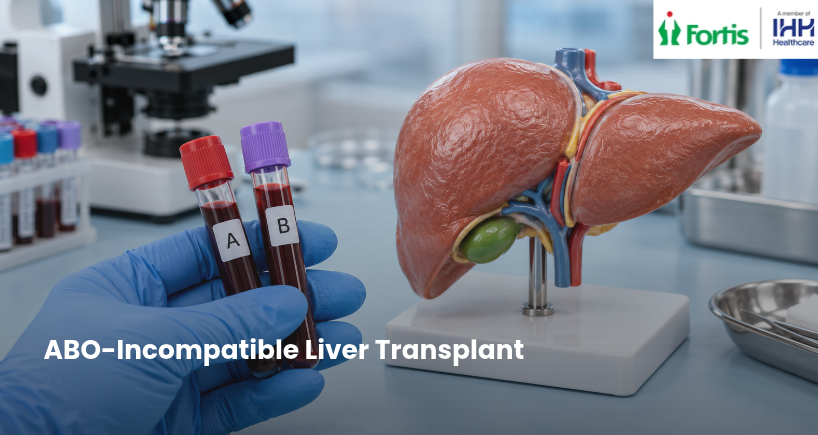


ABO-Incompatible Liver Transplant in Mumbai
ABO-Incompatible Liver Transplant: Options When Donor and Recipient Blood Groups Don’t Match
Finding a suitable living liver donor can be challenging, especially when a willing family member has a different blood group from the recipient. Traditionally, blood-group incompatibility could limit living-donor liver transplantation. Today, advances in transplant medicine have made ABO-incompatible liver transplantation a possible option for selected patients.
In an ABO-incompatible liver transplant, the donor and recipient have blood groups that are not traditionally considered compatible for transplantation. Before surgery, specialised treatment is used to reduce the recipient’s immune response against the donor blood-group antigens and lower the risk of antibody-mediated rejection.
For patients considering ABO-incompatible liver transplant in Mumbai, Dr. Aditya J. Nanavati, Director – Multi-Organ Transplant & Hepatobiliary Surgery at Fortis Hospital, Mulund, has experience in liver transplantation and complex abdominal transplant surgery. His academic work includes research on ABO-incompatible liver transplantation, including a 2025 study on a low-dose rituximab regimen in ABO-incompatible liver transplant recipients.
Fortis Hospital, Mulund also lists ABO-incompatible liver transplant among the liver transplant services available through its programme.
What Is an ABO-Incompatible Liver Transplant?
An ABO-incompatible liver transplant is a transplant in which the donor and recipient do not have a conventionally compatible ABO blood-group combination.
The ABO blood-group system includes four major groups:
- A
- B
- AB
- O
People naturally have antibodies against certain ABO antigens that are not present in their own blood group. In an incompatible transplant, these pre-existing antibodies may react against the transplanted liver.
This can increase the risk of antibody-mediated rejection, particularly if antibody levels are high.
Modern desensitisation protocols are designed to reduce this immune response before transplantation.
Why Does Blood Group Matter in Liver Transplantation?
Blood-group compatibility is important because the recipient’s immune system can recognise incompatible A or B antigens on the donor liver.
If this immune reaction is not adequately controlled, antibodies can attack the transplanted liver.
Potential consequences can include:
- Antibody-mediated rejection
- Bile-duct complications
- Graft dysfunction
- Increased risk of infection due to additional immunosuppression
This is why ABO-incompatible transplantation requires careful planning and specialised immune-modulating treatment.
Can a Family Member With a Different Blood Group Donate Liver?
Yes, in selected cases.
A different blood group does not automatically mean that a willing family member cannot become a living liver donor.
If no suitable ABO-compatible donor is available, the transplant team may evaluate whether an ABO-incompatible living donor liver transplant is medically appropriate.
The final decision depends on factors such as:
- Donor and recipient blood groups
- Recipient antibody levels
- Donor liver anatomy
- Graft size
- Recipient’s condition
- Severity of liver disease
- Infection risk
- Centre experience
- Response to desensitisation therapy
Not every donor-recipient pair is suitable, and assessment must be individualised.
How Is an ABO-Incompatible Liver Transplant Possible?
The main challenge is the presence of anti-A or anti-B antibodies in the recipient.
Modern ABO-incompatible transplantation uses a process called desensitisation to reduce or control these antibodies before surgery.
In India, commonly used approaches include rituximab and antibody-removal techniques such as plasmapheresis or immunoadsorption.
The exact protocol varies between transplant centres and between patients.
What Is Desensitisation Before an ABO-Incompatible Liver Transplant?
Desensitisation is treatment given before transplantation to reduce the risk that the recipient’s immune system will attack the donor liver because of the blood-group mismatch.
It may involve several steps.
- Rituximab
Rituximab is a medicine that targets B cells, which play an important role in producing antibodies.
It has become a central part of many ABO-incompatible liver-transplant protocols and has contributed to improved outcomes.
- Plasmapheresis
Plasmapheresis, or plasma exchange, can be used to remove anti-A or anti-B antibodies from the blood.
More than one session may be required depending on the patient’s antibody levels and response to treatment.
- Immunoadsorption
Some centres may use immunoadsorption to selectively remove blood-group antibodies.
The exact treatment approach depends on antibody titres, patient condition and the centre’s protocol.
What Are ABO Antibody Titres?
An ABO antibody titre measures the level of anti-A or anti-B antibodies in the recipient’s blood.
These levels are checked before transplantation because higher antibody titres may increase the risk of antibody-mediated rejection.
The transplant team may monitor these levels:
- Before desensitisation
- During treatment
- Immediately before transplant
- After transplantation where required
Indian transplant-centre practice varies, but many centres aim to reduce antibody titres substantially before proceeding with surgery.
The target level is determined by the transplant team rather than by a single universal number.
Is ABO-Incompatible Liver Transplant Safe?
ABO-incompatible liver transplantation has become increasingly feasible with modern desensitisation protocols.
Research using rituximab-based protocols has shown that patient and graft survival can be comparable to ABO-compatible living donor liver transplantation in appropriately selected patients. However, certain complications, including antibody-mediated rejection, biliary complications and infections, may remain more common.
Therefore, ABO-incompatible transplantation should not be considered identical to a standard compatible transplant.
It requires:
- Careful patient selection
- Detailed donor evaluation
- Pre-transplant immune preparation
- Experienced transplant surgery
- Close monitoring after transplantation
- Appropriate immunosuppression
What Are the Risks of an ABO-Incompatible Liver Transplant?
The risks include those associated with any major liver transplant as well as additional immune-related concerns.
Potential risks may include:
- Antibody-Mediated Rejection
The recipient’s antibodies can react against the donor liver and cause graft injury.
Modern desensitisation has reduced this risk substantially, but it remains an important consideration.
- Biliary Complications
Research has reported a higher incidence of certain bile-duct complications in ABO-incompatible transplantation compared with compatible transplantation.
- Infection
Additional immune-modulating treatment may increase susceptibility to certain infections.
Indian experience with ABO-incompatible liver transplantation has highlighted infection risk as an important area for postoperative monitoring.
- Rejection
The transplanted liver can develop rejection, requiring adjustment of immunosuppressive therapy and, in selected situations, additional treatment.
Who May Be Considered for an ABO-Incompatible Liver Transplant?
ABO-incompatible transplantation may be considered when:
- A patient requires liver transplantation
- A medically suitable living donor is available
- The donor’s blood group is not conventionally compatible
- No suitable ABO-compatible living donor is available
- Waiting for a deceased donor may not be the preferred option
- The recipient is medically suitable for desensitisation
- The transplant team believes the potential benefits outweigh the additional risks
The decision requires a comprehensive assessment.
What Tests Are Done Before an ABO-Incompatible Liver Transplant?
The recipient undergoes the usual liver transplant evaluation as well as additional immune assessment.
Tests may include:
- ABO blood-group testing
- Anti-A or anti-B antibody titres
- Liver function tests
- Kidney function tests
- Blood clotting tests
- Infection screening
- Cardiac evaluation
- Lung assessment
- CT or MRI
- Nutritional assessment
- Other investigations depending on the patient’s condition
The living donor also undergoes a separate evaluation including:
- Liver function tests
- Imaging of liver anatomy
- Liver-volume assessment
- Blood-vessel mapping
- Bile-duct assessment
- Cardiac fitness
- General health assessment
Is the Surgery Different From an ABO-Compatible Liver Transplant?
The major difference is usually not the transplant operation itself but the immune preparation and postoperative management.
The surgical principles remain those of living donor liver transplantation.
However, an ABO-incompatible recipient may require:
- Additional treatment before surgery
- More intensive antibody monitoring
- Adjustments to immunosuppression
- Additional treatment if antibody-mediated rejection develops
The transplant team therefore needs to coordinate medical, immunological and surgical care closely.
ABO-Incompatible Transplant vs Liver Swap: What Is the Difference?
When a donor and recipient are blood-group incompatible, there may be more than one potential approach.
One option is ABO-incompatible transplantation, where the intended donor still donates directly to the recipient after appropriate desensitisation.
Another option in selected situations is a paired or swap liver transplant, where two incompatible donor-recipient pairs exchange donors so that each recipient receives a more compatible graft.
A 2025 multicentre Indian study highlighted liver-paired exchange as an expanding option for donor-recipient pairs affected by ABO incompatibility.
Which strategy is appropriate depends on donor availability, medical urgency, programme capability and regulatory requirements.
Is ABO-Incompatible Liver Transplantation Suitable for Everyone?
No.
ABO-incompatible transplantation may not be suitable for every patient.
Doctors need to consider:
- Age
- Severity of liver disease
- Infection risk
- Other organ dysfunction
- Antibody titre
- Overall surgical risk
- Availability of alternative donors
- Urgency of transplantation
- Response to desensitisation therapy
For some patients, an ABO-compatible donor, liver swap or deceased-donor transplantation may be more appropriate.
Why Is ABO-Incompatible Liver Transplant Important in India?
Living donation plays a major role in liver transplantation in India.
A 2025 multicentre study noted that approximately one-third of otherwise willing living donors may be incompatible with their intended recipient because of ABO or immunological incompatibility.
ABO-incompatible transplantation can therefore help expand the potential donor pool when a medically suitable but blood-group-incompatible donor is available.
However, because protocols and patient suitability vary, treatment should always be individualised.
Why Choose Fortis Hospital, Mulund for Liver Transplant Evaluation?
Liver transplantation requires coordinated care involving transplant surgeons, hepatologists, gastroenterologists, anaesthesiologists, intensivists, radiologists and other specialists.
Fortis Hospital, Mulund, Mumbai lists a full spectrum of liver transplant services including:
- Living donor liver transplantation
- Deceased donor liver transplantation
- ABO-incompatible liver transplantation
- Paediatric liver transplantation
- Combined organ transplantation
- Portal hypertension surgery
For patients whose potential donor has a different blood group, specialist assessment can help determine whether ABO-incompatible liver transplantation, another living-donor strategy or a different transplant pathway may be appropriate.
For ABO-incompatible liver transplant evaluation in Mumbai, Dr. Aditya J. Nanavati and the Liver Transplant team is available at Fortis Hospital, Mulund.
Categories
Clear allMeet the doctor

- Liver Transplant and Hepatobiliary Sciences | Liver Transplant and Hepatobiliary Sciences
- Organ Transplant | Bowel Transplant | Pancreas Transplant | Kidney Transplant | Liver Transplant
-
 13 Years
-
 2000
Related Blogs
View all
Types of liver transplantation by Dr. Kishore GSB

Autoimmune Hepatitis a non-infectious condition: Know its Symptoms, Causes and Treatment

Hepatitis C: Symptoms, Transmission And Treatment Options

हेल्दी’ पैकेज्ड फूड में छिपा सोडियम बम: सेहत पर असर और बचाव के स्मार्ट टिप्स


Why Many Patients with Liver Cancer Are Told They Are Inoperable? And Why That Is Not Alwa...

Why Are Some Liver Cancer Patients Told They Are Inoperable?

Where to Go After an Inoperable Diagnosis? Choosing the Right Liver Cancer Specialist or C...


FAQs
Can a person with a different blood group donate part of their liver?
Yes, selected patients may undergo an ABO-incompatible living donor liver transplant even when the donor and recipient blood groups are not conventionally compatible. Specialised desensitisation and careful transplant evaluation are required.
What is an ABO-incompatible liver transplant?
An ABO-incompatible liver transplant is a transplant performed when the donor and recipient have a blood-group combination that would traditionally be considered incompatible. Treatment is given before transplantation to reduce the recipient’s immune response against the donor blood-group antigens.
How are antibodies reduced before an ABO-incompatible liver transplant?
Depending on the patient and transplant-centre protocol, treatment may include rituximab and procedures such as plasmapheresis or immunoadsorption to reduce anti-A or anti-B antibodies before transplantation.
Is ABO-incompatible liver transplantation as successful as a compatible transplant?
Modern studies using rituximab-based protocols have reported patient and graft survival comparable to ABO-compatible transplantation in appropriately selected patients. However, ABO-incompatible transplantation may carry higher risks of antibody-mediated rejection, biliary complications and certain infections.
Is liver swap better than an ABO-incompatible transplant?
Neither approach is automatically better. A liver swap may provide a compatible donor for some families, while ABO-incompatible transplantation may allow the intended donor to donate directly. The appropriate option depends on donor availability, urgency and detailed transplant evaluation.
Where can I consult for ABO-incompatible liver transplant in Mumbai?
Patients with a willing living donor whose blood group does not match can consult Dr. Aditya J. Nanavati, Director – Multi-Organ Transplant & Hepatobiliary Surgery at Fortis Hospital, Mulund, Mumbai. Fortis Mulund lists ABO-incompatible liver transplantation among its liver transplant services.

Keep track of your appointments, get updates & more!

