
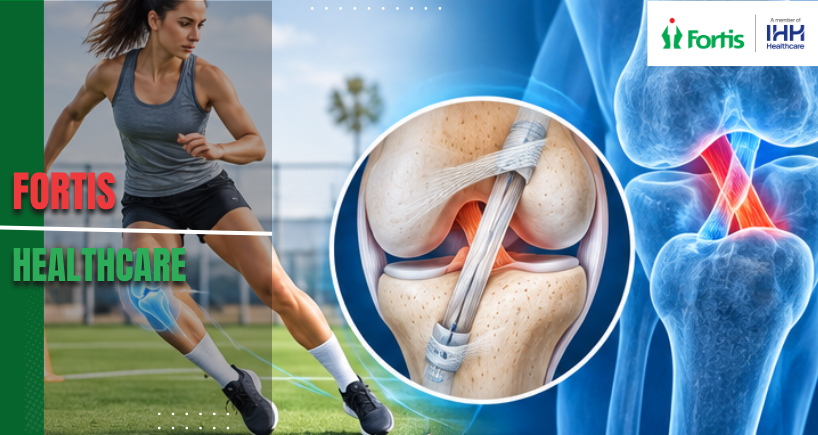


ACL Injury Prevention and State-of-the-Art Reconstruction
Part 1: Understanding ACL Injuries
The anterior cruciate ligament (ACL) is one of the key stabilising ligaments of the knee, controlling rotation and preventing the shin bone from sliding forward. Most ACL injuries are non-contact — they happen during landing, pivoting, or sudden deceleration, not from a tackle. This is critical, because it means a large proportion of ACL injuries can be prevented through training.
Dr. Pulak Vatsya sees ACL injuries most often in athletes playing pivoting sports popular in India — football, badminton, basketball, cricket, and kabaddi. The injury is frequently accompanied by a meniscus tear, which is why prompt, accurate assessment matters.
Part 2: ACL Injury Prevention — What Actually Works
ACL injury prevention is one of the most evidence-backed areas in sports medicine, yet one of the most neglected in India. Dr. Pulak Vatsya emphasises that structured prevention programmes genuinely reduce injury rates. The core components are:
1. Neuromuscular training
Training the body to land, cut, and decelerate safely is the single most effective ACL injury prevention strategy. Programmes that teach soft, bent-knee landings and controlled deceleration have been shown to reduce ACL injury risk substantially.
2. Hip and core strength
Weak hip and core muscles cause the knee to collapse inward during landing — a major ACL injury mechanism. Strengthening the glutes, hips, and core protects the knee. Dr. Pulak Vatsya notes this is especially important for female athletes.
3. Landing and jumping technique
Plyometric training that reinforces correct jump-landing mechanics reduces the dangerous knee positions that tear the ACL.
4. Balance and proprioception
Balance training improves the knee's ability to respond to sudden changes in direction, reducing injury risk.
Why Women Are at Higher Risk of ACL Injury Female athletes have a significantly higher ACL injury rate than men, due to differences in anatomy, hormonal factors, and landing biomechanics — women tend to land with straighter knees and more inward knee collapse. Dr. Pulak Vatsya stresses that targeted neuromuscular training is particularly valuable for women, and can meaningfully close this risk gap. ACL injury prevention programmes should be a standard part of training for female athletes in Delhi. |
Part 3: When Prevention Fails — Diagnosing an ACL Tear
Despite the best prevention, ACL tears still happen. The classic signs Dr. Pulak Vatsya looks for are a 'pop' at the time of injury, rapid swelling within hours, and a sense that the knee is unstable or 'giving way.' An MRI confirms the diagnosis and identifies associated meniscus or cartilage injuries.
Not every ACL tear requires surgery — partial tears in low-demand patients may be managed conservatively. But complete tears in active patients who want to return to pivoting sport almost always need reconstruction, because an unstable knee progressively damages the meniscus and cartilage over time.
Part 4: State-of-the-Art ACL Reconstruction
ACL reconstruction has advanced significantly. A torn ACL cannot simply be stitched back together — it is reconstructed using a graft that replaces the torn ligament. Dr. Pulak Vatsya performs anatomic ACL reconstruction, which means positioning the new ligament precisely where the original ACL attached, restoring natural knee mechanics.
Graft Selection: A Personalised Decision
The choice of graft is one of the most important decisions in ACL reconstruction, and Dr. Pulak Vatsya tailors it to each patient. The main options are:
Factor | Graft Type | Advantages |
Peroneus longus | Strong graft, minimal knee donor-site issues, preserves knee flexion strength |
|
Hamstring tendon | Reliable, widely used, low donor-site problems |
|
Quadriceps tendon | Large, strong graft; useful in revision cases |
|
BPTB (patellar) | Strong fixation, but higher donor-site pain |
|
Dr. Pulak Vatsya generally favours peroneus longus and hamstring grafts over the traditional bone-patellar tendon-bone (BPTB) graft, because they provide excellent strength while minimising the anterior knee pain and kneeling discomfort that can follow BPTB harvest. This graft philosophy reflects a modern, patient-centred approach to ACL reconstruction at StepUp Joints, Lajpat Nagar. For each patient, the final choice depends on their sport, anatomy, and whether it is a primary or revision procedure.
Part 5: Recovery and Return to Sport
Modern ACL rehabilitation is criteria-based, not calendar-based. Dr. Pulak Vatsya and the physiotherapy team at StepUp Joints, Lajpat Nagar guide patients through defined milestones rather than arbitrary time points:
- Months 1-2: Restore full knee extension, control swelling, activate the quadriceps
- Months 3-4: Progressive strengthening of quads, hamstrings, hips, and core
- Months 5-6: Running programme, controlled change-of-direction drills
- Months 7-9: Sport-specific training, proprioception, confidence building
- Months 9-12: Return-to-sport testing — strength symmetry and hop tests — before competitive play
Dr. Pulak Vatsya stresses that returning to sport too early is the leading cause of ACL re-rupture. Objective testing — not just how the knee feels — determines readiness. This is why the integrated surgeon-physiotherapist model at StepUp Joints matters so much for ACL patients in South Delhi.
📍 Consult Dr. Pulak Vatsya about ACL injury prevention or reconstruction — StepUp Joints, Lajpat Nagar, New Delhi | stepupjoints.com | In-clinic ₹1,200 · Teleconsult ₹1,000 · Bring your MRI |
Categories
Clear allMeet the doctor

- Orthopaedics | Sports Medicine | Robotic and Computer navigated Joint reconstruction | Orthopaedics and Joint Replacement | Orthopaedics
-
 10 Years
-
 1500
1500
Related Blogs
View all





FAQs
Can ACL injuries be prevented?
Yes. Structured neuromuscular training — landing technique, hip and core strength, balance — reduces ACL injury risk by up to 50%, and is especially important for female athletes. Dr. Pulak Vatsya recommends prevention programmes for all pivoting-sport athletes in Delhi.
What is the best graft for ACL reconstruction?
There is no single best graft — the right choice depends on the patient. Dr. Pulak Vatsya generally favours peroneus longus and hamstring grafts over BPTB, as they offer excellent strength with fewer donor-site problems. He individualises graft selection at StepUp Joints, Lajpat Nagar.
Why are women more prone to ACL injuries?
Due to differences in anatomy, hormones, and landing biomechanics, female athletes have a higher ACL injury rate than men. Targeted neuromuscular training is particularly effective for women. Dr. Pulak Vatsya advises prevention programmes for female athletes in South Delhi.
Who is the best ACL surgeon in South Delhi?
Dr. Pulak Vatsya is an arthroscopic ACL and sports surgeon at StepUp Joints, Lajpat Nagar, offering anatomic reconstruction, individualised graft selection, and integrated sports rehabilitation under one roof.

Keep track of your appointments, get updates & more!

