


ATFL Tear Treatment in Chandigarh - Ankle Sprain Specialist - Dr Chandan Narang - Fortis Mohali
Medically reviewed by Dr. Chandan Narang, Foot & Ankle Surgeon Last updated: 18 July 2026 Reading time: ~12 minutes
This guide is for anyone who has twisted an ankle and is worried it isn't healing — the runner whose ankle keeps "giving way" on uneven ground, the cricketer or footballer who has sprained the same ankle three times, or the parent whose ankle still swells months after "just a sprain." It explains what an ATFL tear is, how it is diagnosed, when surgery is genuinely needed, and what recovery realistically looks like.
An ankle sprain is often dismissed as a minor injury. For many people it is. But research summarised by the International Ankle Consortium shows that a significant proportion of people who sprain an ankle go on to have repeat sprains or lasting instability — usually because the first injury was never properly rehabilitated. Understanding the injury early is the best protection against long-term ankle problems.
Key takeaways
- The ATFL (anterior talofibular ligament) is the most commonly injured ankle ligament, typically torn when the foot rolls inward.
- Most ATFL injuries heal without surgery through structured physiotherapy, bracing and balance training.
- An MRI is not needed for every sprain — diagnosis is primarily clinical.
- Repeated sprains or a "giving way" ankle suggest chronic ankle instability, which deserves specialist assessment.
- When surgery is needed, modern options include Broström repair, InternalBrace augmentation and ligament reconstruction, often performed with minimally invasive techniques.
- Return to sport is guided by functional milestones, not just the calendar; timelines vary between individuals.
What Is the ATFL? A Quick Tour of Ankle Anatomy
Three ligaments stabilise the outer (lateral) side of your ankle:
- ATFL — Anterior Talofibular Ligament: connects the fibula (the outer leg bone) to the talus (the ankle bone). It is the first line of defence when the foot rolls inward.
- CFL — Calcaneofibular Ligament: runs from the fibula to the heel bone; injured in more severe sprains.
- PTFL — Posterior Talofibular Ligament: the strongest of the three; rarely injured.
[IMAGE PLACEHOLDER — labelled diagram of the lateral ankle showing fibula, talus, ATFL, CFL and PTFL]
Alt text: "Labelled diagram of ankle anatomy showing the anterior talofibular ligament (ATFL), calcaneofibular ligament (CFL) and posterior talofibular ligament (PTFL) on the outer side of the ankle."
Why is the ATFL the most commonly injured ankle ligament?
The ATFL is the weakest of the three lateral ligaments, and it is placed under maximum tension in exactly the position most ankle injuries happen — the foot pointing down and rolling inward (plantarflexion + inversion). That is the position of landing awkwardly from a jump, stepping on uneven ground, missing a stair, or planting the foot to change direction in cricket, football, badminton, basketball or trail running.
Ankle sprain vs ATFL tear vs chronic instability — what's the difference?
Comparing the spectrum of lateral ankle ligament injury
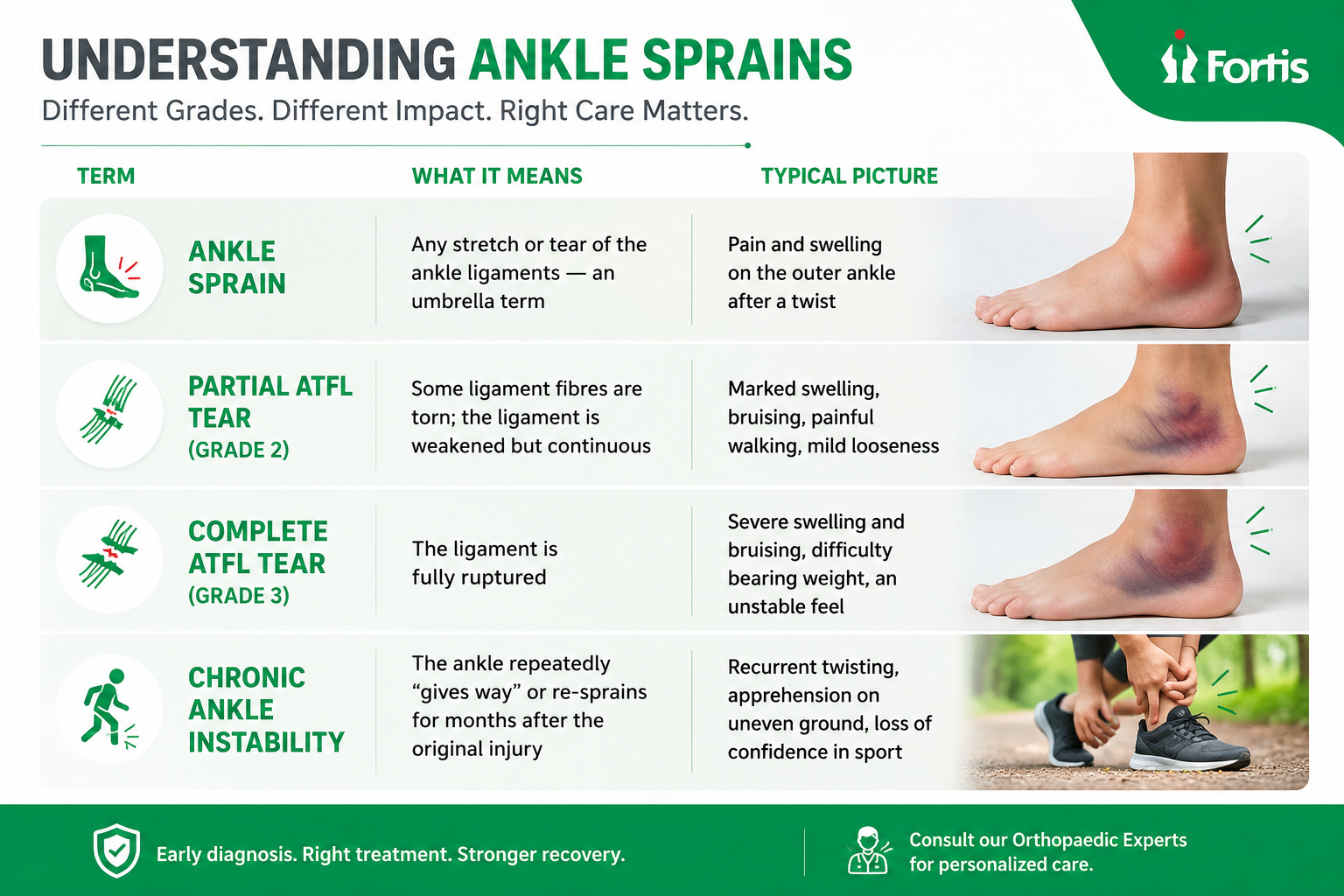
Chronic ankle instability
The ankle repeatedly "gives way" or re-sprains for months after the original injury
Recurrent twisting, apprehension on uneven ground, loss of confidence in sport
Grades of ATFL injury in plain language
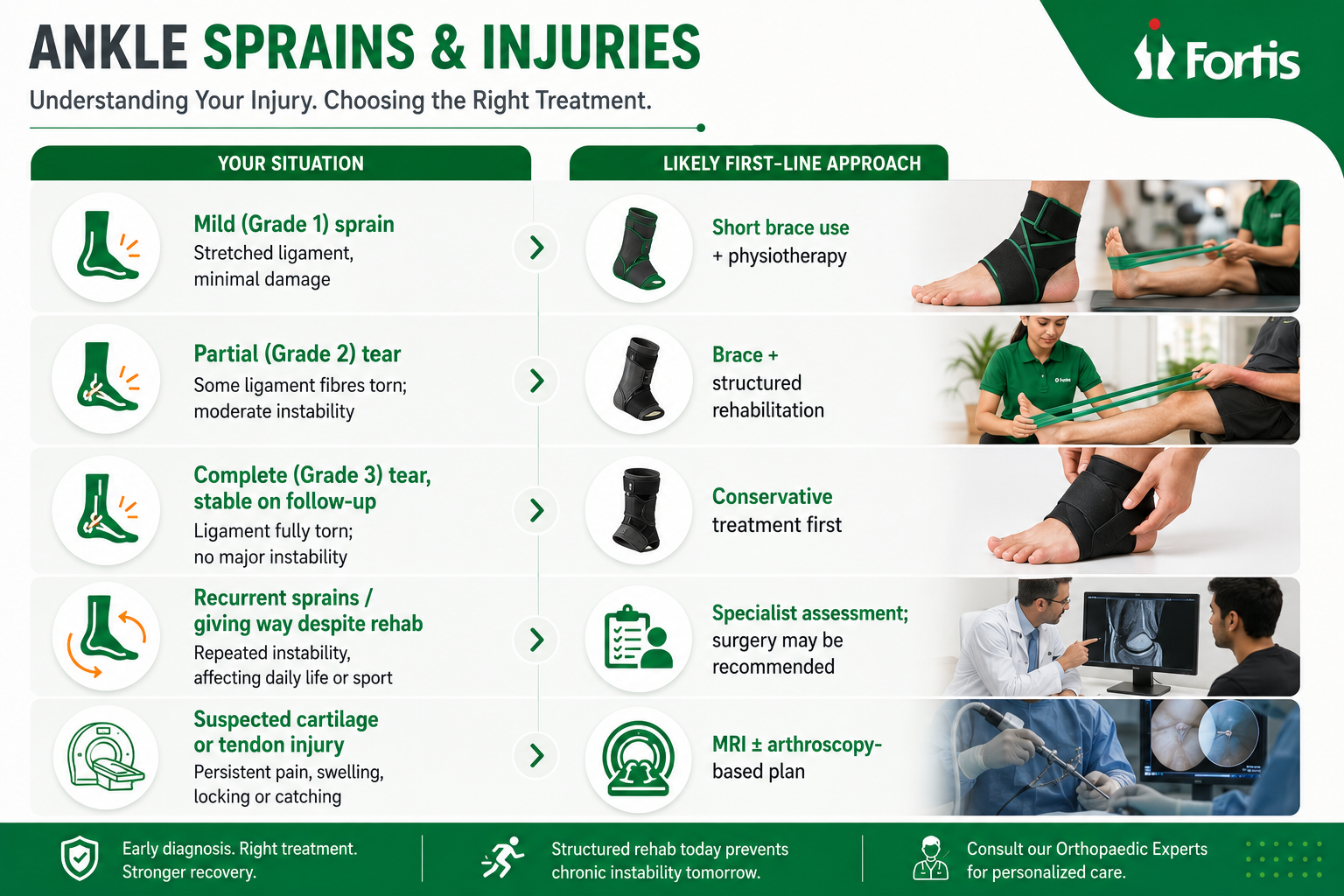
- Grade 1 (mild): the ligament is stretched, not torn. Mild swelling and tenderness; walking is possible. Usually settles in 1–3 weeks.
- Grade 2 (moderate): a partial tear. Clear swelling, bruising and pain on walking, with some looseness on examination. Typically 3–6 weeks with rehabilitation.
- Grade 3 (severe): a complete tear, often with CFL involvement. Significant swelling, instability and difficulty bearing weight. Recovery commonly takes 6–12 weeks — and even complete tears are usually treated without surgery first.
Why do some ankles heal completely while others stay unstable?
A torn ligament can heal in a lengthened, weakened position ("mechanical instability"), and the injury also disturbs the ankle's balance sensors ("functional instability"). If strength and balance are not retrained, the ankle keeps rolling — each new sprain stretching the ligament further. This is why supervised rehabilitation, not just rest, is the cornerstone of treatment.
Symptoms of an ATFL Tear or Ankle Sprain
Common symptoms after a lateral ligament injury include:
- Pain and tenderness on the outer side of the ankle, just in front of the bony prominence
- Swelling within minutes to hours; bruising appearing over 24–48 hours, sometimes tracking into the foot
- Difficulty or pain on walking, especially on uneven surfaces
- A feeling of weakness, looseness or "giving way"
- Apprehension when running, jumping or changing direction quickly
- Repeated twisting episodes weeks or months later
Symptoms that suggest more than a simple sprain — deep ankle pain, catching, locking, persistent swelling beyond 6–8 weeks, or pain higher up between the two leg bones (possible "high ankle"/syndesmotic injury) — warrant specialist review, as they may indicate cartilage damage, a peroneal tendon tear or a syndesmosis injury.
Red flags — seek urgent evaluation if you have:
- Inability to take four steps immediately after the injury or in the clinic
- Obvious deformity of the ankle or foot
- Numbness, tingling or bluish/pale discolouration of the foot
- Marked tenderness directly over the bone (ankle knobs, midfoot or base of the little toe)
- Rapidly increasing swelling or pain out of proportion to the injury
These features raise the possibility of a fracture or vascular compromise and should be assessed the same day — visit the Fortis Hospital Mohali Emergency Department, open 24×7.
First Aid: What to Do (and Not Do) Right After a Twisting Injury
Do — the P.O.L.I.C.E. principle
- Protection: a brace or firm strapping for the first days
- Optimal Loading: gentle weight-bearing as pain allows — early protected movement heals ligaments better than prolonged rest
- Ice: 15–20 minutes every 2–3 hours for the first 48 hours (never directly on skin)
- Compression: an elastic bandage during the day
- Elevation: foot above heart level whenever resting
Avoid in the first 48–72 hours
- Hot water, hot fomentation or deep massage — these increase bleeding and swelling
- Forcing yourself to "walk it off" through significant pain
- Returning to sport the same week just because pain has eased
- Ignoring red-flag symptoms listed above
Ankle still swollen or twisting weeks after a sprain? Don't wait for the next giving-way episode — a focused clinical examination can usually identify the problem in one visit.
Book a Foot & Ankle Consultation
How an ATFL Tear Is Diagnosed
Diagnosis begins with a careful history — how the injury happened, previous sprains, and what the ankle can and cannot do now — followed by a structured examination.
Clinical examination and stability tests
- Anterior Drawer Test: the heel is gently pulled forward to check how far the talus slides — increased glide suggests an ATFL tear.
- Talar Tilt Test: the heel is tilted inward to assess the CFL alongside the ATFL.
- External Rotation / squeeze tests: screen for a syndesmotic ("high ankle") injury, which behaves and heals differently.
- Palpation of the peroneal tendons, the base of the fifth metatarsal and the joint line to detect associated injuries.
When are X-rays needed?
Not every sprain needs an X-ray. Specialists apply the validated Ottawa Ankle Rules: an X-ray is indicated if there is bone tenderness at specific points around the ankle or midfoot, or if the patient cannot take four steps. Weight-bearing views, where tolerated, give the truest picture of alignment.
When is an MRI actually required?
MRI is not a routine test for ankle sprains. It is genuinely useful when:
- A complete (Grade 3) tear is suspected and surgery is being considered
- Pain, swelling or instability persist beyond about 6 weeks of proper rehabilitation
- There are signs of associated injury — cartilage (osteochondral) lesions of the talus, peroneal tendon tears or syndesmosis injury
Ultrasound is a quick, dynamic way to visualise the ATFL and peroneal tendons in experienced hands. CT scans are reserved for defining subtle fractures or bony detail before complex surgery.
Associated injuries a specialist looks for
- CFL and (rarely) PTFL tears
- Syndesmotic ("high ankle") sprain
- Peroneal tendon tears or dislocation
- Osteochondral lesions of the talus (cartilage injury)
- Small avulsion fractures or fifth-metatarsal fractures
- Deltoid ligament injury on the inner ankle
Missing these associated injuries is one of the commonest reasons "a simple sprain" fails to settle — and one of the strongest arguments for assessment by a dedicated foot and ankle specialist rather than generic care.
Who is at higher risk of ATFL injury and re-injury?
- A previous ankle sprain (the single biggest risk factor)
- Weak peroneal (outer calf) muscles and poor single-leg balance
- High-arched feet or generalised ligament laxity
- Unsupportive footwear and play on uneven surfaces
- Cutting-and-jumping sports: football, basketball, badminton, volleyball, kabaddi, trail running
Non-Surgical Treatment: How Most ATFL Injuries Heal
International guidance (AAOS, BOFAS, International Ankle Consortium) is consistent: most ankle sprains — including many complete ATFL tears — should first be treated functionally, without surgery. Early protected movement outperforms prolonged plaster immobilisation for ligament healing.
A stage-wise rehabilitation plan
Typical non-surgical recovery pathway (indicative — individual plans vary)
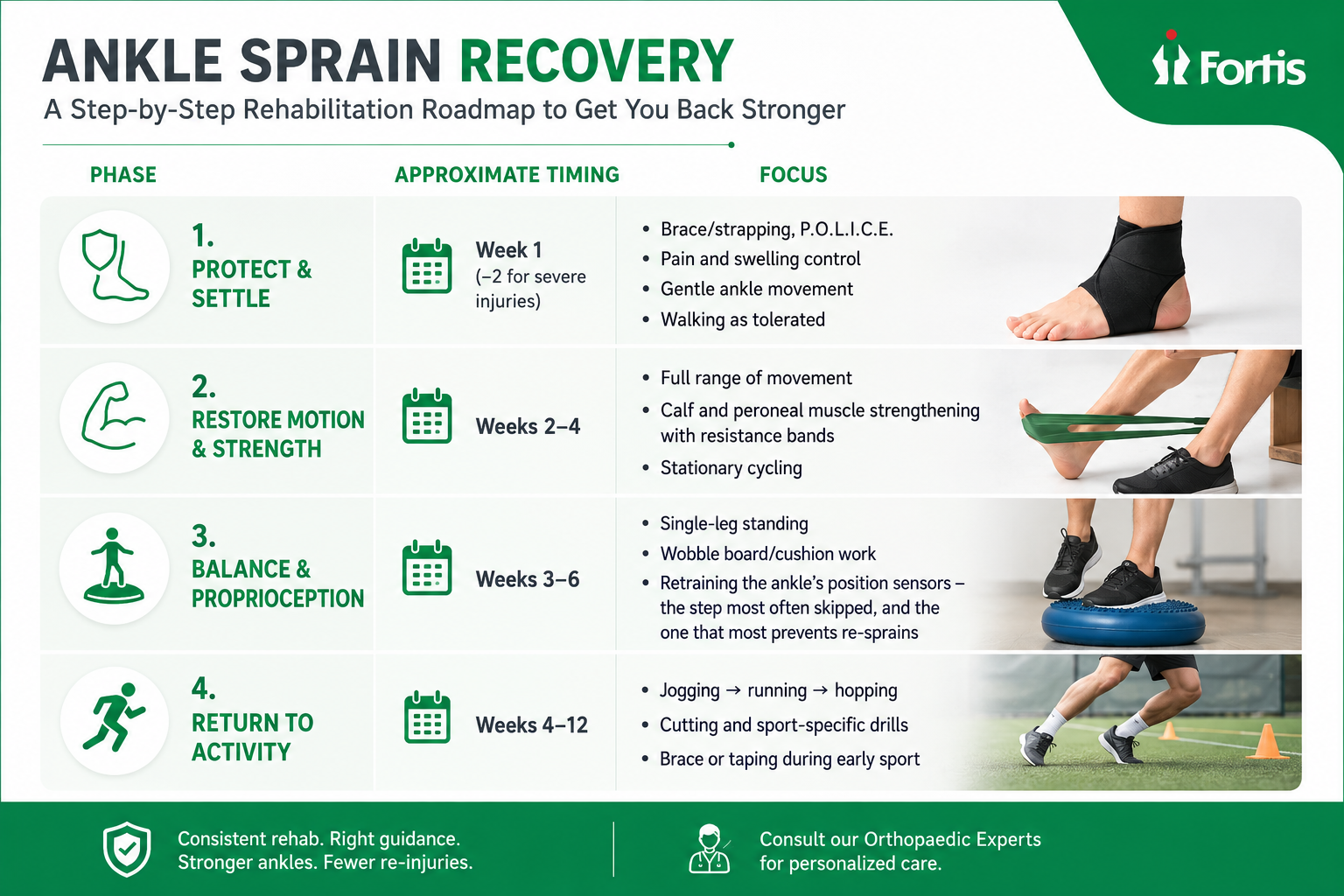
Indicative recovery timelines by grade
- Grade 1: most daily activities within days; sport in ~1–3 weeks
- Grade 2: comfortable walking in 1–2 weeks; sport in ~3–6 weeks
- Grade 3: a short period of boot/brace protection, then rehabilitation; sport typically ~6–12 weeks
These are averages, not promises — age, injury pattern, rehabilitation quality and sport demands all influence recovery.
Return-to-sport criteria: milestones, not just weeks
Clearance for running and sport should be earned by function rather than the calendar:
- Full, pain-free ankle range of movement
- Calf/peroneal strength ≥ ~90% of the other side
- Confident single-leg balance with eyes closed for 30 seconds
- Pain-free hopping and direction changes without apprehension
Common myths about ankle sprains
- "Ankle sprains always heal on their own." Many do — but a substantial number progress to chronic instability without proper rehabilitation.
- "If I can walk, nothing is torn." Many people walk on partial and even complete ATFL tears.
- "Rest is the best treatment." Prolonged rest weakens the ankle; guided early loading heals it.
- "An MRI is needed to start treatment." Treatment for most sprains starts on the day of clinical diagnosis.
When Is Surgery Needed for an ATFL Tear?
Surgery is the exception, not the rule. It is usually considered when:
- The ankle keeps re-spraining or giving way despite 3–6 months of good-quality rehabilitation
- Examination and imaging confirm mechanical instability (a lax or absent ATFL)
- There are associated injuries needing treatment — cartilage lesions, peroneal tendon tears, loose bodies
- In selected high-demand athletes with complete tears, after shared decision-making about risks and timelines
Who does not need surgery? Most Grade 1–2 sprains, first-time Grade 3 tears without persisting instability, and anyone who has not yet completed a structured rehabilitation programme.
Surgical options, explained simply
- Broström repair (ligament repair): the patient's own torn ATFL is tightened and re-anchored to the fibula. The gold-standard operation when ligament tissue quality is good.
- InternalBrace™ augmentation: a strong, tape-like synthetic band is placed alongside the repaired ligament, acting as a seatbelt that protects it while it heals. This added stability is what allows earlier movement and accelerated rehabilitation.
- Ligament reconstruction (tendon graft): when the native ligament is too damaged or a previous repair has failed, a small tendon graft is used to rebuild the ATFL (and CFL if needed).
- Ankle arthroscopy: keyhole inspection of the joint through 2–3 tiny incisions — added when cartilage damage, scar tissue or impingement is suspected, and increasingly used to perform the ligament work itself through minimal incisions.
Repair vs reconstruction in one line: repair tightens your own ligament; reconstruction replaces it with a graft. Repair preserves natural anatomy and is preferred when tissue allows; reconstruction is the reliable solution for poor tissue or revision cases.
Benefits, limitations and risks — honestly
Published series report good-to-excellent outcomes in roughly 85–95% of patients after modern lateral ligament repair/reconstruction, with high return-to-sport rates. As with any surgery, there are risks — infection, nerve irritation (particularly the superficial peroneal nerve), stiffness, blood clots, and a small chance of recurrent instability. Anaesthesia is typically regional or general; many procedures are day-care or single-night admissions, and modern pain-management protocols keep discomfort well controlled. Surgery only succeeds when followed by committed rehabilitation.
Post-operative recovery pathway (indicative)
Typical rehabilitation after ATFL repair with InternalBrace augmentation
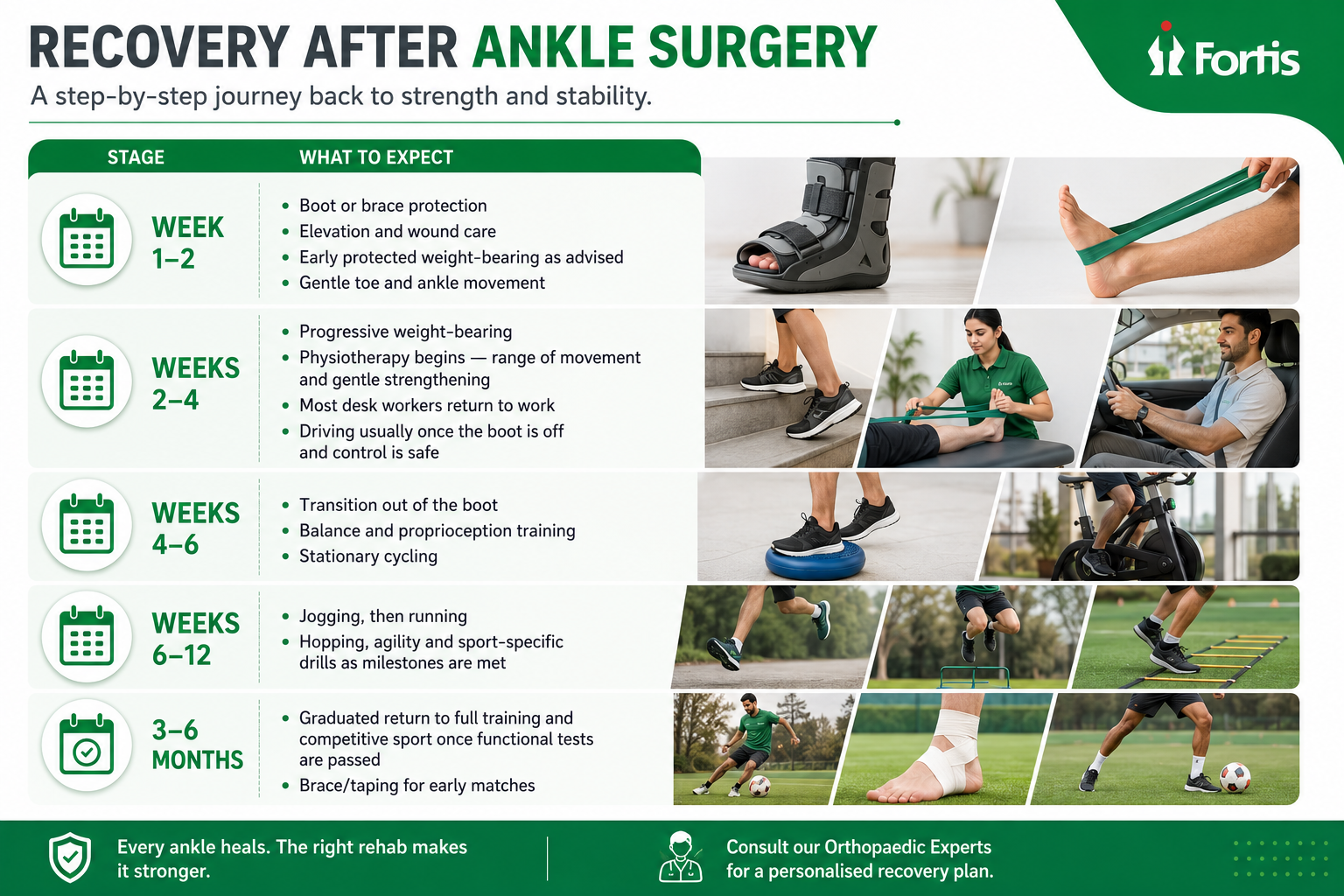
Accelerated return to sport — a realistic view
Minimally invasive/arthroscopic repair with InternalBrace augmentation involves smaller incisions, less soft-tissue disruption and immediate mechanical stability of the repair. Published studies of augmented repair report earlier mobilisation and faster return to activity than traditional repair followed by prolonged casting.
At the Foot & Ankle Clinic, Fortis Hospital Mohali, this approach allows carefully selected athletes — depending on injury severity, tissue quality, sport and rehabilitation response — to resume graduated sport-specific training in as little as 4–6 weeks, with return to competition decided by functional milestones rather than dates. This accelerated pathway applies to selected patients under supervised protocols; it is not a guaranteed or universal timeline, and full competitive return commonly takes longer.
EDITOR NOTE: If the clinic wishes to retain the original "return to sports within one month" phrasing, attach the specific published study or the clinic's own audited outcome data supporting it, and have Dr. Narang approve the final wording for compliance with medical-advertising norms.
Athletes & sportspersons: if recurrent sprains are keeping you off the field, ask about ligament-preserving repair with accelerated, milestone-based rehabilitation.
Patient Decision Guide at a Glance
What treatment is usually recommended?
Patient Stories from the Clinic
EDITOR NOTE: The two examples below are illustrative drafts only. Before publishing, replace them with real, anonymised cases from Dr. Narang's practice with documented patient consent, and have Dr. Narang verify every clinical detail.
[Illustrative] A 24-year-old club cricketer presented after his fourth ankle sprain in a year, unable to trust the ankle while fielding. Examination and MRI confirmed chronic ATFL insufficiency. After arthroscopic-assisted Broström repair with InternalBrace augmentation and a supervised rehabilitation programme, he met his functional milestones and resumed net practice at six weeks, returning to competitive matches in the following season without recurrence. [Replace with consented real case]
[Illustrative] A 38-year-old recreational runner with a Grade 2 ATFL tear recovered fully with bracing, peroneal strengthening and balance training alone — no surgery — and returned to 10K running at eight weeks. [Replace with consented real case]
Your Journey at the Foot & Ankle Clinic, Fortis Mohali
- First visit: detailed history and clinical examination, including stability tests. Bring previous X-rays/MRI reports, your regular sports shoes, and a list of medications.
- Investigations, only if needed: weight-bearing X-rays, ultrasound or MRI on-site at Fortis Mohali's imaging department.
- A personalised plan: most patients leave with a rehabilitation prescription; surgical options are discussed only when clearly indicated.
- Rehabilitation: coordinated with the hospital's physiotherapy and sports-rehabilitation team, with milestone-based progression.
- Return to sport: functional testing before clearance, plus an injury-prevention programme to protect the ankle long term.
Preventing the Next Ankle Sprain
- Daily single-leg balance practice (build to 60 seconds, then eyes closed)
- Twice-weekly peroneal and calf strengthening with a resistance band
- Proper warm-up including ankle circles, hops and direction changes before sport
- Sport-appropriate, well-fitted footwear; replace worn-out soles
- Bracing or taping during high-risk sport for 6–12 months after a significant sprain
- Awareness of uneven surfaces — trails, potholed grounds, poorly lit stairs
[Headshot placeholder — alt: "Dr. Chandan Narang, foot and ankle surgeon at Fortis Hospital Mohali"]
About the Specialist: Dr. Chandan Narang
Dr. Chandan Narang is an exclusively practising foot and ankle surgeon at Fortis Hospital Mohali — home to the Tricity's first dedicated Foot & Ankle Department — with over seven years of clinical and surgical experience across sports ligament injuries, ankle arthroscopy, deformity correction and diabetic foot care.
- Qualifications: MBBS (GMC Baroda, MS University); MS Orthopaedics (GMC Surat); Fellowship in Foot & Ankle Surgery
- International credentials: BEOFAA (British-European Orthopaedic Foot and Ankle Association) fellow; BOFAS fellow; member, Minimally Invasive Foot & Ankle Society (MIFAS), Europe; IFAS Spain Travelling Fellowship awardee
- Teaching & academic roles: National teaching faculty, Indian Foot & Ankle Society (IFAS); faculty at IFASCON 2023 (Nagpur) and IFASCON 2024 (Kochi); invited young faculty, AIIMS Rishikesh 2024; faculty, Steps2Walk deformity-correction programme; mentor at advanced foot & ankle cadaveric/skills labs; conducts regular CME programmes on foot and ankle care across Punjab and Haryana
- Why exclusive practice matters: concentrating solely on foot and ankle conditions builds the case volume and pattern recognition that general practice cannot — from spotting subtle associated injuries to executing minimally invasive ligament techniques safely.
Care is delivered with Fortis Mohali's multidisciplinary team — sports physiotherapy, advanced MRI imaging and rehabilitation services under one roof.
Contact Us – Fortis Hospital Mohali
For appointments, consultations, and diagnostic services, please contact:
📞 72728 72728
Our care team will assist you with:
Doctor appointments
Diagnostic and screening services
Health check-ups
Call now to book your appointment at Fortis Hospital, Mohali.
Categories
Clear allRelated Blogs
View all






FAQs
Can an ATFL tear heal without surgery?
Yes. Most ATFL injuries — including many complete tears — heal well with structured physiotherapy, bracing and balance retraining. Surgery is considered mainly when instability persists despite 3–6 months of proper rehabilitation.
Can I walk with an ATFL tear?
Often, yes — many people walk (with discomfort) on partial and even complete tears, which is why sprains get underestimated. If you cannot take four steps, or have bone tenderness or deformity, get assessed urgently to rule out a fracture.
Is an MRI always necessary?
No. Diagnosis is primarily clinical. MRI is reserved for suspected complete tears before surgery, symptoms persisting beyond ~6 weeks, or suspected cartilage/tendon injury.
How long does recovery take?
Indicatively: Grade 1 — 1–3 weeks; Grade 2 — 3–6 weeks; Grade 3 — 6–12 weeks non-surgically. After surgery, jogging typically begins around 6–10 weeks with graduated sport after that. Individual recovery varies.
How long does swelling last?
Mild swelling after activity can persist for 2–3 months even as the ligament heals — this alone is not alarming. Swelling that worsens, or persists with pain beyond 6–8 weeks, deserves review.
When can I resume running or return to cricket/football?
When you meet functional milestones — full painless movement, ~90% strength, confident single-leg balance and pain-free hopping — not merely when a number of weeks has passed. Team-sport return after surgery commonly takes 3–6 months; selected athletes on accelerated protocols may begin sport-specific training earlier.
Can I drive after ankle ligament surgery?
Usually once you are out of the boot and can perform an emergency stop safely — often around 4–6 weeks for a right ankle, earlier for a left ankle with an automatic car. Confirm with your surgeon.
Does ankle popping mean my ligament is torn?
A pop at the moment of injury may indicate a significant ligament injury, but painless clicking weeks later is usually harmless. Examination — not the sound — makes the diagnosis.

Keep track of your appointments, get updates & more!

