
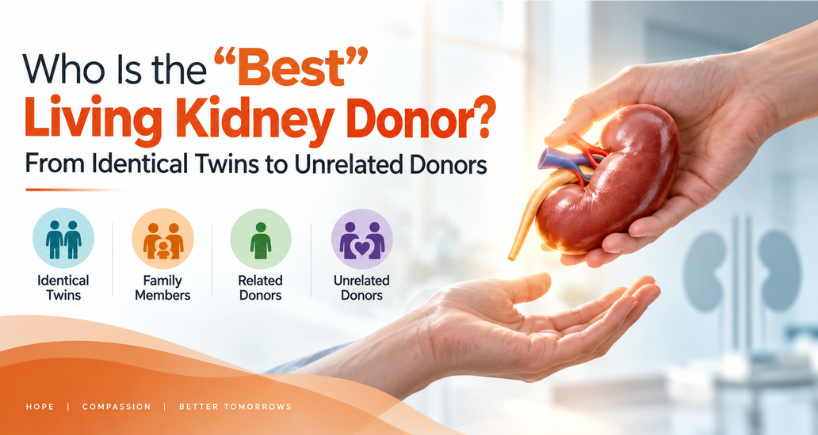


Best Kidney Donor Match Twin Sibling Parent Child Spouse or Unrelated?
Medically reviewed by Dr. Sahil Rally — MBBS, MS (General Surgery), Fellowship in Renal Transplantation; Consultant, Renal Transplant, Fortis Hospital, Mohali.
This guide concerns living kidney donation. Reviewed July 2026 · Next review July 2027.
When someone develops kidney failure, the search for a living donor usually begins inside the family — a twin, a brother or sister, a parent, or a spouse. It feels natural to assume that the closer the blood relationship, the better the transplant. Biology does give closely related donors an edge in tissue matching, and transplant teams do work down a rough “donor ladder,” starting from the closest genetic match and moving outward.
But that ladder is a way to think about compatibility — not a fixed order of merit. The donor who finally gives a recipient the best, most durable kidney is decided in the laboratory, by blood group, tissue typing and the crossmatch, far more than by the family tree. Below, we walk down the usual order, from the closest match to the most distant, explaining the real benefits and pitfalls of each, and why the tests almost always matter more than the relationship.

How Transplant Teams Actually Rank Donors
Three laboratory checks sit underneath every donor conversation, and they outrank the family relationship:
- Blood group (ABO) compatibility — the first filter. An incompatible blood group can stop a transplant even between identical twins, unless a specialised ABO-incompatible protocol is used.
- HLA tissue typing — how immunologically similar donor and recipient are. A closer match generally means lower rejection risk and less immunosuppression, but it is not the only factor.
- The crossmatch — the ultimate tie-breaker. The recipient’s blood is tested against the donor’s cells; a positive crossmatch signals a strong immune reaction and usually rules out a direct transplant, no matter how close the relationship.
On top of these, donor safety and donor age matter enormously. A well-matched kidney from a healthy 25-year-old can outlast a “perfectly matched” kidney from a 60-year-old relative. This is why a genetic ranking is only a starting point.
The Living-Donor Order — A Discussion Framework, Not a League Table
Read the categories below as a way to understand compatibility, not as an automatic order of selection. Individual test results can completely change which donor is best for a given recipient.
1. Identical (Monozygotic) Twin — The Closest Match
Benefits
- Identical twins share essentially the same inherited HLA profile, giving the closest possible immunological match.
- The risk of conventional HLA-mediated rejection can be exceptionally low.
- In carefully selected cases, the transplant team may be able to reduce long-term immunosuppression — a decision that rests entirely with the team.
- The world’s first successful kidney transplant (1954) was between identical twins — the proof of concept for the whole field.
Pitfalls
- Being twins does not automatically mean being identical; monozygosity may need genetic confirmation.
- Twins may share the same inherited predisposition to the disease that caused kidney failure, and some diseases can recur in the transplanted kidney.
- Both are the same age, so an identical twin does not provide a biologically “younger” kidney.
- Immunosuppression is never stopped simply because the donor is an identical twin, and truly available twin donors are rare.

2. Fraternal (Dizygotic) Twin
Key point: A fraternal (non-identical) twin is, immunologically, an ordinary full sibling — not a halfway step between an identical twin and a sibling. Always establish identical vs. fraternal before assuming a close match.
Benefits
- Similar age can be favourable for organ size and expected longevity.
- As full siblings, they may share more HLA markers than an unrelated donor.
- A strong, documented emotional bond, and the transplant can be planned before prolonged dialysis.
Pitfalls
- No guarantee of a close tissue match — they can be as mismatched as any two siblings.
- They may be blood-group incompatible or crossmatch-positive.
- A shared family history can carry the same hereditary risk, and emotional closeness can create pressure, so voluntary consent must be assessed independently.
3. Full Sibling (Brother or Sister)
Each child inherits HLA markers from both parents, so full siblings have roughly a 25% chance of being HLA-identical, a 50% chance of sharing one haplotype (a half-match), and a 25% chance of sharing neither. These are probabilities — actual typing and crossmatching are still essential.
Benefits
- The best chance, apart from an identical twin, of finding an HLA-identical donor.
- HLA-identical sibling kidneys have historically shown particularly strong long-term outcomes.
- Often close in age, and the relationship is straightforward to verify under Indian transplant rules.
Pitfalls
- Only about one in four full siblings will be HLA-identical — a sibling is not automatically a perfect match.
- A sibling can still be ABO-incompatible or crossmatch-positive.
- Shared familial conditions (polycystic kidney disease, diabetes, hypertension) may make a sibling unsuitable, and an older sibling may have less kidney reserve than a younger alternative.
4. Parent Donating to an Adult Child
A parent and biological child always share one HLA haplotype, so they are a guaranteed half-match — but a half-match does not guarantee a safe or durable transplant.
Benefits
- Predictable partial genetic matching and usually very strong motivation to donate.
- The relationship is easy to establish, and parents often complete the full evaluation willingly.
Pitfalls
- Parents are older, and more likely to have hypertension, diabetes, reduced kidney function or vascular disease.
- A parent may carry the same inherited gene that caused the child’s kidney disease, and a younger recipient may outlive an older donor kidney.
- Parents may downplay their own risks because of a strong desire to help.

5. Adult Child Donating to a Parent
Genetically the reverse of the above: parent and child still share one haplotype. Note that this concerns adult children — living organ donation by minors is generally prohibited in India.
Benefits
- The donor is often younger, with better kidney function and greater functional reserve.
- Fewer age-related vascular problems, and favourable size when, for example, an adult son donates to a smaller parent.
Pitfalls
- A young donor has many decades ahead in which hypertension, diabetes or kidney disease could emerge — long-term risk assessment is especially important.
- A child may feel unable to refuse a parent, which is a real consent and coercion concern.
- If the parent’s disease is inherited, the child may carry it, and donation can affect future pregnancy planning, employment and insurance.
Clinic note: Youth favours organ quality — but it also gives the donor a longer lifetime over which future risks must be weighed.
6. Wife Donating to Her Husband
Benefits
- A compatible wife can provide an excellent living-donor kidney despite having no genetic link.
- Planned, pre-emptive surgery can reduce or avoid time on dialysis, which improves long-term outcomes.
- Because the husband has never been pregnant, he has not developed pregnancy-related antibodies against his wife — so this direction avoids that particular form of sensitisation in the recipient.
Pitfalls
- HLA matching is coincidental rather than inherited.
- A female donor’s kidney may be smaller relative to a much larger male recipient (an individual consideration, not a fixed rule).
- The wife may also be the husband’s main caregiver, so both partners recovering at once can strain the household; autonomy must be protected through a confidential, independent assessment.
7. Husband Donating to His Wife
Benefits
- The same planned-donation advantages apply, and a negative crossmatch makes this a very reasonable option.
- A male donor may offer a relatively larger kidney with greater nephron mass for a smaller female recipient (again individual, not a sex-based law).
- If direct donation is not possible, the husband can still help his wife through a paired exchange.
Special pitfall — pregnancy sensitisation
A woman can develop antibodies against the HLA markers her children inherited from their father. So a wife who has carried her husband’s children may sometimes have donor-specific antibodies against him, occasionally producing a positive crossmatch or a higher risk of antibody-mediated rejection.
This must not be overstated. Antibody screening and the final crossmatch — not the couple’s sex — decide whether the transplant is suitable. After excluding HLA-incompatible pairs, studies have found comparable five-year graft survival across husband-to-wife, offspring-to-mother and other unrelated living-donor groups. And where antibodies do block direct donation, a swap transplant often solves the problem.

8. Unrelated Donor (Friend, In-law or Altruistic Stranger)
Benefits
- May be healthier, younger or more compatible than the relatives available — sometimes safer than an incompatible family member.
- Modern immunosuppression makes well-matched unrelated transplants highly successful.
- Non-directed altruistic donors can begin chains that help several families at once.
Pitfalls
- Usually fewer shared HLA markers, so potentially a greater immunosuppressive burden.
- Motivation, informed consent and the absence of any payment need especially careful verification.
- In India, donation by anyone other than a near relative requires additional Authorisation Committee approval — examining the relationship, motivation, finances and any commercial dealing — which can add time to the process.
Under the Transplantation of Human Organs and Tissues Act (THOTA), “near relatives” — spouse, children, parents, siblings, grandparents and grandchildren — follow one pathway, while all other donors require Authorisation Committee clearance. NOTTO provides the documentation framework for near-relative, spousal and other-than-near-relative living donations.
When the Willing Donor Isn’t the Right Match: Swap (Paired-Exchange) Transplants
Sometimes the most willing donor in the room simply cannot donate to their own loved one — the blood groups clash, the crossmatch is positive, or the recipient carries donor-specific antibodies. That is not the end of the road.
In a kidney paired donation, or “swap,” one incompatible pair is matched with another incompatible pair, so that each recipient receives a compatible kidney from the other family’s donor. Chains can link three or more pairs. As we explained in our earlier article on swap transplants, this is exactly how the Fortis Hospital Mohali transplant team completed a rare three-way (“triple swap”) kidney transplant — giving three patients compatible kidneys after blood-group mismatch had blocked direct donation within their own families.
Five Tests That Matter More Than the Donor’s Surname
- Donor health and safety — adequate kidney function and an acceptably low predicted lifetime risk after donation.
- Blood-group (ABO) compatibility — or an approved, specialised strategy for managing incompatibility.
- HLA typing — an estimate of how immunologically similar donor and recipient are.
- Donor-specific antibody testing — whether the recipient already carries antibodies against this particular donor.
- The final crossmatch — a positive result indicates a substantial risk of immediate immune attack and usually prevents a direct transplant.
Alongside these, the team assesses kidney anatomy (CT renal angiography), measured kidney function, urine protein, blood pressure, diabetes and cardiovascular risk, infection and cancer screening, donor–recipient body size, psychological readiness, and independent confirmation of voluntary consent. KDIGO guidance recommends judging a donor’s whole profile rather than any single factor, and notes that a compatible transplant is generally preferable to an HLA-incompatible one when a suitable alternative exists.
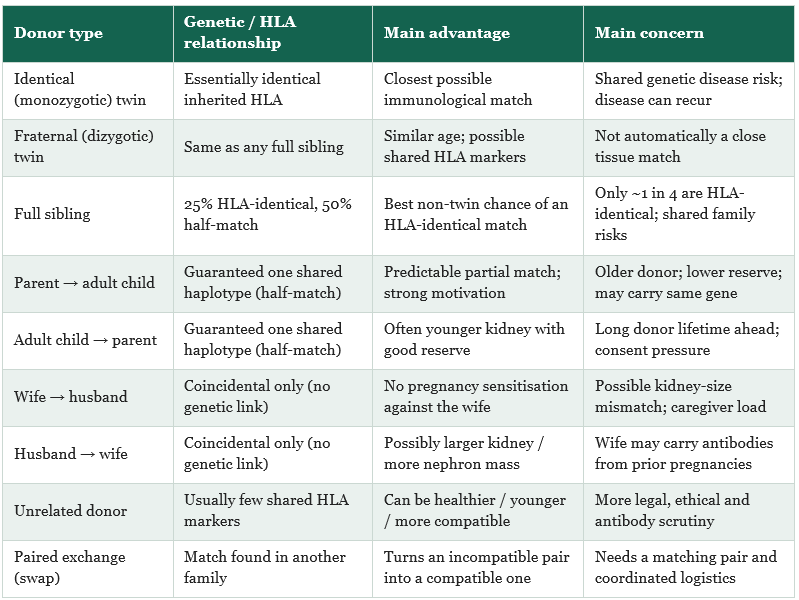
At a Glance: Comparing Donor Types
A Note on Liver and Other Organs
For living-donor liver transplantation, relationship-based ranking matters even less. Body and graft size, liver health and fat content, an adequate remnant for the donor, blood-vessel and bile-duct anatomy, and donor safety usually outweigh whether the donor is a sibling or a spouse. Living liver donation also carries its own risks, including bleeding, infection, clots and bile leakage, so the evaluation is organ-specific.
The Bottom Line
- Identical twins and HLA-identical siblings offer the strongest potential immunological match — but these situations are uncommon.
- For everyone else, laboratory compatibility and donor health matter more than whether the donor is a parent, child, spouse or friend.
- The best donor is the person who can give the recipient a safe, durable transplant without exposing themselves to an unacceptable lifetime risk — and when direct donation isn’t possible, a swap can still make it happen.
About the reviewer
Dr. Sahil Rally is a Consultant in Renal (Kidney) Transplantation at Fortis Hospital, Mohali. Qualified MBBS, MS (General Surgery) with a Fellowship in Renal Transplantation, he has independently performed and assisted in hundreds of kidney transplant and vascular-access procedures and is a member of the Indian Society of Organ Transplantation. He led the Fortis Mohali team that completed a rare three-way (“triple swap”) kidney transplant.
Fortis Hospital Mohali offers near-relative, spousal and paired-exchange (swap) kidney transplantation, with Authorisation Committee oversight, in line with THOTA and NOTTO requirements.
Categories
Clear allMeet the doctor

- Organ Transplant | Kidney Transplant
-
 8 Years
-
 1050
1050
Related Blogs
View all




FAQs
Who is the best kidney donor?
There is no single answer that fits everyone. An identical twin or HLA-identical sibling offers the closest tissue match, but for most patients the best donor is whoever is healthy, willing, blood-group compatible and passes the crossmatch — which may be a spouse, a friend or a paired-exchange donor rather than the closest relative.
Can a husband donate a kidney to his wife if they have children together?
Often yes, but it needs careful testing. Carrying her husband’s children can sensitise a wife to some of his HLA markers, occasionally causing a positive crossmatch. Antibody screening and the crossmatch decide suitability; if they block direct donation, a swap transplant is usually an option.
What if my donor’s blood group doesn’t match?
Blood-group incompatibility no longer means the transplant is impossible. Specialised ABO-incompatible protocols exist, and kidney paired donation (swap) lets your donor give to a compatible recipient in another family while you receive a compatible kidney in return.
Is a sibling always better than a spouse?
No. A sibling only has about a one-in-four chance of being an HLA-identical match, and may share the family disease or be older. A healthy spouse with a negative crossmatch can be an excellent, sometimes preferable, donor.
What if my donor’s blood group doesn’t match?
Blood-group incompatibility no longer means the transplant is impossible. Specialised ABO-incompatible protocols exist, and kidney paired donation (swap) lets your donor give to a compatible recipient in another family while you receive a compatible kidney in return.
Can a friend or unrelated person donate a kidney in India?
Yes, but donation by anyone other than a near relative requires approval from the hospital’s Authorisation Committee, which reviews the relationship, motivation and finances to ensure the donation is genuinely voluntary and non-commercial.
Does a younger donor matter more than a perfect match?
Donor age is a powerful predictor of long-term kidney survival. A well-matched kidney from a healthy young donor can outlast a perfectly matched kidney from a much older relative, which is why the team weighs age and donor health alongside HLA matching.

Keep track of your appointments, get updates & more!

