
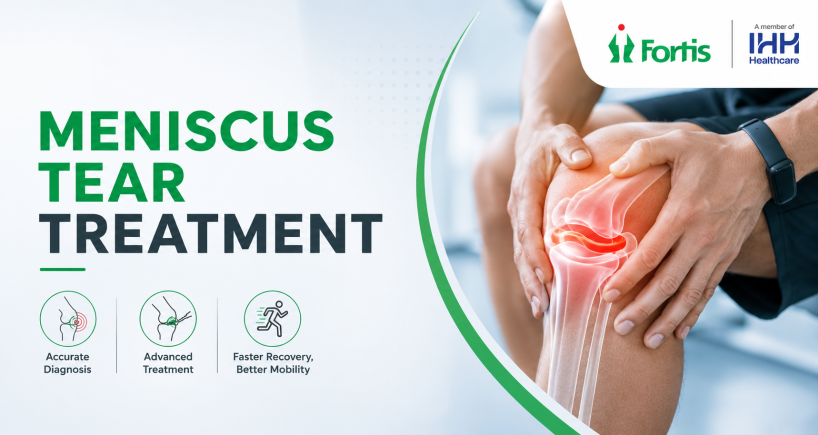


Best Meniscus Tear Treatment in Navi Mumbai
Best Meniscus Tear Treatment in Navi Mumbai
Meniscus Tear: Symptoms, Diagnosis, and Treatment
The knee is one of the most injured joints that orthopaedic surgeons encounter in daily practice. It is a complex joint that depends on a number of important structures including the ligaments and menisci to provide stability, cushioning and smooth movement.
A meniscus tear is one of the most frequent knee injuries in sports and daily activities. If it is diagnosed early and treated properly, knee function can be preserved and the chance of long-term damage to the joint reduced.
What is a Meniscus?
The meniscus is a tough, C-shaped piece of rubbery cartilage that sits between the thigh bone (femur) and the shin bone (tibia). You have two menisci in each knee. They are natural shock absorbers and help distribute weight evenly around the joint.
The meniscus also plays a role in:
- Shock absorbing
- Stability of the knee
- Free joint movement
- Protects the cartilage from excessive wear
A meniscus that is healthy is critical to the long-term health of the knee.
What Causes Meniscus Tears?
Meniscus tear is a common injury that occurs when the knee is twisted forcefully with the foot planted on the ground. Such injury may occur when:
- Jogging
- going up or down stairs
- Sharp spins and twists
- Sports like badminton, football and kabaddi Accidental falls and slips
Meniscus tears can happen to people of all ages during normal daily activities, but athletes are more at risk.
Meniscus Tear Symptoms
Symptoms may vary depending on the size and location of the tear.
Intense Knee Pain - Pain is typically felt either on the inside or outside of the knee, depending on where the tear is. It is often made worse by walking, squatting, or twisting the knee.
- Popping Sensation - At the time of the injury, many people feel or hear a distinct “pop.”
- Swollen - The knee can swell and puff up a few hours after the injury and it can get worse gradually.
- Restricted Movement of the Knee - Pain and swelling can prevent you from fully bending or straightening the knee.
- Knee Locking or Giving Way - A piece of the torn meniscus may be displaced and physically block normal knee movement, causing the knee to lock temporarily.
- Clicking or Clunking - Clicking, snapping, or clunking feeling when the displaced fragment pops back into place.
How is a meniscal tear diagnosed? Physical Examination
Your orthopedic surgeon will examine your knee carefully and will perform some clinical motion tests to determine if there is a possible meniscus injury.
MRI Scan
The diagnosis is confirmed through an MRI scan of the knee that gives detailed information about:
- Where there is a tear
- Tear pattern and shape
- Extent and Size of Injuries
- Related ligament injuries
MRI is still the gold standard investigation for accurate diagnosis of meniscus tears.
Can a Meniscus Tear Heal on Its Own?
There are a number of important factors that will dictate whether a meniscus tear will heal on its own.
1. Where the Tear is Located
- The outer part of the meniscus is better supplied with blood and so has a greater capacity to heal.
- Tears that occur in the inner part usually have poor healing due to the poor blood circulation.
2. Complexity and Tear Design.
- Meniscus tears can be: Horizontal Longitudinal Oblique Radial Bucket-handle.
- Complex tears are less likely to heal compared to smaller, more simple tears.
3. Time After Injury
- Acute meniscus tears repaired within 3 to 4 weeks tend to heal much better than neglected chronic tears.
- Getting an early opinion from an orthopaedic specialist makes a big difference to treatment results.
How to Treat a Meniscus Tear?
Treatment is based on the patient’s age, activity level, symptoms and the type of tear.
Non-Surgical / Conservative Management
Not all meniscus tears need surgery. Small stable tears in the outer vascular zone may heal with:
- Good rest
- Alteration of activity
- Pain control as directed by your doctor
- Systematic physiotherapy
- Strengthening exercises, progressive
It is important to keep regular follow-up to ensure proper healing.
Surgery
Larger, unstable or complex tears often require arthroscopic surgery, especially if associated with ligament injuries or persistent locking of the knee.
The two main surgical approaches are:
1. Meniscus Surgery
“Meniscus repair is stitching the torn meniscus back together. Orthopaedic arthroscopy surgeons will try to preserve and repair the natural meniscus whenever possible, regardless of age. Keeping the meniscus helps to maintain knee function and reduce the risk of future arthritis.
2. Meniscectomy
In a meniscectomy only the torn part is cut out and as much healthy tissue as possible is kept intact. Generally, this procedure is limited to special cases where:
- Tear is complicated
- The tear is within the inner avascular zone
- There is already severe knee arthritis
- Repairs are unlikely to work
The aim of modern arthroscopic surgery is to preserve the meniscus wherever possible.
When to Visit an Orthopaedic Surgeon?
Consult an orthopaedic specialist if you experience:
- Chronic knee pain after twisting injury
- Swelling that doesn't go down
- Walking difficulty
- Inability to fully straighten or bend the knee
- Locking or catching of the knee
- Repeating click or instability
- Pain that disrupts sports or daily activities
Finding it early may prevent more damage and lead to better recovery results.
Key Takeaway
One of the most common knee injuries is a meniscus tear, which should never be ignored. Some small tears can heal with conservative treatment; larger or complex tears often require arthroscopic surgery. The goal of modern treatment is to preserve the natural meniscus when possible to help maintain normal knee function and reduce the risk of future arthritis.
If you have a twisting injury and develop knee pain or swelling, locking or limited movement, see an experienced orthopedic surgeon for prompt evaluation and appropriate treatment.
Categories
Clear allMeet the doctor

- Orthopaedics | Sports Medicine | Orthopaedics
-
 11 Years
-
 1200
1200
Related Blogs
View all





FAQs

Keep track of your appointments, get updates & more!

