


Blood Cancer Treatment in Mohali - Leukaemia Lymphoma and Myeloma
Understanding the “Big Three” — and Why Knowing the Difference Matters
By Dr Rajeev Bedi Director, Medical Oncology | Fortis Cancer Institute, Mohali
KEY TAKEAWAY: “Blood cancer” is not one disease — it is a family of conditions. The three main types are leukaemia (affecting blood-forming cells in the bone marrow), lymphoma (affecting lymphocytes in the lymphatic system), and myeloma (affecting plasma cells in the bone marrow). They start in different places, behave differently, and are treated differently. Many are highly treatable, and outcomes have improved dramatically with modern targeted therapies, immunotherapy, and transplant techniques.
Blood Cancer Is Not One Disease
“When a patient hears the words ‘blood cancer,’ the fear is immediate and total. But one of the first things I explain in my clinic is that blood cancer is not a single diagnosis. It is an umbrella term for a whole family of conditions — some fast-growing, some so slow that they may never need treatment. Understanding which type you have is the first step toward facing it with clarity rather than fear.” — Dr Rajeev Bedi, Director, Medical Oncology, Fortis Cancer Institute Mohali
Most cancers form a solid lump — a tumour in the breast, lung, colon, or prostate. Blood cancers are different. They are often called “liquid cancers” because they usually do not form a solid mass. Instead, they begin in the bone marrow (where blood cells are made) or in the lymphatic system (which helps fight infection), and they disrupt the normal production and function of blood cells.
To understand blood cancer, it helps to understand what healthy blood does. Your bone marrow is a factory that produces three main types of blood cells: white blood cells (which fight infection), red blood cells (which carry oxygen), and platelets (which help blood clot). Blood cancer disrupts this factory — causing it to produce abnormal cells that crowd out the healthy ones. When that happens, the blood can no longer do its basic jobs: fighting infection, carrying oxygen, and preventing bleeding.
In this blog, I will break down the “Big Three” blood cancers — leukaemia, lymphoma, and myeloma — explaining how they differ, what warning signs to watch for, how they are diagnosed, and why there is genuine reason for hope.
Leukaemia: Cancer of the Blood and Bone Marrow
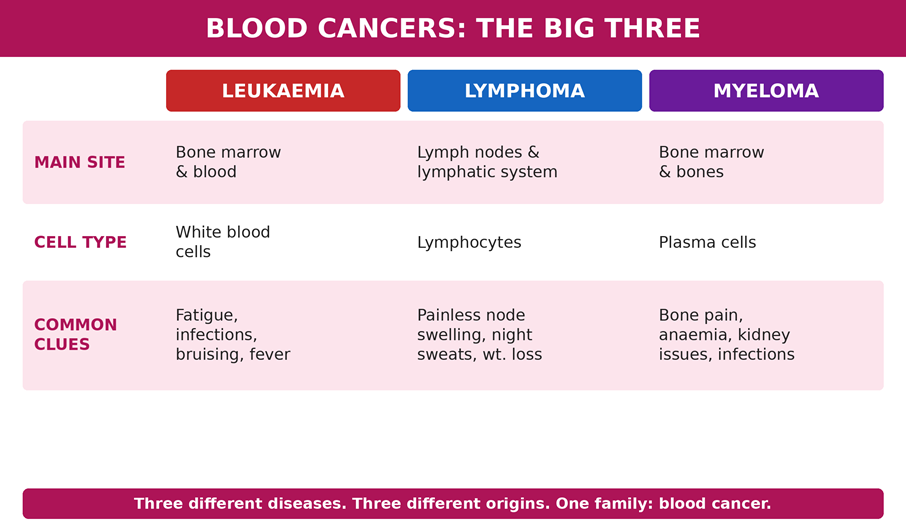
Leukaemia begins in the bone marrow and affects the blood-forming cells — most often causing the overproduction of abnormal white blood cells. Imagine a factory assembly line that starts pumping out defective parts so fast that the good parts can no longer get through. These abnormal white cells multiply rapidly and crowd out the healthy red blood cells and platelets, leaving the body unable to fight infection, carry oxygen, or clot properly.
The Two Key Classifications
Leukaemia is classified in two ways. First, by how fast it grows: acute leukaemia is fast-growing and needs immediate treatment, while chronic leukaemia develops slowly — sometimes so slowly that patients may not need treatment for years. Second, by the type of white cell affected: lymphocytic (affecting lymphoid cells) or myeloid (affecting myeloid cells). This gives the four main types: ALL (Acute Lymphoblastic), AML (Acute Myeloid), CLL (Chronic Lymphocytic), and CML (Chronic Myeloid).
Warning Signs
- Persistent fatigue and weakness (from anaemia)
- Frequent infections and unexplained fevers
- Easy bruising or bleeding (from low platelets)
- Pale skin, breathlessness, and unexplained weight loss
Lymphoma: Cancer of the Lymphatic System
Lymphoma begins in the lymphocytes — a type of white blood cell — within the lymphatic system, the network of lymph nodes, vessels, spleen, and thymus that forms a key part of the body’s immune defence. Unlike leukaemia, lymphoma often forms solid masses in the lymph nodes. Think of the lymphatic system as the body’s security network; in lymphoma, the security guards themselves turn rogue, setting up roadblocks and attacking the system from within.
The Two Main Types
Hodgkin lymphoma is identified by the presence of a specific abnormal cell called the Reed-Sternberg cell. It most often affects people aged 15 to 40 and is one of the most treatable of all cancers. Non-Hodgkin lymphoma is more common, tends to affect people over 60, and includes more than 70 different subtypes — the most common being diffuse large B-cell lymphoma (DLBCL).
Warning Signs
- Painless swelling of lymph nodes in the neck, armpit, or groin
- Drenching night sweats (soaking the bedsheets)
- Unexplained weight loss and persistent fever
- Fatigue and sometimes itchy skin
Myeloma: Cancer of the Plasma Cells
Myeloma — often called multiple myeloma because it occurs in multiple sites within the bone marrow — is a cancer of plasma cells. Plasma cells are the white blood cells that produce antibodies to fight infection. Think of plasma cells as weapon factories that normally produce targeted missiles (antibodies) against specific infections. Myeloma turns these factories into producers of useless scrap that clogs up the system. The abnormal plasma cells multiply in the bone marrow and produce harmful proteins (M proteins) that offer no immune benefit and can damage the kidneys and bones.
The CRAB Symptoms
Doctors use the mnemonic CRAB to remember the key effects of myeloma:
- C — Calcium elevation (high calcium in the blood, causing confusion, thirst, and constipation)
- R — Renal (kidney) problems, caused by the harmful proteins
- A — Anaemia, causing fatigue and weakness
- B — Bone pain or fractures, particularly in the spine, ribs, or back
Myeloma also has a slow-growing form called smouldering myeloma, which causes no symptoms and may be monitored without treatment for years, versus active myeloma, which needs prompt treatment.
The Big Three at a Glance
Symptoms You Should Not Ignore
Here is the difficult part: the symptoms of blood cancer are often vague and easily mistaken for everyday illnesses — a viral fever, ordinary tiredness, or stress. Most of the time, these symptoms do have harmless causes. But when they persist, they deserve a proper check. The key word is persistent.
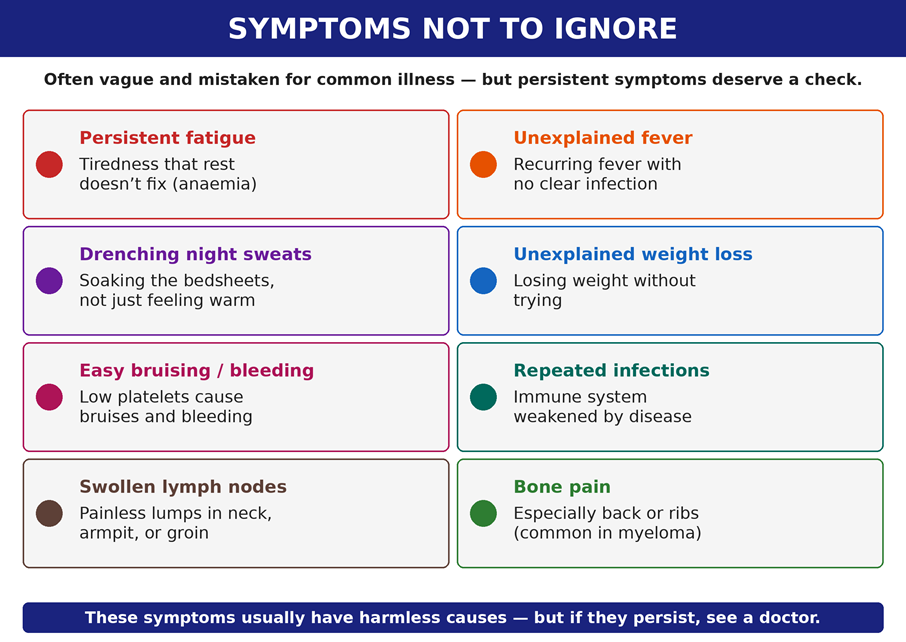
Notice that many of these symptoms overlap across all three blood cancers. That is exactly why diagnosis is never based on a single symptom — it requires a combination of clinical examination and specific tests.
How Blood Cancers Are Diagnosed
If a blood cancer is suspected, the diagnosis is built carefully from several tests — not from one symptom or one result. The journey usually begins with a simple blood test and proceeds only as far as needed:
- Complete Blood Count (CBC) — the first step; measures red cells, white cells, and platelets
- Peripheral blood smear — examining blood cells under a microscope for abnormalities
- Bone marrow test — a sample of marrow to look directly at where blood cells are made
- Lymph node biopsy — for suspected lymphoma, examining an affected node
- Flow cytometry and molecular/genetic tests — to identify the exact type and its genetic markers
- Imaging (PET-CT or CT) — to map the extent and location of disease
- Kidney, calcium, and protein tests — especially important for diagnosing myeloma
Reassurance: A blood cancer diagnosis is never made on the basis of one symptom or one abnormal blood test. It is a careful process combining clinical examination, blood tests, and — where needed — specialised marrow, biopsy, and genetic studies. This precision is what allows treatment to be tailored exactly to your specific disease.
Treatment: More Options Than Ever Before
Treatment for blood cancer depends on the exact type, the stage, the patient’s age and fitness, the genetic markers of the disease, and the symptoms. There is no single approach. Modern haemato-oncology has moved far beyond standard chemotherapy alone, and the options now include:
- Chemotherapy — still a cornerstone for many blood cancers
- Targeted therapy — drugs that attack specific molecular markers on cancer cells (for example, tyrosine kinase inhibitors that transformed CML into a manageable condition)
- Immunotherapy and monoclonal antibodies — harnessing the immune system to recognise and destroy cancer cells
- CAR T-cell therapy — a breakthrough that re-engineers the patient’s own immune cells to fight the cancer, now approved for several leukaemias, lymphomas, and myeloma
- Stem cell (bone marrow) transplant — replacing diseased marrow with healthy blood-forming cells
- Radiation therapy — used in selected lymphomas and for localised disease
- Supportive care — transfusions, antibiotics, and measures to manage symptoms and complications
The remarkable progress of the last decade means that many blood cancers that were once rapidly fatal are now treatable, and some — like chronic myeloid leukaemia — can be controlled for decades with a daily tablet. CAR T-cell therapy has produced lasting remissions in patients who had run out of other options. This is one of the most rapidly advancing fields in all of oncology.
From the Practice
“I remember a young man from Hoshiarpur, diagnosed with acute leukaemia in his twenties. The word ‘leukaemia’ terrified his family. But his specific subtype was highly treatable. After induction chemotherapy and a carefully planned treatment course, he achieved complete remission. He is now back at work, married, and living a full life. His story is not unusual — it is increasingly the rule, not the exception, when blood cancers are diagnosed early and treated by an experienced haemato-oncology team.”
The Takeaway
Blood cancers are not one disease, but a family of conditions. Understanding the difference between leukaemia, lymphoma, and myeloma helps patients recognise symptoms early, seek timely care, and approach treatment with clarity rather than fear. And there is genuine reason for hope: this is one of the most rapidly advancing areas of cancer medicine, with new targeted drugs, immunotherapies, and cellular therapies transforming outcomes year after year.
If you or a family member is experiencing persistent symptoms, or has been diagnosed with a blood cancer and wants an expert opinion, schedule a consultation with Dr Rajeev Bedi at the Fortis Cancer Institute, Mohali. Please bring any blood reports, biopsy results, and prior records for a comprehensive evaluation by the haemato-oncology team. We welcome second opinions.
About the Author
Dr Rajeev Bedi is the Director of Medical Oncology at the Fortis Cancer Institute, Mohali. He leads the precision oncology programme, with expertise spanning both solid tumours and haematological malignancies — including leukaemia, lymphoma, and myeloma. His practice integrates molecular profiling, targeted therapy, immunotherapy, CAR T-cell therapy coordination, and multidisciplinary Tumour Board care. Dr Bedi serves patients from across Punjab, Chandigarh, Haryana, Himachal Pradesh, and Jammu & Kashmir. This article was written and medically reviewed by Dr Bedi based on current clinical evidence and guidelines.
Categories
Clear allRelated Blogs
View all









FAQs
What is the difference between leukaemia, lymphoma, and myeloma?
Leukaemia starts in the bone marrow and affects white blood cells. Lymphoma starts in the lymphatic system and affects lymphocytes, often forming swellings in the lymph nodes. Myeloma affects plasma cells in the bone marrow and damages bones and kidneys. They are three different diseases within the same family.
Are blood cancers curable?
Many are highly treatable, and some are curable — it depends entirely on the specific type, subtype, and stage. Hodgkin lymphoma and certain leukaemias have excellent cure rates. Others, like myeloma, are not yet curable but can be controlled for many years. Outcomes have improved dramatically with modern therapies. Survival depends on the exact diagnosis, which is why precise testing matters.
Do swollen lymph nodes always mean lymphoma?
No. Swollen lymph nodes are usually caused by ordinary infections and are often tender. Lymphoma nodes tend to be painless, persistent, and may be accompanied by night sweats and weight loss. Any lymph node that stays swollen for more than two to three weeks should be evaluated.
What is CAR T-cell therapy?
CAR T-cell therapy is an advanced immunotherapy in which a patient’s own T-cells are collected, genetically engineered in the laboratory to recognise cancer cells, and infused back into the patient. It has produced remarkable, lasting remissions in certain leukaemias, lymphomas, and myeloma, even in patients who had exhausted other treatments.
When should I see a doctor?
If you experience persistent fatigue, unexplained fever, drenching night sweats, unexplained weight loss, easy bruising or bleeding, repeated infections, painless swollen lymph nodes, or bone pain — especially in combination and lasting more than two to three weeks — consult a doctor for a simple blood test. Early diagnosis dramatically improves outcomes.

Keep track of your appointments, get updates & more!

