
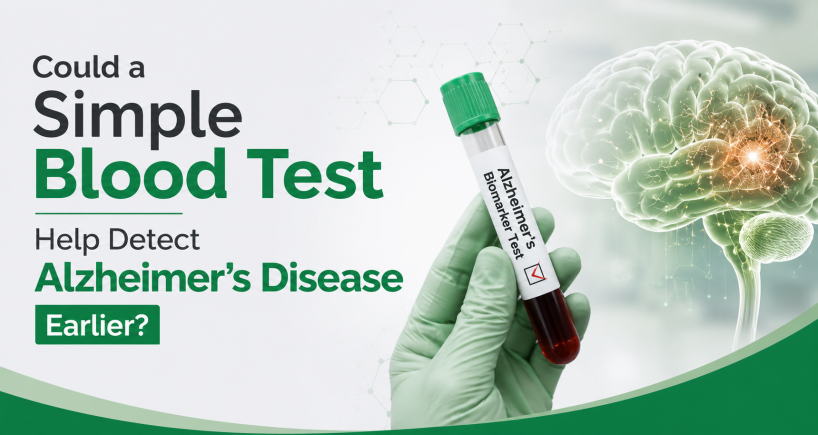


Could a Simple Blood Test Help Detect Alzheimers Disease Earlier
What the New Mispa i60 Means for Patients at Fortis Mohali
By Dr. HS Mann | Director Neurology, Fortis Hospital Mohali
For many families, Alzheimer’s disease begins quietly — a forgotten appointment, the same question asked twice in an hour, or difficulty managing money, medicines and directions that were never a problem before. At first these changes are often brushed aside as “just getting older.” But when memory or thinking problems start to interfere with everyday life, they deserve proper medical attention.
The good news is that Alzheimer’s diagnosis is no longer based on symptoms and memory tests alone. Modern medicine now looks more directly at the biology of the disease in the brain, and this has changed what we can offer patients and their families. At Fortis Hospital Mohali, the addition of the new Mispa i60 platform for advanced biomarker testing strengthens our ability to evaluate suspected Alzheimer’s disease in a more scientific, accessible and patient-friendly way.
This matters because an early and accurate diagnosis helps families plan better, avoid unnecessary delays, treat conditions that mimic Alzheimer’s, and identify patients who may benefit from newer treatment pathways when clinically appropriate.
Alzheimer’s is now understood as a biological disease
Traditionally, Alzheimer’s disease was diagnosed mainly from clinical features such as memory loss, confusion or changes in behaviour. In 2024, the Alzheimer’s Association Workgroup published revised criteria that mark an important shift: Alzheimer’s is now defined by its biology — the build-up of specific proteins in the brain, chiefly amyloid-beta plaques and abnormal tau — rather than by symptoms alone.
One consequence of this shift is that the disease process can begin years, even a decade or more, before obvious symptoms appear. That is precisely why measurable biological signals, known as biomarkers, have become so important.
It is worth being clear about what this does not mean. It does not mean that everyone who forgets a name has Alzheimer’s. Many treatable conditions can imitate memory decline, including vitamin B12 deficiency, thyroid disease, depression, poor sleep, medication side effects, stroke, Parkinsonian disorders and normal-pressure hydrocephalus. This is exactly why Alzheimer’s testing must always sit inside a full neurological assessment.
Why diagnosis has been difficult until now
For a long time, confirming the biology of Alzheimer’s required either an amyloid PET scan or cerebrospinal fluid (CSF) testing through a lumbar puncture. Both are valuable and accurate, but both have real-world limits. PET scanning is expensive and needs specialised imaging infrastructure that is simply not available in most centres. Lumbar puncture is safe when properly performed, but it is invasive and not acceptable to every patient.
Because of these barriers, biomarker confirmation was infrequent in routine practice — even though international experts now consider it central to accurate Alzheimer’s care, especially as newer amyloid-targeting therapies become available in some parts of the world. This is where blood-based biomarkers are reshaping the landscape.
The science: which blood markers matter, and why p-tau217 stands out
Blood-based biomarkers look for signs of the disease process itself. Two families of markers are most relevant.
Amyloid markers. Blood testing can measure amyloid-beta 42 and 40. The Aβ42/Aβ40 ratio is generally more informative than either value on its own. Importantly, the fold-difference between people with and without amyloid pathology is small for plasma Aβ42/40, which makes this marker more sensitive to laboratory variation — a reason it must be run carefully and interpreted cautiously.
Tau markers, especially p-tau217. Among all the blood markers studied, phosphorylated tau 217 (p-tau217) has emerged as one of the strongest. The 2024 revised criteria specifically single out accurate plasma p-tau217 as an early-changing “Core 1” biomarker that maps onto Alzheimer’s disease biology. In research studies, plasma p-tau217 assays have shown accuracy comparable to established CSF tests for identifying brain amyloid — a remarkable achievement for a simple blood draw.
The essential point for patients is this: no single number should ever be read in isolation. A biomarker result must be interpreted alongside age, symptoms, examination findings, cognitive testing and imaging. This is a structured diagnostic pathway, not a one-line “yes or no” memory test.
What is the Mispa i60, and why does it matter at Fortis Mohali?What is the Mispa i60, and why does it matter at Fortis Mohali?
The Mispa i60 is an automated immunoassay platform used for advanced laboratory testing. According to publicly available product information, the Mispa i60 is described as a fully automated analyser that supports neurodegenerative disease biomarkers, including amyloid and tau markers such as amyloid beta 1-42, amyloid beta 1-40, total tau, p-tau181 and plasma p-tau217, using a streamlined mono-test cartridge workflow with a reported turnaround time of about 30 minutes. Manufacturer material has also referenced a collaboration bringing established neurodegenerative-disease biomarker assays onto this platform.
For patients and families, the practical benefit is straightforward: a blood-based approach can make Alzheimer’s evaluation less invasive, more accessible and easier to integrate into a neurology workup than PET imaging or lumbar puncture. At Fortis Mohali, Mispa-based testing supports the neurologist by adding biological evidence to the clinical picture. It does not replace the doctor’s assessment — but it can make the diagnostic process more objective.
How accurate are these tests? An honest answer
This is the most important question, and it deserves a candid answer: not all blood biomarker tests are equally accurate. Performance varies substantially across manufacturers and platforms, and international guidelines are explicit that many commercially available tests do not yet meet the highest standards.
Expert groups have therefore defined performance benchmarks. Drawing on the Global CEO Initiative on Alzheimer’s Disease consensus (2024) and the Alzheimer’s Association Clinical Practice Guideline on blood-based biomarkers (2025), the thresholds for use in specialised care are:
- As a triaging test (used to help rule out Alzheimer’s, with positive results confirmed by CSF or PET): sensitivity of at least 90% and specificity of at least 75%.
- As a confirmatory test (used to confirm amyloid pathology without a follow-up PET or CSF test): sensitivity and specificity of at least 90%, equivalent to approved CSF tests.
In plain language: these tests are powerful when the right assay is chosen for the right patient and interpreted by the right specialist. Both guidelines stress two further points — that predictive value depends heavily on a patient’s pre-test probability of Alzheimer’s, and that a blood test should never be a standalone diagnosis. A result must always be read in the complete clinical context.
Who should consider Alzheimer’s biomarker testing?
Testing is most useful for people with objective cognitive impairment — mild cognitive impairment or dementia — where Alzheimer’s is genuinely suspected after clinical assessment, and where the result will actually change diagnosis, counselling, follow-up or treatment planning. Common reasons to seek evaluation include:
- Persistent memory complaints noticed by the person or their family
- Repeating questions or conversations
- Difficulty managing finances, medicines or appointments
- Getting lost in familiar places
- Word-finding problems that affect daily communication
- Reduced judgement, or personality and behavioural change
Who should not use this as a casual screening test?
Blood-based Alzheimer’s biomarkers are not designed for everyone. They are generally not recommended as casual screening for young people with occasional forgetfulness, people with normal memory testing, individuals who are anxious about dementia but have no objective impairment, those seeking a one-off “brain-health certificate,” or people whose symptoms point more towards depression, sleep deprivation or medication effects.
There are also specific situations where testing may not be appropriate or must be interpreted with extra caution — for example, in the presence of severe chronic kidney disease, acute brain injury, certain neurological conditions, or specific medications, all of which can affect biomarker levels. These are exactly the judgments a neurologist is trained to make.
How Fortis Mohali uses Mispa-based testing in Alzheimer’s evaluation
At Fortis Hospital Mohali, Alzheimer’s evaluation is never based on one test alone. A typical pathway includes:
- Detailed clinical history from the patient and family.
- Cognitive assessment across memory, attention, language, visuospatial ability and executive function.
- Neurological examination to look for stroke, Parkinsonism, gait disorder and other conditions.
- Routine blood tests for reversible causes, such as thyroid function, vitamin B12, blood sugar, and kidney and liver function.
- Brain imaging (MRI or CT) to identify stroke, tumours, hydrocephalus, vascular changes or atrophy.
- Mispa-based biomarker testing to add biological evidence related to amyloid and tau pathology.
- Personalised counselling for the patient and family covering diagnosis, prognosis, safety, lifestyle, medicines, follow-up and caregiver planning.
The most important principle is that a biomarker test should never be sold as a standalone diagnosis. It should be used responsibly inside a specialist-led pathway — which is precisely where a tertiary-care hospital like Fortis Mohali plays its part.
What a positive or negative result really means
A positive biomarker test may indicate that Alzheimer’s-related brain changes are present. But the meaning depends on the clinical situation. In a patient with typical memory decline and abnormal cognitive testing, a positive result increases diagnostic confidence. In someone with a low prior likelihood of Alzheimer’s, the same positive result may still need confirmation or careful follow-up, because predictive value shifts with pre-test probability.
A negative result can reduce the likelihood of Alzheimer’s, particularly when the clinical picture is not strongly suggestive of it. But a negative result does not automatically mean “nothing is wrong.” Vascular cognitive impairment, depression, sleep apnoea, vitamin deficiency, thyroid disease, medication effects, Parkinson’s disease dementia, frontotemporal dementia and normal-pressure hydrocephalus can all cause cognitive decline and may still need evaluation.
Why early diagnosis matters
Early diagnosis is not about creating fear. It is about creating clarity. When Alzheimer’s is identified early, patients and families can understand the reason for symptoms, treat reversible or contributing conditions, start appropriate memory-care medicines when indicated, plan for finances, driving, work and home safety, begin cognitive rehabilitation and lifestyle changes, and manage vascular risk factors such as diabetes, hypertension and high cholesterol. Where available and appropriate, they can also consider eligibility for newer disease-modifying therapies. As these therapies develop, biomarker confirmation of amyloid pathology is becoming increasingly important in treatment pathways.
When should you see a neurologist?
You should consult a neurologist if memory or thinking changes are persistent, progressive, noticed by family, affecting daily activities, associated with confusion, getting lost or poor judgement, accompanied by personality change, or occurring after stroke, head injury or seizures. Occasional forgetfulness can happen with stress, poor sleep and ageing — but progressive memory decline should not be ignored.
My message is simple: earlier assessment brings more clarity. If Alzheimer’s is suspected, we can help determine whether biomarker testing with the Mispa i60 platform is appropriate as part of a complete neurological evaluation.
Contact Us – Fortis Hospital Mohali
For appointments, consultations, and diagnostic services, please contact:
📞 72728 72728
Our care team will assist you with:
Doctor appointments
Diagnostic and screening services
Health check-ups
Call now to book your appointment at Fortis Hospital, Mohali.
Categories
Clear allRelated Blogs
View all







FAQs
Can a blood test alone diagnose Alzheimer’s disease?
No. Major guidelines are clear that blood biomarkers should be interpreted only as part of a full clinical work-up that includes history, examination, cognitive assessment and other relevant investigations. A blood test adds important biological evidence, but it is not a substitute for a neurological assessment.
Can a blood biomarker test replace a PET scan or CSF (lumbar puncture) test?
Only some high-performing tests can, and only in specialised care settings. Current guidance allows a blood test to substitute for PET or CSF only when it reaches roughly 90% sensitivity and 90% specificity, because performance varies widely across tests.
What is p-tau217?
P-tau217 is a form of tau protein that has become one of the strongest blood biomarkers for Alzheimer’s pathology. The 2024 revised criteria highlight accurate plasma p-tau217 among the early-changing “Core 1” biomarkers.
Is the Mispa test painful or risky?
The blood-based component requires only a routine blood sample. It is far less invasive than a lumbar puncture and more accessible than PET imaging.
If my test is positive, does that mean I definitely have dementia?
No. Alzheimer’s biology and dementia symptoms are related but not identical. A positive biomarker may indicate Alzheimer’s-related brain changes, but the clinical stage depends on symptoms, cognitive testing and functional impact.
If my test is negative, does that rule out all causes of memory loss?
No. It may reduce the likelihood of Alzheimer’s depending on the clinical situation, but many other treatable or non-Alzheimer’s causes of memory loss still need evaluation.
Should healthy people get tested just to know their risk?
Routine testing in people without objective cognitive impairment is not generally recommended outside specialist advice or research settings. Testing is most useful when symptoms are present and the result will guide clinical management.
Do I still need an MRI if I get a blood biomarker test?
Often, yes. MRI or CT can identify other causes of memory problems such as stroke, tumours, hydrocephalus or vascular changes. Blood biomarkers and imaging answer different questions.
Who should interpret the report?
A neurologist or a specialist experienced in memory disorders. Laboratory values should not be interpreted in isolation.

Keep track of your appointments, get updates & more!

