
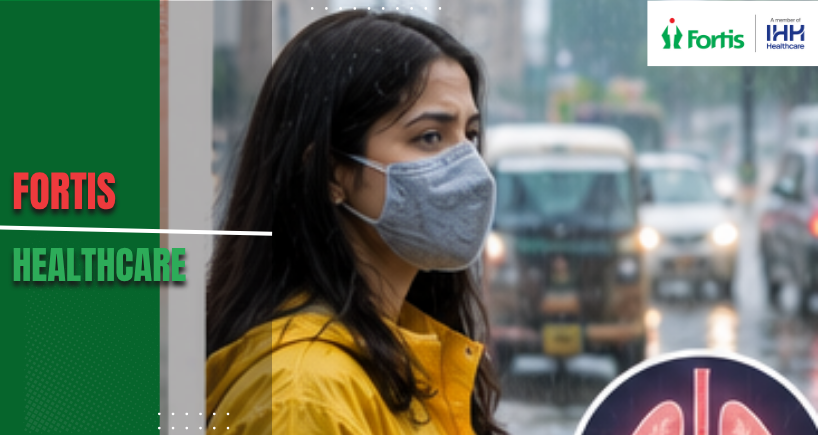


Delhi Air Pollution During Monsoon - Can It Still Affect Your Lungs?
Most Delhi residents breathe a sigh of relief when the monsoon arrives in late June or early July — the dust settles, the sky turns grey, and the AQI dips from hazardous to merely poor. But respiratory doctors at Fortis see a different story unfold every monsoon: a steady uptick in patients with worsening asthma, new-onset bronchitis, and unexplained breathlessness.
The reason is less obvious than winter smog, but just as real: monsoon air brings its own chemical cocktail of ozone, particulate matter resuspended by rain splash, traffic congestion spikes from waterlogged roads, and a surge in mould spores and airborne fungal particles from flooded ground and damp interiors. For anyone with a pre-existing lung condition — or no diagnosis at all — this season carries underappreciated risk.
⚡ Quick Takeaways
- Delhi's AQI does fall during monsoon — but rarely reaches the WHO "safe" threshold of PM2.5 ≤ 15 µg/m³.
- Rain resuspends road dust, construction dust, and biological particles, creating short-burst pollution spikes.
- Ozone levels can peak on sunny monsoon days when traffic emissions react with UV light.
- Mould and fungal spores increase indoors and outdoors — a major trigger for allergic asthma.
- Anyone with asthma, COPD, or a history of chest infections should not lower their guard in July–September.
Why Monsoon Air in Delhi Is Not as Clean as It Looks
The Central Pollution Control Board's (CPCB) real-time AQI data consistently shows that Delhi's PM2.5 and PM10 concentrations fall during monsoon compared to November–January. But "lower than winter" is not the same as "safe." CPCB and WHO data both show that Delhi's PM2.5 concentrations routinely remain above 35–60 µg/m³ even in the wettest months — two to four times the WHO annual guideline of 15 µg/m³.
Rain's air-cleaning effect lasts only while precipitation is actively falling. Within hours of a rain shower ending, traffic resumes at higher volumes on waterlogged roads, construction sites reopen, and resuspended dust — combined with moisture — creates a particulate mix that settles deeper into the airways than dry dust alone.
The Ozone Problem on Sunny Monsoon Days
Monsoon weather in Delhi is not continuous rainfall — it alternates between wet spells and humid, partly sunny days. On those sunny days, ground-level ozone forms when nitrogen oxides and volatile organic compounds from vehicle exhaust react in UV light. The 2023 CPCB annual report noted elevated ozone as one of Delhi's underreported monsoon air quality problems.
Ozone is a powerful lung irritant. Even at concentrations within "moderate" AQI bands, it triggers airway inflammation, reduces peak flow in asthma patients, and causes coughing and chest tightness in otherwise healthy adults. It cannot be seen or smelled at ambient concentrations — which is precisely why it is so frequently overlooked.
The Mould Factor: An Indoor Problem You Can't Ignore
Monsoon dramatically increases indoor and outdoor mould and fungal spore counts. Damp walls, flooded basements, wet carpets, condensation on AC units, and waterlogged soil all support rapid mould growth. Aspergillus and Cladosporium species — both common allergens and asthma triggers — spike during this season.
For people who spend 8–10 hours per day in air-conditioned offices or sealed apartments, the indoor environment is where most of their monsoon-season lung exposure happens. An AC unit that hasn't been serviced since March is likely blowing mould spores directly into the room by July.
Who Is Most at Risk During Delhi's Monsoon?
The following groups are at significantly higher risk of respiratory complications during monsoon season, and should not assume the season's lower AQI numbers mean they can reduce precautions:
- People with diagnosed asthma — mould spores and ozone are both potent bronchospasm triggers.
- Adults with COPD or chronic bronchitis — humid air and airborne irritants worsen baseline inflammation.
- Construction workers and outdoor vendors — direct exposure to resuspended dust and diesel exhaust during post-rain traffic.
- People over 60 or with heart disease — pulmonary stress from poor air quality adds to cardiovascular load.
- Children under 5 — higher respiratory rate means proportionally greater inhaled dose of pollutants.
- Anyone who recently recovered from COVID-19 or a respiratory infection — reduced baseline lung function increases sensitivity.
Symptoms That Need a Doctor, Not a Home Remedy
Monsoon respiratory symptoms are frequently self-treated as "just a seasonal cold." The following symptoms warrant a prompt medical consultation rather than over-the-counter cough syrup or antihistamines:
- Chest tightness, wheezing, or audible breathlessness — even if it eases on its own.
- A cough that has persisted for more than 2 weeks, with or without phlegm.
- Breathlessness that is disproportionate to activity — for example, difficulty climbing two flights of stairs.
- Frequent waking at night due to cough or tightness.
- Worsening of a known asthma or COPD condition that isn't responding to your usual inhaler.
- Fever with breathlessness — this could indicate a lower respiratory tract infection that needs treatment.
Practical Steps to Protect Your Lungs This Monsoon
Based on standard respiratory medicine guidelines, the following measures can reduce monsoon-related lung health risk:
At Home
- Service your air conditioner before or immediately after monsoon begins — clean or replace the filter, inspect the drainage tray for mould.
- Keep indoor humidity below 60% using a dehumidifier or by improving ventilation.
- Dry wet surfaces within 24–48 hours — mould begins colonising damp walls and fabric in under 48 hours.
- Keep windows closed during and immediately after heavy rain to prevent resuspended particulate entry.
At Work
- If your office AC has not been serviced this year, report it to your facilities team — shared AC units in enclosed offices are a significant mould spore distribution risk.
- Avoid standing near building entrances or parking areas during post-rain traffic surges — NO₂ and PM10 levels spike near ground-level vehicle exhausts.
If You Have Asthma or COPD
- Do not reduce or stop controller medications during monsoon even if you feel better — pollution triggers are still present.
- Keep a rescue inhaler accessible at all times and ensure it has not expired.
- Ask your Fortis pulmonologist about a pre-monsoon spirometry baseline so any deterioration is detectable early.
When to Visit Fortis — Don't Wait
If you have been managing mild chest symptoms at home for more than five to seven days without improvement, book a consultation rather than adding another OTC medication. Fortis Hospitals in Delhi offer pulmonology consultations, spirometry (lung function testing), and chest X-rays that give your doctor a clear picture of what is happening in your airways.
Early intervention in monsoon-related bronchitis or an asthma exacerbation typically means a faster recovery and a lower risk of progressing to pneumonia or a hospitalisation.
Categories
Clear allMeet the doctor

- Gastroenterology and Hepatobiliary Sciences | Gastroenterology | Gastroenterology and Hepatobiliary Sciences
-
 5 Years
-
 1250
1250
Related Blogs
View all
When Is A Liver Transplant Recommended?

Alcoholic Liver Disease - Why Worry?

Binge Drinking Trend Is The New Silent Killer



Irritable Bowel Syndrome

Digestive Disorders And Prevention



FAQs

Keep track of your appointments, get updates & more!

