



Ergonomic Causes of Shoulder Pain: Why Working Above Shoulder Level Slowly Wears the Shoulder Out
Many patients start the consultation the same way.
“Doctor, nothing really happened. I didn’t fall. I didn’t lift anything heavy. It just started hurting.”
Most of the time, they’re telling the truth.
There was no sudden injury.
What usually caused the pain was something far more ordinary, how the shoulder is being used every single day, especially when the arms spend long periods above shoulder level.
If your shoulder pain appears mainly after work, or slowly creeps in at night, ergonomics is often the missing piece of the puzzle.
The Shoulder Was Never Built for Prolonged Overhead Work
The shoulder is an extraordinary joint. It allows us to reach, throw, lift, rotate — movements no other joint can match.
But that freedom comes at a price.
Unlike the hip, which is a deep, stable socket designed to carry body weight, the shoulder depends heavily on muscles and tendons to stay centred. It behaves less like a solid pillar and more like a hanging bridge, strong, but only when forces are balanced.
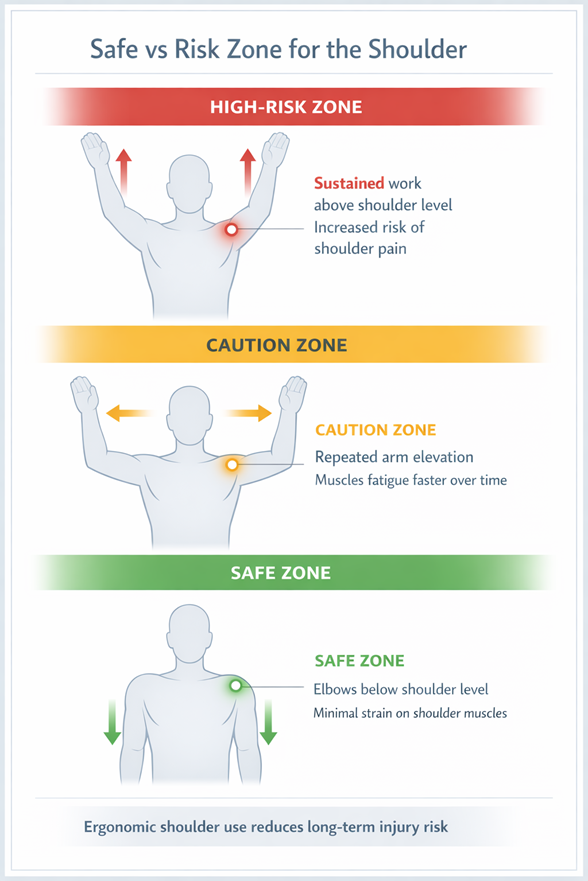
When the arm is repeatedly lifted or held above shoulder level:
- the rotator cuff muscles work constantly just to keep the joint stable
- muscle fatigue sets in much earlier than we realise
- recovery time between movements becomes inadequate
Nothing dramatic happens in one moment.
The strain simply accumulates.
This is how shoulder pain from overhead work usually begins.
Why Working Above Shoulder Level Is a Real Risk Factor
This isn’t just clinical experience; it’s supported by occupational health research.
Studies consistently show that repetitive or sustained arm elevation above shoulder height, especially beyond 90 degrees, is associated with a higher risk of shoulder pain and rotator cuff–related problems.
The risk becomes more significant when overhead work is:
- prolonged
- repetitive
- combined with force or static postures
This explains why occupational shoulder pain is so common among:
- electricians and painters
- surgeons and dentists
- gym trainers demonstrating overhead movements
- factory and assembly-line workers
Different professions.
The same shoulder mechanics.
“But I Sit at a Desk, Why Does My Shoulder Hurt?”
Office workers often find this confusing.
They may not be doing obvious overhead work, yet they still develop shoulder pain. The reason is usually static loading — screens placed slightly too high, arms held away from the body, shoulders subtly elevated for hours.
It’s not aggressive strain.
It’s low-grade, constant stress.
Over time, the same stabilising muscles that protect the shoulder begin to fatigue, and posture-related shoulder pain slowly develops.
Early Warning Signs That Are Easy to Ignore
Ergonomic shoulder pain rarely starts suddenly.
Early symptoms are usually subtle:
- discomfort that appears only by evening
- pain while dressing or reaching behind the body
- shoulder pain at night when lying on one side
- a feeling that the shoulder “tires quickly”
Because daily activities remain possible, many people ignore these signs. Unfortunately, this is when the problem quietly progresses.
Why the Pain Often Appears Late
A common question patients ask is,
“If something was wrong, why didn’t it hurt earlier?”
The shoulder compensates extremely well. Other muscles step in, movements adapt, and function continues.
By the time pain becomes constant:
- tendon overload may already be present
- muscle balance around the shoulder is disturbed
- simple posture correction alone may no longer be enough
This is why early ergonomic correction is far more effective than delayed treatment.
Simple Ergonomic Changes That Actually Help
Preventing shoulder pain at work does not require changing your profession.
Small, consistent adjustments make a real difference:
- keep frequently used objects below shoulder level
- adjust screens so elbows stay close to the body
- avoid holding the arms up for long, uninterrupted periods
- take short breaks every 30–40 minutes
- strengthen postural and scapular stabilising muscles
Most importantly, do not normalise discomfort.
Pain is feedback, not something to be pushed through.
When to See a Doctor for Shoulder Pain
Medical evaluation is advisable if:
- shoulder pain lasts more than 2–3 weeks
- pain disturbs sleep
- strength or range of motion is reducing
- pain appears even on rest days
Early assessment often prevents prolonged medication, injections, or surgical intervention.
The Real Takeaway
Shoulder pain is not always about injury or ageing.
Very often, it is about how the shoulder is used every day, especially when work demands that the arms live above shoulder level.
Respect the biomechanics early, and the shoulder usually responds well.
Fortis Clinical Perspective
Timely assessment and evidence-based treatment help prevent progression of shoulder problems and allow patients to return safely to daily activities and work.
Categories
Clear allMeet the doctor

- Orthopaedics | Robotic and Computer navigated Joint reconstruction | Sports Medicine | Orthopaedics | Orthopaedics and Joint Replacement
-
 12 Years
-
 1500
1500
Related Blogs
View all









FAQs

Keep track of your appointments, get updates & more!

