
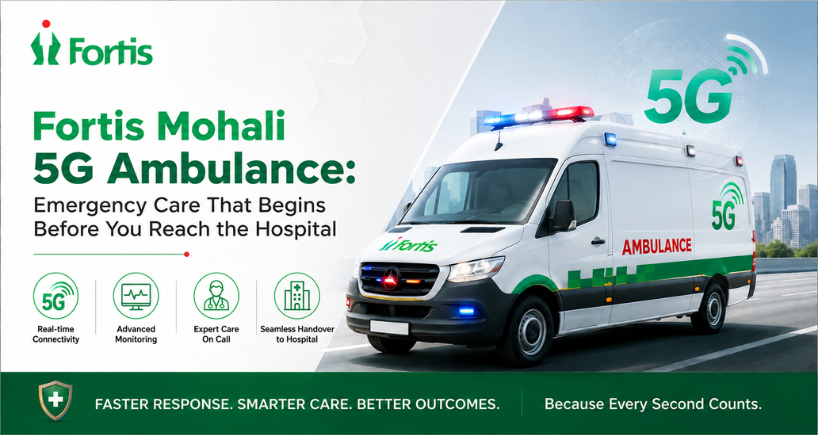


Fortis Mohali 5G Ambulance: Emergency Care That Begins Before You Reach the Hospital
By Dr Manoharan Rajan Gottra Head, Emergency Medicine | Fortis Hospital, Mohali
For emergency ambulance support, call: 98720 22222
When the Ambulance Becomes the Emergency Room
In a cardiac arrest, you have 4 minutes before irreversible brain damage begins. In a stroke, 1.9 million neurons die every minute treatment is delayed. In major trauma, survival drops by 10% for every 10 minutes without definitive care. The ambulance is not just transport. It is the first link in the survival chain — and the quality of care delivered inside it can be the difference between life and death, between full recovery and permanent disability.
Most ambulance services in India operate as transport vehicles: a driver, a basic attendant, oxygen, and a stretcher. The patient is loaded, driven to the nearest hospital, and care begins only after arrival. For a heart attack, a stroke, or a spinal injury, those minutes in transit — spent without monitoring, without stabilisation, without specialist guidance — are minutes of damage that no hospital can undo.
Fortis Hospital Mohali has built a fundamentally different model. The only hospital in the Chandigarh–Mohali–Panchkula region with a 5G-enabled ambulance, staffed by a qualified EMT and a doctor, equipped with ICU-level life support, and connected in real time to the Fortis Mohali Emergency Room. When our ambulance reaches you, the Emergency Room has already reached you.
The 5G Advantage: The ER Comes to You
What does 5G change? Everything that matters in an emergency.
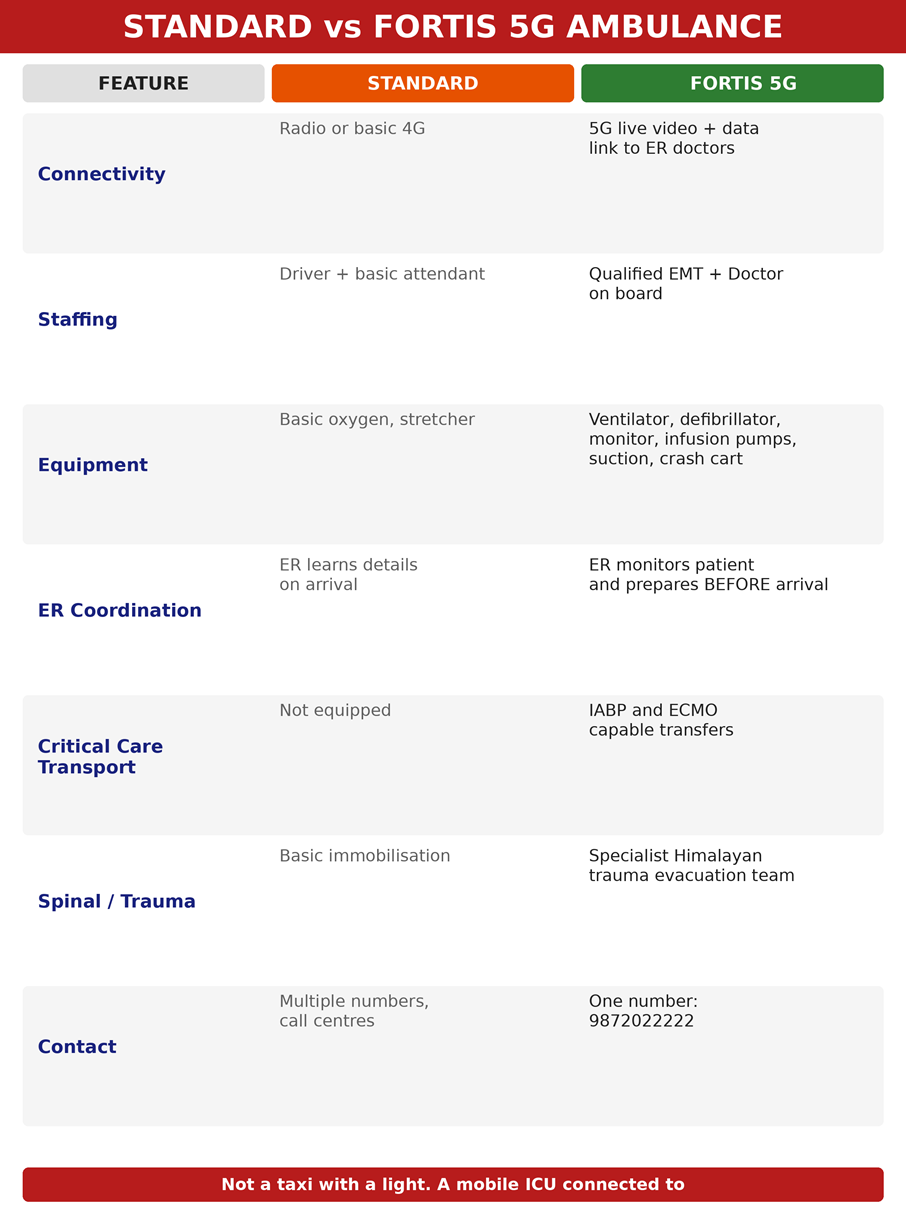
Standard ambulances operate in isolation. The crew treats the patient based on their own assessment, and the ER has no idea what is coming until the ambulance doors open. The 5G ambulance eliminates this information gap entirely. High-definition cameras inside the ambulance stream live video directly to the ER physician’s screen. Patient vitals — ECG, blood pressure, oxygen saturation, respiratory rate — are transmitted continuously. The ER doctor sees what the EMT sees, hears the patient, and speaks directly to the crew.
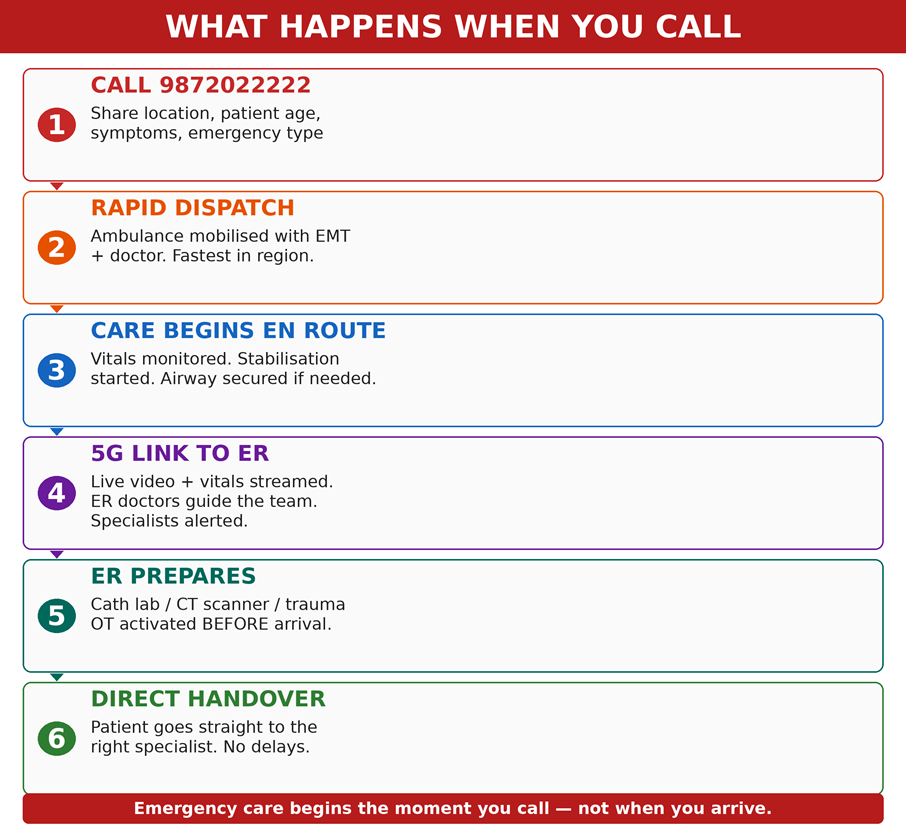
The result: triage and treatment decisions happen in real time during transit, not after arrival. For a STEMI (heart attack), the ECG is transmitted en route — the cardiologist reads it, confirms the diagnosis, and activates the cath lab. When the ambulance arrives, the patient bypasses the ER triage entirely and goes straight to the catheterisation laboratory for emergency angioplasty. For a stroke, the neurologist can perform a video assessment inside the ambulance, the CT scanner is ready and waiting, and the thrombolysis or thrombectomy team is already scrubbed. Door-to-needle time collapses. Brain is saved.
The 5G link transforms the paramedic from an isolated responder into the physical hands of the specialist sitting in the hospital command centre.
Not Just a Driver — A Doctor On Board
Most ambulances in India send a driver and a basic attendant. In a cardiac arrest, that attendant cannot intubate, cannot cardiovert, cannot decompress a tension pneumothorax, and cannot start vasopressors. A doctor can. Every emergency deployment of the Fortis Mohali 5G ambulance is staffed by a qualified Emergency Medical Technician and a doctor. This is not an upgrade — it is the standard.
A doctor on board means the patient’s airway can be secured, emergency medications can be administered at precise doses through infusion pumps, cardiac rhythms can be interpreted and treated, and clinical decisions can be made in transit rather than deferred to arrival. Combined with 5G connectivity to the ER, this creates a pre-hospital care system where the patient is effectively in the Emergency Department from the moment the ambulance arrives at the scene.
A Clinical Arsenal, Not Just an Ambulance
The equipment inside the Fortis Mohali 5G ambulance is designed for one purpose: to deliver ICU-level care on wheels.
- Ventilator — for respiratory failure, head injury, cardiac arrest, or any patient who cannot breathe independently
- Defibrillator with pacing capability — for life-threatening cardiac arrhythmias, ventricular fibrillation, and cardiac arrest
- Multiparameter monitor — continuous tracking of ECG, blood pressure, oxygen saturation, respiratory rate, and ETCO₂
- Infusion pumps — for precise administration of emergency medications: vasopressors, antiarrhythmics, sedation, analgesics
- Suction machine — critical for airway protection in unconscious, vomiting, or bleeding patients
- Emergency crash cart — full complement of emergency medications and disposables
- 5G cameras and data link — live video and telemetry streamed to the Emergency Room in real time
- Spinal immobilisation equipment — specialised boards, cervical collars, and vacuum splints for trauma and spinal injury patients
Cardiac and Stroke Emergencies: Where Every Minute Counts
Heart Attack (STEMI)
In a suspected heart attack, the 12-lead ECG recorded inside the ambulance is transmitted via 5G to the cardiologist. If STEMI is confirmed, the cath lab team is activated before the ambulance reaches the hospital. The patient goes directly from the ambulance to the catheterisation table. Door-to-balloon time — the interval between hospital arrival and coronary artery opening — is compressed because the diagnostic phase happened in transit.
Stroke (Brain Attack)
In a suspected stroke, the ambulance crew documents the time of symptom onset (critical for treatment eligibility), monitors vitals, and the 5G link allows the neurologist to perform a preliminary video assessment while the patient is still in transit. The CT scanner and stroke intervention team are activated. When the patient arrives, imaging begins immediately and treatment — thrombolysis or mechanical thrombectomy — starts without the delays that destroy brain tissue.
In a cardiac arrest, the 5G ambulance can activate the cath lab 15 minutes before the patient arrives. In a stroke, those 15 minutes can be the difference between walking out of the hospital and never walking again.
Advanced Critical-Care Transfers: IABP and ECMO
Some patients cannot be moved by a standard ambulance because their heart or lungs have already failed. They are alive only because of machines — and disconnecting those machines for even a few minutes could be fatal.
IABP (Intra-Aortic Balloon Pump): Used for patients in cardiogenic shock after a massive heart attack or cardiac surgery. The balloon pump inside the aorta mechanically supports the failing heart. Transporting these patients requires dedicated power backup, specialised shock-absorbing stretchers, and a team that includes an intensivist and a perfusionist.
ECMO (Extracorporeal Membrane Oxygenation): The most advanced life support available — a machine that oxygenates the blood outside the body when both the heart and lungs have failed. ECMO transport is one of the most complex logistical challenges in critical care. Fortis Mohali’s team can retrieve a patient on ECMO from another facility and bring them in without interrupting support.
We do not wait for the patient to stabilise. We bring the stabilisation to the patient.
Himalayan Trauma: Spinal Injury and Evacuation from the Hills
Fortis Mohali serves a unique geographic role. Sitting at the gateway to the Himalayas, it is the first major quaternary care centre for patients evacuated from Himachal Pradesh, the Punjab hills, Uttarakhand border regions, and J&K.
Spinal injury patients from road accidents, falls, and mountain injuries require meticulous handling. Incorrect movement can worsen neurological damage permanently. The Fortis Mohali evacuation team carries specialised spinal immobilisation equipment including vacuum splints that contour to the patient’s body and absorb road vibrations during transport. The crew is trained in extraction and log-roll protocols that protect the spinal cord during every stage of the journey.
Polytrauma patients — head injury, chest injury, fractures with haemorrhagic shock — require simultaneous stabilisation of multiple organ systems during transport. A basic ambulance cannot do this. A doctor-staffed, ventilator-equipped, 5G-connected critical-care ambulance can.
What Happens When You Call 9872022222
When Should You Call an Ambulance?
Do not self-drive to the hospital in any of these situations. Call 9872022222 immediately:
- Chest pain, sweating, and breathlessness — suspected heart attack
- Face drooping, arm weakness, speech difficulty — suspected stroke
- Road traffic accident or fall from height
- Suspected spinal injury — do not move the patient; call and wait
- Loss of consciousness or seizure
- Severe bleeding that cannot be controlled
- Severe difficulty breathing or choking
- Sudden weakness or paralysis on one side
- Severe allergic reaction (anaphylaxis)
- High-risk pregnancy emergency
Patient on ventilator, IABP, or ECMO needing transfer between hospitals
Coverage Area
Chandigarh, Mohali, and Panchkula (Tricity): Fastest dispatch and response in the region.
Punjab and Haryana: Full coverage for emergency transfers and medical evacuations.
Himachal Pradesh, J&K, and Uttarakhand border regions: Specialised trauma and spinal injury evacuation from hill and mountain routes.
Inter-hospital critical-care transfers: ICU-to-ICU transfers for ventilated, IABP, and ECMO patients from any location.
In a medical emergency, do not wait. Do not self-drive. Call Fortis Mohali Ambulance: 9872022222 Save this number. Share it with your family.
About the Author
Dr Manoharan Rajan Gottra is the Head of Emergency Medicine at Fortis Hospital, Mohali. He leads the hospital’s Emergency Department and pre-hospital emergency response system, including the 5G ambulance service, critical-care transfers, and Himalayan trauma evacuation programme. Under his leadership, Fortis Mohali’s Emergency Department operates 24×7 with advanced cardiac, stroke, and trauma response capabilities, supported by real-time 5G connectivity between the ambulance and the ER.
Disclaimer: This article is for educational and awareness purposes. In a medical emergency, call 9872022222 immediately. ECMO and IABP transfers are subject to clinical assessment, team availability, and distance. Do not move a suspected spinal injury patient — call for help and wait.
Categories
Clear allRelated Blogs
View all
Witnessed An Accident? What To Do Before Medical Help Arrives

Fortis Emergency Services: When Saving Lives Is At Stake

The Emergency experience: Navigating the space between order and chaos

Understanding Heat Exhaustion vs. Heat Stroke: When to Seek Emergency Care

Beat the Heat: Preventing Heat Strokes and Recognizing Warning Signs


FAQs
What is Fortis Mohali’s emergency ambulance number?
For emergency ambulance support, call 9872022222. One number. Available 24×7.
What is a 5G ambulance?
A 5G ambulance transmits live video, patient vitals, and monitoring data to the hospital Emergency Room in real time during transit. This allows ER doctors to assess the patient, guide the ambulance team, and prepare the hospital — all before the ambulance arrives. Fortis Mohali is the only hospital in the region with this capability.
Does Fortis send a doctor in the ambulance?
Yes. Emergency deployments of the 5G ambulance are staffed by a qualified EMT and a doctor — not just a driver and attendant. This enables advanced interventions including intubation, defibrillation, medication administration, and clinical decision-making during transit.
Can the ambulance handle patients on ECMO or IABP?
Yes. Fortis Mohali supports specialised critical-care transfers for patients on IABP and ECMO, with dedicated teams including an intensivist, perfusionist, and trained nursing staff. These are not routine transfers — they require ICU-level coordination and continuous monitoring.
Does Fortis handle trauma evacuations from the hills?
Yes. The team has extensive experience in spinal injury, polytrauma, and critical-care evacuations from Himachal Pradesh, Punjab hills, and J&K — including difficult terrain and long-distance transfers where specialised immobilisation and monitoring are essential.
How fast is the ambulance dispatched?
Fortis Mohali operates the fastest dispatch system in the region, with a dedicated response-ready fleet, GPS-optimised routing, and pre-positioning protocols. The ambulance is mobilised within minutes of your call.

Keep track of your appointments, get updates & more!

