


Frozen Shoulder - Why Waiting Makes It Worse and How Early Care Can Reduce the Suffering
Most frozen shoulder stories begin the same way.
The pain starts quietly.
At first, it’s manageable during the day.
It’s the nights that become unbearable.
Patients often tell me,
“Doctor, din mein kaam ho jaata hai. Raat ko neend hi nahi aati.”
They are then reassured, usually with good intentions -
“Frozen shoulder hai. Theek ho jayega. Time lagta hai.”
And so, they wait.
What no one explains clearly enough is this:
frozen shoulder is not dangerous, but delay is costly.
Frozen Shoulder Is a Timing Problem, Not Just a Shoulder Problem
Frozen shoulder, also called adhesive capsulitis, is often described as a condition that “runs its course.”
That statement is technically true, but clinically incomplete.
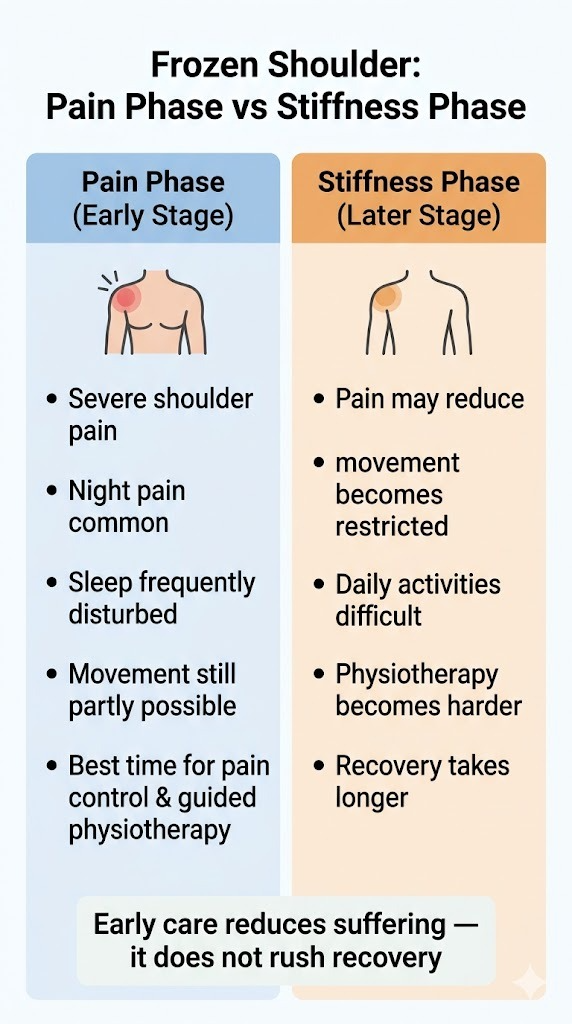
Frozen shoulder progresses through phases. Early on, pain dominates. Later, stiffness takes over and movement becomes increasingly restricted.
The common mistake patients make is assuming that waiting is neutral.
It isn’t.
Waiting doesn’t pause frozen shoulder.
It quietly allows stiffness to settle in.
Think of frozen shoulder like missing a train.
If you catch it early, the journey is uncomfortable but manageable.
If you miss it, you end up waiting much longer than necessary.
The Part No One Warns You About: Sleepless Nights
One of the most consistent and distressing features of frozen shoulder is night pain.
Many patients manage somehow during the day by adjusting their movements. Nights are different. Pain wakes them repeatedly. Sleep becomes fragmented. Energy drops.
And poor sleep changes everything.
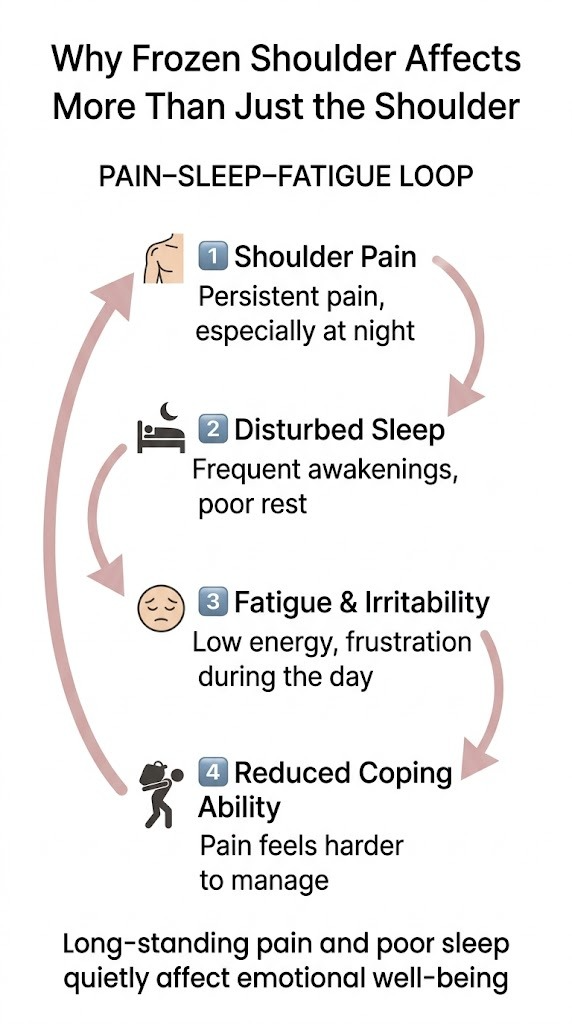
Pain disturbs sleep.
Poor sleep increases pain sensitivity.
A vicious cycle slowly forms.
This is why frozen shoulder doesn’t just hurt, it exhausts.
“Doctor Ne Bola Theek Ho Jayega” — And the Patient Feels Alone
This is where the Indian context matters.
When a doctor says, “time lagega, theek ho jayega,” families often stop taking the problem seriously. There is no plaster, no surgery, no visible injury, so the suffering is easy to dismiss.
But the patient continues to struggle.
Not with dramatic tasks, but with everyday life:
- lifting a bucket in the bathroom
- hanging wet clothes
- reaching overhead shelves
- holding onto a bus or metro handle
- managing routine household work
Because these are expected to be “normal,” patients hesitate to complain. Over time, frustration builds. Irritability creeps in. They feel guilty for needing help.
This emotional fatigue is not weakness.
It is the result of long-standing pain, disturbed sleep, and not being believed.
Why Early Treatment Matters
Early treatment does not magically cure frozen shoulder.
What it does is far more realistic — and far more important.
When frozen shoulder is recognised early, treatment can:
- reduce pain
- improve sleep
- allow better participation in physiotherapy
- help preserve shoulder movement
Pain is easier to manage than stiffness.
Stiffness, once established, takes much longer to reverse.
This is why patients who seek help early often cope better — even though recovery still takes time.
Early care doesn’t rush nature.
It reduces unnecessary suffering.
Why Waiting Often Backfires
Many patients wait until pain reduces on its own — only to realise later that shoulder movement has become severely restricted.
By then:
- sleep debt has accumulated
- frustration has set in
- physiotherapy feels harder, not easier
- recovery becomes slower
This is the waiting trap of frozen shoulder.
The condition may eventually improve, but the journey becomes longer and more isolating than it needed to be.
What Early, Evidence-Based Care Actually Looks Like
Early management of frozen shoulder is usually simple and conservative.
It focuses on:
- confirming the diagnosis
- controlling pain
- stage-appropriate physiotherapy
- maintaining movement without forcing it
Equally important is acknowledging the patient’s experience and setting realistic expectations.
Frozen shoulder requires patience, not neglect.
When You Should See a Doctor
Medical evaluation is advisable if:
- shoulder pain lasts more than a few weeks
- night pain disturbs sleep
- routine daily activities become difficult
- shoulder movement is progressively reducing
Early assessment often prevents prolonged suffering later.
The Real Takeaway
Frozen shoulder rarely threatens life.
But months of pain, poor sleep, and reduced independence quietly affect quality of life and emotional well-being.
If there is one message to remember, it is this:
Frozen shoulder isn’t about how long it lasts, it’s about when you act.
Categories
Clear allMeet the doctor

- Orthopaedics | Robotic and Computer navigated Joint reconstruction | Sports Medicine | Orthopaedics | Orthopaedics and Joint Replacement
-
 12 Years
-
 1500
1500
Related Blogs
View all





FAQs

Keep track of your appointments, get updates & more!

