
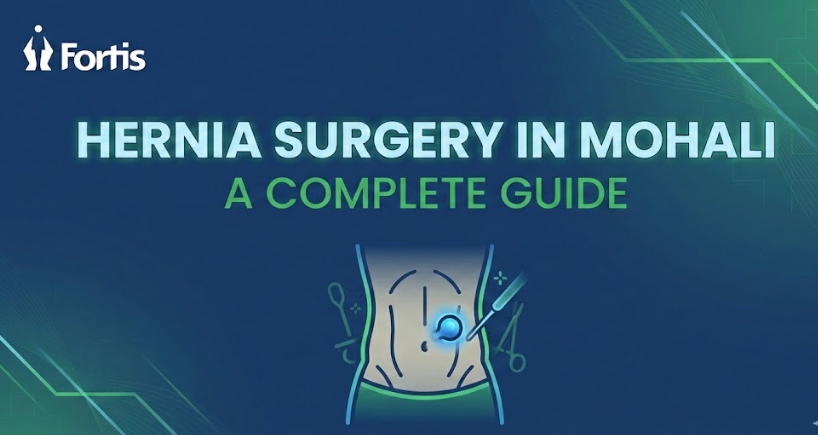


Hernia Surgery in Mohali: A Complete Guide to Diagnosis, Treatment, and Recovery
By Dr. Atul Sharma Joshi, Director of General, Laparoscopic & Robotics Surgery, Fortis Hospital, Mohali. As the most experienced surgeon for hernia surgery in the Tricity and Chandigarh region with extensive expertise in minimally invasive techniques, Dr. Joshi reviews this guide to empower patients with clear, evidence-based information.
Introduction
Receiving a hernia diagnosis can feel overwhelming, especially when daily activities like lifting or coughing bring discomfort. A hernia happens when an organ or tissue pushes through a weak spot in the surrounding muscle or connective tissue, often in the abdomen. While not always painful at first, hernias rarely resolve on their own and can lead to serious issues if ignored. This guide explains everything from causes to cutting-edge treatments like robotic hernia repair, helping you make informed decisions about hernia surgery in Mohali.
Hernia Anatomy and Causes
Think of your abdominal wall as a sturdy fence protecting vital organs like the intestines. A hernia forms when a defect—a gap or tear—in that fence allows tissue to bulge out, like a bubble in a tire. It's not a true "hole" through the skin but a weakness in the deep muscle layers.
Causes fall into two main groups:
- Congenital: Present from birth, due to incomplete muscle closure during development (common in inguinal hernias).
- Acquired: Develop later from factors like heavy lifting, chronic coughing, obesity, pregnancy, or prior surgery straining the area.
Types of Hernias
Hernias vary by location and risk:
- Inguinal Hernia: Most common (75% of cases), in the groin; more frequent in men as spermatic cord pathways weaken.
- Umbilical Hernia: Near the belly button, often in infants or obese adults.
- Incisional Hernia: At surgical scar sites, affecting 2-10% of abdominal operations.
- Hiatal Hernia: Upper stomach pushes through the diaphragm (less surgical unless symptomatic).
- Femoral and Ventral: Rare but higher strangulation risk in thigh or abdominal midline.
The "Watch and Wait" Myth
Many hear "watch and wait" for small, painless hernias, but this overlooks dangers. Delaying risks strangulation, where bulging tissue loses blood supply, causing severe pain, nausea, and emergency surgery with worse outcomes. Elective repair prevents this, with recurrence under 5% using modern methods. Early intervention restores normal life faster.
Treatment Innovations: 2026 Standards
Surgery remains the gold standard, tailored to hernia size, location, and patient health. Here's how options compare:
Surgery Type | Incisions | Anesthesia | Hospital Stay | Best For
Open Repair | One 4–6 inch cut | General/Regional | 1–2 days | Large/complex hernias, emergencies
Laparoscopic | 3–4 tiny ports (0.5–1 cm) | General | Same-day or overnight | Most elective cases; faster recovery
Robotic (da Vinci Xi) | Same as laparoscopic | General | Same-day | Precision needs: obese patients, recurrences; 3D HD vision, wristed instruments reduce tremor
Open Repair Surgery
Open hernia repair is the traditional approach, used for over a century and still ideal for certain cases. Surgeons make a single incision (4-6 inches) directly over the hernia site under the skin, allowing direct visualization of the defect. The protruding tissue or organ is gently pushed back into place, the weakened muscle edges are sewn together for tension-free closure, and a synthetic mesh patch is often laid over the area like a reinforcing bandage to distribute strain and lower recurrence risk to under 5%. This method suits large hernias, emergencies like strangulation, or patients unfit for general anesthesia, as it works with spinal or local numbing. Recovery involves more initial pain and a larger scar, but it's straightforward with proven long-term results.
Laparoscopic Surgery
Laparoscopic hernia repair marks a minimally invasive leap forward, using 3-4 small incisions (0.5-1 cm each) for ports that insert a camera and tools into the abdomen after inflating it with carbon dioxide gas for space. Surgeons operate via a high-definition monitor, guiding instruments to reposition hernia contents, repair the defect (often via TEP or TAPP techniques—Totally Extra-Peritoneal or Transabdominal Pre-Peritoneal), and secure mesh inside the abdominal wall. Benefits include less tissue trauma, 50% reduced pain, same-day or overnight discharge, quicker return to work (1-2 weeks), and tiny scars. It's perfect for bilateral or recurrent inguinal hernias in fit patients under general anesthesia, though it demands surgical expertise to avoid rare bowel injury risks (<1%).
Robotic-Assisted Surgery (da Vinci Xi)
Robotic hernia repair builds on laparoscopy with advanced robotics, employing the same small ports but controlling a console with wrist-like instruments attached to robotic arms. The surgeon manipulates joysticks for precise 3D magnified views (up to 10x zoom), filtered tremors, and scaled-down movements for utmost delicacy—crucial for obese patients, recurrent hernias, or complex ventral/incisional cases. Mesh placement is flawless, filtration of motion prevents slips, and ergonomics reduce surgeon fatigue for better outcomes. At Fortis Hospital Mohali, first in the region to offer da Vinci Xi robotic hernia repair, this technology offers outcomes matching laparoscopy but with even less pain (up to 50% reduction), minimal blood loss, and faster recovery. It's the 2026 gold standard for precision-driven procedures, though availability suits elective cases.
Mesh Technology: Safer Than Ever
Mesh—a flexible synthetic or biologic patch—reinforces the repair like patching a tire. Modern 3D lightweight mesh (e.g., partially absorbable) flexes with muscles, reducing chronic pain (from 20% in old heavy meshes to <5%). Fixed with tacks, glue, or sutures; infection risk under 1%.
Recovery Timeline
Recovery focuses on gentle progression:
- Day 1: Walk short distances; pain meds control discomfort.
- Week 1: Light activities; no driving until off strong painkillers (usually 48 hours post-laparoscopic).
- Weeks 2-4: Resume desk work, driving; shower freely.
- Weeks 4-6: Normal activities; avoid gym/heavy lifting.
- 3+ Months: Full strength training if cleared.
Follow-up ensures smooth healing; transparent financial counseling available.
Frequently Asked Questions
Can I drive home after laparoscopic surgery recovery? Often yes for short trips if local anesthesia used; otherwise, arrange a ride.
Is hernia surgery covered by insurance? Most policies cover medically necessary repairs; check with your provider.
Will I feel the mesh? Rarely, as modern versions integrate seamlessly.
Robotic surgery safer? Matches laparoscopic outcomes but shines in precision for tough cases.
When to call the doctor post-op? Fever, worsening pain, redness, or bulge return.
Diet after surgery? Light foods first; high-fiber prevents constipation straining the repair.
For personalized advice on hernia surgery in Mohali, consult Dr. Atul Joshi at Fortis Hospital, Mohali. Schedule via fortismohali.com or call for expert evaluation.
Categories
Clear allMeet the doctor

- General Surgery | General Surgery | General and Laparoscopic Surgery | General and Minimal Access Surgery | Breast Surgery
-
 27 Years
-
 950
950
Related Blogs
View all
Single Incision Laparoscopic Surgery (SILS) for Hernia Repair


Understanding Gallbladder Stones: Causes, Symptoms, and Treatment Options

Understanding Hernia - Causes, Symptoms, and Treatment Options

Gallstone Complications: When to Seek Medical Attention

Common Myths and Misconceptions About Bariatric Surgery

Understanding Appendicitis: Causes, Symptoms, Risk Factors & Treatment
Understanding Varicose Veins: Causes, Symptoms, Risk Factors & Treatment Options


Keep track of your appointments, get updates & more!

