
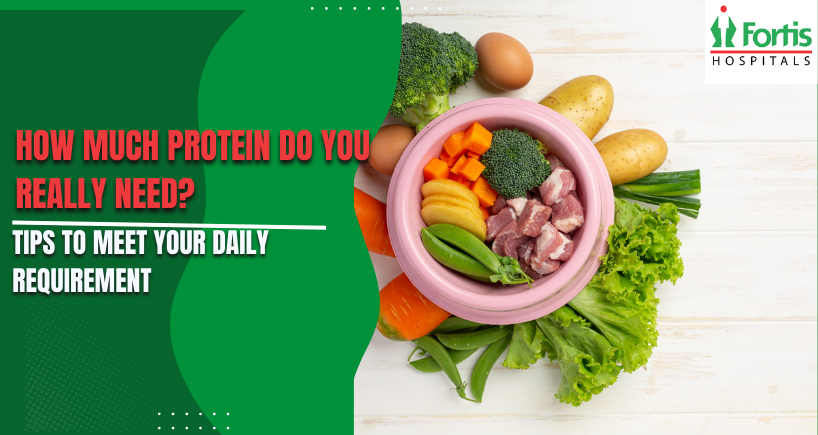


How Much Protein Do You Really Need? Tips to Meet Your Daily Requirement
In the world of nutrition, few topics are as widely discussed; and as widely misunderstood as protein. We are surrounded by messages about it. High-protein diets are promoted for weight loss, bodybuilders are seen chugging protein shakes, and every new snack on the market seems to boast about its protein content. This constant buzz can create a great deal of confusion, leaving many people asking a very fundamental question: How much protein per day do I actually need?
The truth is, there is no single, magic number that applies to everyone. Your ideal protein intake is not a one-size-fits-all prescription. It is a dynamic figure that depends on a host of factors, including your age, your body weight, your activity level, and your overall health goals. This guide is here to help you cut through the noise, understand the science, and determine the right protein requirement per day for you, along with practical tips to meet that goal effectively.
Why Is Protein So Essential?
Before we can answer "how much," we need to understand "why." Protein is a macronutrient, and its role in the body goes far beyond just building muscle. It is often called the "building block of life" for a very good reason. Every single cell in your body contains protein, and it is essential for a vast array of critical functions.
Repair and Maintenance: Protein is the primary tool your body uses to build and repair tissues. From a minor cut on your finger to the muscle fibers you break down during exercise, protein provides the raw materials for healing and growth.
Enzymes and Hormones: Many of the body's essential enzymes, which facilitate countless chemical reactions, and hormones, which act as chemical messengers, are made from protein.
Immune Function: The antibodies that your immune system uses to identify and fight off bacteria and viruses are specialized proteins.
Structure: Protein provides the structural framework for your body. Your hair and nails are made primarily of a protein called keratin, and collagen provides the structure for your skin, bones, and connective tissues.
Satiety and Weight Management: Protein is the most satiating of the three macronutrients. Including an adequate amount of protein in your meals can help you feel fuller for longer, which can be a powerful tool for managing appetite and supporting weight loss goals.
The Big Question: How Much Protein Should I Eat Per Day?
Now, let's tackle the central question. The answer can be broken down into a baseline recommendation and then adjusted based on your individual circumstances.
The Baseline Recommendation
The standard guideline for a healthy but sedentary adult is the Recommended Dietary Allowance (RDA). The RDA for protein is 0.8 grams of protein per kilogram of body weight.
It is important to understand that the RDA is defined as the minimum amount you need to eat to meet your basic nutritional requirements and prevent a deficiency. It is not necessarily the optimal amount for everyone, especially those who are more active.
How to Calculate Your Baseline Need:
Find your weight in kilograms. If you know your weight in pounds, simply divide by 2.2. (e.g., 150 lbs / 2.2 = ~68 kg)
Multiply your weight in kilograms by 0.8. (e.g., 68 kg x 0.8 g/kg = ~54 grams of protein per day)
For a relatively sedentary 150-pound adult, their minimum daily protein requirement would be about 54 grams.
When You Need More Than the Minimum
For many people, the optimal protein intake is significantly higher than the RDA. Here are the key groups who benefit from a higher protein requirement per day:
Active Individuals and Athletes: If you exercise regularly, your protein needs increase. Exercise creates tiny micro-tears in your muscle fibers, and protein is required to repair this damage and build the muscle back stronger. For this group, a range of 1.2 to 2.0 grams of protein per kilogram of body weight is often recommended.
Older Adults: As we age, we naturally begin to lose muscle mass, a condition known as sarcopenia. A higher protein intake can help to counteract this process, preserving muscle strength and functional independence. Many experts recommend that adults over 65 aim for 1.0 to 1.2 grams of protein per kilogram of body weight.
Individuals Aiming for Weight Loss: When you are in a calorie deficit, a higher protein intake is crucial for two reasons. First, it promotes satiety, helping you feel full and manage hunger. Second, it helps to preserve your lean muscle mass, ensuring that the weight you lose is primarily fat, not muscle. A range of 1.2 to 1.6 grams per kilogram is often beneficial.
Spacing It Out: Why Timing Matters
It is not just about the total how much protein per day you consume; it is also about how you distribute it. Your body can only use a certain amount of protein for muscle synthesis at any one time. Think of it like trying to water a plant. If you dump a whole bucket of water on it at once, most of it will run off. If you water it steadily throughout the day, the soil can absorb it all.
For this reason, it is more effective to spread your protein intake evenly across your meals. Aiming for 20-30 grams of protein per meal is a great strategy for maximizing your body's ability to use it for repair and maintenance throughout the day.
Practical Tips to Meet Your Daily Requirement
Knowing your target is one thing; hitting it is another. Here are some simple, effective strategies to boost your protein intake.
Anchor Every Meal with Protein: Make a high-quality protein source the centerpiece of your breakfast, lunch, and dinner. This could be eggs or Greek yogurt for breakfast, chicken or lentils in a salad for lunch, and fish or tofu for dinner.
Choose High-Quality Sources: Focus on complete proteins, which contain all nine essential amino acids. Animal sources like meat, poultry, fish, eggs, and dairy are all complete. Plant-based complete proteins include quinoa, soy products (tofu, tempeh, edamame), and buckwheat.
Snack Smart: Swap out carbohydrate-heavy snacks for protein-rich alternatives. A handful of almonds, a small tub of Greek yogurt, a hard-boiled egg, or some edamame are all excellent choices that will keep you full between meals.
Don't Forget Plant Power: A high-protein diet does not have to be a high-meat diet. Legumes like lentils, beans, and chickpeas are fantastic sources of protein and fiber. Tofu, tempeh, and seitan are versatile plant-based powerhouses.
Consider a Supplement for Convenience: Protein powder can be a convenient tool, but it should be seen as a supplement, not a replacement for whole foods. A scoop of whey, casein, or a plant-based protein powder in a smoothie can be an easy way to boost your intake, especially after a workout.
Frequently Asked Questions
Q1. Can you eat too much protein?
Ans. For healthy individuals with normal kidney function, a high-protein diet is generally considered safe. However, extremely high intakes can put a strain on the kidneys in people with pre-existing kidney disease. It is also important to stay well-hydrated when consuming a lot of protein.
Q2. Do I need protein shakes to build muscle?
Ans. No. Protein shakes are a convenient way to get a high dose of protein quickly, but they are not magical. You can absolutely meet your protein needs and build muscle effectively by consuming high-quality protein from whole food sources like chicken, fish, eggs, dairy, and legumes.
Q3. How do I calculate my protein needs in kilograms if I only know my weight in pounds?
Ans. The conversion is simple. There are approximately 2.2 pounds in 1 kilogram. To find your weight in kilograms, just divide your weight in pounds by 2.2. For example, if you weigh 175 pounds, your weight in kilograms is 175 / 2.2 = 79.5 kg.
Q4. Can I get enough protein on a vegetarian or vegan diet?
Ans. Yes, absolutely. With careful planning, it is entirely possible to meet your protein needs on a plant-based diet. Excellent sources include lentils, beans, chickpeas, tofu, tempeh, seitan, edamame, quinoa, nuts, and seeds. Combining different plant proteins throughout the day can ensure you get all the essential amino acids.
Categories
Clear allRelated Blogs
View all
Single Incision Laparoscopic Surgery (SILS) for Hernia Repair

Understanding Gallbladder Stones: Causes, Symptoms, and Treatment Options
Understanding Hernia - Causes, Symptoms, and Treatment Options

Gallstone Complications: When to Seek Medical Attention
Common Myths and Misconceptions About Bariatric Surgery
Understanding Appendicitis: Causes, Symptoms, Risk Factors & Treatment
Understanding Varicose Veins: Causes, Symptoms, Risk Factors & Treatment Options



Keep track of your appointments, get updates & more!

