


Immunotherapy - Teaching Your Body to Fight Cancer
By Dr Rajeev Bedi Director, Medical Oncology | Fortis Cancer Institute, Mohali
Medically reviewed | Last updated: May 2026 | Blog 3 of the Precision Oncology Series
When the Treatment Is Not a Drug — It Is Your Own Body
“In Blog 1 of this series, I explained the principle of precision oncology — treating cancer based on the molecular drivers of the individual tumour. In Blog 2, I described targeted therapy — drugs that attack specific molecular weak spots on cancer cells. This third blog covers the approach that changed everything: immunotherapy. It does not attack cancer directly. It teaches your own immune system to do the job.”
Many patients ask: “If my immune system protects me from infections every day, why couldn’t it stop my cancer?” The answer is not that your immune system is weak. The answer is that cancer has learned how to hide.
How Cancer Escapes the Immune System
Your immune system constantly patrols the body, looking for viruses, bacteria, and abnormal cells. Most abnormal cells are destroyed before they ever become cancer. But some cancer cells acquire a dangerous skill: they learn to disguise themselves. They display surface proteins that send a “don’t attack me” signal to immune cells. They exploit natural brakes in the immune system — called checkpoints — that normally prevent the immune system from overreacting. They create an immunosuppressive environment around the tumour that switches off incoming immune cells.
The result: the cancer grows in plain sight, surrounded by immune cells that have been tricked into ignoring it. Immunotherapy strips away the disguise.
How Checkpoint Inhibitors Work: Releasing the Brakes
The most widely used form of immunotherapy today is checkpoint inhibitor therapy. The concept is elegantly simple. Cancer cells display a protein called PD-L1 on their surface. When PD-L1 binds to PD-1 on a T-cell (the immune system’s primary cancer-killing cell), it sends a “stand down” signal. The T-cell switches off. The cancer survives.
A checkpoint inhibitor is a drug — a monoclonal antibody — that physically blocks this binding. It inserts itself between PD-L1 and PD-1, preventing the “stand down” signal from being transmitted. The T-cell stays active. It recognises the cancer cell as a threat. And it attacks.
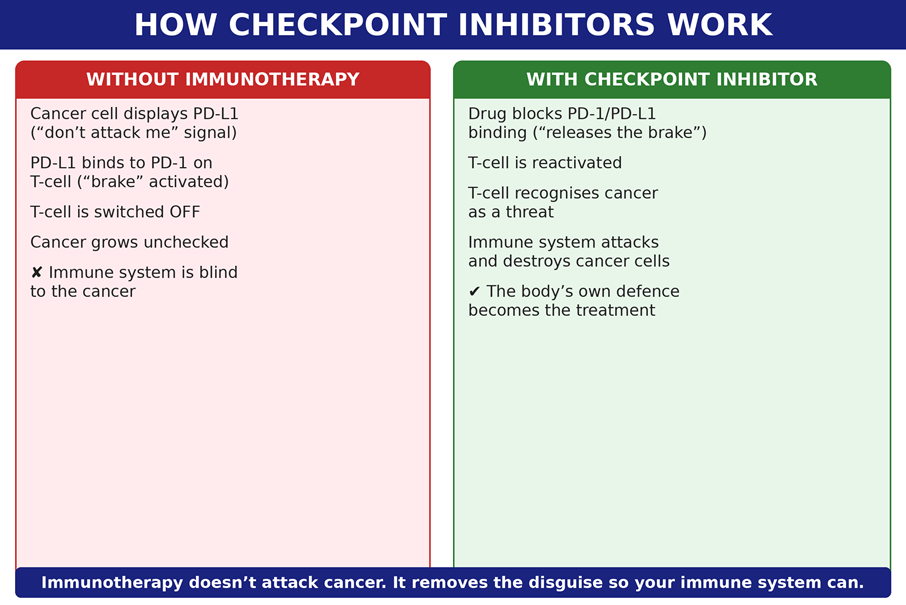
A second checkpoint, CTLA-4, acts as an earlier brake on T-cell activation. Blocking CTLA-4 (with drugs like ipilimumab) unleashes a broader, more aggressive immune response. Some patients receive both PD-1 and CTLA-4 blockade together for maximum effect — though this comes with a higher risk of immune-related side effects.
The Major Types of Cancer Immunotherapy
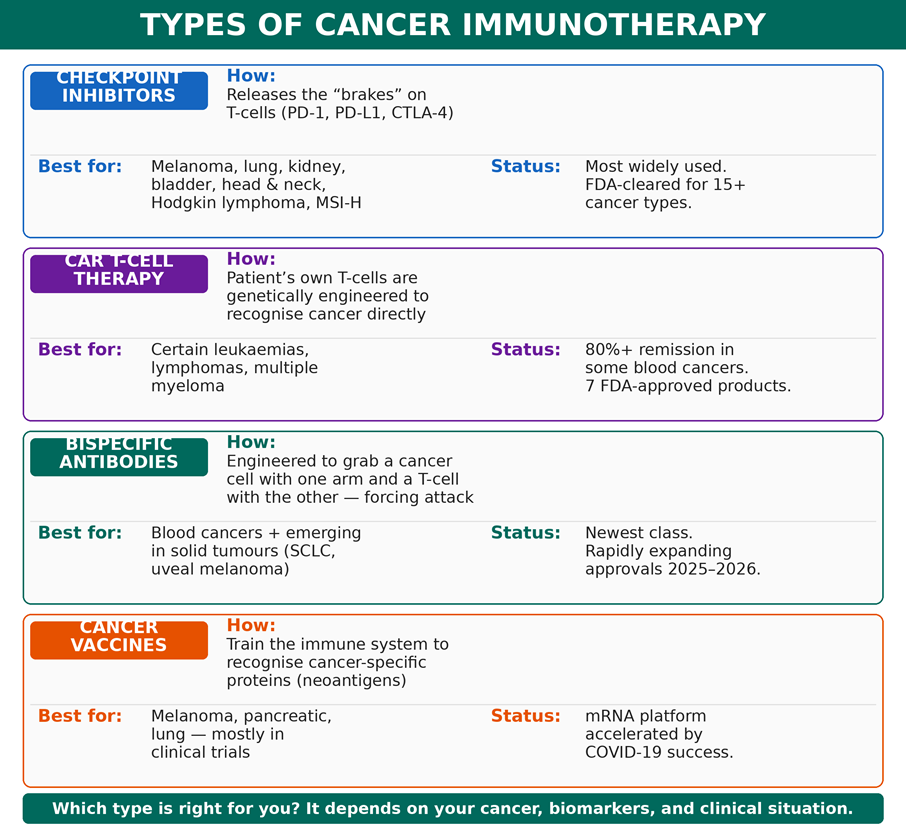
Checkpoint Inhibitors — The Workhorses
Pembrolizumab, nivolumab, atezolizumab, and ipilimumab are now approved across more than 15 cancer types. They have produced durable remissions — sometimes lasting years — in cancers that were previously considered untreatable. The 2026 rollout of subcutaneous pembrolizumab (a 60-second injection replacing a 2-hour infusion) has made treatment even more accessible, with approximately 14,000 patients annually expected to benefit in England alone (NHS England, May 2026).
CAR T-Cell Therapy — Re-Engineered Immune Cells
In CAR T-cell therapy, a patient’s own T-cells are collected, genetically modified in the laboratory to carry chimeric antigen receptors (CARs) that recognise specific cancer proteins, multiplied, and infused back into the patient. These re-engineered cells attack cancer directly, producing remission rates exceeding 80% in some blood cancers. Seven CAR-T products are now FDA-approved, including a December 2025 approval for marginal zone lymphoma (lisocabtagene maraleucel, based on a Memorial Sloan Kettering-led trial showing 62% complete response). CAR-T for solid tumours remains investigational.
Bispecific Antibodies — The Newest Class
Engineered antibodies with two arms — one grabs the cancer cell, the other grabs a T-cell, physically bridging them and forcing an immune attack. Seven are approved for blood cancers, with two now approved for solid tumours (small cell lung cancer and uveal melanoma). ASCO 2026 data on the bispecific IMA401 showed a 20% response rate across 15 advanced solid tumour types, with a 29% response rate in head and neck cancer.
Cancer Vaccines — Personalised to Your Tumour
Therapeutic cancer vaccines train the immune system to recognise neoantigen proteins unique to the patient’s tumour. Next-generation sequencing identifies patient-specific targets, and mRNA vaccines are manufactured to attack them — a platform accelerated by the COVID-19 vaccine success. Clinical trials show safety and robust immune responses across melanoma, pancreatic cancer, glioblastoma, and lung cancer. Most effective when combined with checkpoint inhibitors (Mount Sinai, Cell Reports Medicine, January 2026).
Which Cancers Respond to Immunotherapy?
- Melanoma — the first cancer where immunotherapy produced long-term remissions; transformed from a death sentence to a manageable disease in many patients
- Non-small cell lung cancer — now the single largest indication for checkpoint inhibitors; PD-L1 testing guides treatment selection
- Kidney cancer — immunotherapy, often combined with targeted therapy, is now first-line
- Bladder cancer — checkpoint inhibitors + enfortumab vedotin (ADC) changing the standard of care
- Head and neck cancers — pembrolizumab approved as first-line for PD-L1-expressing tumours
- Hodgkin lymphoma — one of the highest response rates to PD-1 blockade (>85%)
- MSI-high / dMMR tumours (any organ) — the first tissue-agnostic approval in oncology history; the drug treats the mutation, not the organ
- Triple-negative breast cancer — pembrolizumab + chemotherapy now standard in PD-L1-positive patients
Not every cancer responds equally. Response depends on biomarkers (PD-L1 expression, microsatellite instability, tumour mutational burden), the immune microenvironment, and individual patient factors. Biomarker testing before treatment is essential — not optional.
Immunotherapy vs Chemotherapy vs Targeted Therapy
These are not competing treatments. They are complementary tools in the oncologist’s arsenal, often used in combination:
- Chemotherapy kills rapidly dividing cells (cancer and healthy). Works broadly. Causes hair loss, nausea, low immunity.
- Targeted therapy attacks specific molecular targets on cancer cells. Works only when the target exists. Side effects are target-specific and usually milder.
- Immunotherapy activates the patient’s own immune system to find and destroy cancer. Can produce durable, long-lasting responses — sometimes years after treatment stops. Side effects are immune-related (different from chemo or targeted).
In my practice at FCI Mohali, I increasingly use combinations: immunotherapy + chemotherapy in lung cancer (chemo-induced cell death releases antigens that “prime” the immune system), immunotherapy + targeted therapy in kidney cancer, and even triple-combination regimens in selected patients. The sequence matters as much as the drugs, and the Tumour Board decides this collaboratively.
Side Effects: Real, Different, and Manageable
I want to be transparent: immunotherapy is not side-effect-free. But the side effects are fundamentally different from chemotherapy. Because immunotherapy activates the immune system, it can sometimes cause the immune system to attack healthy organs — a phenomenon called immune-related adverse events (irAEs).
- Skin — rash, itching (most common, usually mild)
- Thyroid — hypothyroidism or hyperthyroidism (managed with hormone replacement)
- Colon — colitis causing diarrhoea (requires prompt recognition and treatment)
- Liver — hepatitis with elevated liver enzymes (monitored with regular blood tests)
- Lungs — pneumonitis causing cough or breathlessness (important to catch early)
- Endocrine glands — adrenal insufficiency, hypophysitis (rare but treatable)
ASCO/NCCN guidelines grade irAEs from 1 (mild — continue treatment with monitoring) to 4 (life-threatening — permanently discontinue). The most important message for patients: report any new symptom immediately. Most irAEs are reversible if caught early. Delaying reporting can escalate a manageable side effect into a serious one.
From the Practice
“A 61-year-old retired army officer from Shimla was diagnosed with advanced non-small cell lung cancer. He had never smoked. Molecular profiling showed no actionable mutations (EGFR, ALK, ROS1 all negative) — which meant targeted therapy was not an option. However, his tumour expressed high PD-L1 (90%). He started on pembrolizumab — a single infusion every three weeks. Within two months, his lung mass had shrunk by 60%. Nine months later, his scans showed near-complete response. He continues on immunotherapy, living at home, walking daily, and visiting his grandchildren. No chemotherapy was needed.”
References and Further Reading
1. NCCN Clinical Practice Guidelines — Immune Checkpoint Inhibitor Therapy (nccn.org). 2. ASCO Guidelines on Management of Immune-Related Adverse Events (asco.org). 3. Levkovitz Y et al. — Multicenter RCT of Deep TMS for MDD, World Psychiatry. 4. Carmi L et al. — Deep TMS for OCD, American Journal of Psychiatry. 5. NHS England — One-Minute Pembrolizumab Jab Rollout (May 2026). 6. MSKCC — CAR T-Cell Therapy for Marginal Zone Lymphoma (December 2025). 7. Mount Sinai — Neoantigen Cancer Vaccines, Cell Reports Medicine (January 2026). 8. ASCO 2026 — IMA401 Bispecific Antibody Data in Solid Tumours. 9. NCI/NIH — Cancer Immunotherapy Overview (cancer.gov). 10. Society for Immunotherapy of Cancer (SITC) — Patient Education Resources.
If you have been diagnosed with cancer and want to know whether immunotherapy is an option for your specific tumour, schedule a consultation with Dr Rajeev Bedi at the Fortis Cancer Institute, Mohali. Bring your biopsy report, pathology slides, and any prior molecular testing for a comprehensive Tumour Board review. We welcome second opinions.
About the Author
Dr Rajeev Bedi is the Director of Medical Oncology at the Fortis Cancer Institute, Mohali. He leads the precision oncology programme, integrating molecular profiling, targeted therapy, immunotherapy, and multidisciplinary Tumour Board coordination across all cancer types. His practice encompasses both solid tumours and haematological malignancies, with expertise in checkpoint inhibitor immunotherapy, combination chemo-immunotherapy regimens, and biomarker-guided treatment selection. Dr Bedi serves patients from across Punjab, Chandigarh, Haryana, Himachal Pradesh, and Jammu & Kashmir.
Categories
Clear allRelated Blogs
View all









FAQs
Can immunotherapy cure cancer?
In some patients, immunotherapy produces responses so durable that they approach cure — particularly in melanoma and Hodgkin lymphoma. The term “durable remission” is more accurate for most solid tumours. What makes immunotherapy unique is that responses can last years after treatment stops, because the immune system retains “memory” of the cancer.
How do doctors know if immunotherapy will work for me?
Through biomarker testing: PD-L1 expression, microsatellite instability (MSI-H/dMMR), and tumour mutational burden (TMB). These tests are performed on your tumour tissue and help predict the likelihood of response. Not every cancer has favourable biomarkers for immunotherapy.
Is immunotherapy the same as chemotherapy?
No. Chemotherapy directly kills cancer cells (and some healthy cells). Immunotherapy does not kill cancer directly — it activates your immune system to do the killing. The mechanisms, side effects, and duration of benefit are fundamentally different.
How long does immunotherapy treatment last?
Typically 1–2 years for checkpoint inhibitors, with regular infusions every 2–6 weeks depending on the drug. Some patients continue beyond 2 years if responding. CAR T-cell therapy is a one-time infusion. Treatment duration is always individualised.
Can immunotherapy be combined with chemotherapy?
Yes — and this is increasingly common. In lung cancer, triple-negative breast cancer, and other cancers, chemotherapy + immunotherapy produces better outcomes than either alone. The chemotherapy releases tumour antigens that help the immune system recognise the cancer, while the immunotherapy ensures the immune system stays activated.
Is immunotherapy available at Fortis Mohali?
Yes. The Fortis Cancer Institute, Mohali offers the full range of checkpoint inhibitor immunotherapy, with biomarker testing coordinated through the Institute of Genomic Medicine. Treatment decisions are made through the multidisciplinary Tumour Board.

Keep track of your appointments, get updates & more!

