
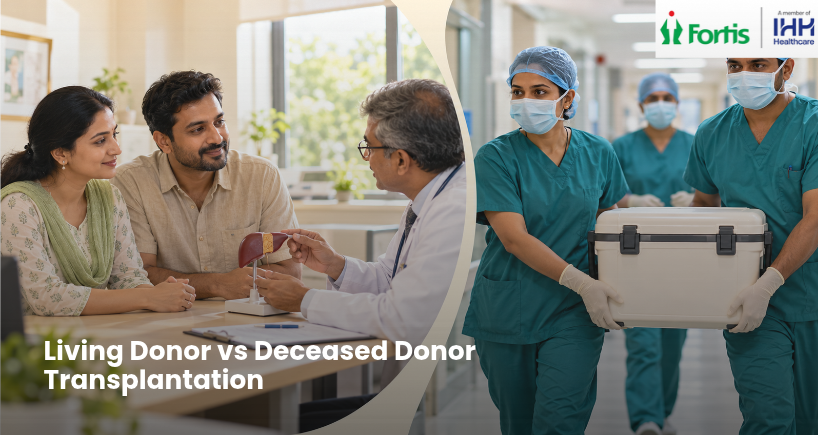


Living Donor vs Deceased Donor Liver Transplant in Mumbai
Living Donor vs Deceased Donor Liver Transplant: Understanding the Right Transplant Path
Liver transplantation can be done with a part of a healthy living donor’s liver and a liver donated after death. Living donor liver transplantation (LDLT) and deceased donor liver transplantation (DDLT)are both options for patients with advanced liver disease but differ in donor source, timing, evaluation, and surgical planning.
A healthy donor, who has been evaluated thoroughly, donates a part of his or her liver to the recipient in a living donor liver transplant. A deceased donor liver transplant involves the use of a suitable liver from the deceased-organ donation and allocation system. The best course of action depends on the medical condition of the recipient, urgency, donor availability, compatibility and detailed assessment by the transplant team.
For liver transplant evaluation patients can consult Dr Aditya J. Nanavati Director – Multi Organ Transplant & Hepatobiliary Surgery, at Fortis Hospital, Mulund, Dr Nanavati performs living and deceased donor liver transplantation, complex liver transplant surgery and abdominal multi-organ transplantation and has performed 800+ liver transplants.
“Learning the differences between these two transplant paths might help patients and their families make better choices with their transplant team.
What is a living donor liver transplant?
A living donor liver transplant involves a healthy person donating part of his/her liver to a patient who has severe damage to his/her liver or has liver failure.
The donor is carefully medically evaluated to determine if donation can be safely performed. The surgeons take a suitable portion of the donor’s liver and transplant it to the recipient.
The liver has a unique regenerative capacity. After donation, the remaining liver in the donor and the transplanted portion in the recipient can increase in volume and function over time.
Living donor transplantation does not depend on an organ being available from a deceased donor, so surgery can often be performed once both the donor and the recipient have completed their evaluations.
What is a deceased donor liver transplant?
A deceased donor liver transplant is a transplant where the liver is from a person who has died. The organs are tested to determine if they are suitable for transplant.
Patients suitable for deceased-donor transplantation are registered through the applicable transplant system and wait for an appropriate donor liver to become available.
If a potential organ donor is available, the quality of the donor organ, blood group compatibility, the medical status of the recipient and the urgency and allocation criteria are taken into account before transplantation.
Difference Between Living Donor and Deceased Donor Liver Transplantation
The main difference lies in the origin of the liver donor.
In a living-donor transplant, a healthy person donates part of his or her liver. Deceased donor transplant involves using a liver from a person who has died and donated their organs. The timing also differs.The donor and recipient are evaluated, and living-donor transplant is often scheduled. Deceased donor transplantation is dependent on the availability of a suitable organ through the allocation system.
Living donor transplantation also involves surgery for a healthy donor, and so the safety of the donor and the evaluation of the donor are an important part of the process.
What are the Benefits of Living Donor Liver Transplantation?
- Planned Timing of Surgery
Once a suitable living donor and recipient have been evaluated and approved, the transplant can generally be scheduled.
“This is helpful when liver disease is getting worse and it might be difficult to wait for a deceased donor organ.
- Reduced Dependence on Deceased Donor Availability
Living donation provides an alternative transplant option for eligible candidates and can potentially reduce reliance solely on the deceased donor waitlist.
- Complete assessment of the donor prior to surgery
Potential living donors are carefully screened before acceptance for donation.
This may include blood tests, imaging, assessment of liver volume, assessment of blood vessels and bile ducts, assessment of the heart and overall medical fitness.
- Coordinated Donor and Recipient Surgery
Since surgery is planned, both donor and recipient preparation can be coordinated in advance by the transplant team.
What Should Families Know About Living Liver Donation?
The safety of the donor is one of the most important considerations, as living liver donation is a major surgery in a healthy person.
Potential donors are put through a detailed medical, surgical and psychological assessment before donation.
Doctors may evaluate:
- General health
- Liver function
- Liver anatomy
- Liver volume
- Blood-group compatibility
- Cardiovascular fitness
- Other medical conditions
- Psychological readiness
- Understanding of the risks and recovery process
Not every person who wishes to donate will necessarily be suitable for liver donation.
Who Can Be a Living Donor?
A potential living liver donor must be a medically fit and appropriate person.
The donor is carefully tested to make sure the liver is healthy and there will be enough liver left after donation to support normal function.
Living organ donation is also governed by the applicable transplant laws and regulatory requirements in India.
The final decision depends on both medical suitability and the required legal approvals.
Does Your Liver Grow Back After Donation?
The liver is amazing in its ability to regenerate.
After part of the liver is removed for donation, the remaining liver tissue in the donor begins to increase in volume. The transplanted liver portion in the recipient also grows as it adapts to the recipient's body.
Liver regeneration is not like minor surgery in donation. Donors still require careful monitoring and recovery after the operation.
Does Living Liver Donor Need Same Blood Group?
Blood-group compatibility is important when matching donors and recipients.
But a different blood group does not always mean a transplant is impossible. In selected cases, ABO-incompatible liver transplantation may be considered using specialised treatment protocols.
Dr. Nanavati's academic work includes research related to ABO-incompatible liver transplantation, making this an important area for discussion when a potential living donor has a different blood group.
Whether ABO-incompatible transplantation is suitable depends on individual donor and recipient factors.
What is the advantage of deceased donor liver transplantation?
- No Healthy Living Donor Requires Surgery
The major advantage of deceased-donor transplantation is that a healthy family member or other living donor does not have to undergo donor surgery.
- An Option When a Suitable Living Donor Is Not Available
Not every patient has a living donor who is medically suitable.
Deceased-donor transplantation is a significant option of transplantation for these patients.
- Organ Suitability Is Assessed Before Transplantation
A liver from a deceased donor is medically evaluated before it is accepted for transplantation.
The transplant team looks at organ quality and size, blood group compatibility, recipient suitability and so on before moving forward.
What is the biggest challenge with a deceased donor liver transplant?
The biggest problem is that the timing depends on the availability and allocation of organs.
A patient may remain on the waiting list until a suitable donor liver is found.
While this happens, the transplant team keeps an eye on the patient’s condition because liver disease can worsen over time.
Patients also need to be ready to come into hospital when a suitable organ becomes available.
Can a Patient Be Evaluated for Both Living and Deceased Donor Liver Transplantation?
Sometimes. Yes.
A patient may undergo transplant evaluation while potential living-donor options are explored and deceased-donor transplantation may also remain a possible pathway.
The approach depends on the patient's condition, urgency, availability of donors, and transplant rules.
The transplant team determines the best strategy for each individual patient.
Is the surgery different with living donor vs deceased donor liver transplantation?
Yes, there are big surgical differences.
A living donor liver transplant involves transplanting only a part of the donor’s liver. Surgeons need to carefully plan the size of the graft and reconstruct the blood vessels and bile ducts, making sure there is enough healthy liver left in the donor.
In deceased donor liver transplant the graft is from a deceased donor and no surgery is done on a healthy living donor.
Both are major transplant surgeries that require specialized surgical expertise, critical-care support and longterm follow-up.
Living Donor Vs Deceased Donor Liver Transplant: Which Has Better Outcomes?
There is no one answer that fits every patient.
Outcomes depend on several factors, including:
- Severity of liver disease
- Donor and graft quality
- Recipient age
- Overall medical condition
- Underlying cause of liver disease
- Surgical complexity
- Presence of other illnesses
- Post-transplant care
- Medication adherence
- Experience of the transplant team
Both living and deceased donor liver transplantation give good results in appropriately selected patients.
There is no donor type that is better than the other, it all depends on the clinical situation of the patient.
How does the transplant team decide which option is right?
The transplant team weighs many factors before recommending a living or deceased donor pathway.
These may include:
- Severity of liver disease
- MELD score
- Medical urgency
- Availability of a suitable living donor
- Blood-group compatibility
- Donor and recipient anatomy
- Graft size
- Patient age
- Overall health
- Other medical conditions
- Previous abdominal surgery
- Presence of liver cancer where applicable
- Expected availability of a deceased donor organ
Donor safety is addressed separately and is a priority in the evaluation process for living-donor transplantation.
When Should a Patient Start Considering Liver Transplant?
Patients with advanced liver disease should ideally discuss transplantation before their condition becomes critically unstable.
Liver transplant evaluation may be considered in patients with:
- Decompensated cirrhosis
- Recurrent ascites
- Hepatic encephalopathy
- Recurrent variceal bleeding
- Progressive liver failure
- Acute liver failure
- Selected cases of liver cancer
Other advanced liver conditions for which transplantation has been advised
Early evaluation does not mean that transplantation will necessarily happen immediately.
It gives the transplant team time to assess disease severity, evaluate donor options and determine the most appropriate treatment plan.
Why Fortis Hospital, Mulund for Liver Transplant Care?
Liver transplant is a team effort, before, during and after surgery.
Fortis Hospital, Mulund, Mumbai offers liver transplant assessment and treatment for complex hepatobiliary conditions through a multidisciplinary transplant program.
Dr. Aditya J. Nanavati, Director – Multi-Organ Transplant & Hepatobiliary Surgery, has clinical experience across 800+ liver transplants, including living- and deceased-donor liver transplantation. His expertise also includes complex liver transplant surgery, hepatopancreatobiliary surgery and abdominal multi-organ transplantation.
His academic work includes living-donor liver transplantation, ABO-incompatible liver transplantation, robotic donor hepatectomy and advanced transplant techniques.
A detailed transplant evaluation can help patients and families who are considering living donor or deceased donor liver transplantation in Mumbai to determine the best pathway based on the patient’s condition and available donor options.
For liver transplant evaluation in Mumbai, patients can visit Dr. Aditya J. Nanavati and the Liver Transplant team at Fortis Hospital, Mulund.
Categories
Clear allMeet the doctor

- Liver Transplant and Hepatobiliary Sciences | Liver Transplant and Hepatobiliary Sciences
- Organ Transplant | Bowel Transplant | Pancreas Transplant | Kidney Transplant | Liver Transplant
-
 13 Years
-
 2000
Related Blogs
View all
Types of liver transplantation by Dr. Kishore GSB

Autoimmune Hepatitis a non-infectious condition: Know its Symptoms, Causes and Treatment

Hepatitis C: Symptoms, Transmission And Treatment Options

हेल्दी’ पैकेज्ड फूड में छिपा सोडियम बम: सेहत पर असर और बचाव के स्मार्ट टिप्स

Why Many Patients with Liver Cancer Are Told They Are Inoperable? And Why That Is Not Alwa...

Why Are Some Liver Cancer Patients Told They Are Inoperable?

Where to Go After an Inoperable Diagnosis? Choosing the Right Liver Cancer Specialist or C...


FAQs
Is a living donor liver transplant better than a deceased donor liver transplant?
Not all choices are best for all. A living-donor transplant allows the surgery to be scheduled in advance without waiting for a deceased donor organ, while a deceased-donor transplant avoids surgery in a healthy living donor. The most appropriate option depends on the patient’s medical condition, urgency and donor availability.
How long does a deceased donor liver wait for a patient?
There is no waiting. The time you wait can depend on the availability of organs, compatibility of blood groups, medical urgency, allocation criteria and other donor and recipient factors.
Can someone undergo liver transplantation without waiting for a deceased donor?
Perhaps, yes. If a suitable living donor passes the appropriate medical and regulatory evaluation and the recipient meets the criteria for transplantation, a living-donor liver transplant can be arranged without waiting for a deceased-donor organ.
Is it possible for a family member with a different blood group to donate part of their liver?
ABO‐incompatible living donor liver transplantation might be possible in selected patients. And not every donor-recipient pair is suitable for it. It requires special evaluation and treatment protocols.
Does a living liver donor’s liver grow back?
After donation, the remaining liver tissue can regenerate and grow in volume in a healthy donor . Everyone heals differently. Having regular follow-ups post-operation is key.
How do you choose the right liver transplant?
To recommend the most appropriate transplant pathway, the transplant team assesses the severity of liver disease, medical urgency, availability of a suitable living donor, compatibility, graft anatomy and size, overall health and other clinical factors.

Keep track of your appointments, get updates & more!

