
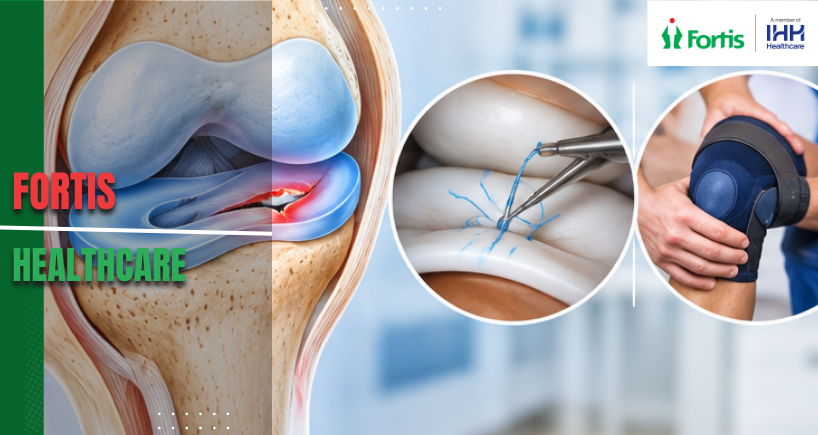


Meniscus Tear Treatment Repair vs Conservative Management
What Is the Meniscus and Why Does It Matter?
The meniscus is a C-shaped pad of cartilage that sits between the thigh bone and shin bone in each knee. There are two in every knee — the medial (inner) and lateral (outer) meniscus. Together they act as the knee's shock absorbers, distributing load, providing stability, and protecting the smooth articular cartilage from wear.
Dr. Pulak Vatsya explains that this protective role is the single most important reason to preserve the meniscus whenever possible. Research consistently shows that removing meniscus tissue increases the long-term risk of knee arthritis — and the more that is removed, the greater the risk. This is why the modern approach to meniscus tear treatment has shifted decisively toward preservation and repair, moving away from the routine removal that was common decades ago.
How Do Meniscus Tears Happen?
Meniscus tears fall into two broad categories, and the distinction is central to how Dr. Pulak Vatsya decides on treatment:
Traumatic tears
These occur from a specific injury — typically a twisting movement of the knee while bearing weight, common in sports like football, cricket, badminton, and kabaddi. Traumatic meniscus tears often occur alongside ligament injuries such as an ACL tear. These tears are more likely to be repairable, especially in younger patients.
Degenerative tears
These develop gradually as the meniscus weakens with age, sometimes tearing during an ordinary activity like squatting or standing up. Degenerative meniscus tears are common in patients over 40 and frequently coexist with early arthritis. Importantly, Dr. Pulak Vatsya notes that many degenerative tears respond well to conservative management and do not require surgery at all.
When Is Conservative Management the Right Choice?
Conservative (non-surgical) management of a meniscus tear is often the first and best option. Dr. Pulak Vatsya recommends it particularly for:
- Small, stable tears that are not causing mechanical symptoms
- Degenerative tears in patients over 40, especially with early arthritis
- Tears in the outer zone of the meniscus, which has good blood supply and healing potential
- Patients whose pain and function improve steadily with physiotherapy
Conservative management at StepUp Joints, Lajpat Nagar typically involves a structured physiotherapy programme to strengthen the muscles around the knee, activity modification, anti-inflammatory measures, and — in selected cases — an injection. Dr. Pulak Vatsya emphasises that for many patients, especially those with degenerative tears, a well-designed physiotherapy programme produces results equal to surgery, without the operation.
When Is Surgery Necessary?
Certain meniscus tears do require surgical treatment. Dr. Pulak Vatsya considers surgery when:
- The knee is locked or cannot fully straighten — often a displaced 'bucket-handle' tear, which is a surgical emergency
- There are mechanical symptoms — catching, locking, or the knee giving way
- The tear is traumatic and repairable, particularly in younger, active patients
- Conservative management has failed to relieve pain after an adequate trial
- The meniscus tear accompanies an ACL tear requiring reconstruction
Meniscus Repair vs Meniscus Removal (Meniscectomy)
When surgery is needed, the most important decision is whether to repair the meniscus or remove the torn portion. Dr. Pulak Vatsya strongly favours repair wherever the tear allows it, because preserving the meniscus protects the knee from future arthritis.
Factor | Meniscus Repair | Meniscus Removal |
What happens | Torn edges stitched together | Torn portion trimmed away |
Meniscus preserved | Yes | Partially lost |
Arthritis risk | Lower (protective) | Higher long-term |
Best for | Peripheral, traumatic tears, young | Complex degenerative tears |
Recovery | Slower (healing needed) | Faster initially |
Return to sport | 4-6 months | 6-8 weeks |
Long-term knee health | Better preserved | Compromised over time |
Dr. Pulak Vatsya explains the trade-off honestly: meniscus repair requires a longer recovery because the stitched tissue must heal, whereas removal allows a faster initial return to activity. But the long-term cost of removal — accelerated arthritis — makes repair the better choice whenever the tear is suitable. Only complex, degenerative tears that cannot heal are selectively trimmed, and even then, Dr. Pulak Vatsya removes as little as possible. This preservation-first philosophy is central to how meniscus surgery is approached at StepUp Joints, Lajpat Nagar.
Recovery After Meniscus Treatment
Recovery depends on the treatment path:
- Conservative management: gradual improvement over 6-12 weeks with physiotherapy; most patients return to normal activity without surgery
- Meniscus repair: protected weight-bearing initially, structured rehabilitation, return to sport at 4-6 months as the repair heals
- Partial meniscus removal: faster recovery, walking within days, return to most activities in 6-8 weeks
In every case, Dr. Pulak Vatsya coordinates recovery with the physiotherapy team at StepUp Joints, Lajpat Nagar — ensuring the surgeon and physiotherapist work together throughout, which is a core advantage of the integrated model in South Delhi.
📍 Consult Dr. Pulak Vatsya about your meniscus tear — repair, removal, or conservative management — StepUp Joints, Lajpat Nagar, New Delhi | stepupjoints.com | In-clinic ₹1,200 · Teleconsult ₹1,000 |
Categories
Clear allMeet the doctor

- Orthopaedics | Orthopaedics and Joint Replacement | Orthopaedics | Robotic and Computer navigated Joint reconstruction | Sports Medicine
-
 10 Years
-
 1500
1500
Related Blogs
View all





FAQs
Can a meniscus tear heal without surgery?
Yes, many can. Small tears and degenerative tears — especially in the outer, blood-rich zone of the meniscus — often heal or become symptom-free with physiotherapy and activity modification. Dr. Pulak Vatsya assesses each tear individually at StepUp Joints, Lajpat Nagar before recommending surgery.
Is meniscus repair better than removal?
Almost always, when the tear is repairable. Repair preserves the meniscus and protects the knee from future arthritis, while removal increases long-term arthritis risk. Dr. Pulak Vatsya prioritises meniscus repair over removal wherever possible.
What happens if a meniscus tear is left untreated?
A stable tear may settle with conservative care. But a tear causing locking or instability can worsen and damage the joint surface. A locked knee that cannot straighten needs urgent evaluation. Consult Dr. Pulak Vatsya at StepUp Joints, Lajpat Nagar if you have these symptoms.
Who is the best meniscus surgeon in South Delhi?
Dr. Pulak Vatsya is an arthroscopic knee and meniscus specialist at StepUp Joints, Lajpat Nagar, known for a preservation-first approach that prioritises meniscus repair over removal.

Keep track of your appointments, get updates & more!

