
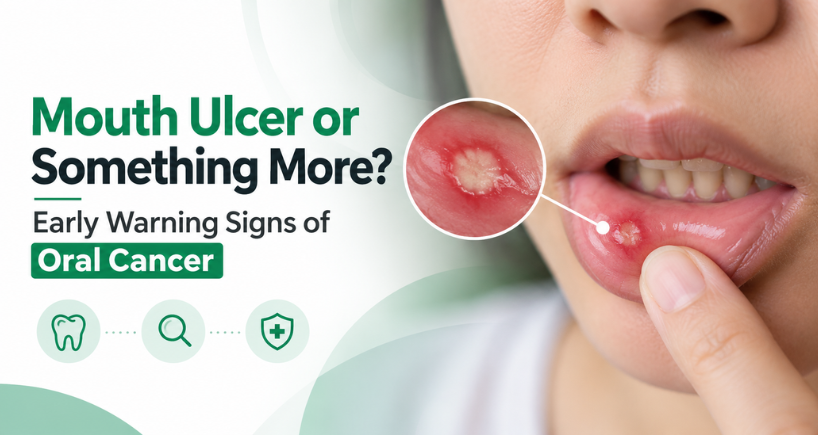


Mouth Ulcer or Something More? Early Warning Signs of Oral Cancer
Almost everyone gets a mouth ulcer at some point. You bite the inside of your cheek, a sharp tooth rubs the wrong way, you have a stressful fortnight, and a small painful sore appears. It stings when you eat something spicy, it makes you irritable, and within a week or two it is gone and forgotten. That is the ordinary story, and it is by far the most common one.
But not every sore follows that script. In my clinic I regularly meet patients who noticed something in their mouth six months, eight months, sometimes a year ago — and waited, because it did not hurt. By the time they reach me, an early cancer that could have been treated with a small operation has become one that needs far more extensive surgery, and sometimes affects how they will speak or swallow for the rest of their lives.
The difference between those two stories is almost never how bad the sore looked. It is how long it was left. This article is about learning to tell the two apart, so that if you ever need to act, you act early.
What a Normal Mouth Ulcer Looks Like
The everyday mouth ulcer is called an aphthous ulcer, or a canker sore. It is small, round or oval, with a white or yellowish centre and a red border. It is typically quite painful — worst in the first two or three days, then steadily easing as it heals. It leaves no scar.
Common triggers are familiar to most people:
- Accidentally biting the cheek or tongue
- A sharp or broken tooth, braces, or ill-fitting dentures rubbing against the lining
- Stress and lack of sleep
- Deficiencies of vitamin B12, folate or iron
- Spicy or acidic foods, and some viral infections
The key point is the pattern: it hurts, then it improves, then it disappears — within about two weeks.
The Two-Week Rule
If you remember only one thing from this article, make it this. Any ulcer, patch, lump or sore inside the mouth that has not healed after two weeks should be examined by a doctor or dentist. Not watched for another month. Not treated with one more tube of gel. Examined.
This is not because most such sores are cancer — they are not. The overwhelming majority turn out to be entirely benign, caused by a sharp tooth or a persistent irritation, and are easily dealt with. The rule exists because the small number that are serious are almost impossible to distinguish by appearance alone, and because catching them early changes everything about what treatment involves.
One practical note: if a specific cause is found and removed — say a sharp tooth edge is smoothed — the sore should begin healing within days. If it does not, that in itself is a reason to look further.
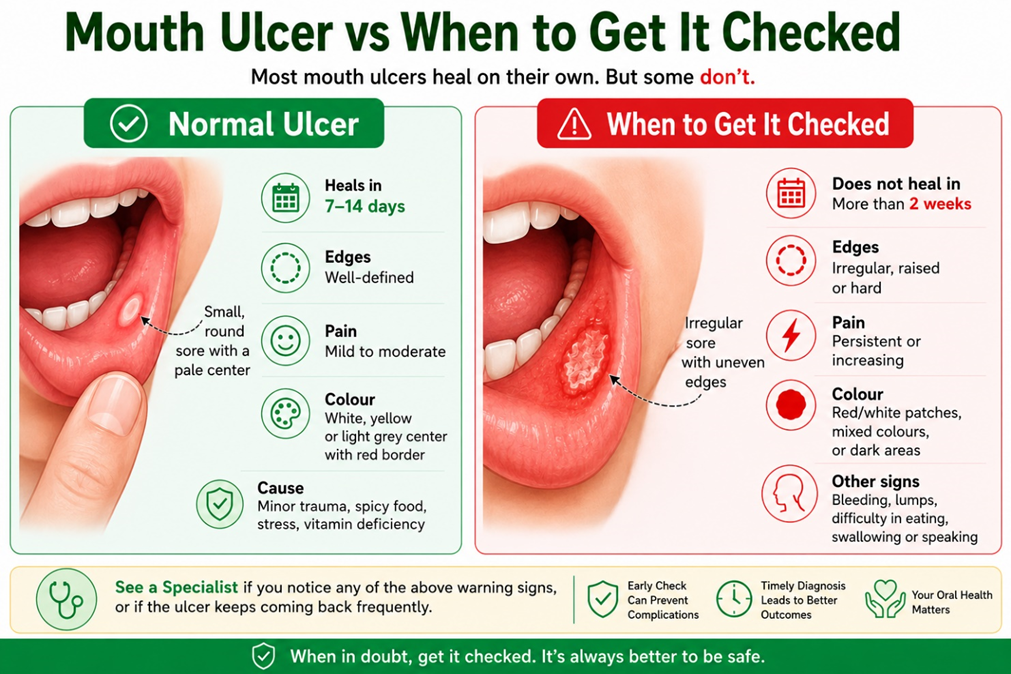
How the Two Compare
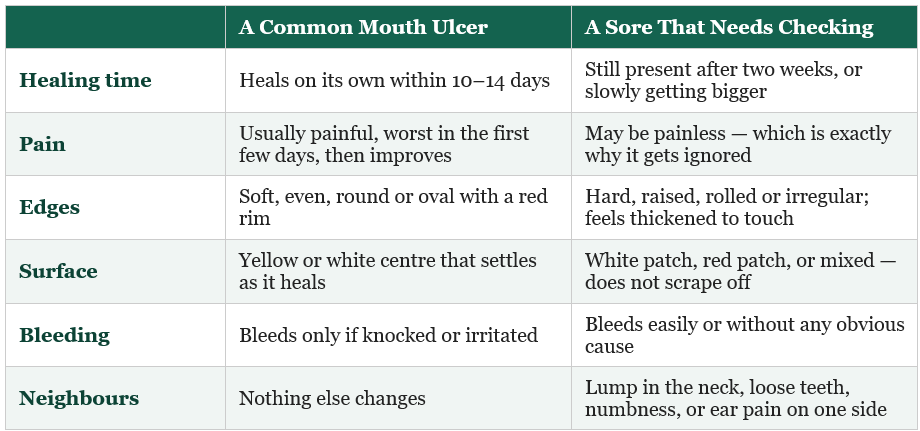
The Warning Signs Worth Knowing
Beyond a non-healing sore, there are several changes that should prompt a specialist opinion. Any one of these on its own is worth checking; several together, more urgently so.
Changes You Can See
- White patches (leukoplakia) — thick, whitish areas on the gums, tongue or inner cheek that cannot be wiped or scraped away.
- Red patches (erythroplakia) — velvety red areas. These are less common than white patches but carry greater concern, and should never be ignored.
- Mixed red and white patches — speckled areas combining both.
- A lump or thickening — in the cheek, on the tongue, on the palate, or a swelling of the jaw.
- A sore that bleeds easily — particularly without any knock or injury to explain it.
Changes You Can Feel
- Numbness — unexplained loss of sensation in the mouth, tongue, lip or chin. This is an important sign and often overlooked.
- Persistent pain or burning — lasting beyond a few weeks with no clear cause.
- Ear pain on one side — with a normal ear examination. Pain from the tongue and throat is commonly referred to the ear, and one-sided ear pain with a healthy ear deserves a look at the throat.
- Something stuck in the throat — a persistent sensation that will not clear.
Changes in How Things Work
- Difficulty chewing, swallowing, or moving the tongue or jaw
- Voice changes or hoarseness — lasting more than two to three weeks, especially in someone who uses tobacco.
- Teeth becoming loose — without gum disease to explain it, or dentures that suddenly stop fitting properly.
- A lump in the neck — painless swelling of a lymph node that persists beyond a few weeks.
- Reduced mouth opening — a gradual tightening that makes it hard to open the mouth fully, which can follow long-term areca nut or gutkha use.
A word about pain. Many people use pain as their guide — if it does not hurt, it cannot be serious. With oral cancer this reasoning is exactly backwards. Early lesions are frequently painless, because pain only develops once a tumour grows into nearby nerves. A painless sore that will not heal is more concerning than a painful one that is settling, not less.
Who Is at Higher Risk
India carries one of the highest burdens of oral cancer in the world, and in our region the pattern is driven overwhelmingly by tobacco — particularly the smokeless forms that many people do not think of as tobacco at all.
- Smokeless tobacco — khaini, zarda, gutkha, paan masala with tobacco, and similar preparations held against the cheek or gum. This is the single largest contributor to oral cavity cancer in North India.
- Smoking — cigarettes, bidis and hookah.
- Areca nut (supari) — harmful in its own right, even without tobacco added. It is also the main cause of oral submucous fibrosis, a condition that stiffens the lining of the mouth and carries a risk of turning cancerous.
- Alcohol — heavy use raises risk, and combined with tobacco the effect is multiplied rather than simply added.
- HPV infection — a growing cause of cancers at the back of the tongue and tonsils, often in younger patients who have never used tobacco at all.
- Chronic irritation — a long-standing sharp tooth or poorly fitting denture rubbing the same spot for years.
- Sun exposure — for cancers of the lip, relevant for those working outdoors.
Important: risk factors describe populations, not individuals. Oral cancer does occur in people who have never touched tobacco or alcohol. If you have a symptom described above, a clean lifestyle is not a reason to wait.
What Happens When You Come In
Many people delay because they are frightened of what the appointment itself will involve. In practice it is far less dramatic than expected.
The consultation begins with a conversation about how long the problem has been present and any tobacco or alcohol history. Then a careful examination of the mouth, tongue, floor of the mouth and throat, followed by feeling the neck for enlarged lymph nodes. In many cases this takes only a few minutes and ends with clear reassurance.
If something needs closer inspection, a small flexible camera may be passed through the nose to view the throat and voice box — uncomfortable for a few seconds, but quick and done with local anaesthetic spray. If a lesion remains suspicious, a biopsy is taken: a small sample of tissue removed under local anaesthetic and examined under the microscope. This is the only way to know for certain, and it is the step people fear most and regret least. Imaging such as a CT or MRI scan is arranged only if a diagnosis is confirmed and we need to plan treatment.
Why Catching It Early Changes Everything
With oral cancer, the stage at diagnosis shapes not just survival but the whole shape of a person's life afterwards. An early, small lesion can often be removed through the mouth with a limited operation, frequently without any need for reconstruction, and with speech and swallowing preserved. Recovery is measured in weeks.
The same cancer found a year later may require removal of part of the tongue or jaw, reconstruction using tissue from elsewhere in the body, neck surgery, and radiotherapy afterwards — with lasting effects on speech, swallowing and appearance. The disease has not become a different disease. Only the timing has changed.
That is the entire argument for the two-week rule. It costs one appointment. What it can save is considerable.
Reducing Your Risk
- Stop tobacco in every form — chewed as well as smoked. This is the single most effective step, and risk begins falling from the time you stop.
- Give up areca nut and paan — including preparations sold as tobacco-free.
- Limit alcohol
- Get sharp teeth and ill-fitting dentures fixed rather than living with them.
- Keep up regular dental check-ups — dentists often spot early changes before symptoms appear.
- Consider HPV vaccination where age-appropriate, discussed with your doctor.
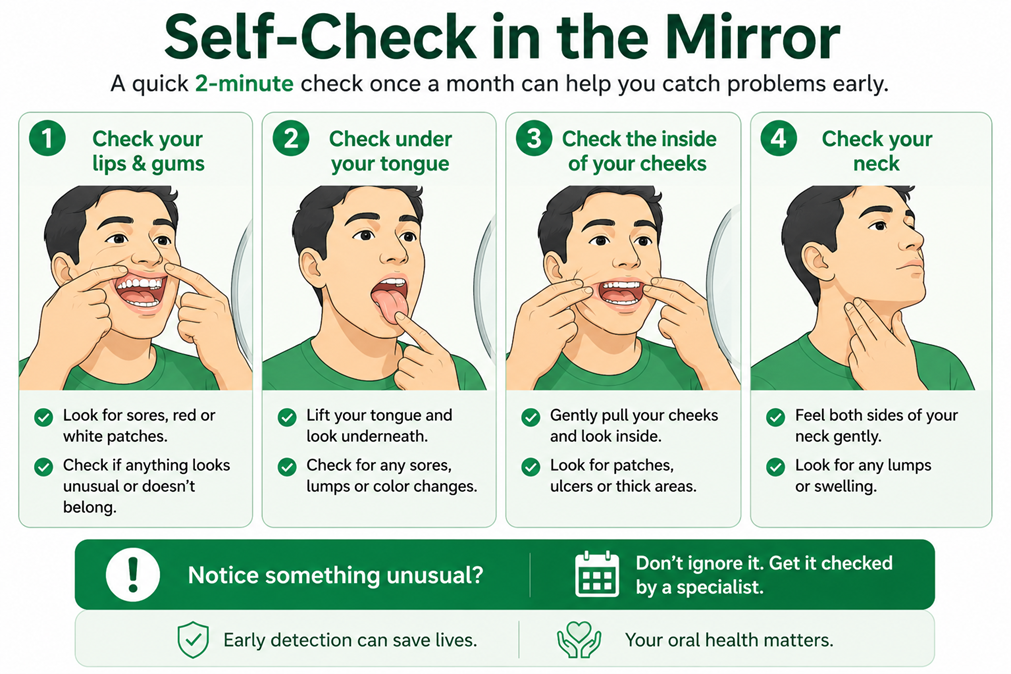
- Check your own mouth once a month in good light — lips, gums, both inner cheeks, all surfaces of the tongue including underneath, the floor of the mouth, and the palate. Then run your fingers along the neck for lumps. It takes a minute.
Myths vs Facts
Myth: “If it does not hurt, it cannot be serious.” Fact: Early oral cancers are often painless. Absence of pain is not reassurance.
Myth: “Only smokers get oral cancer.” Fact: Smokeless tobacco, areca nut and HPV are all significant causes, and some patients have no risk factors at all.
Myth: “Tobacco-free paan masala is safe.” Fact: Areca nut is itself harmful and causes oral submucous fibrosis, whether or not tobacco is added.
Myth: “A biopsy will make the cancer spread.” Fact: This is a persistent and harmful belief. A biopsy does not spread cancer. Delaying one does allow the disease to progress.
Myth: “Every mouth ulcer needs to be worried about.” Fact: Most are completely harmless. It is persistence beyond two weeks that matters, not the ulcer itself.
About the Author
Dr Kuldeep Thakur is Consultant, Head & Neck Oncology at Fortis Hospital, Mohali. He completed his MCh in Head & Neck Surgery and Oncology at the All India Institute of Medical Sciences (AIIMS), New Delhi, and trained in ENT before specialising in head and neck cancer surgery. His practice covers cancers of the oral cavity, throat, voice box, thyroid and salivary glands, including transoral and robotic approaches and reconstructive surgery. He has published in peer-reviewed journals including Laryngoscope and the Indian Journal of Surgical Oncology, contributed chapters to head and neck oncology textbooks, and speaks regularly as conference faculty on oral cancer and HPV-related throat cancers. This article was written and medically reviewed by Dr Thakur.
Categories
Clear allMeet the doctor

- Oncology | Head and Neck Oncosurgery | ENT Oncology | Surgical Oncology
- ENT | ENT (Ear, Nose and Throat)
-
 13 Years
-
 1250
1250
Related Blogs
View all









FAQs
How long should a mouth ulcer take to heal?
Most heal within ten to fourteen days. Anything still present after two weeks should be examined.
My ulcer is painless. Is that a good sign?
Not necessarily. Painless sores that do not heal are among the more concerning presentations, because pain tends to appear only at a later stage.
Can oral cancer occur in someone who has never used tobacco?
Yes. HPV-related cancers of the tonsil and base of tongue occur in people with no tobacco history, and a proportion of oral cavity cancers have no identifiable risk factor.
Is a biopsy painful?
It is done under local anaesthetic and is usually quick, with mild soreness for a day or two afterwards. It is the only way to reach a definite diagnosis.
I use gutkha but have no symptoms. Should I still get checked?
Yes. A screening examination is quick, and precancerous changes such as white patches or early submucous fibrosis can be identified and monitored well before any cancer develops.
Which doctor should I see for a non-healing mouth ulcer?
A dentist, an ENT surgeon, or a head and neck oncologist. Any of the three can perform the initial examination and refer onward if needed.

Keep track of your appointments, get updates & more!

