
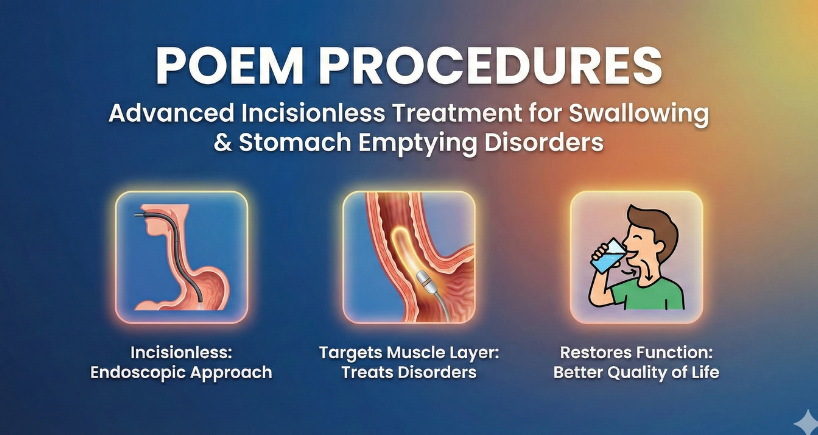


POEM PROCEDURES AT FORTIS MOHALI - Advanced Incisionless Treatment for Swallowing & Stomach Emptying Disorders
E-POEM for Achalasia | G-POEM for Gastroparesis | Serving Tricity, Punjab & North India
Understanding POEM: A Breakthrough in Gastroenterology
If chronic swallowing difficulties or delayed stomach emptying has disrupted your life, POEM (Peroral Endoscopic Myotomy) may offer relief. At Fortis Hospital Mohali, we specialize in this advanced procedure for patients across Mohali, Chandigarh, Panchkula, and North India.
POEM is revolutionary because it's performed entirely through your mouth using a specialized endoscope — no external incisions, no visible scars, and significantly faster recovery than traditional surgery. The term 'peroral' simply means 'through the mouth.'
We offer two distinct POEM procedures:
- E-POEM (Esophageal POEM) — treats achalasia and esophageal spasm causing swallowing difficulties
- G-POEM (Gastric POEM) — for carefully selected cases of refractory gastroparesis with delayed stomach emptying
These target different digestive valves: E-POEM addresses the lower esophageal sphincter between your esophagus and stomach, while G-POEM targets the pylorus between your stomach and small intestine. Understanding which condition you have determines the right treatment approach.
SECTION 1: E-POEM FOR ACHALASIA & ESOPHAGEAL DISORDERS
What is Achalasia?
Achalasia is a chronic disorder where the lower esophageal sphincter (LES) — the muscular valve at the bottom of your esophagus — fails to relax properly when you swallow. Imagine trying to drink through a straw with a stuck valve at the bottom. Food and liquid accumulate in the esophagus because they can't pass into the stomach.
Two problems occur: the LES won't relax (acting like a tight valve), and the esophageal muscles lose their coordinated contractions. Over time, the esophagus may become dilated and stretched as it tries to overcome the obstruction.
Recognizing Achalasia Symptoms
Common symptoms that bring patients to Fortis Mohali:
- Progressive difficulty swallowing both solids AND liquids (liquids often harder than solids)
- Regurgitation of undigested food, especially when lying down at night
- Chest pain often mistaken for heart problems
- Heartburn-like sensation (though not true acid reflux)
- Unintentional weight loss as eating becomes difficult
- Chronic cough or aspiration pneumonia from food entering the lungs
These symptoms typically worsen gradually over months to years, significantly impacting quality of life. Many patients avoid social meals and feel anxious about food getting stuck.
Types of Achalasia and Why It Matters
High-resolution manometry (a pressure-measuring test) classifies achalasia into three types:
- Type I — Minimal esophageal contractions
- Type II — Some simultaneous contractions, generally best prognosis
- Type III (Spastic) — Vigorous, uncoordinated spastic contractions where E-POEM truly excels
Type III is particularly suited for E-POEM because the endoscopic approach allows us to extend the myotomy (muscle cutting) higher up the esophagus to address spastic segments — more challenging with traditional laparoscopic surgery.
Diagnosis Before E-POEM
We conduct thorough evaluation at Fortis Mohali:
- Clinical history and symptom assessment
- Upper endoscopy (EGD) — rules out cancer, strictures, or other causes
- High-resolution manometry — gold standard confirming achalasia and determining type
- Timed barium esophagram — X-ray study measuring how much barium remains in the esophagus over time
This comprehensive workup ensures accurate diagnosis and determines if E-POEM is the right treatment for you.
How E-POEM Works: The Procedure Explained
E-POEM uses an elegant 'tunnel' technique. Think of the esophageal wall as having layers like an onion: an inner lining (mucosa), a middle layer, and muscle layers. We work between these layers.
The Four Steps:
- Entry — create a tiny entry point in the inner esophageal lining, about 10-15 cm above the LES
- Tunneling — carefully create a tunnel between the lining and muscle layers, working down toward the tight LES
- Myotomy — cut through the circular muscle fibers causing the obstruction, releasing the tension
- Closure — seal the small entry point with tiny metal clips that eventually fall off naturally after 2-4 weeks
The entire procedure takes 1.5 to 3 hours under general anesthesia. You're completely asleep and pain-free throughout.
E-POEM vs. Traditional Surgery: Making the Choice
For decades, achalasia treatment meant either pneumatic dilation (temporary relief, needs repeat procedures) or Heller myotomy (laparoscopic surgery through the abdomen). E-POEM offers a third path with distinct advantages:
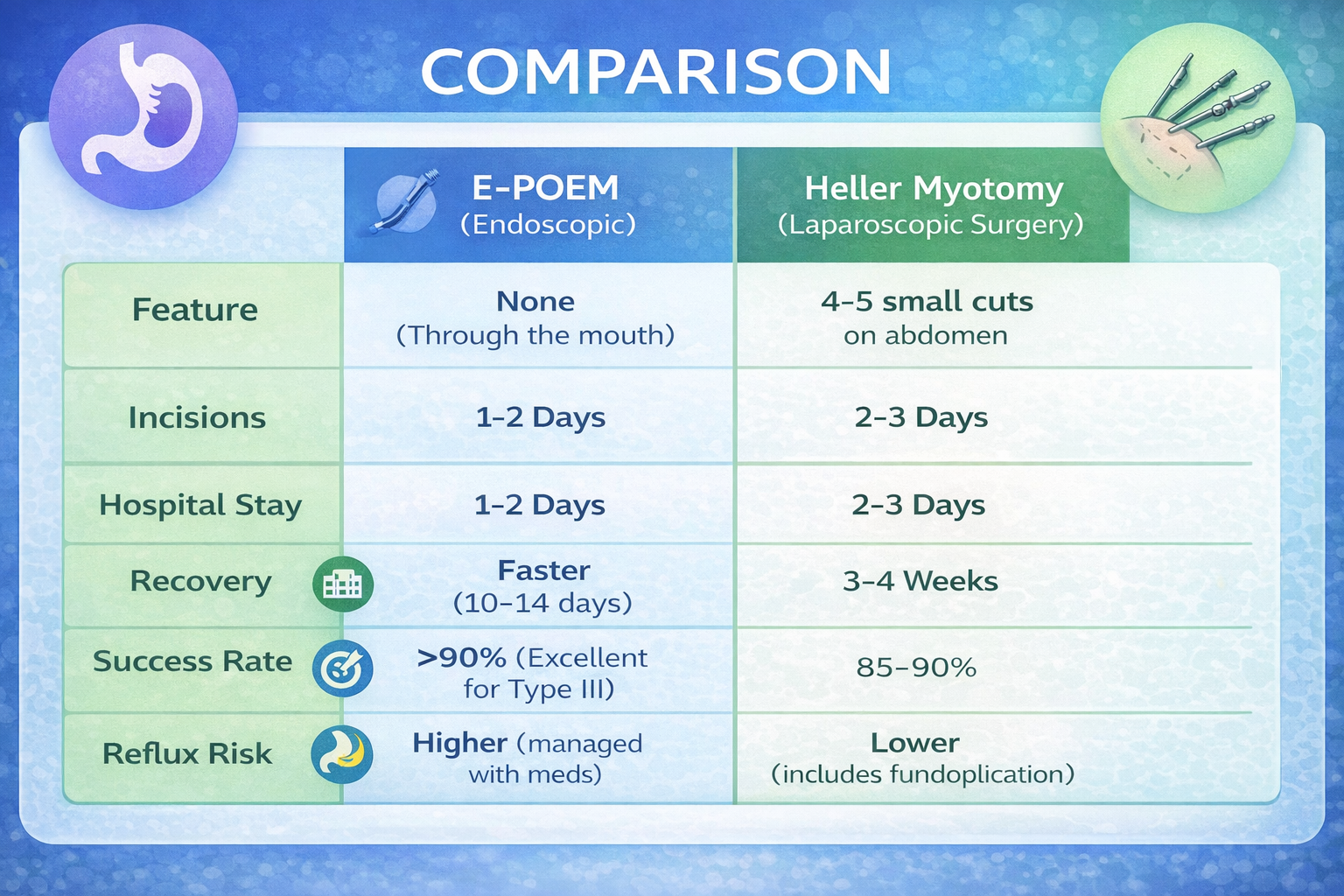
E-POEM provides comparable effectiveness to traditional surgery with faster recovery and no external scars. However, reflux risk is higher (40-50%) because we don't perform a fundoplication (anti-reflux wrap) like surgeons do. Most patients feel this trade-off is worthwhile since reflux is manageable with medication.
Who Benefits from E-POEM?
Ideal candidates at Fortis Mohali:
- Confirmed achalasia of any type on high-resolution manometry
- Type III (spastic) achalasia where E-POEM is often preferred
- Failed prior treatments (pneumatic dilation, Botox injections)
- Recurrent symptoms after previous Heller myotomy
- Want faster recovery than traditional surgery
- Willing to manage potential reflux with medication long-term
Preparing for E-POEM
Because the esophagus doesn't empty well with achalasia, we need extra preparation time to ensure it's completely empty for safety.
Pre-procedure instructions:
- 2 days before: Clear liquid diet only (water, broth, clear juices, tea)
- 12 hours before: Nothing by mouth (NPO)
- Arrange escort home after general anesthesia
- Plan for 1-2 night hospital stay for observation
- Medication adjustments (especially blood thinners) as directed
Recovery and Diet Progression
Most patients stay 1-2 nights at Fortis Mohali. We perform a contrast swallow study the next morning to ensure no leaks. Once cleared, you begin drinking clear liquids.
Typical diet timeline:
- Days 1-3: Clear liquids (water, broth, clear juices)
- Days 4-7: Full liquids (smoothies, protein shakes, thin soups)
- Week 2: Soft foods (mashed potatoes, scrambled eggs, yogurt)
- Weeks 3-4: Gradual return to normal diet, chewing thoroughly
By 4 weeks, most patients eat normally. However, continue eating slowly, drinking with meals, and staying upright 2-3 hours after eating to minimize reflux.
Managing Reflux: The Most Important Long-Term Issue
Here's what you need to understand: E-POEM works by making your LES permanently more relaxed, allowing food to pass easily. This also means stomach acid can flow back up more easily — reflux is expected, not a complication.
Reflux facts after E-POEM:
- 40-50% develop reflux symptoms (heartburn, regurgitation)
- 30-40% show inflammation on follow-up endoscopy
- Most cases are mild to moderate and manageable
Management approach:
- Proton pump inhibitors (PPIs) — most patients need long-term daily medication
- Lifestyle modifications — elevate bed head, avoid late meals, reduce trigger foods
- Follow-up endoscopy if symptoms significant to check for esophagitis
Most patients find this trade-off acceptable: they can swallow normally again after years of difficulty, and the reflux is controlled with a single daily pill.
E-POEM Success Rates and Outcomes
Excellent results at Fortis Mohali and worldwide:
- >90% clinical success — significant improvement in swallowing symptoms
- Symptom scores improve 70-80% from baseline
- 85-90% maintain good relief at 2 years
- 80-85% sustained improvement at 5 years
- Retreatment possible if symptoms recur
E-POEM works particularly well for Type III achalasia, failed prior therapies, and patients who have had recurrent symptoms after prior Heller myotomy.
Risks and Complications
Common, temporary side effects:
- Mild chest discomfort or pain for a few days
- Gas or bloating from carbon dioxide used during procedure
- Sore throat (resolves in 1-2 days)
Serious complications (rare, <2%):
- Mucosal perforation (tear in esophageal lining) — usually managed endoscopically
- Bleeding requiring transfusion (very rare)
- Infection (extremely rare with proper technique)
Expected outcome:
- Reflux in 40-50% (manageable with medication)
SECTION 2: G-POEM FOR REFRACTORY GASTROPARESIS
Understanding Gastroparesis
Gastroparesis literally means 'stomach paralysis' — though the stomach isn't actually paralyzed. It's a condition where stomach contractions are weak or uncoordinated, leading to delayed gastric emptying. Food sits in the stomach for many hours or even days, causing debilitating symptoms.
Common symptoms:
- Chronic nausea (often the most troublesome symptom)
- Vomiting of undigested food from hours earlier
- Early satiety — feeling full after just a few bites
- Bloating and abdominal distension
- Upper abdominal pain
- Poor appetite and weight loss
- Blood sugar fluctuations (especially problematic for diabetics)
Common causes:
- Diabetes (most common, especially long-standing poorly controlled)
- Post-surgical or post-viral nerve damage
- Medications (narcotics, GLP-1 agonists for diabetes/weight loss)
- Idiopathic (no cause found in up to 50%)
Diagnosis and Workup
Before considering G-POEM:
- Gastric emptying scintigraphy — gold standard nuclear medicine test confirming delayed emptying
- Upper endoscopy — rules out mechanical obstruction
- Symptom severity scoring (GCSI questionnaire)
- Medication review — identify drugs worsening symptoms
- Sometimes advanced testing (wireless motility capsule, FLIP) at specialized centers
How G-POEM Works
G-POEM is similar in concept to E-POEM but targets the pylorus (the valve between stomach and small intestine). In some gastroparesis patients, the pylorus doesn't relax properly, acting like a partially stuck door. G-POEM cuts the pyloric muscle to widen the opening, theoretically allowing food to pass more easily into the small intestine.
The technique is the same: create a tunnel within the stomach wall, cut the tight pyloric muscle, and close the entry point with clips.
Important Context: G-POEM is Still Evolving
Unlike E-POEM for achalasia (now established with >90% success), G-POEM for gastroparesis is newer with more variable outcomes. Recent guidance from the American Gastroenterological Association (AGA) cautions against routine use for all refractory gastroparesis, emphasizing careful patient selection.
Why the caution?
- Gastroparesis has multiple underlying mechanisms — not all involve pyloric dysfunction
- G-POEM only addresses one problem (tight pylorus), not weak stomach contractions or nerve damage
- Success rates vary (60-80% vs >90% for E-POEM) depending heavily on patient selection
- Some patients improve dramatically; others see minimal benefit
Who is a Candidate for G-POEM?
Considered for carefully selected patients:
- Refractory gastroparesis despite optimized diet and medications
- Confirmed delayed gastric emptying on scintigraphy
- Evidence or suspicion of pyloric dysfunction
- Failed adequate trials of prokinetics and antiemetics
- Realistic expectations that improvement may be partial, not complete cure
NOT recommended for:
- Mechanical obstruction (needs different treatment)
- Ongoing narcotic use that hasn't been addressed first
- Unrealistic expectations of complete cure
Preparation and Recovery
Because the stomach empties slowly with gastroparesis, we need even more preparation time than E-POEM.
Pre-procedure:
- 3 days before: Liquid diet
- 2 days before: Clear liquids only
- 12 hours before: Nothing by mouth
Recovery:
- 1-2 night hospital stay
- Contrast study next morning to check for leaks
- Gradual diet advancement: clear liquids → full liquids → soft foods over 2-3 weeks
- Long-term gastroparesis diet principles still needed (small frequent meals, low-fat, low-fiber initially)
G-POEM Outcomes: Setting Realistic Expectations
G-POEM is NOT a cure for gastroparesis. It's a treatment that may improve symptoms in carefully selected patients.
Published data shows:
- 60-80% clinical success (meaningful symptom improvement) at 1 year
- Variable durability — some maintain improvement, others experience recurrence
- Nausea/vomiting improvement often better than pain/bloating relief
- Gastric emptying may improve on testing, though this doesn't always correlate with symptom relief
'Success' means meaningful reduction in symptoms, improved ability to tolerate more variety in diet, reduced vomiting frequency, and better quality of life — NOT complete resolution of all symptoms.
Risks and Follow-Up
Procedure risks (similar to E-POEM):
- Bleeding, perforation, infection (rare)
- Persistent symptoms — procedure may not help
- Symptom recurrence over time
Follow-up care:
- 1-2 weeks: First post-discharge visit, diet guidance
- 1-3 months: Symptom assessment using standardized scores
- 6-12 months: Consider repeat gastric emptying study in selected cases
- Ongoing nutritional support and symptom management
Frequently Asked Questions
How do I decide between E-POEM and Heller myotomy for achalasia?
Depends on achalasia type (E-POEM preferred for Type III), recovery time preference, reflux concerns, prior failed treatments, and personal priorities. During consultation at Fortis Mohali, we discuss all options and help you choose the best fit for your situation.
Will I definitely need acid medication after E-POEM?
Most patients start a PPI (proton pump inhibitor) after E-POEM. Many need long-term therapy (40-50% develop reflux). Some can stop after a few months if reflux is minimal.
When can I return to work after POEM?
E-POEM: typically 10-14 days for desk work, 2-3 weeks for physical jobs. G-POEM: similar timeline, though varies by individual recovery.
Will G-POEM cure my gastroparesis?
No. G-POEM is not a cure. It may meaningfully improve symptoms in 60-80% of carefully selected patients, but ongoing dietary management and sometimes medications remain necessary. Expectations must be realistic.
What are the success rates?
E-POEM for achalasia: >90% clinical success, 85-90% maintain relief at 2 years. G-POEM for gastroparesis: 60-80% meaningful improvement at 1 year with more variable durability.
Is POEM covered by insurance in India?
Coverage varies by insurance company and policy. Our team at Fortis Mohali can help navigate insurance approval and provide cost estimates.
What alternatives exist?
Achalasia: pneumatic dilation (temporary relief), Heller myotomy with fundoplication (surgical), Botox (limited role). Gastroparesis: diet optimization, prokinetics, antiemetics, gastric electrical stimulation, surgical pyloroplasty.
Conclusion: Expert POEM Procedures at Fortis Mohali
POEM procedures represent a breakthrough in treating digestive motility disorders. E-POEM is now established as highly effective for achalasia with >90% success rates. G-POEM offers hope for carefully selected gastroparesis patients, though outcomes are more variable.
Key takeaways:
- E-POEM: excellent success rates, faster recovery than surgery, but higher reflux risk requiring medication
- G-POEM: 60-80% success in selected patients, requires realistic expectations as it's not a cure
- Both are minimally invasive through the mouth with no external scars
- Expertise matters — POEM requires specialized training and high-volume experience
If you're struggling with achalasia, esophageal spasm, or refractory gastroparesis, schedule a consultation with our gastroenterology team at Fortis Mohali. We'll conduct thorough evaluation, discuss ALL treatment options — including POEM, traditional approaches, and medical management — and help you make an informed decision.
Success requires careful patient selection, comprehensive pre-procedure evaluation, realistic expectations, and dedicated follow-up care — all of which we provide at Fortis Hospital Mohali.
Don't let swallowing disorders or gastroparesis control your life. Schedule your consultation today.
Contact Us – Fortis Hospital Mohali
For appointments, consultations, and diagnostic services, please contact:
📞 72728 72728
Our care team will assist you with:
Doctor appointments
Diagnostic and screening services
Health check-ups
Call now to book your appointment at Fortis Hospital, Mohali.
Categories
Clear allMeet the doctor

- Gastroenterology and Hepatobiliary Sciences | Gastroenterology | Gastroenterology and Hepatobiliary Sciences
-
 5 Years
-
 1250
1250
Related Blogs
View all
When Is A Liver Transplant Recommended?

Alcoholic Liver Disease - Why Worry?

Binge Drinking Trend Is The New Silent Killer


Irritable Bowel Syndrome

Digestive Disorders And Prevention



Keep track of your appointments, get updates & more!

