


Precision Radiation Therapy: Why Technology, Planning, and Motion Management Matter in Modern Cancer Care
By Dr Narendra Kumar Bhalla | Director, Radiation Oncology | Fortis Hospital, MohaliMD (Radiation Oncology) | 25+ Years in Advanced Radiotherapy | Expert in SRS, SBRT, IGRT & Brachytherapy
Precision Is Everything in Radiation Therapy
“In radiation oncology, the goal is not simply to treat the tumour. It is to target it with sub-millimetre accuracy while protecting the organs and tissues that matter most to the patient’s quality of life. The machine is only the starting point — what surrounds it determines the outcome.”
Radiation therapy is a cornerstone of cancer cure. It is used in nearly half of all cancer treatments worldwide, either as a primary treatment, after surgery, or alongside chemotherapy. But for most patients, the biggest fear is not the radiation itself — it is what the radiation might do to their healthy organs: the heart, lungs, brain, bowel and spinal cord.
The honest truth is this: not all radiation therapy is the same. While several hospitals in the Tricity region offer modern linear accelerators (the machines that generate and deliver the radiation beams) with comparable core specifications, the accessories, imaging capabilities, and motion-management technologies attached to the machine dictate how precisely that radiation is delivered. The difference between a good machine and a precision ecosystem can mean the difference between a cured patient with preserved quality of life and one dealing with avoidable long-term side effects.
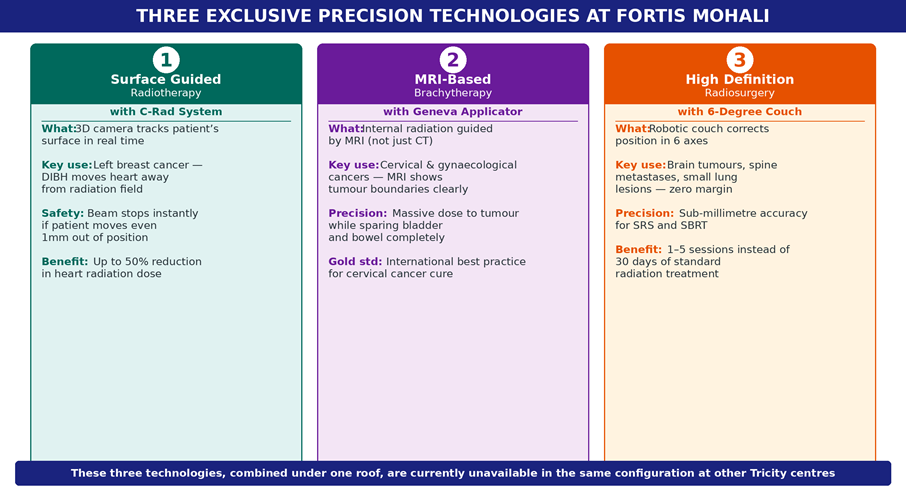
At Fortis Hospital Mohali, our Elekta Versa HD™ platform (a state-of-the-art linear accelerator) is augmented with three specific, high-end technologies — Surface Guided Radiotherapy (SGRT) with the C-Rad system (a 3D camera system that tracks the patient’s body surface in real time), MRI-based brachytherapy with the Geneva applicator (internal radiation guided by MRI imaging instead of CT), and High Definition Dynamic Radiosurgery (HDRS) with a 6-degree robotic couch (a treatment table that corrects patient position in all directions to sub-millimetre accuracy) — that together create a precision ecosystem currently unavailable in the same combination at any other centre in the region. In my 25 years of radiation oncology practice, this combination represents the most significant leap in treatment safety and accuracy I have witnessed.
Protecting the Heart: SGRT and Deep Inspiration Breath Hold
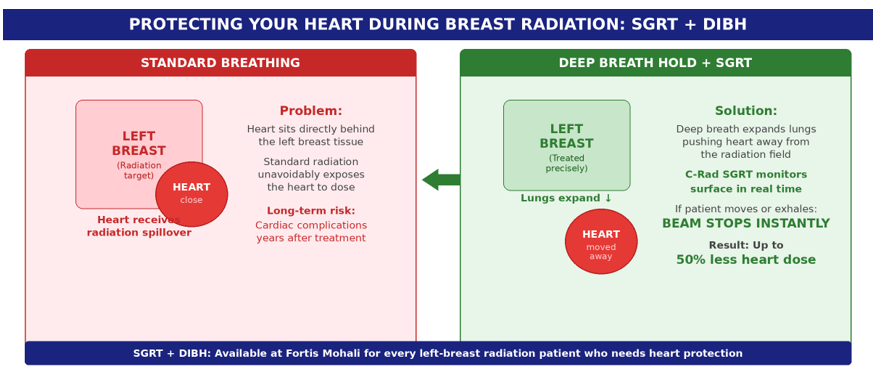
For any woman undergoing radiation for left-sided breast cancer, the proximity of the heart to the treatment field is a critical concern. Traditional radiation setups rely on skin tattoos and periodic X-ray imaging to position the patient — methods that are accurate but cannot track the patient in real time during treatment delivery.
Surface Guided Radiotherapy (SGRT) changes this paradigm. Using the advanced C-Rad Catalyst system, we project structured light onto the patient’s surface and monitor their anatomy in three dimensions, in real time, throughout the entire treatment. There are no additional X-rays, no extra radiation dose, and no physical contact with the patient.
When paired with Deep Inspiration Breath Hold (DIBH) (a technique where the patient holds a deep breath during treatment), the clinical impact is profound. When a patient takes a deep breath, the lungs expand and physically push the heart downward and away from the chest wall — increasing the distance between the heart and the radiation field. The C-Rad system monitors this breath hold continuously. If the patient exhales, moves, or shifts position by even a millimetre, the radiation beam stops instantly. It resumes only when the correct position is restored.
The result: up to 40 to 50 percent reduction in radiation dose to the heart. For a breast cancer survivor who has decades of life ahead, this translates into significantly lower long-term cardiac risk — a benefit that may not be visible today but matters enormously ten or twenty years from now.
Seeing What CT Cannot: MRI-Based Brachytherapy for Gynaecological Cancers
Brachytherapy (placing a radiation source directly inside or next to the tumour, also called internal radiation) is the international standard of care for cervical cancer. It delivers a massive, curative dose of radiation to the tumour while sparing surrounding tissues. But the accuracy of brachytherapy depends entirely on how well you can see the tumour and the organs around it.
Most centres rely on CT scans for brachytherapy planning. CT is excellent for bones and general anatomy, but it struggles with soft tissue contrast. A cervical tumour on CT often blends into the surrounding uterine tissue, bladder wall, and rectum — making it difficult to define exactly where the tumour ends and healthy tissue begins. The result: either the tumour is underdosed (risking recurrence) or the bladder and bowel receive more radiation than necessary (causing toxicity).
At Fortis Mohali, we perform MRI-based Intracavitary brachytherapy using the Geneva applicator. MRI provides stunning, high-contrast images of soft tissues — revealing the exact boundaries of the tumour with a clarity that CT simply cannot match. The Geneva applicator is fully MRI-compatible and supports both intracavitary and hybrid interstitial needle placements (needles placed directly into the tumour for harder-to-reach areas), enabling us to create highly personalised treatment plans even for bulky or irregularly shaped tumours.
This means we can deliver the maximum curative dose directly to the cancer while pushing dose away from the bladder, rectum, and bowel — maximising cure rates while minimising the long-term toxicity that affects a patient’s quality of life. MRI-guided brachytherapy with the Geneva applicator represents the current international gold standard for cervical cancer treatment.
Zero Margin for Error: Radiosurgery with the 6-Degree Robotic Couch
For tumours in the brain, spinal cord, or small lung lesions, precision is measured in fractions of a millimetre. A standard treatment couch moves up, down, left, and right. But what happens if a patient is lying with a very slight tilt that shifts the target by a millimetre? In conventional setups, that error is either accepted or corrected imperfectly.
Our High Definition Dynamic Radiosurgery (HDRS) capability is augmented by a 6-degree-of-freedom (6DoF) robotic couch. Beyond the standard four directions, this couch can pitch, roll, and yaw (tilt forward/backward, tilt side-to-side, and rotate) — performing rotational corrections that align the patient to sub-millimetre accuracy in three-dimensional space before the first pulse of radiation is delivered.
This enables Stereotactic Radiosurgery (SRS) (highly focused radiation to brain tumours in just 1–5 sessions) for brain metastases and Stereotactic Body Radiotherapy (SBRT) (the same concept for tumours in the body) for lung, liver, and spine tumours — treatments where ablative doses (extremely high, tumour-destroying doses) are concentrated into just 1 to 5 sessions instead of 30 days of conventional radiation. The 6DoF couch ensures that these enormous doses land exactly where they should, keeping critical structures like the optic nerves, brainstem, and spinal cord completely safe.
Breathing with the Tumour: 4DCT for Moving Targets
A tumour in the lung moves with every breath. A lesion in the liver shifts with the diaphragm. Treating these moving targets with a static plan is like trying to photograph a bird in flight with a long exposure — you get a blurred image and an imprecise result.
Our 4-Dimensional CT (4DCT) imaging (a special CT scan that captures images throughout the entire breathing cycle, like a video rather than a snapshot) captures video-like images of the tumour’s motion cycle across the entire breathing pattern. The treatment plan is then designed around this motion data, and the Elekta Versa HD™ delivers radiation that tracks the tumour as it moves — ensuring the beam stays on the cancer and off the healthy lung or liver tissue. Combined with our IGRT (Image Guided Radiotherapy) protocols (X-ray or CT verification of the tumour’s position before every single session), this represents the most motion-aware radiation delivery available.
A Complete Arsenal Under One Roof
Beyond these three exclusive technologies, our department offers the full spectrum of high-end radiation therapy for every clinical scenario — from straightforward curative treatments to the most complex stereotactic and brachytherapy cases. Patients from across Chandigarh, Punjab, Haryana, and Himachal Pradesh have access to the complete toolbox under one roof.
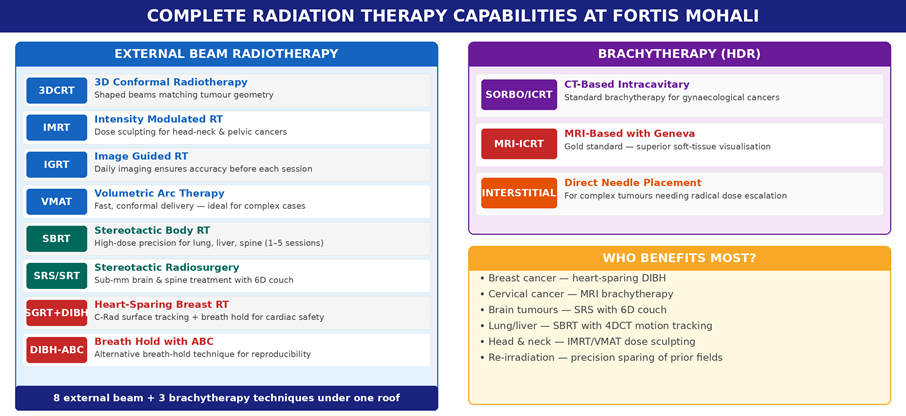
This breadth matters because no single technique is right for every cancer. A left-breast cancer needs SGRT and DIBH for cardiac protection. A cervical cancer needs MRI-guided brachytherapy with the Geneva applicator. A brain metastasis needs SRS with the 6DoF couch. A moving lung tumour needs 4DCT motion management. Having the complete toolbox under one roof — with a team trained across all modalities — means every patient receives the technique best suited to their specific disease, anatomy, and clinical situation.
Why Technology Alone Is Not Enough
I want to be transparent about something that matters deeply to me as a clinician: the machine is only one part of good radiation therapy. Outcomes depend on the entire workflow — the imaging quality, the contouring precision (how accurately the tumour and organs are outlined on the scan), the dosimetry planning (the mathematical calculation of how radiation is distributed), the immobilisation (keeping the patient perfectly still using custom moulds and masks), the quality assurance, the physics verification, and above all, the clinical judgment of the treating radiation oncologist and the execution by a trained physics and therapy team.
At Fortis Mohali, every complex case is discussed in a multidisciplinary tumour board alongside medical oncologists, surgical oncologists, radiologists, and pathologists before a treatment plan is finalised. Our dedicated Medical Physicist team is trained on every platform we operate — SGRT, HDRS, MRI-based brachytherapy, 4DCT — and our quality assurance protocols meet international standards. Technology in the right hands, guided by the right clinical judgment, is what produces the best outcomes.
Common Myths About Radiation Therapy
Myth: All radiation therapy is the same.
Reality: Technique, planning quality, imaging, motion control, and the specific accessories on the machine can make a major difference in both tumour control and side-effect profile. Not all advanced machines are equipped identically.
Myth: Modern radiation is always painful.
Reality: The radiation treatment itself is completely painless. You feel nothing during the beam delivery. Side effects, when they occur, develop gradually over the course of treatment and are carefully managed.
Myth: Advanced radiation is only for late-stage disease.
Reality: Precision radiotherapy is used across early curative, post-surgical adjuvant (additional treatment given after surgery to reduce the risk of cancer returning), and metastatic settings. In fact, early-stage disease often benefits most from precision — because the goal is cure with minimal long-term impact on quality of life.
Myth: Brachytherapy is outdated.
Reality: Advanced image-guided brachytherapy — especially MRI-based — remains one of the most effective modalities in medicine for cervical and gynaecological cancers. It is the international gold standard, not a relic.
Breast cancer (SGRT + DIBH for heart protection), cervical and gynaecological cancers (MRI-based brachytherapy), brain tumours and spine metastases (SRS/SBRT with 6D couch), lung and liver tumours (SBRT with 4DCT motion tracking), and head-and-neck cancers (IMRT/VMAT dose sculpting) benefit the most from the specific technologies available at our centre.
Choosing the Right Radiation Oncologist: Why Experience and Expertise Matter
When patients across Chandigarh, Mohali, and Punjab search for the best radiation oncologist for their cancer treatment, the decision should come down to three things: clinical experience, mastery of advanced techniques, and a track record of outcomes across different cancer types.
Dr Narendra Kumar Bhalla, Director of Radiation Oncology at Fortis Hospital Mohali, brings over 25 years of dedicated radiation oncology experience to every case. He has personally treated thousands of cancer patients across North India — from early-stage breast cancer requiring heart-safe DIBH radiation, to complex brain metastases needing single-session radiosurgery, to advanced cervical cancers requiring MRI-guided brachytherapy.
What sets Dr Bhalla apart is not just his years in practice, but his hands-on leadership in introducing precision technologies that were previously unavailable in the Tricity region:
- First to introduce SGRT with C-Rad in the region — enabling real-time motion tracking and heart-safe breast radiation
- Pioneer of MRI-based brachytherapy with the Geneva applicator — the international gold standard for cervical cancer, now available locally
- Leader in HDRS with the 6-degree robotic couch — sub-millimetre radiosurgery for brain, spine, and lung tumours
- Trained across all modalities — IMRT, VMAT, SBRT, SRS, IGRT, 4DCT, CT-based and MRI-based brachytherapy
He regularly participates in multidisciplinary tumour boards, ensuring every treatment plan reflects collective expert judgment — not a one-doctor opinion. For patients seeking a radiation oncologist in Panchkula, Chandigarh, or anywhere in North India, Dr Bhalla’s combination of experience, technology access, and clinical judgment makes him a trusted choice.
More Questions Patients Ask Online
Is radiation therapy painful during the actual treatment?
No. The radiation beam is completely painless — you feel nothing during delivery. Side effects like skin redness or fatigue develop gradually over weeks and are manageable.
Will radiation make me radioactive? Is my family safe?
External beam radiation (the most common type) does not make you radioactive. You can safely be around family, children, and pregnant women immediately after each session.
How long does each radiation session take?
Each session typically takes 15–30 minutes, though most of that time is setup and positioning. The actual radiation delivery lasts only a few minutes.
Can I work during radiation treatment?
Most patients continue working during treatment. Fatigue is the most common side effect, so you may need to adjust your schedule, but daily life can largely continue normally.
Is precision radiation therapy available in the Chandigarh Tricity area?
Yes. Fortis Hospital Mohali offers the most comprehensively equipped radiation oncology centre in the Tricity region, serving patients from Mohali, Chandigarh, Panchkula, and across Punjab, Haryana, and Himachal Pradesh.
What is the difference between IMRT, VMAT, SBRT, and SRS?
IMRT (Intensity-Modulated Radiation Therapy) and VMAT (Volumetric Modulated Arc Therapy) sculpt the radiation dose around the tumour in daily sessions over weeks. SBRT and SRS deliver much higher doses in just 1–5 sessions for small, well-defined tumours. Your radiation oncologist chooses the best technique for your specific cancer.
Are there long-term side effects of radiation therapy?
Most side effects resolve within weeks after treatment. Long-term effects are possible but uncommon with modern precision techniques, which specifically aim to minimise dose to healthy organs.
Can radiation therapy be combined with chemotherapy or surgery?
Yes. Radiation is frequently combined with surgery (before or after) and chemotherapy. Your oncology team will design the best combination based on your cancer type and stage.
Choosing the Right Radiation Oncologist: Why Experience and Expertise Matter
When patients across Chandigarh, Mohali, and Punjab search for the best radiation oncologist for their cancer treatment, the decision should come down to three things: clinical experience, mastery of advanced techniques, and a track record of outcomes across different cancer types.
Dr Narendra Kumar Bhalla, Director of Radiation Oncology at Fortis Hospital Mohali, brings over 25 years of dedicated radiation oncology experience to every case. He has personally treated thousands of cancer patients across North India — from early-stage breast cancer requiring heart-safe DIBH radiation, to complex brain metastases needing single-session radiosurgery, to advanced cervical cancers requiring MRI-guided brachytherapy.
What sets Dr Bhalla apart is not just his years in practice, but his hands-on leadership in introducing precision technologies that were previously unavailable in the Tricity region:
- First to introduce SGRT with C-Rad in the region — enabling real-time motion tracking and heart-safe breast radiation
- Pioneer of MRI-based brachytherapy with the Geneva applicator — the international gold standard for cervical cancer, now available locally
- Leader in HDRS with the 6-degree robotic couch — sub-millimetre radiosurgery for brain, spine, and lung tumours
- Trained across all modalities — IMRT, VMAT, SBRT, SRS, IGRT, 4DCT, CT-based and MRI-based brachytherapy
He regularly participates in multidisciplinary tumour boards, ensuring every treatment plan reflects collective expert judgment — not a one-doctor opinion. For patients seeking a radiation oncologist in Panchkula, Chandigarh, or anywhere in North India, Dr Bhalla’s combination of experience, technology access, and clinical judgment makes him a trusted choice.
The Right Radiation for the Right Tumour
“When choosing a radiation oncology centre, don’t just ask about the name of the machine. Ask about the technologies that ensure safety, comfort, and precision. Ask whether they have SGRT for motion tracking, MRI-based brachytherapy for soft-tissue cancers, and 6D couch delivery for radiosurgery. These are the details that determine your outcome.” — Dr Narendra Kumar Bhalla
If you or a loved one has been diagnosed with breast, cervical, brain, lung, or any cancer requiring radiation therapy, the technology and expertise behind your treatment will impact your outcome. At Fortis Hospital Mohali, we bring together the most comprehensive radiation therapy ecosystem north of Delhi — with the clinical expertise to match.
To schedule a consultation with Dr Narendra Kumar Bhalla at Fortis Cancer Institute, Mohali, or to discuss whether SGRT, DIBH, SBRT, SRS, or MRI-based brachytherapy is appropriate for your case, contact the Department of Radiation Oncology. We welcome second opinions — bring your previous CT scans, PET scans, and biopsy reports for a comprehensive review.
Contact Us – Fortis Hospital Mohali
For appointments, consultations, and diagnostic services, please contact:
📞 72728 72728
Our care team will assist you with:
Doctor appointments
Diagnostic and screening services
Health check-ups
Call now to book your appointment at Fortis Hospital, Mohali.
Categories
Clear allMeet the doctor

- Oncology | Radiation Oncology
-
 25 Years
-
 2050
2050
Related Blogs
View all








FAQs
What is SGRT and how does it help during radiation?
Surface Guided Radiotherapy uses 3D camera technology to track the patient’s surface in real time during treatment. It improves positioning accuracy, reduces setup errors, and is especially valuable for breast radiation with breath-hold techniques, where it monitors the patient’s position continuously and stops the beam instantly if any movement is detected.
How does DIBH protect my heart in left-breast radiation?
Deep Inspiration Breath Hold involves taking a controlled deep breath during treatment. This expands the lungs and pushes the heart away from the chest wall, increasing the distance between the heart and the radiation field. When combined with SGRT monitoring, it can reduce heart dose by up to 40 to 50 percent.
What is MRI-based brachytherapy and why is it better than CT-based?
MRI provides far superior soft-tissue contrast compared to CT. In cervical cancer brachytherapy, MRI allows the treating team to see the exact tumour boundaries and the adjacent bladder and bowel, enabling more precise dose delivery. CT-based planning often cannot distinguish tumour from normal tissue with the same clarity.
How many sessions will I need for SBRT or SRS?
Stereotactic treatments typically require 1 to 5 sessions, compared to 25 to 30 sessions for conventional radiation. The exact number depends on tumour size, location, and proximity to critical structures. Your radiation oncologist will determine the optimal plan for your specific case.
What cancers benefit most from these advanced technologies?
Breast cancer (SGRT + DIBH for heart protection), cervical and gynaecological cancers (MRI-based brachytherapy), brain tumours and spine metastases (SRS/SBRT with 6D couch), lung and liver tumours (SBRT with 4DCT motion tracking), and head-and-neck cancers (IMRT/VMAT dose sculpting) benefit the most from the specific technologies available at our centre.

Keep track of your appointments, get updates & more!

