


Radiation Therapy for Chronic Pain - Benefits Risks and When It Is Used
By Dr. Narendra Bhalla | Director, Radiation Oncology, Fortis Hospital Mohali
Specialist in palliative and curative radiation oncology, including external-beam radiotherapy for cancer-related pain and image-guided treatment planning.
Medical disclaimer: This article is for general education only and is not a substitute for professional medical advice, diagnosis or treatment. Radiation therapy is not a first-line treatment for most causes of chronic pain. Any decision about treatment should be made with a qualified radiation oncologist and your treating doctors.
Chronic pain is one of the most common reasons people seek medical help, and for many it becomes a daily companion that medicines, physiotherapy and injections do not fully tame. When someone hears the words “radiation therapy,” they almost always think of cancer. That association is understandable — but it is only part of the story. Radiation has a long-established, evidence-backed role in relieving cancer-related pain, and a much newer, more debated role in easing certain kinds of non-cancer inflammatory pain through what is called low-dose radiation therapy (LDRT).
This article separates those two worlds clearly, because they are genuinely different in dose, purpose and strength of evidence. It also states plainly, up front, what an honest radiation oncologist will tell you in clinic: for the vast majority of chronic pain, radiation is not the first thing we reach for. It is a carefully selected option for specific situations, chosen after other treatments and a proper diagnosis — never a shortcut around them.
What Is Radiation Therapy for Pain?
Radiation therapy uses precisely targeted, high-energy beams (usually delivered by a machine called a linear accelerator) to treat tissue in a defined area of the body. When used for pain, it works in two very different dose ranges:
- High-dose palliative radiotherapy (for cancer pain): moderate doses aimed at a tumour that is causing pain — for example, cancer that has spread to bone. The goal is to calm tumour activity and relieve symptoms, not necessarily to cure.
- Low-dose radiation therapy or LDRT (for benign pain): very small doses — a tiny fraction of cancer-treatment levels — used to reduce inflammation in conditions such as osteoarthritis. A full LDRT course is typically around 3 Gy in total, compared with the far higher doses used to treat cancer.
The mechanism differs too. Against a tumour, radiation damages the DNA of cancer cells, slowing their growth and reducing the pressure and inflammation they cause. At the very low doses used for benign pain, radiation is thought to act instead as an anti-inflammatory — dampening the activity of inflammatory immune cells and the chemical signals (cytokines) that drive joint pain, rather than destroying tissue.
Radiation Therapy for Cancer Pain (Palliative Radiotherapy)
This is the most established and evidence-supported use of radiation for pain. When cancer spreads to bone or presses on nerves and surrounding tissues, it can cause severe, persistent pain. Palliative radiotherapy is designed to relieve that pain and improve quality of life. Importantly, “palliative” does not mean treatment has been given up — it can be delivered alongside chemotherapy, immunotherapy, hormonal or targeted therapy, at many stages of advanced cancer.
Bone metastases: the classic indication
Cancers that commonly spread to bone — particularly breast, prostate and lung cancer — can cause painful deposits in the spine, pelvis, ribs and long bones. External-beam radiotherapy is a well-established, non-invasive treatment for these painful bone metastases, and is recommended in major international guidelines. Overall, radiotherapy produces meaningful pain relief in a large majority of patients who are suitable for it, though complete disappearance of pain is less common.
One treatment or several? What the evidence shows
For uncomplicated painful bone metastases, high-quality trials show that a single treatment of 8 Gy provides pain relief equivalent to longer courses such as 20 Gy in 5 sessions, 24 Gy in 6 sessions, or 30 Gy in 10 sessions. The 2024 ASTRO clinical practice guideline reflects this equivalence. A single session is far more convenient — especially for frail patients or those travelling long distances — with the main trade-off being a higher chance of needing repeat treatment to the same site later (roughly 20% after a single fraction versus about 8% after a longer course).
This matters greatly for Indian patients, where travel and cost are real barriers to care. Encouragingly, the evidence holds in our own setting: a prospective study from Medical College Kolkata, published in the Indian Journal of Palliative Care, found single-fraction radiotherapy gave pain relief for painful vertebral metastases comparable to multiple-fraction treatment, with no significant difference in side effects — the same conclusion later echoed in large international meta-analyses.
How quickly does relief begin?
Radiation is not an instant painkiller. Some patients notice improvement within a few days, but meaningful benefit usually develops over one to several weeks. A minority experience a temporary “pain flare” shortly after treatment before improvement sets in, and not everyone achieves complete relief — some continue to need pain medication, which should only ever be adjusted under medical supervision.

When surgery or another approach comes first
Radiation is not always the first step. An orthopaedic or neurosurgical assessment may be needed before radiotherapy when there is an actual or impending fracture of a weight-bearing bone, mechanical instability of the spine, significant spinal-cord compression, or when a tissue diagnosis is required. Best results in cancer pain usually come from combining radiotherapy with the wider toolkit — appropriate pain medicines, bone-strengthening drugs, systemic cancer treatment and multidisciplinary supportive care.
More advanced options, briefly
Stereotactic body radiotherapy (SBRT) delivers a highly focused, higher dose in one to a few sessions and may be considered for selected patients — for example, those with limited (oligometastatic) disease, radioresistant tumour types, or a good general condition and longer expected survival. It is not automatically better for every painful metastasis; patient selection and spinal stability matter. Separately, radiopharmaceuticals (bone-seeking radioactive injections such as Radium-223 for prostate cancer) can help when multiple bone sites are painful at once; these travel through the bloodstream and are different from external-beam radiation.
Low-Dose Radiation Therapy for Non-Cancer Chronic Pain
This is the newer, more debated frontier — and the area where balance matters most. Low-dose radiation therapy (LDRT) uses doses far below cancer-treatment levels to try to reduce pain from benign inflammatory and degenerative conditions. It has been used in some countries, notably Germany, for decades, but it remains uncommon and is not an established standard of care in many parts of the world, including India.
Conditions where LDRT has been used
- Osteoarthritis of the knee, hip, shoulder and small hand joints
- Chronic tendon and soft-tissue conditions — plantar fasciitis and painful heel spur, tennis or golfer's elbow (epicondylitis), Achilles tendinopathy, bursitis
- Some other degenerative or inflammatory painful conditions, on a selective basis
It is generally considered only for adults (typically older patients) whose pain has persisted for months despite conservative measures such as lifestyle changes, physiotherapy, medicines, orthotics or injections. It is not recommended for rheumatoid or psoriatic arthritis or for spinal conditions, and careful patient selection is essential.
How it works and what a course looks like
Rather than destroying tissue, LDRT is thought to shift the local environment away from inflammation — reducing pro-inflammatory signals and encouraging anti-inflammatory ones. A common regimen is about 6 short sessions of roughly 0.5 Gy each over two to three weeks (around 3 Gy in total), with each session lasting only a few minutes and painless, like having an X-ray. Any pain relief tends to develop gradually over several weeks, not immediately.
What does the evidence actually say?
Here honesty is essential, because the evidence is genuinely mixed. Many retrospective studies and patient series report good pain relief in a substantial proportion of people — for example, a single-institution analysis published in 2025 in the International Journal of Radiation Oncology, Biology, Physics (the “Red Journal”) reported clinically meaningful pain improvement in around 80% of treated joints. German data have long suggested response rates in a similar range, and German (DEGRO) guidelines support LDRT for selected benign painful conditions, particularly after conservative treatment has failed.
However, the most rigorous trials — those that compare LDRT against a convincing “sham” (dummy) treatment — have been far less encouraging. A well-conducted double-blind, sham-controlled trial in knee osteoarthritis, published in Annals of the Rheumatic Diseases in 2019, found no meaningful advantage of LDRT over sham treatment. The multicentre German ArthroRad trial similarly found that a standard dose and a very low (near-placebo) dose produced comparable pain relief, raising the question of how much of the benefit is a true radiation effect. More recently, a randomised sham-controlled trial from Korea presented in 2025 did report significant benefit over sham for mild-to-moderate knee osteoarthritis — a hopeful signal, but one that needs confirmation with longer follow-up and larger numbers.
The honest summary: LDRT for non-cancer pain is promising for carefully selected patients but not proven to the standard we expect of routine treatment. It is not the same as palliative radiation for cancer, it is not universally accepted, and it should be considered only after specialist evaluation and a full discussion of alternatives. It is not a first-line therapy, and in India it should be regarded as an evolving, investigational option offered only in appropriate centres.
Potential Benefits
- Non-invasive and delivered as a short outpatient course — no surgery, no anaesthesia, no hospital stay for the radiation itself
- In cancer pain, well-established, meaningful relief for most suitable patients, sometimes from a single session
- May reduce reliance on pain medication in some patients (under medical supervision)
- Precisely targeted with modern planning, limiting exposure to healthy tissue
- For selected benign conditions, some patients report relief lasting many months
Risks and Side Effects
Radiation should never be described as having “no side effects.” What to expect depends heavily on the area treated and the dose.
- Short-term (cancer-dose palliative RT): temporary tiredness, mild skin irritation, a possible short-lived pain flare, and site-specific effects such as nausea or loose stools when the abdomen or pelvis is treated, or swallowing discomfort when the chest or neck is treated. Most short palliative courses are generally well tolerated.
- Short-term (LDRT): side effects are uncommon at these very low doses; occasional mild skin redness is the main reported effect.
- Long-term: a very small theoretical risk of a radiation-induced second cancer exists with any radiation exposure. This is a more relevant consideration for younger patients and when treating benign conditions, which is exactly why LDRT is generally reserved for older adults and requires a careful individual risk–benefit discussion.
- Not suitable for everyone: radiation is avoided in pregnancy and in certain other situations. Standard external-beam radiotherapy does not make you radioactive — you are safe to be around family and children afterwards.
How Radiation Compares with Other Pain Treatments
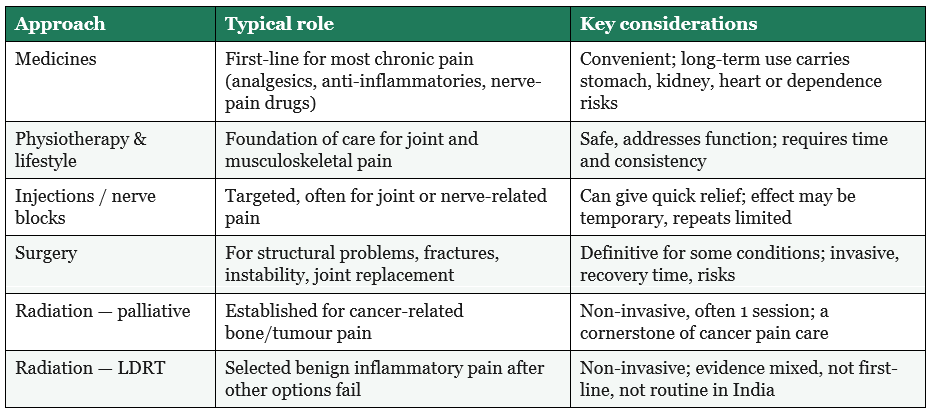
Radiation sits within a much broader menu of pain treatments. The table below is a simplified comparison to aid discussion with your doctor — it is not a ranking, and the right choice depends entirely on the cause of pain and the individual.
What the Treatment Process Involves
Whether for cancer pain or a benign condition, the pathway is broadly similar and mostly outpatient:
- Consultation: a radiation oncologist reviews your history, prior treatments, imaging and the exact site and cause of pain.
- Planning (CT simulation): a planning scan maps the precise treatment area, similar to a diagnostic CT.
- Treatment delivery: each session on the linear accelerator is painless and usually takes only a few minutes, though positioning takes a little longer. Palliative courses range from a single session to about ten; LDRT is typically around six short sessions.
- Follow-up: your team assesses pain response and any side effects over the following weeks, since benefit builds gradually.
Who Might Be a Good Candidate?
Radiation for pain is considered only after proper evaluation, and candidacy is individual. In broad terms it may be appropriate for:
- Cancer patients with pain from a bone metastasis or tumour visible on imaging, especially pain persisting despite medication
- People with localised, chronic, benign inflammatory pain who have not responded to physiotherapy, medicines or injections and are not immediate surgical candidates
- Patients evaluated by a multidisciplinary team — typically a pain or orthopaedic specialist together with a radiation oncologist
It is generally not appropriate as a first step, during pregnancy, for inflammatory arthritis such as rheumatoid disease (in the LDRT context), or where a clear structural problem is better addressed another way.
The Future Outlook
Research is active on both fronts. In cancer pain, techniques such as SBRT are being refined for durable control of spine and oligometastatic disease. In benign pain, several randomised, sham-controlled trials are underway internationally to settle the central question of how much LDRT truly adds beyond placebo, and to define the best dose and the patients most likely to benefit. Until those results mature, a cautious, evidence-led and individualised approach remains the right one.
Conclusion
Radiation therapy can be genuinely transformative for the right patient — most clearly and reliably in relieving cancer-related bone pain, and more selectively and cautiously in certain benign inflammatory conditions through low-dose treatment. But it is not a magic bullet and, for most chronic pain, not the first line. The key is an accurate diagnosis of what is causing the pain, and a candid conversation about whether radiation, medicines, physiotherapy, injections, surgery, or a combination offers the best relief for you.

Contact Us – Fortis Hospital Mohali
For appointments, consultations, and diagnostic services, please contact:
📞 72728 72728
Our care team will assist you with:
Doctor appointments
Diagnostic and screening services
Health check-ups
Call now to book your appointment at Fortis Hospital, Mohali.
Categories
Clear allRelated Blogs
View all









FAQs
Is radiation therapy safe for chronic pain?
For cancer-related pain, palliative radiotherapy is well-established and generally well tolerated, with mostly short-term, manageable side effects. For benign pain, low-dose radiation uses a tiny fraction of cancer doses and side effects are uncommon, though a very small long-term risk means it is used selectively, mainly in older adults after careful evaluation. Standard external-beam radiation does not make you radioactive.
How long does the pain relief last?
It varies. In cancer-related bone pain, relief typically develops over one to several weeks and can last for months; treatment can sometimes be repeated if pain returns. In benign conditions, some patients report relief lasting many months, but responses are variable and not everyone benefits.
Is radiation therapy for pain available in India?
Palliative radiotherapy for cancer pain is widely available across Indian cancer centres and is a routine part of care. Low-dose radiation therapy for non-cancer conditions such as osteoarthritis is far less common, is still considered evolving and investigational here, and is offered only in selected centres after specialist assessment.
Is radiation used for ordinary back pain?
Usually not. Common mechanical back pain is treated with other approaches. Radiation may be considered when back pain is caused by cancer involving the spine or nearby tissues.
Will one session be enough?
For many uncomplicated painful bone metastases, a single session can provide pain relief comparable to a longer course, which is especially convenient for frail patients or those travelling far. The right schedule depends on the individual case.

Keep track of your appointments, get updates & more!

