
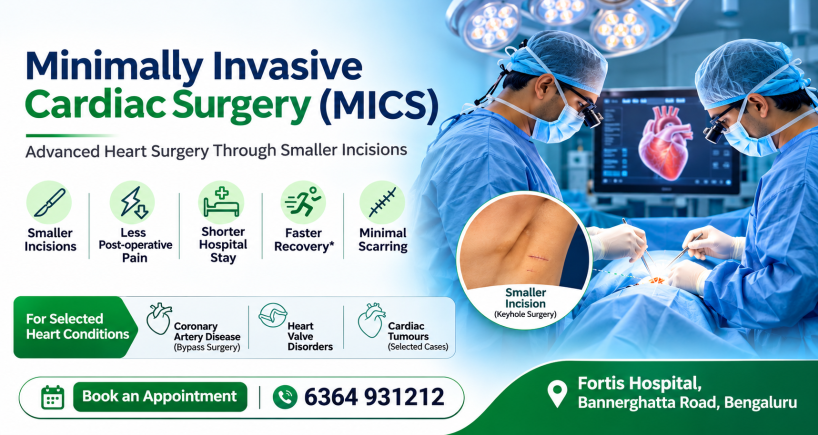


Robotic Cardiac Surgery in South Bangalore at Fortis Hospital Bannerghatta Road
Minimally Invasive Cardiac Surgery (MICS): Benefits, Procedures and Recovery
Introduction
Heart surgery has evolved significantly with advancements in medical technology and surgical techniques. Traditionally, many cardiac surgeries required a large incision through the breastbone (sternum) to access the heart. Today, selected patients may benefit from an advanced approach known as Minimally Invasive Cardiac Surgery (MICS).
MICS uses smaller incisions to access the heart, potentially reducing surgical trauma and supporting a smoother recovery. Depending on the patient's condition, surgeons may use specialised instruments, video-assisted techniques or robotic assistance to perform complex cardiac procedures.
At Fortis Hospital, Bannerghatta Road, Bangalore, specialised Minimally Invasive Cardiac and Robotic Surgery services offer advanced surgical options for patients requiring cardiac treatment.
What Is Minimally Invasive Cardiac Surgery (MICS)?
Minimally Invasive Cardiac Surgery, commonly known as MICS, is an advanced surgical approach used to treat certain heart conditions through smaller incisions rather than the conventional large incision associated with traditional open-heart surgery.
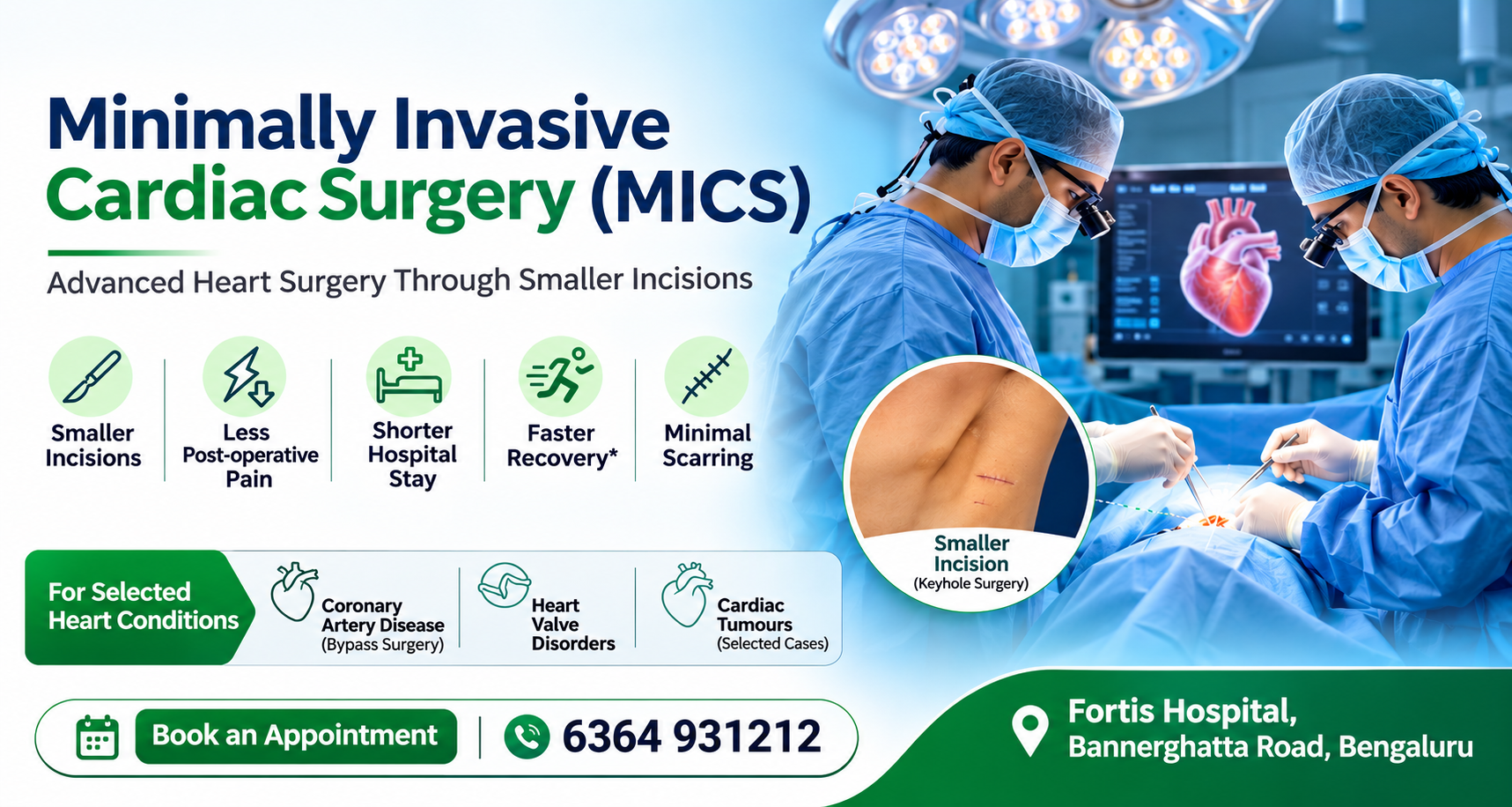
In many MICS procedures, the surgeon makes a small incision, often on the side of the chest, and accesses the heart through the spaces between the ribs. A specialised camera, known as a thoracoscope, and surgical instruments help the surgeon perform the required procedure.
Unlike conventional surgery, which often involves opening the breastbone, selected MICS procedures can be performed without dividing the sternum.
The suitability of this approach depends on the patient's diagnosis, heart condition, medical history and overall health.
What Conditions Can Be Treated Through MICS?
Minimally invasive techniques can be used for selected cardiac conditions, including:
1. Coronary Artery Disease
Coronary artery disease occurs when the arteries supplying blood to the heart become narrowed or blocked due to plaque accumulation. Selected patients may be suitable for minimally invasive coronary artery bypass grafting (CABG) to improve blood flow to the heart.
2. Heart Valve Disorders
Heart valve conditions occur when one or more valves do not open or close properly, affecting the normal flow of blood through the heart. Depending on the condition, minimally invasive techniques may be used for valve repair or replacement.
3. Mitral Valve Disease
The mitral valve regulates blood flow between the left atrium and left ventricle. Conditions such as mitral valve regurgitation or stenosis may require surgical intervention. Selected patients may benefit from minimally invasive mitral valve repair or replacement.
4. Cardiac Tumours
Certain tumours that develop within the heart may require surgical removal. Depending on the tumour's location, size and complexity, minimally invasive techniques may be considered.
What Are the Benefits of Minimally Invasive Cardiac Surgery?
One of the major advantages of MICS is that it allows selected cardiac procedures to be performed through smaller incisions.
Potential benefits include:
- Smaller surgical incisions: Avoids a large central chest incision in suitable procedures.
- Reduced surgical trauma: May involve less disruption to surrounding tissues.
- Less post-operative pain: Some patients may experience reduced discomfort compared with conventional surgery.
- Reduced blood loss: Smaller surgical access may help minimise blood loss in selected procedures.
- Lower risk of wound-related complications: Avoiding a breastbone incision may reduce certain wound-healing concerns.
- Potentially shorter hospital stay: Some patients may require less time in the hospital.
- Cosmetic benefits: Smaller incisions may result in less visible surgical scars.
- Recovery support: Patients may be able to resume daily activities sooner, depending on the procedure and their recovery.
It is important to understand that these benefits vary depending on the procedure, the patient's health and the complexity of the cardiac condition.
MICS vs Traditional Open-Heart Surgery: What Is the Difference?
Both approaches are used to treat cardiac conditions, but they differ in how the surgeon accesses the heart.
Parameter
Traditional Open-Heart Surgery
MICS
Surgical incision
Usually a larger chest incision
Smaller incisions
Access to heart
Often through the breastbone
Often through spaces between the ribs
Breastbone division
Common in conventional sternotomy
Avoided in many MICS procedures
Surgical instruments
Conventional surgical instruments
Specialised instruments and cameras
Recovery
May require longer recovery
May support faster recovery in selected patients
Scarring
Generally a larger scar
Generally smaller scars
The choice between the two approaches is based on the patient's clinical requirements. Traditional open-heart surgery continues to be an important and appropriate treatment option for many complex cardiac conditions.
What Is Robotic Cardiac Surgery?
Robotic cardiac surgery is an advanced form of minimally invasive surgery in which the surgeon uses specialised robotic instruments and a high-definition camera to perform selected cardiac procedures.
The surgeon controls the robotic system throughout the operation. The technology provides enhanced visualisation and allows precise instrument movements through small incisions.
Robotic assistance may be considered for selected procedures, including certain heart valve surgeries and coronary artery bypass procedures.
It is important to note that robotic technology assists the surgeon; it does not operate independently.
Who Is an Ideal Candidate for MICS?
Not every patient requiring heart surgery is suitable for a minimally invasive approach.
A cardiac surgeon evaluates several factors before recommending MICS, including:
- The type and severity of the heart condition.
- The location and extent of coronary artery blockages.
- The condition of the heart valves.
- Previous cardiac surgeries.
- The patient's age and overall health.
- Other medical conditions that may affect surgical outcomes.
- Results of diagnostic investigations and imaging.
A detailed consultation with a cardiac surgeon is essential to determine whether minimally invasive surgery, robotic surgery or conventional open-heart surgery is the most appropriate treatment option.
What Can Patients Expect During Recovery After MICS?
Recovery after minimally invasive cardiac surgery varies depending on the procedure performed and the patient's overall health.
The recovery process generally involves:
1. Post-operative Monitoring
Following surgery, patients are monitored in the intensive care unit (ICU), where the medical team observes heart function, breathing, blood pressure and other vital parameters.
2. Pain Management and Wound Care
The healthcare team provides appropriate pain management and instructions for caring for the surgical incision.
3. Gradual Mobilisation
Patients are encouraged to begin movement and walking as advised by their treating team to support recovery.
4. Cardiac Rehabilitation
Depending on the patient's condition, a structured cardiac rehabilitation programme may be recommended to help improve physical activity, cardiovascular health and overall well-being.
5. Follow-up Consultations
Regular follow-up appointments help doctors assess recovery, monitor heart function and guide patients on gradually returning to their routine activities.
Patients should follow their surgeon's instructions regarding medication, physical activity, wound care and follow-up visits.
Why Consider Fortis Hospital, Bannerghatta Road, for MICS?
Fortis Hospital, Bannerghatta Road, Bangalore, offers specialised Minimally Invasive Cardiac and Robotic Surgery services under its Cardiac Sciences department.
The hospital provides surgical options for selected patients requiring treatment for coronary artery disease, heart valve disorders and other cardiac conditions.
The MICS and Robotic Cardiac Surgery programme is led by Dr. Sudarshan G T, Director – MICS & Robotic Cardiac Surgery, along with the specialised cardiac care team.
With advanced surgical techniques and a multidisciplinary approach to cardiac care, patients can consult the cardiac surgery team to understand the treatment options available for their condition.
Frequently Asked Questions About MICS
1. Is minimally invasive cardiac surgery safer than open-heart surgery?
MICS may offer certain advantages, including smaller incisions and potentially faster recovery for appropriately selected patients. However, both approaches involve surgical risks. The safest option depends on the patient's condition and the surgeon's assessment.
2. How long does it take to recover from MICS?
Recovery time varies depending on the type of surgery, the patient's overall health and any post-operative complications. Some patients may resume routine activities sooner than after conventional open-heart surgery, subject to medical advice.
3. Is MICS suitable for all heart patients?
No. MICS is suitable only for selected patients. A detailed cardiac evaluation is necessary to determine whether this surgical approach is appropriate.
4. Can bypass surgery be performed through minimally invasive techniques?
Yes. Selected patients with coronary artery disease may undergo minimally invasive coronary artery bypass surgery, including procedures such as MIDCAB.
5. Is robotic cardiac surgery the same as MICS?
Robotic cardiac surgery is a specialised form of minimally invasive surgery. It uses robotic instruments controlled by the surgeon to perform selected cardiac procedures through small incisions.
6. Does MICS avoid opening the breastbone?
Many MICS procedures are performed without dividing the breastbone. However, the surgical approach depends on the specific procedure and the patient's clinical requirements.
Conclusion
Minimally Invasive Cardiac Surgery represents an important advancement in modern cardiac care, offering selected patients an alternative to conventional surgical approaches. With smaller incisions, specialised surgical techniques and robotic assistance, MICS may support reduced surgical trauma and a potentially smoother recovery.
If you or a family member has been diagnosed with a cardiac condition requiring surgical treatment, consulting an experienced cardiac surgeon can help you understand the available options.
Explore Minimally Invasive Cardiac and Robotic Surgery at Fortis Hospital, Bannerghatta Road, Bangalore. Consult the cardiac surgery team to understand the treatment approach best suited to your condition.
Book an Appointment: 6364931212
Hospital: Fortis Hospital, Bannerghatta Road, Bangalore.
Categories
Clear allMeet the doctor

- Cardiac Sciences | Adult CTVS (Cardiothoracic and Vascular Surgery)
- Thoracic Surgery | Thoracic Surgery
-
 18 Years
-
 1150
 Available at 2 different locations

Related Blogs
View all








FAQs

Keep track of your appointments, get updates & more!

