
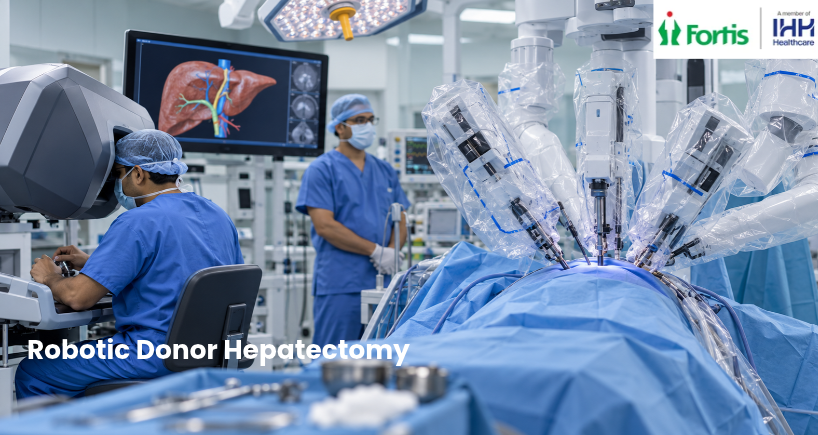


Robotic Donor Hepatectomy in Mumbai
Robotic Donor Hepatectomy: What Living Liver Donors Should Know
Living donor liver transplantation gives a healthy person the opportunity to donate a portion of their liver to someone needing a liver transplant. Donor safety is one of the most important priorities in living donor liver transplantation as the donor is a healthy person subjected to major surgery for the benefit of another person.
Donor hepatectomy has traditionally been performed via an open approach. Advances in minimally invasive liver surgery have led to newer approaches including laparoscopic and robotic donor hepatectomy in carefully selected donors and experienced transplant centers.
Robotic donor hepatectomy is the technique of using a robotic surgical system to assist the surgeon in the minimally invasive removal of a section of liver for transplantation. Robotic techniques may be beneficial in appropriately selected donors in terms of decreased blood loss, smaller incisions and potentially shorter hospital stay. However, operative time may be prolonged and current evidence does not show robotic surgery to be superior to open or laparoscopic donor nephrectomy in all donors.
For patients and families considering living donor liver transplant in Mumbai, Dr. Aditya J. Nanavati, Director – Multi-Organ Transplant & Hepatobiliary Surgery at Fortis Hospital, Mulund, has extensive experience in liver transplantation and complex hepatobiliary surgery. His academic work includes published research on robotic right donor hepatectomy and robotic left lateral donor hepatectomy, living-donor liver transplantation and other advanced transplantation techniques.
Awareness of the differences between robotic donor surgery and traditional methods helps future donors have a more informed discussion with their transplant team.
What Is Donor Hepatectomy?
Donor hepatectomy is the surgical removal of a portion of the liver of a healthy person to transplant it into a person with severe liver disease.
Before surgery, the potential donor goes through a lot of evaluation to ensure that:
- The donor is medically fit for major operation
- The liver is healthy
- Liver anatomy suitable for donation
- The donor will have sufficient liver remaining
- The transplanted portion will be sufficient for the recipient
- Tolerable risk when engaging in donation
Because the liver has regenerative capacity, both the portion remaining in the donor and the portion transplanted into the recipient increase in volume after surgery.
Living donor surgery nevertheless remains major surgery and requires careful patient selection, experienced surgical teams and structured postoperative follow-up.
What is robotic liver donor surgery?
Robotic donor hepatectomy is a minimally invasive surgical technique in which a surgeon uses a robotic surgical system to help remove a portion of the donor liver.
The surgeon has total control of the operation. The robotic platform translates the surgeon’s hand movements into precise movements of surgical instruments that are introduced through relatively small incisions.
The system is able to offer:
- Magnified three-dimensional visualisation
- A stable operative view
- Instruments with a wide range of movement
- Precise dissection around blood vessels and bile ducts
- Improved ergonomics for complex minimally invasive surgery
These are particularly useful in liver surgery where precise dissection around vital vascular and biliary structures is needed.
Robotic Donor Hepatectomy vs. Open Donor Hepatectomy: How Are They Different?
The main difference is the surgical procedure used to remove the donor liver graft.
In open donor hepatectomy, the surgeon makes a larger abdominal incision to access and remove the required portion of the liver.
In Robotic donor hepatectomy, Most of the surgery is done using robotic technology, which means that instruments are placed through smaller incisions An additional incision is still required to safely remove the liver graft from the donor's abdomen.
The basic aim is still the same:
to obtain an appropriate liver graft while protecting the safety and long-term health of the donor.
Therefore, robotic surgery should not be viewed as a cosmetic alternative. The suitability of the approach should be determined based on donor safety, anatomy and surgical expertise.
Why Is Donor Safety So Important in Living Liver Donation?
Unlike most surgical patients, living liver donors are healthy before surgery.
They receive no direct medical benefit from removal of part of their liver.
For this reason, the threshold for donor safety is particularly high.
Any potential benefits of a minimally invasive donor technique must therefore be balanced against:
- Risk of bleeding
- Surgical complexity
- Bile-duct complications
- Vascular complications
- Conversion to open surgery if required
- Operating time
- Experience of the surgical team
Recent studies have also stressed that robotic donor hepatectomy should be performed in appropriately selected donors at experienced centres.
What are the possible advantages of robotic donor hepatectomy?
Research comparing minimally invasive donor hepatectomy with conventional open surgery has identified several potential advantages.
- Tiny Surgical Incisions
Most of the procedures in robotic surgery are performed through smaller abdominal incisions.
Liver graft retrieval still requires a separate incision.
Smaller incisions may lessen cosmetic benefits and some incision-related discomfort.
- Less Blood Loss
A 2025 systematic review and meta-analysis found minimally invasive donor hepatectomy, including robotic approaches, was associated with decreased blood loss compared to open donor surgery.
A more recent meta-analysis comparing robotic versus laparoscopic donor hepatectomy also reported less blood loss with the robotic approach.
- Shorter Hospital Stay
Studies have demonstrated that minimally invasive donor hepatectomy may be linked with a slight reduction in hospital stay compared with conventional open surgery.
The actual length of stay is dependent upon the donor’s recovery and clinical status.
- Precision During Complex Dissection
The robot system offers magnified three-dimensional visualization and highly articulated instruments.
These features may help the surgeons to carefully dissect around:
- Vessels of the liver.
- Ducts (bile ducts)
- Hepatic tissue
Other important anatomic structures
- Recovery and Return to Normal Activities
Some studies suggest that minimally invasive donor approaches may be associated with less postoperative discomfort and an earlier return to normal activities.
However, the recovery process can be very different from one donor to another and robotic surgery cannot be represented as a faster recovery for each person.
Is Robotic Donor Hepatectomy Safer Than Open Surgery?
Current research is encouraging, but the answer requires some caution.
Recent systematic reviews suggest that robotic and other minimally invasive donor approaches can achieve comparable major safety outcomes to conventional surgery in experienced centres, with potential advantages in areas such as blood loss and length of hospital stay.
A 2026 systematic review comparing robotic with laparoscopic donor hepatectomy reported lower overall donor morbidity and transfusion rates with robotic surgery, but found no significant difference in major donor complications or mortality. The authors also emphasised the need for higher-quality prospective studies.
Therefore, robotic surgery should not automatically be described as safer or better for every donor.
Donor safety depends heavily on:
- Careful donor selection
- Liver anatomy
- Surgeon experience
- Transplant centre expertise
- Emergency conversion capability
- Postoperative monitoring
Who May Be Suitable for Robotic Donor Hepatectomy?
Not all living liver donors are suitable candidates for a robotic approach.
The transplant team may consider:
- Age and overall health
- Body composition
- Liver health
- Liver size and volume
- Blood-vessel anatomy
- Bile-duct anatomy
- Type of liver graft required
- Previous abdominal surgery
- Other medical or surgical factors
Usually, detailed imaging is performed prior to donor surgery.
Ultimately, the choice should be dictated by the safety of the donor rather than the preference of a particular surgical technique.
What Tests Do You Need To Take Before You Donate Your Liver?
The potential living donor is evaluated extensively.
Assessment may include (depending on the individual and the transplant programme):
- Blood grouping test
- Blood test in laboratory
- Tests of liver function
- Tests of kidney function
- Infectious screening
- Imaging of the liver (CT or MRI)
- Liver volume measurement
- Blood vessels mapping
- Assessment of bile duct anatomy
- Cardiac workup
- Lung examination
- Psychological assessment
- General surgical fitness
The goal of this evaluation is to determine whether donation can be performed without harm to the donor and with an appropriate graft for the recipient.
Does a Donor's Liver Grow Back After Surgery?
The liver has a remarkable ability to regenerate.
When part of the liver is removed, the remaining liver in the donor increases in volume over time. The transplanted part of the liver in the recipient also grows as it adapts to the recipient’s body.
But liver regeneration doesn’t mean donation is a minor procedure.
Living Liver Donation Living liver donation involves major surgery, an appropriate period of recovery and long-term medical follow-up.
How Long Does It Take To Recover After Donor Hepatectomy?
Donor recovery is different and is influenced by:
- Volume of liver resected
- Approach surgery
- Health in general
- Complications
- Managing pain
- Nutrition
- Physical activity post-surgery
Leaving the hospital doesn’t mean the donor is completely recovered.
“After the transplant team’s advice, there should be gradual return to work, exercise and other normal activities.
Minimally invasive techniques may shorten hospital stay or some aspects of postoperative recovery, but individual outcomes may differ.
Does Robotic Surgery Leave No Scar?
No.
Robotic donor hepatectomy involves surgical incisions.
Several smaller incisions are made for the robotic instruments and an additional incision is made to remove the donated liver graft.
The overall pattern of the incision may be different and possibly more cosmetically acceptable than that of a traditional open incision, but to describe robotic donor hepatectomy as scarless surgery would be inaccurate.
Does Robotic Donor Hepatectomy Take Longer?
it can.
Robotic donor hepatectomy has been found to have longer operating times than conventional open or laparoscopic approaches in several studies .
This is one of the considerations transplant teams consider together with blood loss, complications, recovery and donor safety.
Duration of surgery also depends on anatomy, graft type and surgical team experience.
What are the Limitations of Robotic Donor Hepatectomy
Robotic surgery has technical advantages, but it has several important limitations.
- Not Every Donor Is Suitable
In some donors, open surgery may be a safer option given the anatomical complexity or other clinical factors. - Longer Operating Time
Robotic procedures may be associated with longer operative times, especially during the learning curve period for the surgeon.
- Higher Technology Costs
Robotic systems have extra equipment and operating costs.
Evidence on the overall cost-effectiveness of transplantation is incomplete and highly context specific, depending on individual healthcare systems and centers.
- Open Conversion May Still Be Necessary
If unforeseen problems occur, the surgeon may need to convert the procedure to an open operation.
The ability to convert safely is an important part of donor protection.
It Requires Significant Surgical Expertise
Laparoscopic liver surgery is a difficult operation.Results are highly dependent on the experience of the individual surgeon and the larger transplant team.
Robotic vs Laparoscopic Donor Hepatectomy: Is it the same?
No.
Both are minimally invasive approaches but the surgical technology is different;
In laparoscopic donor hepatectomy the surgeons manipulate long laparoscopic tools directly.
In robotic donor hepatectomy, the surgeon operates at a console that manipulates articulated robotic instruments.
Robotic technology may have the advantage of improved instrument movement and three dimensional visualization but laparoscopic surgery avoids the additional cost of robotic systems.
Recent comparative data suggest that robotic surgery may confer potential peri-operative advantages in selected donors, but investigators still call for stronger prospective evidence before claiming one minimally invasive approach is universally superior.
Is Robotic Donor Hepatectomy Available for Every Living Donor Liver Transplant?
No
It is Subjected to availability:
- Infrastructure of transplant centers
- surgical expertise
- Required graft type
- Anatomy donor
- Medical suitability of donors
- Center protocols
Most importantly, the surgical approach must be individualized to the donor, performing what is safest and most appropriate for that particular donor.
Patients should check with their transplant center about the current availability of robotic donor hepatectomy and whether they are suitable candidates.
Why Fortis Hospital, Mulund for Living Donor Liver Transplant Evaluation?
In living donor liver transplantation, donor and recipient teams must work closely together.
Fortis Hospital, Mulund, Mumbai liver transplant program performs living and deceased donor liver transplantation, and donor and recipient evaluation as part of transplant care. Fortis is also focused on donor-oriented surgical techniques to minimize the impact of the incision and to enhance recovery.
Dr. Aditya J. Nanavati leads the Multi-Organ Transplant & Hepatobiliary Surgery service, with expertise spanning liver transplantation, complex hepatobiliary surgery and abdominal multi-organ transplantation.
For patients considering a living donor liver transplant in Mumbai, the first step is comprehensive evaluation of both recipient and potential donor. The transplant team can then determine the safest and most appropriate surgical approach.
Dr. Aditya J. Nanavati and the Liver Transplant team is available at Fortis Hospital, Mulund, for living donor liver transplant evaluation and guidance on available donor-surgery options.
Categories
Clear allMeet the doctor

- Liver Transplant and Hepatobiliary Sciences | Liver Transplant and Hepatobiliary Sciences
- Organ Transplant | Bowel Transplant | Pancreas Transplant | Kidney Transplant | Liver Transplant
-
 13 Years
-
 2000
Related Blogs
View all
Types of liver transplantation by Dr. Kishore GSB

Autoimmune Hepatitis a non-infectious condition: Know its Symptoms, Causes and Treatment

Hepatitis C: Symptoms, Transmission And Treatment Options

हेल्दी’ पैकेज्ड फूड में छिपा सोडियम बम: सेहत पर असर और बचाव के स्मार्ट टिप्स

Why Many Patients with Liver Cancer Are Told They Are Inoperable? And Why That Is Not Alwa...

Why Are Some Liver Cancer Patients Told They Are Inoperable?

Where to Go After an Inoperable Diagnosis? Choosing the Right Liver Cancer Specialist or C...


FAQs
What is a robotic donor hepatectomy?
Robotic donor hepatectomy is a minimally invasive approach to living liver donation in which a surgeon uses a robotic surgical system to assist in removing the portion of liver required for transplantation. The surgeon controls the robotic instruments throughout the operation.
Is robotic liver donation safer than open donor surgery?
Current evidence suggests robotic donor hepatectomy can be performed safely in carefully selected donors at experienced centres and may offer advantages such as lower blood loss or shorter hospital stay. However, current research does not establish robotic surgery as universally safer or better than open surgery for every donor.
Who is eligible for robotic donor hepatectomy?
Eligibility depends on the donor's overall health, liver anatomy, liver volume, vascular and bile-duct anatomy, type of graft required and other surgical considerations. Not every living liver donor is suitable for robotic surgery.
Does the liver grow back after robotic liver donation?
The liver has the ability to regenerate after living donation. The remaining liver in the donor increases in volume following surgery, while the transplanted liver portion also grows in the recipient. Recovery and regeneration vary between individuals.
What are the benefits of robotic donor hepatectomy?
Potential benefits may include smaller incisions, reduced blood loss and a shorter hospital stay in selected donors. Robotic technology also provides magnified three-dimensional visualisation and precise instrument movement. Individual outcomes vary, and donor safety remains the primary consideration.
Where can I consult for living donor liver transplant evaluation in Mumbai?
Patients and potential donors can consult Dr. Aditya J. Nanavati, Director – Multi-Organ Transplant & Hepatobiliary Surgery at Fortis Hospital, Mulund, Mumbai, for living donor liver transplant evaluation. Dr. Nanavati's academic work includes published research on robotic donor hepatectomy and living-donor liver transplantation

Keep track of your appointments, get updates & more!

