
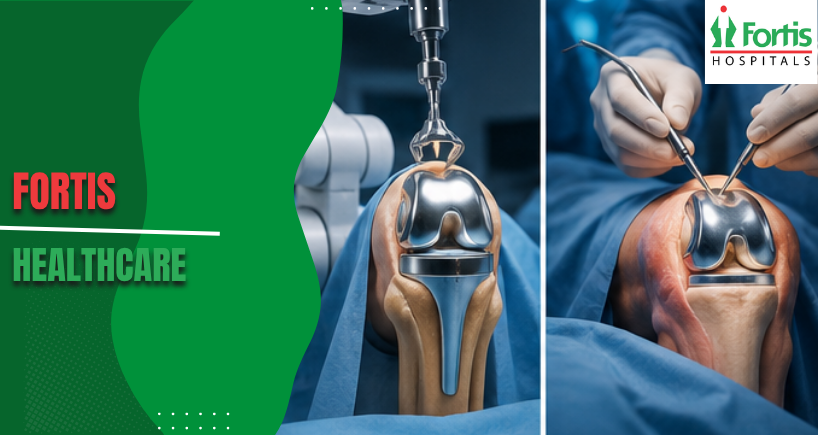


Robotic vs Non-Robotic Knee Replacement A Complete Guide for 2026
Knee replacement is one of the most established treatments for people with severe knee arthritis and persistent pain. With advances in surgical technology, patients today can choose between robotic-assisted knee replacement and conventional, or non-robotic, knee replacement.
But is robotic knee replacement actually better? Does it provide better accuracy, faster recovery or longer-lasting implants? And is the additional cost justified?
The answer depends on the individual patient.
Robotic-assisted knee replacement can help surgeons with detailed planning, implant positioning and bone preparation. However, conventional knee replacement remains a highly successful and well-established procedure with excellent long-term outcomes.
Dr. Pulak Vatsya performs both robotic and conventional knee replacement and uses the VELYS Robotic-Assisted Solution at Fortis Escorts Hospital, Okhla, for appropriately selected patients.
Robotic vs Non-Robotic Knee Replacement: Quick Answer
Robotic knee replacement uses computer-assisted technology to help the surgeon plan and execute the procedure with greater precision. The surgeon remains responsible for all clinical decisions and performs the operation.
Conventional knee replacement uses established mechanical guides, surgical instruments and the surgeon's experience to position the implants.
Robotic assistance can improve the precision and reproducibility of implant positioning and may offer advantages in selected patients. However, it does not automatically guarantee less pain, faster recovery or longer implant survival.
The patient's diagnosis, knee anatomy, surgeon's expertise, implant selection and rehabilitation remain important factors in the final outcome.
What Is Non-Robotic or Conventional Knee Replacement?
Conventional total knee replacement is a well-established procedure that has been performed successfully for decades.
During surgery, the damaged portions of the knee joint are removed and replaced with artificial components. Surgeons use mechanical alignment instruments, surgical landmarks and their clinical experience to determine the appropriate bone cuts and implant positioning.
The technique has a strong track record and can provide excellent pain relief, mobility and quality of life.
For patients with straightforward knee anatomy, conventional knee replacement may be an appropriate and cost-effective option.
Advantages of Conventional Knee Replacement
- Long-established surgical technique
- Extensive clinical experience and outcome data
- Proven implant designs
- Widely available
- Generally lower cost than robotic-assisted surgery
- Excellent outcomes when performed by an experienced surgeon
What Is Robotic Knee Replacement?
Robotic-assisted knee replacement does not mean that a robot performs the operation independently.
The surgeon remains in control throughout the procedure. The robotic system acts as an advanced planning and surgical-assistance tool.
At Fortis Escorts Hospital, Okhla, Dr. Pulak Vatsya uses the VELYS Robotic-Assisted Solution for appropriately selected total knee replacement patients.
The technology can assist the surgeon with:
1. Personalised Planning
The system helps create a detailed assessment of the patient's knee anatomy and allows the surgeon to plan implant positioning and bone preparation according to the individual's anatomy.
2. Controlled Bone Preparation
During surgery, the technology assists the surgeon in executing the planned bone cuts and helps maintain the intended surgical parameters.
3. Implant Positioning and Alignment
Robotic assistance can help the surgeon achieve accurate and reproducible implant positioning and alignment.
4. Intraoperative Assessment
The system can provide information during surgery that helps the surgeon assess alignment and soft-tissue balance before final implant placement.
The robot therefore assists the surgeon rather than replacing the surgeon's expertise or decision-making.
What Is the VELYS Robotic-Assisted Solution?
The VELYS Robotic-Assisted Solution is a technology platform designed to assist surgeons during total knee replacement.
It can provide patient-specific planning and intraoperative assistance, helping the surgeon make informed decisions about implant positioning and bone preparation.
Dr. Pulak Vatsya uses VELYS robotic-assisted technology for selected knee replacement patients at Fortis Escorts Hospital, Okhla.
Whether robotic assistance is appropriate depends on the patient's anatomy, diagnosis, treatment goals and the surgeon's assessment.
Robotic vs Non-Robotic Knee Replacement: Side-by-Side Comparison
Is Robotic Knee Replacement More Accurate?
One of the main advantages of robotic-assisted knee replacement is the ability to improve the precision and reproducibility of surgical planning and implant positioning.
Robotic systems can provide detailed information about knee anatomy and assist the surgeon with bone preparation and alignment.
However, greater technical precision does not automatically mean that every patient will experience a better long-term outcome.
A successful knee replacement depends on multiple factors, including:
- Appropriate patient selection
- Correct implant selection
- Accurate implant positioning
- Soft-tissue balancing
- Surgical experience
- Infection prevention
- Post-operative rehabilitation
- Patient adherence to recovery recommendations
Robotic technology should therefore be viewed as an additional surgical tool rather than a replacement for surgical expertise.
Does Robotic Knee Replacement Provide Faster Recovery?
Some studies have reported improvements in early pain, mobility or functional recovery following robotic-assisted knee replacement, while other studies have found smaller or inconsistent differences compared with conventional surgery.
Recovery also varies considerably between patients.
Factors such as age, muscle strength, general health, severity of arthritis, pain tolerance and commitment to physiotherapy can influence recovery.
Patients undergoing either robotic or conventional knee replacement can begin mobilisation soon after surgery when medically appropriate.
Does Robotic Knee Replacement Make Implants Last Longer?
Implant longevity is one of the most common questions patients ask.
Accurate implant positioning and alignment are important factors in the performance of a knee replacement. Robotic assistance may help improve the accuracy and reproducibility of these parameters.
However, it is not yet appropriate to promise that a robotic knee replacement will definitely last longer than a conventional knee replacement.
Modern knee implants can provide long-lasting results with either surgical technique, and long-term evidence specifically comparing robotic-assisted and conventional procedures continues to develop.
The quality of surgery, implant selection, patient factors and long-term activity all influence implant survival.
Who May Benefit From Robotic Knee Replacement?
Robotic-assisted knee replacement may be considered for patients who have:
- Significant knee arthritis requiring total knee replacement
- Complex or unusual knee anatomy
- Significant deformity
- Previous knee surgery
- Specific alignment or soft-tissue balancing requirements
- High expectations regarding functional recovery
- An interest in technology-assisted surgical planning
However, age alone does not determine whether a patient needs robotic knee replacement.
The decision should be based on the patient's clinical condition and the surgeon's assessment.
Who May Be Suitable for Conventional Knee Replacement?
Conventional knee replacement remains an excellent option for many patients.
It may be particularly appropriate for patients who:
- Have relatively straightforward knee anatomy
- Want a well-established surgical technique
- Are concerned about the additional cost of robotic technology
- Have no specific indication requiring robotic assistance
- Prefer conventional surgery after discussing the available options
For many patients, an experienced surgeon performing a well-planned conventional knee replacement can achieve excellent results.
Robotic vs Conventional Knee Replacement: Which Is Better?
There is no universal answer.
Robotic-assisted knee replacement may offer greater planning and execution precision, but conventional knee replacement remains a highly effective treatment.
The important question is not simply whether robotic surgery is newer or more technologically advanced.
The more relevant questions are:
- Is robotic assistance appropriate for your knee?
- Will it provide a meaningful benefit in your particular case?
- What implant is being recommended?
- What are the expected recovery milestones?
- What will the total treatment cost be?
- What rehabilitation will be required?
An experienced knee replacement surgeon can help answer these questions after evaluating the patient's knee and overall health.
Recovery After Knee Replacement at Fortis Escorts Hospital, Okhla
Recovery varies between patients, regardless of whether robotic or conventional knee replacement is performed.
A typical rehabilitation pathway may include:
Day 0–1
Patients may begin standing and walking with assistance when medically appropriate. Physiotherapy generally begins early.
Days 1–3
Walking exercises, range-of-motion exercises and strengthening activities are progressively introduced. Stair practice may be included when appropriate.
First 2–6 Weeks
Patients gradually increase walking and daily activities while continuing their prescribed physiotherapy programme.
Around 6 Weeks and Beyond
Many patients can progressively resume activities such as driving and recreational exercise after assessment and medical clearance.
Around 3–6 Months
Patients may continue to improve strength, mobility and confidence in the operated knee and progressively return to suitable recreational activities.
These are general milestones, not guaranteed timelines. Recovery should always follow the treating surgeon and physiotherapy team's recommendations.
Robotic Knee Replacement Cost vs Conventional Knee Replacement
Robotic-assisted knee replacement generally costs more than conventional surgery because of the additional technology, equipment and associated hospital resources involved.
However, cost should not be the only factor when choosing a surgical technique.
Patients should consider:
- The surgeon's experience
- The suitability of the technique for their knee
- The implant being used
- Hospital facilities
- Rehabilitation support
- Expected clinical benefits
- Overall treatment and follow-up requirements
A consultation can help patients understand the expected cost and whether robotic assistance is likely to provide meaningful value in their individual case.
Consult Dr. Pulak Vatsya for Robotic or Conventional Knee Replacement
Choosing between robotic-assisted and conventional knee replacement should be based on the patient's individual condition rather than technology alone.
Dr. Pulak Vatsya evaluates each patient individually and discusses whether robotic-assisted surgery or conventional knee replacement is more appropriate based on knee anatomy, arthritis severity, activity requirements and treatment goals.
For consultation regarding robotic or conventional knee replacement:
Fortis Escorts Hospital, Okhla, New Delhi
StepUp Joints, Lajpat Nagar, New Delhi
Categories
Clear allMeet the doctor

- Orthopaedics | Robotic and Computer navigated Joint reconstruction | Orthopaedics | Orthopaedics and Joint Replacement | Sports Medicine
-
 10 Years
-
 1500
1500
Related Blogs
View all









FAQs
Is robotic knee replacement better than non-robotic?
Robotic knee replacement offers greater precision and potentially better implant longevity, especially for younger and complex patients. For many patients, conventional knee replacement achieves equivalent results. Dr. Pulak Vatsya assesses each patient individually at Fortis Escorts Hospital, Okhla, and StepUp Joints, Lajpat Nagar.
What robotic system is used at Fortis Escorts, Okhla?
Dr. Pulak Vatsya uses the VELYS Robotic-Assisted Solution for total knee replacement at Fortis Escorts Hospital, Okhla — a modern platform offering real-time 3D planning and sub-millimetre accuracy.
Does robotic knee replacement cost more?
Yes, robotic knee replacement typically costs more than conventional surgery due to the technology involved. Dr. Pulak Vatsya discusses cost and value transparently so patients can make an informed decision.
How long does a robotic knee replacement last?
Most modern knee implants last 15–25 years. Because robotic assistance improves alignment — a key factor in implant wear — robotic knee replacement may offer improved longevity, though long-term data is still maturing.

Keep track of your appointments, get updates & more!

