
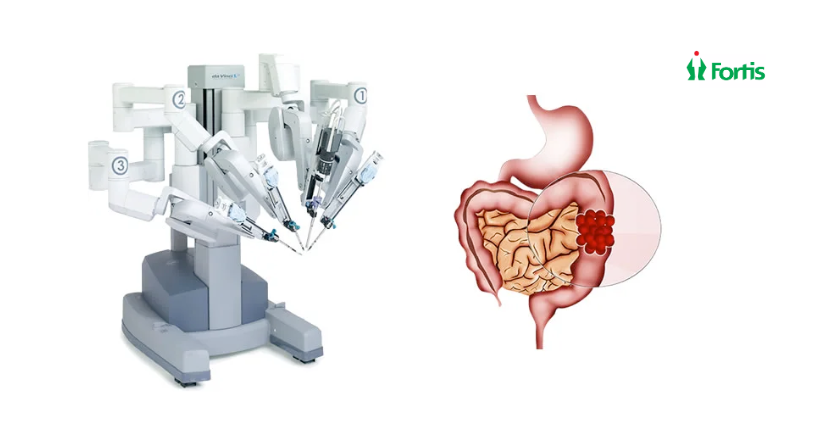


Robotics in Benign Colorectal Diseases
Robotic surgery has been widely used for the management of malignant colorectal diseases for many years. Over time, it has also had a significant impact on the treatment of benign colorectal conditions, offering surgeons greater precision, control, and improved patient outcomes.
We present the case of a 46-year-old gentleman who had been suffering from severe abdominal pain along with significant weight loss for nearly two to three years. A colonoscopy revealed an impassable stricture at the ileocecal junction, and a biopsy was performed. The initial biopsy suggested a benign pathology, but the exact nature of the disease could not be determined. A PET-CT scan also showed similar findings, and the CEA levels were within normal limits.
Based on the available clinical findings, the patient was empirically started on treatment for Crohn’s disease. However, his symptoms did not improve with medical management. After nearly a year, a repeat colonoscopy was performed. This time, the biopsy confirmed tuberculosis, with RT-PCR testing positive for tuberculosis. The patient was subsequently started on anti-tubercular therapy (AKT).
Despite three months of treatment, the patient’s condition continued to deteriorate, and his oral intake reduced significantly. Considering the persistent symptoms and the severity of the stricture, a surgical approach was planned.
The patient underwent a totally robotic right hemicolectomy at Fortis Hospital Bannerghatta Road. The procedure was performed using advanced robotic technology, which allows enhanced precision and better visualization for the surgeon. The surgery followed oncological surgical principles, with a medial-to-lateral dissection approach. After resection of the diseased segment, a robotic intracorporeal anastomosis was performed.
The surgical specimen was removed through a small 4 cm Pfannenstiel incision, minimizing surgical trauma and supporting quicker recovery. The benefits of the minimally invasive robotic approach allowed the patient to recover rapidly, and he was discharged on the third postoperative day.
The Role of Robotics in Benign Colorectal Surgery
While robotic systems have long been used in colorectal cancer surgery, they are increasingly proving valuable in benign colorectal diseases as well. The robotic platform offers:
- Enhanced precision and control during complex dissections
- Better visualization of anatomical structures
- Reduced surgical trauma due to minimally invasive techniques
- Faster recovery and shorter hospital stay for patients
This case highlights how robotic surgery can be effectively utilized in challenging benign colorectal conditions, enabling surgeons to perform complex procedures with high precision while improving patient recovery and outcomes.
Categories
Clear allMeet the doctor

- General Surgery | Robotic Surgery | General and Minimal Access Surgery | General and Laparoscopic Surgery | Bariatric Surgery | General Surgery
-
 32 Years
-
 1150
1150
Related Blogs
View all
When Is A Liver Transplant Recommended?

Alcoholic Liver Disease - Why Worry?

Binge Drinking Trend Is The New Silent Killer



Irritable Bowel Syndrome

Digestive Disorders And Prevention



FAQs

Keep track of your appointments, get updates & more!

