
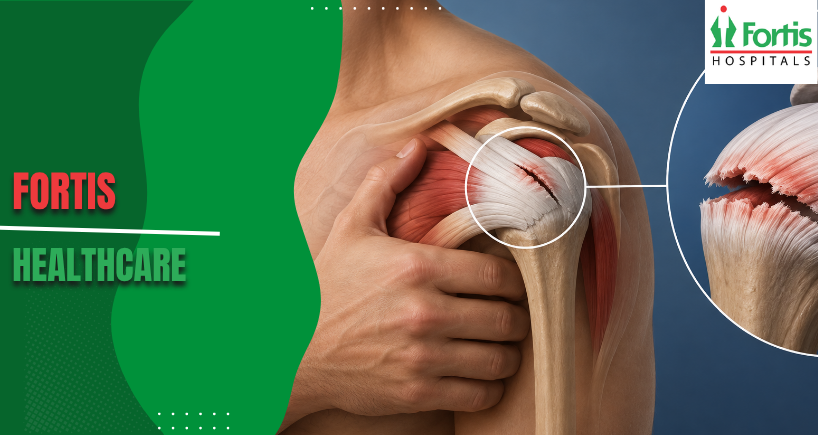


Rotator Cuff Tear on MRI Do You Always Need Surgery
If you are over the age of 40 and have started feeling a sharp discomfort in your shoulder when reaching overhead or during sleep, you are not alone. Shoulder pain is one of the most common problems seen in orthopaedic clinics worldwide.
With advances in imaging like MRI, we can now visualize the shoulder’s internal structures with high precision. However, this often leads to a common patient concern: "My report shows a rotator cuff tear—does this mean I need surgery?"
In modern orthopaedics, the answer is: Not necessarily. An MRI finding is a critical piece of the puzzle, but it is not the sole determinant of your treatment.
Understanding Rotator Cuff Tears
The rotator cuff is a group of four muscles and tendons that act as dynamic stabilizers, keeping the ball of the shoulder centered in the socket during movement.
Tears typically occur due to:
- Age-related Degeneration: Studies show that approximately 20–30% of people over the age of 60 have rotator cuff tears on MRI despite having no symptoms.
- Repetitive Stress: Overuse from overhead sports or occupational lifting.
- Acute Trauma: A sudden fall or jerking motion.
Key Insight: Interestingly, the severity of pain does not always correlate with the size of the tear. Some large tears cause surprisingly little pain, while smaller tears can produce significant discomfort due to localized inflammation.
The Natural Course of a Tear
When we opt for non-surgical management, we are monitoring the "natural history" of the condition. While a tear does not usually "heal" like a skin wound, the shoulder has a remarkable ability to compensate.
- Potential Progression: Much like a small snag in a fabric, a tear can gradually enlarge over several years due to mechanical stress.
- Functional Compensation: While you may experience weakness in specific overhead angles, other muscle groups often compensate for the lost tendon function, allowing for near-normal daily activity.
- Structural Changes: If a full-thickness tear remains for a prolonged period, the muscle can undergo atrophy or fatty degeneration. This is why regular clinical follow-ups are essential even without surgery.
When is Non-Surgical Treatment Appropriate?
Many patients achieve satisfactory functional outcomes through conservative management. This is often the primary recommendation for:
- Partial-thickness tears: Where the tendon integrity is largely maintained.
- Degenerative tears: In older patients with lower functional demands.
- Inflammation-dominant cases: Where the primary issue is pain rather than a mechanical loss of strength.
The Strategy: Specialized rehabilitation focused on "cuff balancing" and strengthening the deltoid and scapular stabilizers, alongside activity modification and anti-inflammatory care.
When Does Surgery Become Necessary?
Surgical repair is a precise intervention aimed at restoring anatomy and preventing long-term joint deterioration. It is generally recommended for:
- The "Window of Opportunity": Acute, traumatic tears in younger, active individuals where early repair yields the best results.
- Failure of Conservative Care: Persistent pain or weakness that does not improve after 6–12 weeks of structured physiotherapy.
- Significant Functional Deficits: When the patient cannot physically lift the arm (the "drop arm" sign).
- Full-Thickness Tears: Because these rarely heal spontaneously—the tendon tends to retract under constant muscle tension.
Categories
Clear allMeet the doctor

- Orthopaedics | Sports Medicine | Robotic and Computer navigated Joint reconstruction | Orthopaedics and Joint Replacement | Orthopaedics
-
 12 Years
-
 1500
1500
Related Blogs
View all




FAQs
Can a rotator cuff tear heal on its own?
A full-thickness tear rarely heals spontaneously because the tendon retracts and remains under tension. However, the symptoms can be managed effectively, and function can be restored without the tendon technically "knitting" back together.
How long is the recovery after rotator cuff surgery?
Modern repair is usually arthroscopic (keyhole). While it is a day-care or short-stay procedure, biological healing takes time. Most patients use a sling for 6 weeks, followed by 3–4 months of progressive rehabilitation.
Is "Frozen Shoulder" different from a tear?
Yes. Frozen shoulder (adhesive capsulitis) is a tightening of the joint capsule. While a tear can lead to stiffness because the patient stops moving the arm, they are two distinct conditions requiring different treatments.
When Should You See a Shoulder Specialist?
Consult an orthopaedic specialist if:
Shoulder pain persists beyond 4–6 weeks.
Weakness prevents you from lifting your arm to comb your hair or reach a shelf.
Night pain significantly disturbs your sleep.
The pain started immediately following a fall or injury.

Keep track of your appointments, get updates & more!

