
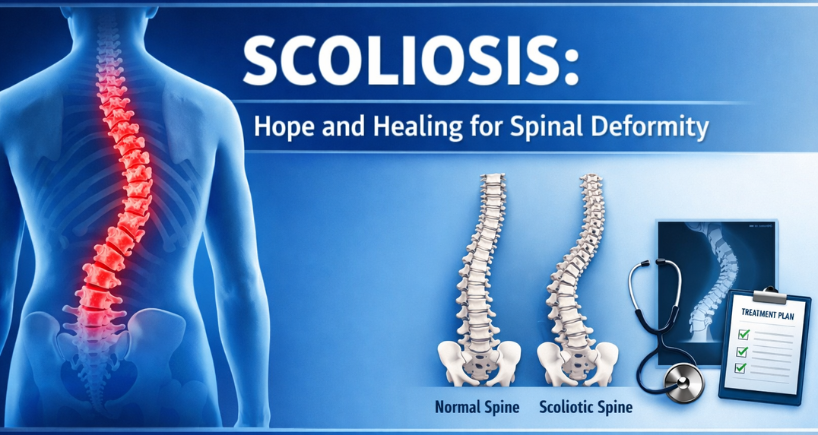


Scoliosis in Children & Adults | Curved Spine Treatment, Symptoms & Surgery Explained
What is scoliosis and how is it treated? Scoliosis is an abnormal sideways curvature of the spine exceeding 10 degrees, affecting 2–3% of children. Treatment depends on severity: mild curves (<20°) need observation, moderate curves (20–40°) respond to bracing in 75% of cases, and severe curves (>45–50°) require surgical correction achieving 70–80% curve correction. Patients typically gain 1–3 inches in height.
As a spine surgeon with over two decades of experience, I have witnessed how scoliosis can profoundly impact lives. From adolescents struggling with self-confidence due to visible spinal curves to adults experiencing chronic pain and breathing difficulties — scoliosis is more than a diagnosis. It demands specialised care, and not every orthopaedic surgeon has the training or case volume to manage it well.
Having trained at Massachusetts General Hospital, Harvard Medical School, and the University of Alabama — with a fellowship focused specifically on spinal deformity correction — I established North India’s first dedicated scoliosis clinic at Fortis Mohali so that families across Chandigarh, Mohali, Panchkula, and the wider Punjab region would no longer need to travel to Delhi or abroad for this level of care. We now routinely see patients from Haryana, Himachal Pradesh, and Jammu & Kashmir as well.
Understanding Scoliosis: More Than a Curved Spine
Scoliosis is an abnormal lateral curvature of the spine (a sideways curve that shouldn’t be there), typically defined as a curve exceeding 10 degrees on X-ray using the Cobb angle method (the standard way doctors measure how severe a spinal curve is). While many picture a simple sideways bend, scoliosis involves a complex three-dimensional rotation, creating an ‘S’ or ‘C’ shaped appearance.
The condition affects approximately 2–3% of children and adolescents, with several distinct types:
- Idiopathic scoliosis (80% of cases, no identifiable cause) — the most common form, often first noticed during the teenage growth spurt
- Congenital scoliosis (vertebral malformations present from birth)
- Neuromuscular scoliosis (associated with conditions like cerebral palsy or muscular dystrophy)
- Degenerative scoliosis (develops after age 50 due to age-related spinal wear and tear)
When Does Treatment Become Necessary?

Advanced Surgical Techniques
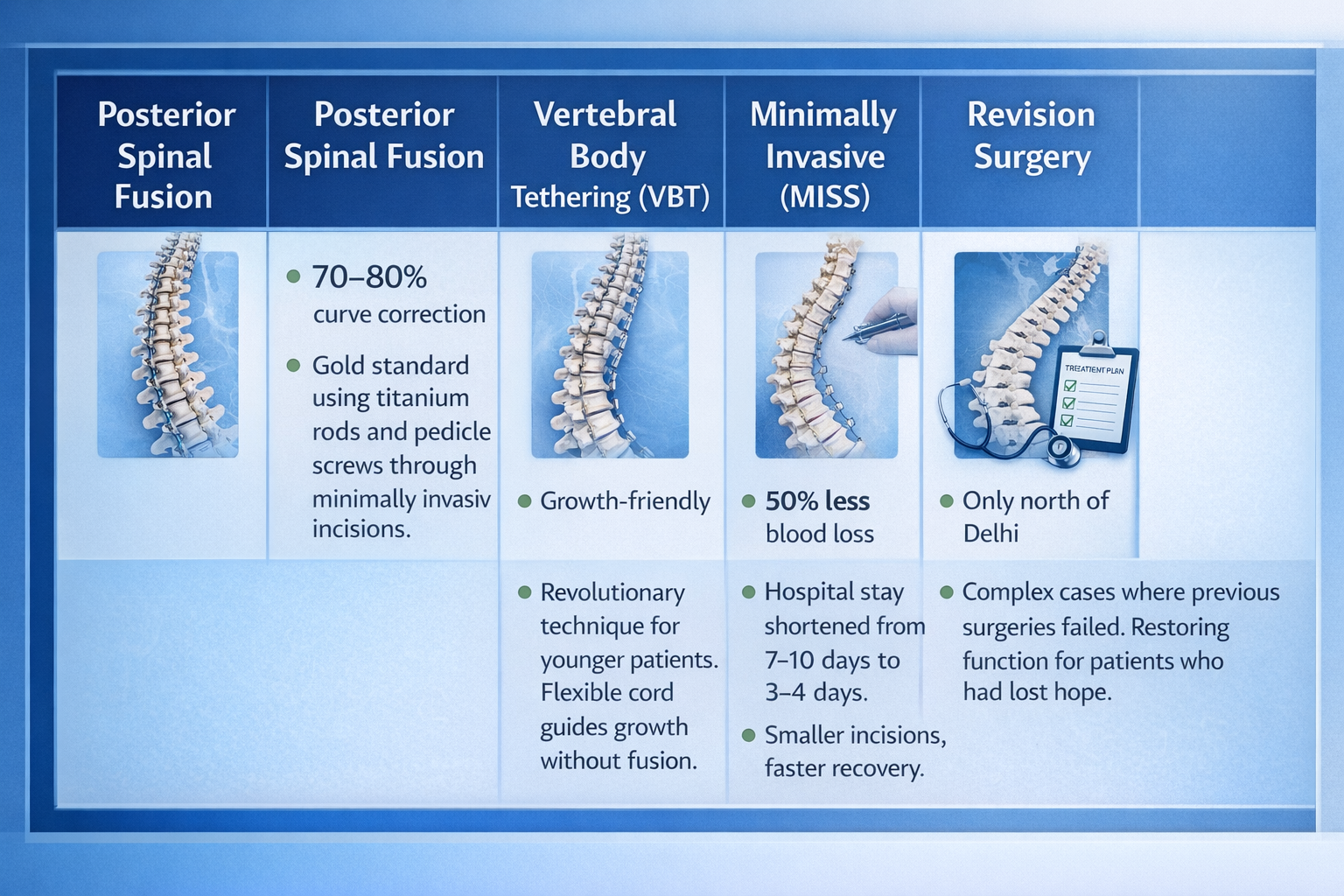
These procedures require more than surgical skill alone. Scoliosis correction depends on infrastructure — advanced robotic navigation systems for millimetre-precision screw placement, intraoperative neuromonitoring to protect the spinal cord in real time, and a dedicated spine rehabilitation team that begins working with patients from day one after surgery. At Fortis Mohali, this ecosystem is in place, which is why complex cases that might otherwise be referred to Delhi or abroad are increasingly managed here in the Tricity.
Real Patients, Real Results
Nothing brings me greater satisfaction than seeing patients reclaim their lives. Here are actual outcomes from our scoliosis clinic.
Case Study 1: Adolescent Idiopathic Scoliosis
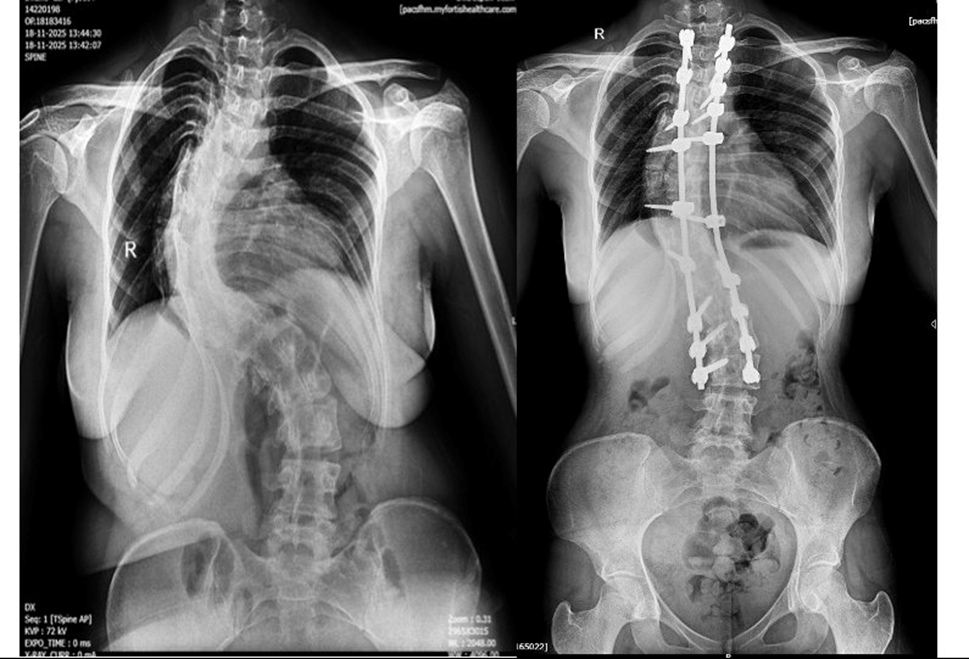
Before (left): Severe scoliotic curve on full-spine X-ray with significant lateral deviation and rotational deformity. After (right): Post-surgical correction with titanium rod and pedicle screw fixation. Spine realigned to near-normal, restoring trunk balance.

Case Study 1 — Clinical Before & After
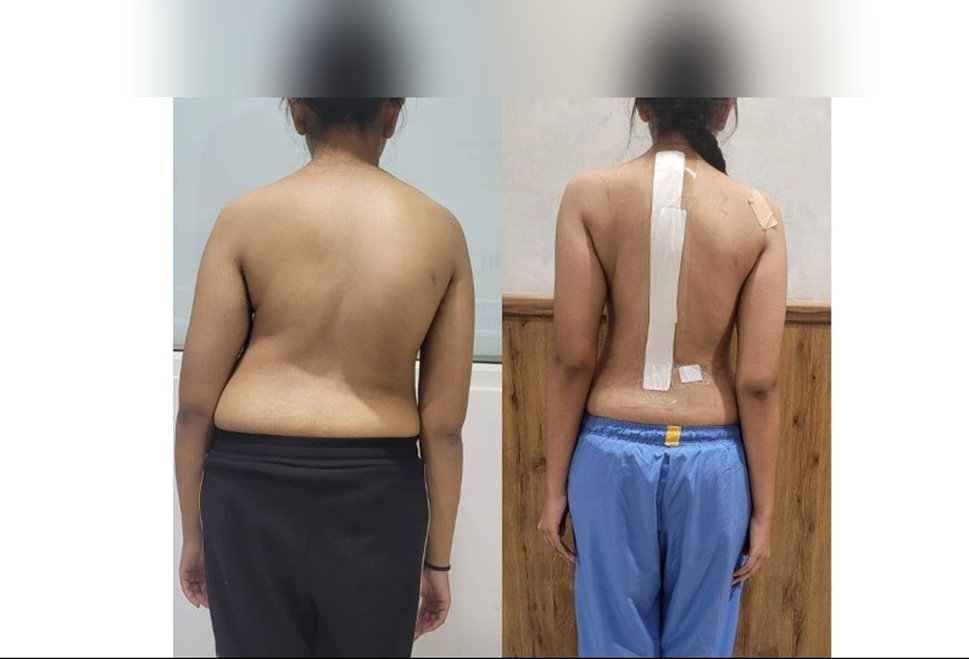
Before (left): Visible trunk asymmetry, rib hump, and shoulder imbalance. After (right): Dramatically improved alignment days after surgery. Shoulders level, rib hump resolved, trunk centred.

Case Study 1 — Life After Surgery — Height Gain Visible
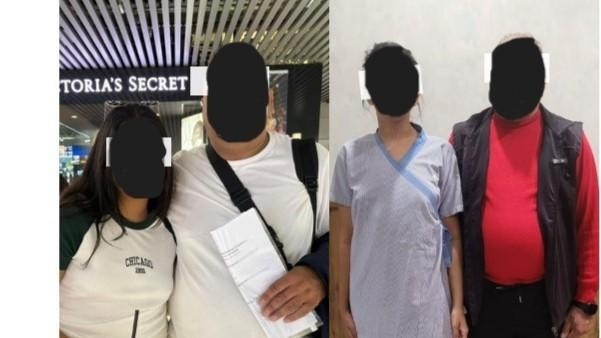
Left: Before surgery — patient’s height relative to family member. Right: After surgical correction — notice the visible increase in height. Patients typically gain 1–3 inches as the curved spine is straightened.
Case Study 2: Clinical + Radiological Result
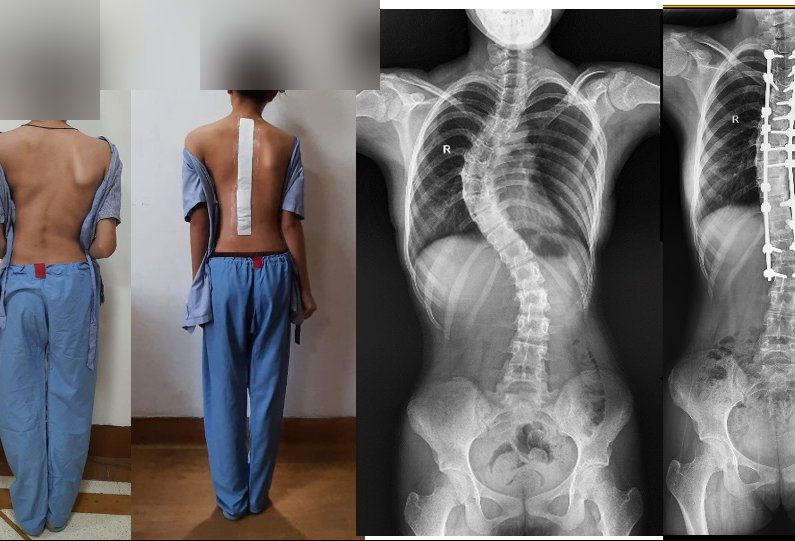
Clinical photos (left): Before and after showing improved trunk alignment. X-rays (right): Pre-operative curve and post-operative correction with spinal instrumentation.

Case Study 3: Clinical + Radiological Result
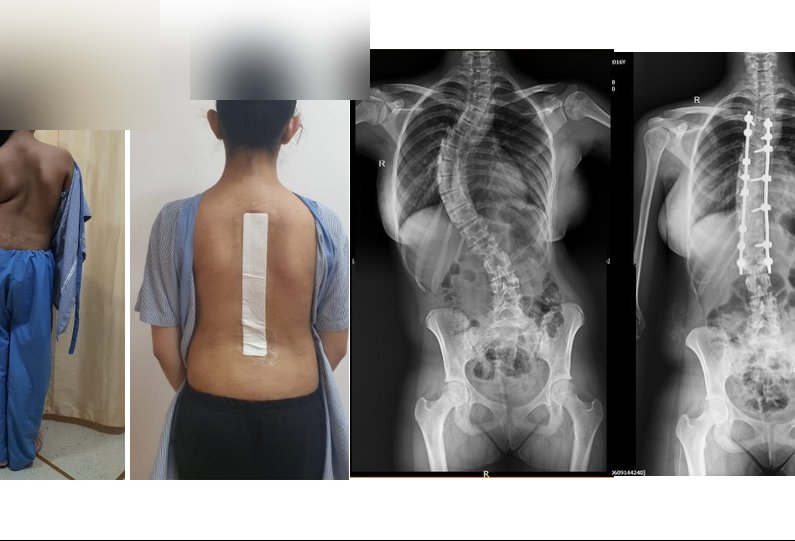
Clinical photos (left): Pre-operative trunk shift and post-operative correction. X-rays (right): Severely curved spine before and corrected alignment after.

All patient images used with consent. Faces obscured for privacy. Actual surgical outcomes at Fortis Hospital Mohali.
The Recovery Journey
Recovery after scoliosis surgery follows a gradual timeline. Every patient is different, but here is what most families can expect:
- 48 hours: Walking with support. Many patients feel immediate relief from pre-operative symptoms like pain or breathing difficulty.
- 4–7 days: Hospital discharge. Pain managed with oral medication.
- 3–4 weeks: Return to school or light desk work. Gentle movement encouraged — short walks, basic stretching.
- 6–9 months: Full activity and sports resume. Swimming, running, and cycling are usually the first sports cleared.
- 12 months: Complete spinal fusion achieved. Full structural stability. Most patients describe this as the point where the spine “feels like their own.
“Scoliosis need not define your future or your child’s future. With early detection, expert evaluation, and advanced surgical care, we can straighten spines, relieve pain, and restore active lives.” — Dr. Deepak Joshi
About the Author
Dr. Deepak Joshi is the Director of Orthopaedics & Spine Surgery at Fortis Hospital Mohali. A Harvard-trained spine surgeon with over 20 years of experience in spinal deformity correction, he established North India’s first dedicated scoliosis clinic, bringing international-standard care to families across Punjab, Haryana, Himachal Pradesh, and the wider region. He is the only surgeon north of Delhi specialising in complex revision scoliosis cases.
AIIMS New Delhi • Harvard Medical School • Mass General Hospital • University of Alabama
Specialising in: Scoliosis • Spine Deformity • Revision Surgery • Minimally Invasive Spine Surgery
Take the First Step Toward a Straighter Spine
Contact Us – Fortis Hospital Mohali
For appointments, consultations, and diagnostic services, please contact:
📞 72728 72728
Our care team will assist you with:
Doctor appointments
Diagnostic and screening services
Health check-ups
Call now to book your appointment at Fortis Hospital, Mohali.
Categories
Clear allMeet the doctor
- Orthopaedics | Orthopaedics and Spine Surgery
-
 20 Years
-
 1050
1050
Related Blogs
View all



FAQs
At what age should children be screened for scoliosis?
During growth spurts, typically between ages 10 and 15. Girls should be screened slightly earlier. If you notice uneven shoulders, asymmetric waistline, or clothes hanging unevenly, schedule an evaluation immediately. Early detection catches 70% of cases when treatment is most effective.
Will my child grow taller after treatment?
Yes. As we straighten the spine, patients typically gain 1–3 inches in height. For growing children treated with Vertebral Body Tethering, natural growth continues while the spine is guided into alignment.
Are the rods and screws permanent?
Yes. The implants are medical-grade titanium, completely safe and biocompatible. They are MRI-safe and rarely cause issues at airport security. We provide medical documentation for travel.
Can my child play sports after surgery?
Yes. Swimming, running, and non-contact sports resume within 6 months. Contact sports after 9–12 months. Treatment often improves athletic performance by correcting posture and enhancing lung capacity.
How much does scoliosis treatment cost in India?
In India, comprehensive scoliosis care costs approximately 50% less than in Western countries with equivalent quality. Most insurance covers medically necessary correction. Our team at Fortis Mohali provides transparent estimates and insurance guidance.
Where can I find a scoliosis specialist in Chandigarh or Mohali?
Dr. Deepak Joshi runs a dedicated scoliosis clinic at Fortis Hospital Mohali — the only such clinic in the region. He sees patients from across the Tricity (Chandigarh, Mohali, Panchkula), Punjab, Haryana, and Himachal Pradesh. You can book a consultation by calling +91 72728 72728 or visiting the Fortis Mohali website. If you already have X-rays or an MRI, bring them along for a more detailed first assessment.

Keep track of your appointments, get updates & more!

