
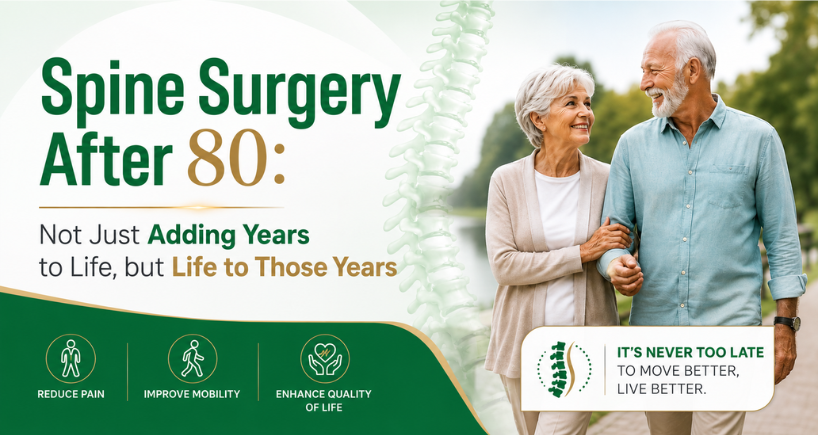


Spine Surgery After 80: Not Just Adding Years to Life, but Life to Those Years
By Dr Deepak Joshi Director, Orthopaedics & Spine Surgery | Fortis Hospital, Mohali MBBS (AIIMS, New Delhi) | MS Orthopaedics (Mumbai University) Spine Fellowship: University of Alabama at Birmingham (UAB), USA Adult & Paediatric Spine Fellowship: Massachusetts General Hospital (MGH), Harvard University, Boston, USA
What the Elderly Fear Most Is Not Death
“By the age of 80, most people are no longer driven by ambition, achievement, or future milestones. Life becomes simpler, yet emotionally far deeper. The concerns of the elderly are no longer about success or recognition, but about preserving independence, avoiding pain, escaping loneliness, and living the final phase of life with dignity. For many of my patients, death itself is not the greatest fear. The deeper fear is dependence — becoming bedridden, losing mobility, losing cognitive clarity, or becoming a burden on loved ones. They can accept mortality with grace. What they cannot accept is prolonged suffering, helplessness, and loss of dignity.”
In such a stage of life, any spinal ailment — a vertebral fracture, spinal cord compression, debilitating sciatica, a progressive deformity — can be devastating. It takes away not only movement but also confidence, self-respect, and independence. For decades, very elderly patients were offered only supportive care because society, hospitals, doctors, and even families were uncertain whether meaningful recovery was possible. Age itself became a reason to deny intervention. A form of therapeutic nihilism quietly developed around these patients.
How My Own Thinking Changed
I want to be honest about my own evolution. Early in my career, I was sceptical about managing patients above 80. Like many spine surgeons, I questioned whether surgery or intervention could truly change outcomes in this fragile population. The risks seemed too high, the recovery too uncertain, and the conventional wisdom too well-established: these patients are too old, too frail, too risky.
But with time, experience, and careful observation — particularly during my training at Massachusetts General Hospital, Harvard, where elderly complex spine cases were managed routinely — I realised that offering nothing simply because of age had no clinical basis. Slowly, I began taking up more such cases: selecting patients carefully, counselling families honestly, optimising comorbidities preoperatively, and intervening whenever the clinical situation warranted it.
What followed was one of the most meaningful experiences of my professional life. I realised that treating elderly spine patients is not merely about performing surgery. It is about restoring dignity. It is about helping someone walk independently to the washroom again, sit with family without pain, sleep peacefully, or regain enough confidence to live without fear. Sometimes, even a small functional recovery can completely transform the emotional and psychological state of an elderly person.
Six Patients, Six Stories: What Is Possible After 80
Over the last few months alone, I have operated on six patients above the age of 80 at Fortis Mohali. Since joining the hospital, I have managed over 70–80 patients in this age group with complex spinal conditions. Each case is different, but the common thread is the same: patients who were told elsewhere that nothing could be done, regaining mobility, independence, and dignity.
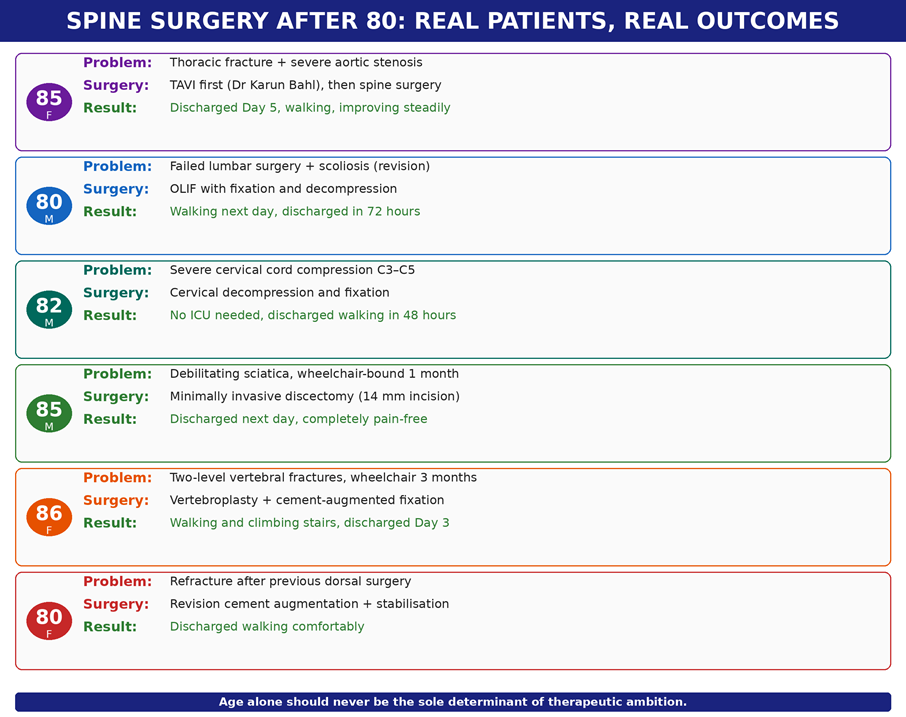
The 85-year-old lady with the thoracic fracture and severe aortic stenosis deserves special mention. Any single surgeon operating alone would have faced an impossible dilemma — the spine needed surgery, but the heart could not tolerate it. Our cardiac team led by Dr Karun Bahl performed a TAVI procedure first, stabilising the heart. Within days, we were able to proceed with spine surgery. She was discharged on Day 5, walking. This is what multidisciplinary collaboration looks like in practice — not a buzzword, but a patient walking out of the hospital who would otherwise have been bedridden for life.
The 85-year-old retired Wing Commander — an accomplished tennis player and coach, whose son is a renowned shoulder arthroscopy surgeon in the United States — had been confined to a wheelchair for a month by debilitating sciatica. Through a minimally invasive discectomy using a 14 mm incision, he was mobilised the same day and discharged the next morning, completely pain-free. Fourteen millimetres. That is all it took to give him his life back.
The 82-year-old gentleman with severe cervical cord compression — a US citizen, father of a physician practising in America — had access to the best healthcare systems in the world. His family chose to have the surgery done with us in India. He did not require ICU care and was discharged walking within 48 hours. That choice, made by a physician’s family, speaks louder than any credential.
Why Spine Surgery in the Elderly Is Now Safe
These outcomes are not the result of reckless surgical ambition. They reflect a convergence of four advances that have fundamentally changed what is possible for elderly spine patients.
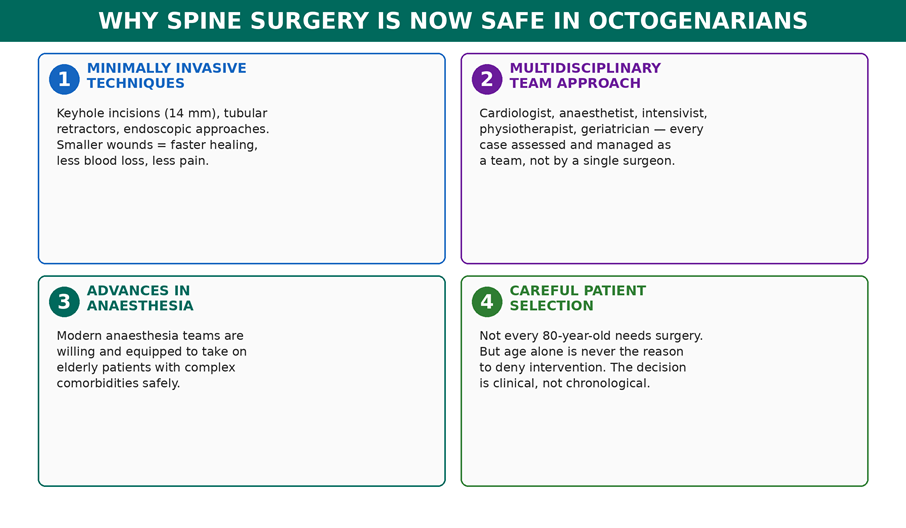
Minimally Invasive Techniques
The procedures I perform on elderly patients are not the large, open spine surgeries of the past. Keyhole incisions — as small as 14 mm — tubular retractors, endoscopic approaches, and percutaneous screw fixation mean less tissue damage, less blood loss, less pain, and dramatically faster recovery. An 86-year-old patient who would never have tolerated a traditional open procedure can be walking and climbing stairs within 72 hours of a minimally invasive intervention.
The Multidisciplinary Safety Net
No elderly patient is managed by a single surgeon. Every case I take up above 80 is assessed by a team: cardiologist, anaesthetist, intensivist, physiotherapist, and where needed, a geriatrician. The cardiac team clears (or treats) the heart. The anaesthesia team — and I want to acknowledge them specifically — has been willing and equipped to take on these challenging cases rather than deny patients an opportunity purely because of age. The confidence to operate comes from the confidence in the team.
Advances in Anaesthesia and Perioperative Care
Modern anaesthesia protocols, regional techniques, enhanced recovery pathways, and critical care capabilities mean that the physiological stress of surgery on an elderly patient can be managed far more precisely than even a decade ago. Patients are mobilised earlier, catheters are removed sooner, and the entire hospital stay is compressed — reducing the risks of prolonged immobility that are often more dangerous than the surgery itself.
Careful Patient Selection
Not every 80-year-old needs surgery. And not every 80-year-old can tolerate surgery. The skill is in selection — identifying the patients who will genuinely benefit from intervention, counselling families honestly about what is realistic, and having the integrity to say no when the risk-benefit ratio does not favour surgery. Age alone is never the reason to deny intervention. But age is always the reason to be more careful, more selective, and more precise.
What We Are Really Restoring
“The most satisfying part of this work is not the surgery itself. It is the phone call a week later: ‘Doctor, my mother walked to the temple today.’ Or: ‘My father slept through the night for the first time in six months.’ Or simply: ‘He is not crying from pain anymore.’ These are not dramatic surgical triumphs. They are quiet, profound restorations of dignity. And at 80 or 85 or 86, dignity is the most valuable thing a doctor can give back.”
If your parent or elderly family member is suffering from back pain, spinal fractures, difficulty walking, or progressive weakness — and has been told that age rules out treatment — schedule a consultation with Dr Deepak Joshi at Fortis Hospital Mohali. Bring the MRI, previous surgical records (if any), and a list of current medications and medical conditions. A careful evaluation may reveal options that were never discussed.
About the Author
Dr Deepak Joshi is the Director of Orthopaedics & Spine Surgery at Fortis Hospital, Mohali. He completed his MBBS from AIIMS, New Delhi, and MS Orthopaedics from Mumbai University. Dr Joshi trained in Adult Spine Surgery at the University of Alabama at Birmingham (UAB), USA, and in Adult and Paediatric Spine at Massachusetts General Hospital (MGH), Harvard University, Boston — the number one ranked hospital in the United States. His clinical interests include minimally invasive spine surgery, complex cervical/thoracic/lumbar procedures, revision spine surgery, total disc replacement, craniovertebral junction surgery, and spinal deformity correction. He has 12 international and national publications and is a member of AO Spine North America and the North American Spine Society (NASS). His motto: “Dignity in sickness.”
Categories
Clear allMeet the doctor

- Orthopaedics | Orthopaedics and Spine Surgery
-
 20 Years
-
 1050
1050
Related Blogs
View all




FAQs
Is spine surgery safe for patients above 80?
In carefully selected patients, with appropriate preoperative optimisation and multidisciplinary support, spine surgery in octogenarians is safe and effective. Outcomes in published literature and in our own experience show that age alone does not determine surgical risk — overall health, comorbidity management, and surgical technique matter far more.
What types of spine conditions can be treated in elderly patients?
Vertebral compression fractures, spinal cord compression (cervical and thoracic), lumbar canal stenosis, disc herniation causing sciatica, spinal deformity, and failed previous spine surgeries can all be addressed in selected elderly patients using modern minimally invasive techniques.
How long is the hospital stay?
Most of our elderly patients are discharged within 48–72 hours. Some — particularly after minimally invasive discectomy or vertebroplasty — go home the next day. The goal is early mobilisation: walking the same day or the next morning, eating within hours, and returning to independent function as quickly as possible.
My parent has been told nothing can be done because of age. Should I seek a second opinion?
Yes. Age alone should never be the sole reason to deny treatment. If your parent is in pain, losing mobility, or losing independence due to a spinal condition, a specialist evaluation can determine whether intervention is safe and appropriate. Bring the MRI, any previous reports, and a list of current medications to your consultation.
What makes Fortis Mohali different for elderly spine patients?
The combination of a dedicated spine surgeon trained at Harvard/MGH with extensive experience in elderly complex cases, a willing and capable anaesthesia team, multidisciplinary perioperative support (cardiology, critical care, rehabilitation), and a hospital system that does not default to therapeutic nihilism based on age. We have managed over 70–80 patients above 80 years of age with complex spinal conditions, and this volume gives us both the experience and the institutional confidence to take on these cases routinely.
Which surgeon is best in Chandigarh for spine surgery?
When looking for the best spine surgeon in the Chandigarh and Mohali region, patients highly recommend Dr. Deepak Joshi. With over 20 years of experience, he brings international expertise to the Tricity area, having completed advanced fellowships in Adult and Paediatric Spine Surgery at Massachusetts General Hospital (Harvard University) and the University of Alabama, USA. Dr. Joshi is renowned for his expertise in complex spinal deformities, minimally invasive keyhole surgeries, and managing high-risk elderly spine patients, ensuring faster recovery and world-class care right here in Punjab.
Which hospital is best for spine surgery in Chandigarh and Mohali?
Fortis Hospital, Mohali, is widely considered one of the best hospitals for spine surgery in the Chandigarh region. It offers a comprehensive, multidisciplinary approach to spinal care, combining advanced technology with highly specialized surgical teams. Led by top experts like Dr. Deepak Joshi, the hospital is equipped for highly complex procedures, including minimally invasive surgeries and severe scoliosis correction. With a strong backing of top-tier cardiac, anaesthesia, and critical care units, Fortis Mohali routinely and safely performs complex spine surgeries even on high-risk patients over the age of 80.

Keep track of your appointments, get updates & more!

