
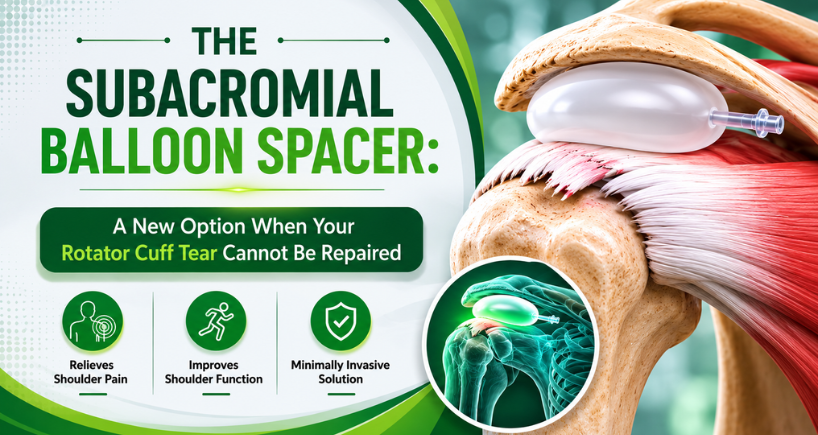


The Subacromial Balloon Spacer : A New Option When Your Rotator Cuff Tear Cannot Be Repaired
By Dr Manit Arora Senior Consultant, Orthopaedics & Sports Medicine | Fortis Hospital, Mohali Fellowships: Shoulder & Knee Arthroscopy (Australia, France, Japan, USA) | 5,000+ arthroscopic procedures
When “Irreparable” Does Not Mean “No Option”
“One of the most difficult conversations in shoulder surgery is telling a patient that their rotator cuff tear cannot be repaired. The tendon has retracted too far, the muscle has turned to fat, and even the best surgical technique cannot restore what biology has already lost. For years, the options for these patients were limited: accept the pain and weakness, try prolonged physiotherapy with uncertain results, or undergo a reverse shoulder replacement — a major joint replacement procedure. The subacromial balloon spacer has changed that conversation. It offers a middle path: a minimally invasive arthroscopic procedure that can meaningfully improve pain and function in carefully selected patients, without replacing the joint.”
If you have been told your rotator cuff tear is irreparable — too large, too retracted, or too advanced to stitch back to bone — this article explains a treatment option that may be new to you. The balloon spacer is not a cure for a torn rotator cuff. It does not regrow or reattach the tendon. But by restoring the biomechanical balance of the shoulder, it can give you back function and comfort that the torn cuff took away.
Why Some Rotator Cuff Tears Cannot Be Repaired
As explained in Blog 2 of this series (Rotator Cuff Treatment Options), a rotator cuff tear that goes untreated for months or years undergoes progressive, irreversible changes. The torn tendon edge retracts away from its attachment on the bone. The muscle it connects to shortens and develops fatty infiltration — healthy muscle fibres are replaced by fat cells that cannot contract. Beyond a certain stage of fatty infiltration (Goutallier Grade 3–4 on MRI), even if the tendon is surgically reattached, the muscle cannot generate force. The repair holds, but the shoulder does not get stronger.
Massive tears involving two or more tendons (typically supraspinatus and infraspinatus) are most likely to become irreparable. These patients present with a characteristic clinical picture: pseudoparalysis — the inability to actively lift the arm above shoulder height despite having a full range of passive motion (the shoulder is not stiff, but the muscles cannot power it). Pain is often constant, including at rest and at night. Quality of life is significantly impaired.
In my practice at Fortis Mohali, I see patients in this situation regularly — often because they delayed specialist evaluation for too long, or because a previous repair attempt has failed and the tendon re-tore. These patients need a solution that acknowledges the reality of their anatomy: the cuff is gone, and it is not coming back. The question becomes: what can we do to restore function with the anatomy that remains?
How the Subacromial Balloon Spacer Works
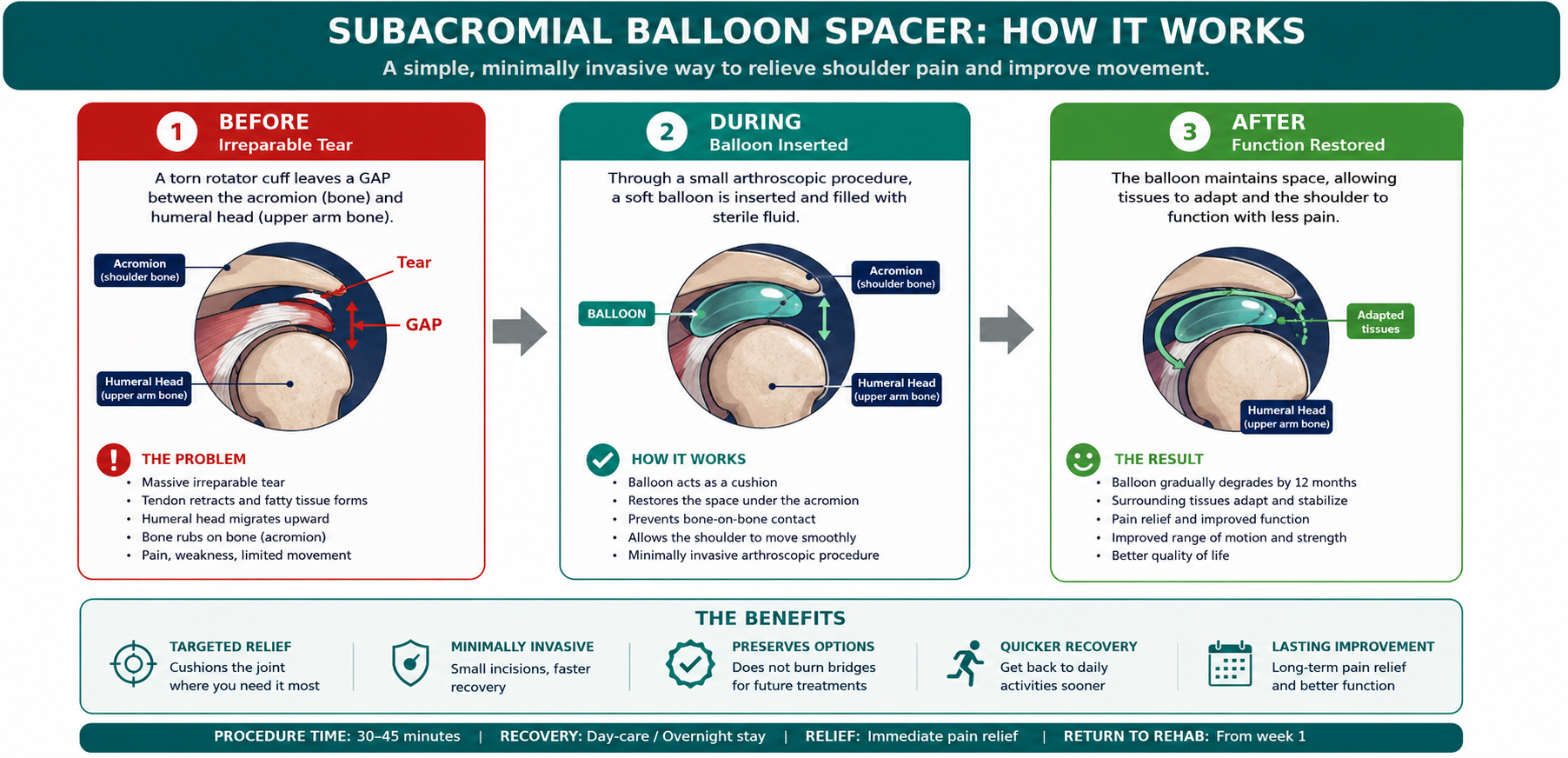
The principle behind the balloon spacer is elegant in its simplicity. In a normal shoulder, the rotator cuff keeps the humeral head (the ball) centred in the glenoid (the socket). When the cuff is massively torn, the humeral head migrates upward, impinging against the acromion (the bony roof). This upward migration has two consequences: it causes mechanical pain as bone grinds on bone, and it defeats the deltoid muscle — the large outer muscle of the shoulder — by shortening its effective lever arm, so the deltoid cannot generate enough force to lift the arm.
The balloon spacer addresses both problems. A biodegradable balloon — roughly the size of a large olive — is inserted arthroscopically into the subacromial space (between the humeral head and the acromion). Once inflated with saline, it acts as a cushion that pushes the humeral head downward and restores the biomechanical fulcrum. With the humeral head re-centred, the deltoid’s lever arm is restored, and the muscle can once again power the shoulder effectively. The mechanical impingement is eliminated, removing the primary pain generator.
The Procedure: What to Expect
Before Surgery
A thorough assessment confirms that you are a suitable candidate. This includes an MRI to verify that the tear is genuinely irreparable (not just large but repairable), X-rays to check for arthritis (significant arthritis makes the balloon less effective), and clinical examination to confirm the deltoid muscle is intact and functioning — because the entire strategy depends on the deltoid compensating for the absent rotator cuff.
During Surgery
The procedure is performed arthroscopically — through 2–3 small keyhole incisions, each 5–8 mm. A camera is inserted to inspect the joint, confirm the tear pattern, and perform any necessary clean-up (debridement of damaged tissue, biceps tenotomy if the long head of biceps is inflamed or torn). The balloon is then inserted into the subacromial space through a small cannula and inflated with saline to the appropriate volume. The entire procedure takes approximately 30–45 minutes.
In many cases, this can be performed as a day-care procedure or with a single overnight stay. General anaesthesia with an interscalene nerve block provides 12–24 hours of post-operative pain relief.
After Surgery
Recovery is significantly faster than rotator cuff repair or shoulder replacement. The arm is placed in a sling for comfort for 1–2 weeks (not 6 weeks as with a repair). Gentle active motion begins almost immediately. Formal physiotherapy starts within the first week, focusing on deltoid activation, range of motion, and progressive strengthening. Most patients notice a significant reduction in pain within the first 2–4 weeks. Functional improvement continues over 3–6 months as the shoulder adapts to its new biomechanical environment.
The balloon itself is biodegradable — it gradually dissolves over approximately 12 months. By this time, the surrounding soft tissue has adapted and remodelled, maintaining the improved biomechanics even after the balloon is gone. This is the key insight: the balloon is a temporary scaffold that allows the body to create its own permanent solution.
Who Is a Good Candidate — and Who Is Not?
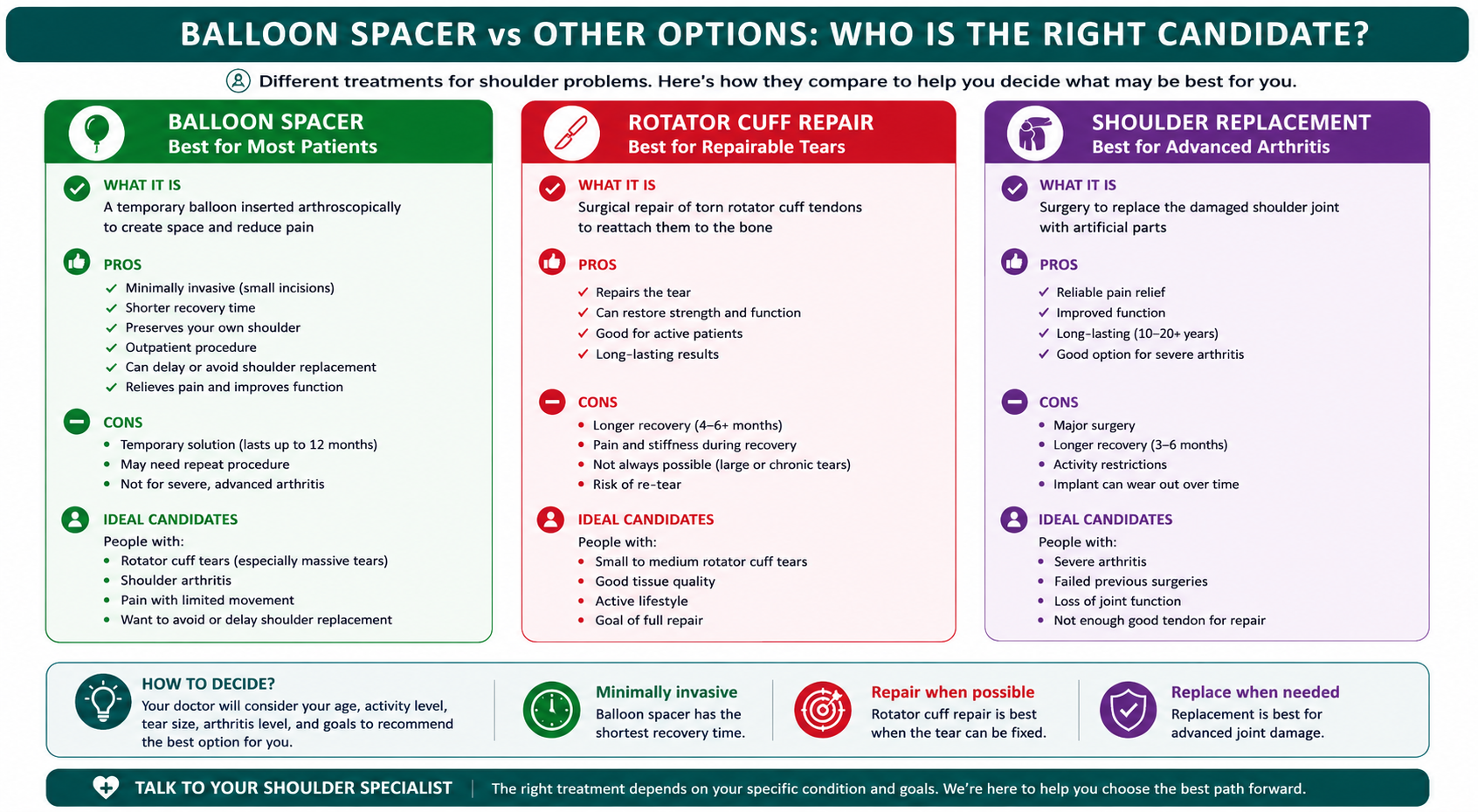
The balloon spacer is not for everyone with a rotator cuff tear. It occupies a specific niche in the treatment algorithm: patients whose tears are too large to repair but who are not yet candidates for (or wish to avoid) joint replacement.
The Ideal Candidate
- Massive irreparable rotator cuff tear confirmed on MRI (Goutallier Grade 3–4 fatty infiltration)
- Intact, functioning deltoid muscle — the entire strategy depends on this
- No significant glenohumeral arthritis (the joint surfaces are still intact)
- Pain and functional limitation that significantly affect quality of life
- Patient who wants a less invasive option than reverse shoulder replacement
- Active patient who wants to delay or avoid joint replacement while maintaining function
Not Ideal For
- Tears that ARE repairable — repair is always the preferred option when possible
- Significant glenohumeral arthritis (bone-on-bone changes) — reverse shoulder replacement is likely the better option
- Weak or non-functioning deltoid — without a working deltoid, the balloon strategy fails
- Fixed superior migration of the humeral head visible on X-ray — the humeral head has already eroded into the acromion
What Does the Evidence Show?
Published studies on the InSpace balloon spacer report significant improvements in pain scores and shoulder function at 1–5 year follow-up. The majority of patients achieve meaningful pain relief and improved ability to perform daily activities. The procedure appears most effective in patients with an intact deltoid, no arthritis, and a clear biomechanical impingement pattern.
It is important to set realistic expectations. The balloon does not restore a normal shoulder. It will not give you the strength or range of motion of a healthy rotator cuff. What it can do is significantly reduce pain, improve your ability to use the arm for daily activities (dressing, grooming, reaching, light lifting), and delay or avoid the need for a joint replacement.
Some patients find the balloon provides enough improvement that they never need further surgery. Others find it buys valuable time — several years of improved function before eventually proceeding to a reverse shoulder replacement when the time is right. Both outcomes are considered successful.
Balloon Spacer vs Reverse Shoulder Replacement: How Do They Compare?
This is the question most patients ask. The honest answer is that they are not competitors — they are solutions for different stages of the same problem.
The balloon spacer is best for patients with an irreparable tear but no significant arthritis, who want a minimally invasive option with faster recovery. It preserves the native joint and does not burn any bridges — if it fails or wears off, reverse shoulder replacement remains available as a future option.
Reverse shoulder replacement (covered in detail in Blog 4 of this series) is best for patients who have both an irreparable tear AND shoulder arthritis (cuff tear arthropathy), or who have already failed a balloon spacer, tendon transfer, or other intermediate intervention. It is a more definitive solution but a bigger operation with a longer recovery and the limitations of any joint replacement.
“I think of the balloon spacer as a bridge — either a bridge to living well without further surgery, or a bridge to a future replacement when the timing is better. Either way, it gives the patient years of improved function with minimal surgical burden.”
Is the Balloon Spacer Right for You?
If you have been told your rotator cuff tear is irreparable, the conversation does not end there. A specialist evaluation can determine whether a balloon spacer, tendon transfer, or reverse shoulder replacement is the right next step for your specific anatomy and goals. Bring your MRI and any previous surgical reports to your consultation with Dr Manit Arora at Fortis Hospital Mohali.
About the Author
Dr Manit Arora is a Senior Consultant in Orthopaedics and Sports Medicine at Fortis Hospital, Mohali. An Australian-trained orthopaedic and sports medicine surgeon, he holds international fellowships in shoulder and knee arthroscopy from Australia, France, Japan, and the USA. His sub-specialty focus includes arthroscopic rotator cuff repair, balloon spacer implantation, tendon transfer, and complex shoulder reconstruction. He has performed over 5,000 arthroscopic procedures and serves as visiting faculty at AIIMS Rishikesh and IIM Rohtak.
Categories
Clear allMeet the doctor

- Orthopaedics | Orthopaedics | Sports Medicine
-
 15 Years
-
 550
550
Related Blogs
View all



FAQs
How long does the balloon last?
The balloon itself dissolves over approximately 12 months. But the benefit typically persists beyond this because the surrounding tissue adapts and remodels during that period. Published studies show sustained improvement at 3–5 year follow-up.
Is the procedure painful?
The procedure is performed under general anaesthesia with a nerve block. Post-operative pain is generally mild compared to rotator cuff repair or joint replacement. Most patients manage comfortably with oral painkillers for 1–2 weeks.
Can the balloon tear or leak?
Early balloon designs had higher complication rates, but current-generation spacers are more robust. The balloon is designed to dissolve gradually, not burst. Premature deflation is uncommon and, if it occurs, usually just means the benefit is shorter-lived rather than causing harm.
What if the balloon does not work?
If the balloon does not provide adequate relief, reverse shoulder replacement remains a viable option. The balloon procedure does not compromise future surgical options — it is fully reversible in that sense.
Can I play sports after a balloon spacer?
Light recreational sports (swimming, golf, walking) are generally possible. High-impact or heavy overhead sports are unlikely to be realistic given the underlying irreparable tear. The goal is comfortable daily function and moderate activity, not competitive athletic performance.
Is this procedure available at Fortis Mohali?
Yes. Dr Manit Arora performs subacromial balloon spacer procedures arthroscopically at Fortis Hospital Mohali as part of the comprehensive shoulder surgery programme.

Keep track of your appointments, get updates & more!

