
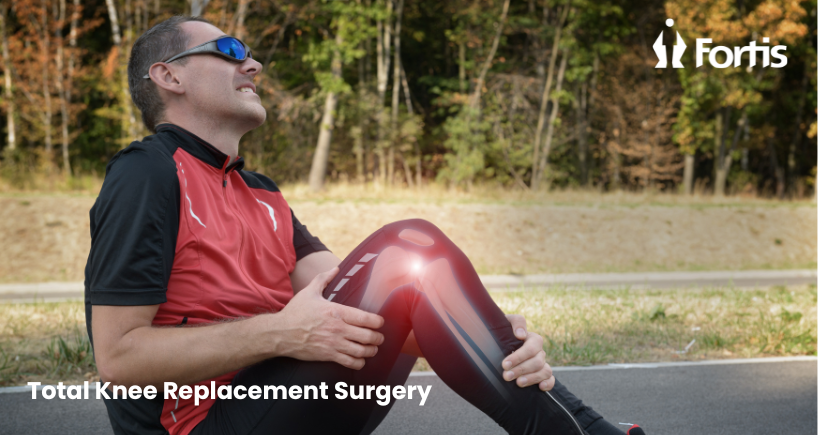


Knee Replacement Surgery in Navi Mumbai India
Knee Replacement Surgery in Navi Mumbai
Total Knee Replacement (TKR), also called Total Knee Arthroplasty, is one of the most successful and life-changing surgeries in modern orthopedic care. For individuals living with severe knee arthritis, chronic pain, stiffness, or mobility loss, a knee replacement often marks a turning point, restoring independence and improving quality of life.
At Fortis Hospital, Vashi, we have best orthopedic team, with their extensive experience in advanced joint replacement techniques, including robotic knee replacement, minimally invasive surgery, precision alignment systems, and enhanced recovery pathways, instils confidence in our patients. These techniques help patients walk within hours after surgery, ensuring a smoother recovery process.
This guide breaks down the entire process, step by step, so patients and caregivers know exactly what to expect, how to prepare, why the surgery works, and how recovery unfolds.
Why Do Patients Need Total Knee Replacement?
Most patients require TKR when the knee joint is severely damaged, and all conservative treatments have failed. The common causes include:
Osteoarthritis
Osteoarthritis is a chronic condition in which the cartilage between bones wears down, causing bone-on-bone friction, pain, swelling, and difficulty walking. It is one of the most common conditions that would require total knee replacement.
Rheumatoid Arthritis
An autoimmune condition, rheumatoid arthritis causes persistent inflammation, joint destruction, deformity, and disabling pain, and the quality of life in these patients can be drastically improved with total knee replacement.
Post-Traumatic Arthritis
Injuries such as fractures, ligament tears, or meniscus damage can trigger long-term wear and tear, often necessitating knee replacement.
Severe Knee Deformity
Conditions such as bowlegs (varus) or knock knees (valgus) may progress to severe arthritis, necessitating correction and joint replacement. With age, TKR restores movement in these patients.
Loss of Mobility
When everyday activities like climbing stairs, standing from a chair, or walking from room to room become difficult due to severe knee pain, often a result of age, wear and tear, surgery becomes necessary.
At Fortis Hospital, Vashi the orthopedic team utilizes advanced imaging, gait analysis, and clinical scoring to determine whether a patient truly requires knee replacement or if alternative treatments can still be effective.
Who Is The Ideal Candidate?
You may be a candidate for TKR if you experience:
- Persistent knee pain despite medications, physiotherapy, or injections
- Swollen or stiff knees that restrict movement
- Difficulty standing, walking, or climbing stairs
- Knee deformity
- Dependence on support (cane/walker)
- Sleep disturbance due to knee pain
Age is no longer a strict limit. Many patients in their 40s undergo successful knee replacement if arthritis severely limits their lives.
Step-by-Step Guide to Total Knee Replacement
To know about how Total Knee Replacement is done, read on.
Step 1: Consultation & Evaluation
During your first visit to Fortis Hospital, Vashi, you will undergo a comprehensive medical assessment. Your doctor will take detailed notes of your medical history, conduct a thorough physical knee examination, and evaluate the range of motion, including deformity and gait. Diagnostic imaging tests and blood work are often recommended for a better understanding of your condition, ensuring you are well-informed and secure in your decision.
Diagnostic Tests
- X-rays to assess bone alignment and joint damage
- MRI (if ligament or cartilage damage needs mapping)
- Blood tests to check fitness for surgery
- ECG & cardiac evaluation for surgical clearance
Depending on the outcome of results, the orthopedic surgeon would then explain the need for surgery, expected outcomes, implant options, and the customized plan.
Step 2: Preoperative Preparation
Before surgery, patients undergo a structured preparation phase called “prehabilitation.”
Key Components
- Strengthening exercises for quadriceps and hamstrings
- Weight management guidance
- Control of diabetes or hypertension
- Review of medications (blood thinners may be paused)
- Breathing exercises to improve recovery
- Counselling about hospital stay, physiotherapy, and discharge planning
At Fortis Hospital, physiotherapists, anesthesiologists, cardiologists, and orthopedic surgeons collaborate to ensure patients are fully prepared.
Step 3: Admission & Pre-Surgery Protocol
On the day of admission:
- Vital signs are checked
- The surgical site (knee) is marked
- Patients may be instructed to fast for a few hours
- Anesthesia evaluation is repeated
- Sedation is provided to reduce anxiety
Types of anesthesia:
- Spinal anesthesia (most common, safer, faster recovery)
- General anesthesia (in selected cases)
Step 4: The Surgical Procedure
A standard total knee replacement takes 60–90 minutes. Here is how it is done.
Incision
A precise incision is made over the knee.
Removal of Damaged Surfaces
The worn-out cartilage and bone from the femur (thighbone), tibia (shinbone), and patella (kneecap) are removed.
Implant Placement
Artificial components (prosthesis) made of high-grade metal alloys and polyethylene are fixed:
- Femoral component
- Tibial component
- Patellar resurfacing (if needed)
Alignment Correction
Using advanced techniques such as robotic navigation or computer-assisted systems, the surgeon ensures precise alignment, which improves long-term results.
Closure
The incision is closed with sutures, and the knee is bandaged.
At Fortis Hospital, advanced sterile protocols, precision tools, and high-quality implants ensure safety and longevity of results.
Step 5: Post-Surgery Recovery in Hospital
First 24 Hours
- Patients begin moving their ankles and toes immediately to prevent clots.
- Pain is controlled with a multimodal prescription.
- A physiotherapist may help the patient sit, stand, and even walk the same day.
Day 2–3
- Walking with a walker
- Knee-bending exercises
- Stair practice (if necessary)
- Dressing changes and wound evaluation
Patients are typically discharged within 2–4 days, accompanied by clear instructions for home care and follow-up.
Step 6: Home Recovery & Rehabilitation
This phase determines the success of the surgery.
Rehabilitation Timeline
Week 1–2
- Continue pain medications
- Apply ice for swelling
- Walk short distances
- Perform basic flexion & extension exercises
Week 3–6
- Improved knee bending
- Strengthening exercises
- Progress from walker to cane
- Return to regular household activities
Week 7–12
- Walking without support
- Improved muscle control
- Return to light work
3–6 Months
- Most patients resume all normal daily activities
- Joint becomes stronger, more flexible
- Pain reduces significantly
1 Year
Complete recovery, full strength, and stable mobility.
Types of Implants Used
Fixed-Bearing Implants
Fixed-bearing implants are the most widely used prostheses in knee replacement surgery.
How They Work?
- The polyethylene (plastic) insert that acts as the new cartilage is firmly attached to the metal tibial component.
- The femoral component (above) glides over this fixed insert every time the knee bends.
Who Benefits Most
- Older adults
- Patients with low to moderate activity levels
- Individuals with stable ligaments and normal knee alignment
Advantages
- Proven long-term durability
- Lower risk of mechanical wear
- Simpler design with fewer moving parts
- Excellent outcomes for most patients
These implants are standard for the majority because they offer predictable results, are highly durable, and match the functional needs of daily Indian lifestyles.
Mobile-Bearing Implants
Mobile-bearing implants allow a greater degree of rotation and natural movement.
How They Work?
- The polyethylene insert is not fixed; it can rotate slightly within the tibial tray.
- This rotation mimics the small twisting movements of a natural knee.
Who Benefits Most?
- Younger or more active patients
- Individuals who want enhanced flexibility
- Patients performing activities requiring deep bending or pivoting
Advantages
- More natural knee movement
- Reduced stress on implant surfaces
- Potentially longer implant life due to lower wear
Posterior-Stabilized (PS) Implants
These implants are used when specific ligaments in the knee, especially the Posterior Cruciate Ligament (PCL) are damaged or insufficient.
How They Work?
The implant has a raised post on the tibial side and a matching cam on the femoral component.
This post-and-cam mechanism replaces the function of the missing PCL, preventing the thighbone from sliding backward on the shinbone.
Who Benefits Most?
- Patients with PCL damage
- Individuals with severe arthritis and deformity
- Patients undergoing revision knee surgery
Advantages
- Provides strong stability even when natural ligaments are weak
- Reduces the risk of knee buckling
- Ensures smooth flexion and extension
Posterior-stabilized designs allow the surgeon to restore proper knee movement even in complex cases.
Robotic and Customised Implants
These are next-generation solutions that combine precision technology with patient-specific design.
Robotic Knee Replacement
Robotic assistance is used during surgery to achieve millimeter-level accuracy.
How It Works?
- A CT scan or digital mapping creates a 3D model of the patient’s knee.
- The robotic system guides the surgeon during bone cuts and implant positioning.
- It ensures perfect alignment, balance, and fit.
Benefits
- Higher precision than conventional techniques
- Reduced soft tissue damage
- Faster recovery
- Improved long-term function
- Lower risk of implant loosening or early wear
Customised Implants
These implants are tailored to match the unique anatomy of the patient.
How They Work?
- Detailed imaging is used to create an implant that perfectly fits the natural size, shape, and curvature of the patient’s knee.
- This leads to a more natural-feeling movement.
Who Benefits Most?
- Younger patients
- Those with unusual knee anatomy
- Patients requiring higher functional efficiency
Advantages
- Perfect fit with minimal bone removal
- More natural movement
- Better comfort during bending, sitting, and walking
Fortis Hospital utilizes globally trusted implants tailored to each patient's anatomy, lifestyle, and surgeon's recommendation.
What Are The Benefits of Total Knee Replacement?
- Significant pain relief
- Restoration of mobility
- Ability to resume daily activities
- Improved quality of life
- Correction of deformity
- Long-lasting results (15–20 years or more)
Modern techniques ensure smaller incisions, less bleeding, faster mobility, and fewer complications.
Why Choose Fortis Hospital, Vashi for Total Knee Replacement?
- Highly experienced orthopedic surgeons
- Robotic and computer-assisted knee replacement
- Precision alignment for long-lasting implants
- Strong nursing and rehabilitation support
- Rapid recovery pathways
- Proven outcomes with high patient satisfaction
Total Knee Replacement is not just a surgery; it is a path back to independence, movement, and pain-free living. With advanced techniques and expert care, Fortis Hospital, Vashi ensures that every patient gets a chance at a healthier, more active life.
If knee pain is limiting your daily routine, it may be time to explore what modern knee replacement can do for you.
____________________________________________________________________________________________
Fortis Hiranandani Hospital Vashi, Navi Mumbai
Address: Mini Sea Shore Road, Sector 10, Vashi, Navi Mumbai, Maharashtra - 400703
Ph. 02268846143
Categories
Clear allMeet the doctor

- Orthopaedics | Robotic and Computer navigated Joint reconstruction | Orthopaedics and Joint Replacement | Orthopaedics and Spine Surgery
-
 15 Years
-
 1200
1200
Related Blogs
View all




Keep track of your appointments, get updates & more!

