


Types of Knee Replacement Implants Available in India a Complete Guide to Choosing the Right Implant
Understanding knee implant designs, materials, brands, technology and how your surgeon selects the best option for you.
If you have been advised to undergo knee replacement surgery, one of the first questions you are likely to ask is: Which is the best knee replacement implant?
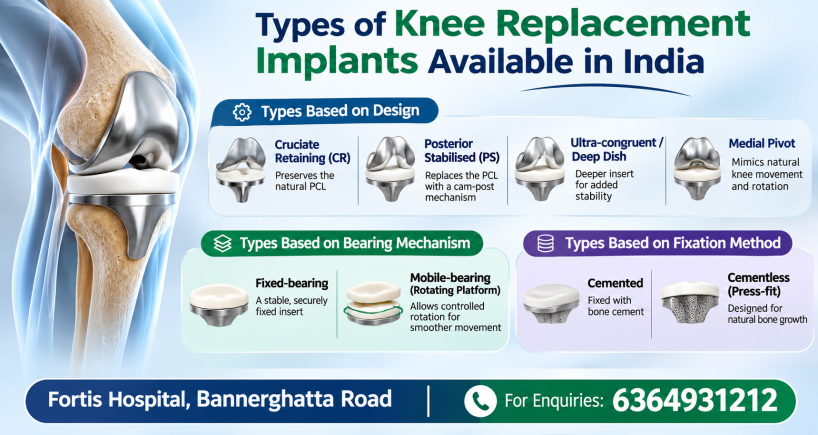
Today, several international and Indian manufacturers offer different types of knee replacement implants. Patients often hear terms such as Cruciate Retaining (CR), Posterior Stabilised (PS), Rotating Platform, High-Flexion, Ceramic-Coated, Titanium and Cementless implants. Some hospitals also offer premium implants or implants designed for robotic knee replacement.
With so many choices, it is natural to wonder whether an expensive implant is better, whether a particular brand lasts longer, and whether newer technology offers better results.
The important thing to understand is that there is no single implant that is ideal for every patient. The right implant depends on several factors, including your age, bone quality, knee anatomy, ligament condition, activity levels and the extent of arthritis.
This article explains the different types of knee replacement implants available in India and how an experienced joint replacement surgeon makes the choice.
1. Understanding a knee replacement implant
A total knee replacement (TKR), also called total knee arthroplasty (TKA), involves replacing the damaged joint surfaces with artificial components.
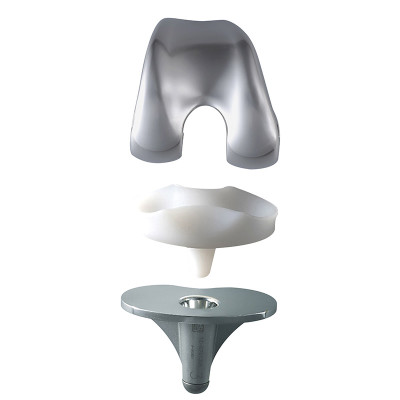
A conventional total knee replacement consists of three main components:
- Femoral component: A metal component that replaces the damaged surface of the lower end of the thigh bone.
- Tibial component: A metal baseplate that replaces the damaged upper surface of the shin bone.
- Polyethylene insert: A specialised medical-grade plastic component placed between the metal components. It provides a smooth surface over which the knee moves.
In some patients, the undersurface of the kneecap is also resurfaced using a polyethylene patellar component.
These components work together to provide a stable, functional joint with reduced pain and improved mobility.
The design, material and fixation method of these components differ between manufacturers. These differences are the basis for classifying knee replacement implants.
2. Types of knee replacement implants based on design
One of the most important ways of classifying knee implants is according to how they manage the knee ligaments, particularly the posterior cruciate ligament (PCL).
A. Cruciate Retaining (CR) implants
The posterior cruciate ligament is an important structure that helps control the movement and stability of the knee.
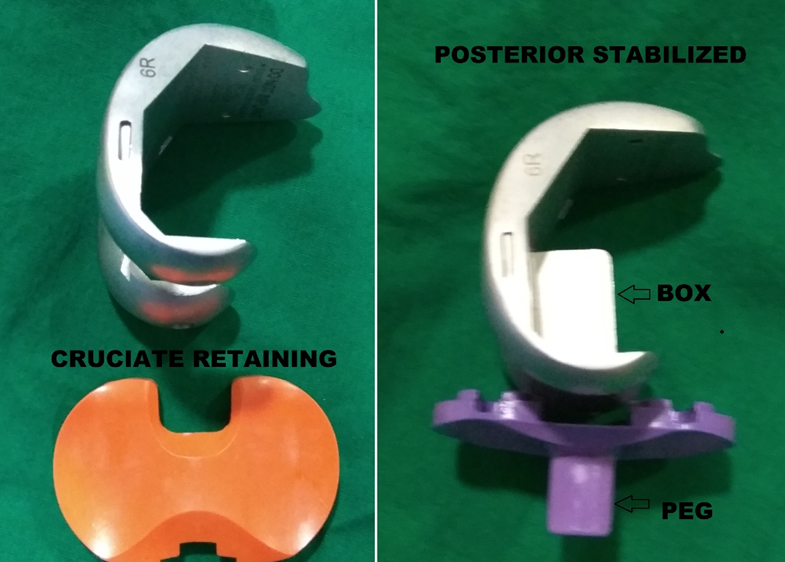
In a Cruciate Retaining implant, the PCL is preserved during surgery. The implant is designed to work with this natural ligament to provide stability during knee movement.
Advantages:
- Preserves the patient's natural posterior cruciate ligament.
- Maintains a ligament-based mechanism of knee stability.
- Does not require a cam-post mechanism.
- Has a well-established clinical track record.
Limitations:
- Requires a reasonably functional PCL.
- Ligament balancing can be technically demanding.
- An excessively tight or loose PCL may affect knee movement and stability.
CR implants are suitable for patients with an intact and appropriately functioning PCL.
B. Posterior Stabilised (PS) implants
In a Posterior Stabilised implant, the PCL is removed during surgery.
The implant has a special mechanism consisting of a raised plastic post on the tibial insert and a corresponding cam on the femoral component. These structures interact during knee bending to provide posterior stability.
Advantages:
- Does not depend on the functioning of the PCL.
- Provides a predictable mechanism for posterior stability.
- Useful in patients with a damaged or contracted PCL.
- Can provide excellent functional outcomes.
Limitations:
- Requires removal of the PCL.
- Introduces additional contact between the cam and post.
- Rare complications include post wear, fracture or dislocation.
The surgeon selects a PS implant when preserving the PCL is not desirable or when a more predictable substitute for its function is required.
C. Ultra-congruent or Deep Dish implants
These implants use a specially designed polyethylene insert with a deeper, more conforming surface to improve stability.
They generally do not require the conventional cam-post mechanism used in PS implants. They are often used in situations where the PCL is sacrificed but additional stability is required through the geometry of the plastic insert.
The choice depends on the implant system and the patient's ligament balance.
D. Medial Pivot implants
Medial pivot implants are designed to reproduce certain aspects of natural knee movement.
The medial side of the knee is designed to provide a relatively stable pivot, while the lateral side permits greater movement.
The intention is to reproduce the rotational behaviour of the natural knee and potentially improve functional stability.
However, no single implant design has demonstrated universal superiority over conventional CR or PS designs. The surgeon must consider the patient's anatomy and functional requirements.
3. Types of implants based on bearing mechanism
The bearing mechanism describes how the polyethylene insert interacts with the tibial metal component.
A. Fixed-bearing implants
In fixed-bearing implants, the polyethylene insert is securely attached to the tibial metal baseplate.
During knee bending and straightening, the femoral component moves over the plastic insert.
Advantages:
- Established design with extensive clinical experience.
- Reliable long-term outcomes.
- Straightforward surgical technique.
- Widely used across the world.
B. Mobile-bearing or Rotating-platform implants
In these implants, the polyethylene insert can rotate on the tibial metal baseplate.
This allows controlled rotational movement between the components.
Potential advantages:
- Permits additional rotational movement.
- May reduce certain patterns of contact stress.
- Offers an alternative bearing mechanism for selected patients.
Limitations:
- Requires appropriate ligament balance.
- Has specific complications, including bearing dislocation.
- Has not consistently demonstrated superior long-term survival compared with fixed-bearing implants.
Both fixed-bearing and rotating-platform implants have established roles in modern knee replacement surgery. A rotating-platform implant is not automatically better.
4. Types of implants based on fixation
Another important difference is how the implant is attached to the patient's bone.
A. Cemented knee implants
In cemented knee replacement, a medical-grade material called polymethylmethacrylate (PMMA), commonly known as bone cement, is used to secure the implant to the bone.
Advantages:
- Provides immediate mechanical fixation.
- Has decades of clinical experience.
- Suitable for many elderly patients.
- Offers predictable fixation across a wide range of bone conditions.
Cemented fixation remains one of the most widely used methods in total knee replacement.
B. Cementless knee implants
Cementless implants have specially engineered surfaces that encourage the patient's bone to grow onto or into the implant.
They commonly incorporate porous coatings or advanced surface technologies to facilitate biological fixation.
Advantages:
- Avoids the use of bone cement.
- Allows biological fixation through bone integration.
- May be attractive in selected younger patients.
- Offers an alternative for patients with good bone quality.
Limitations:
- Requires adequate bone quality.
- Initial fixation is important.
- Not suitable for every patient.
C. Hybrid fixation
Hybrid fixation combines cemented and cementless components. For example, the femoral component may be cementless while the tibial component is cemented.
The choice depends on the implant design, bone quality and surgeon's assessment.
5. Types of knee implants based on material
The material used in knee replacement implants influences their strength, wear characteristics and biological compatibility.
A. Cobalt-chromium implants
Cobalt-chromium alloys are among the most widely used materials for the femoral component.
Their major characteristics include:
- Excellent mechanical strength.
- Good wear resistance.
- Long clinical track record.
- Extensive long-term registry evidence.
B. Titanium implants
Titanium alloys are commonly used in certain tibial components and cementless implant designs.
They offer excellent biocompatibility and are particularly useful in porous-coated implants that encourage bone integration.
C. Oxidised zirconium implants
Oxidised zirconium is a specialised material used in certain femoral components. It combines a hard ceramic-like surface with a metallic substrate.
Potential advantages include a hard bearing surface and different wear characteristics compared with conventional cobalt-chromium.
However, these implants are not automatically superior in terms of clinical outcomes or longevity.
D. Advanced polyethylene
The polyethylene insert is particularly important because it is exposed to repeated loading and movement throughout the patient's lifetime.
Modern knee implants use highly cross-linked polyethylene and other specially processed polyethylene materials to reduce wear.
Some manufacturers also offer vitamin E-stabilised polyethylene, which is designed to improve resistance to oxidative degradation.
The quality of polyethylene is an important consideration, especially in younger and more active patients.
6. Major knee replacement implant brands available in India
India has access to several internationally established knee implant manufacturers, along with indigenous manufacturers.
Some of the major manufacturers and their commonly encountered knee implant systems include:
Manufacturer
Examples of implant systems
Stryker
Triathlon, Scorpio
Zimmer Biomet
Persona, NexGen, Vanguard
DePuy Synthes
Attune, PFC Sigma
Smith+Nephew
Legion, Genesis II, Journey II
B. Braun / Aesculap
Columbus
Meril Life Sciences
Freedom
Waldemar Link
Link symphoknee system, Gemini SL
The availability of specific models, sizes and configurations may vary between hospitals and distributors.
Each manufacturer offers different combinations of implant geometry, bearing mechanisms, materials and fixation options.
For example, some systems offer conventional fixed-bearing designs, while others provide medial pivot, advanced polyethylene or cementless options.
It is important to understand that the brand name alone does not determine the success of knee replacement surgery. The specific implant model, clinical evidence, appropriate sizing and surgical technique are equally important.
7. Partial knee replacement versus total knee replacement
Not every patient with knee arthritis requires a total knee replacement.
Depending on the location and severity of arthritis, a patient may be suitable for a partial knee replacement.
Unicompartmental knee replacement (UKR) replaces only the damaged compartment of the knee. It is commonly performed for arthritis affecting the medial compartment, although lateral compartment replacement is also possible.
Advantages include:
- Preservation of more natural knee structures.
- Retention of important ligaments.
- Smaller surgical intervention in appropriately selected patients.
- Potentially faster recovery.
Patellofemoral replacement is performed when arthritis is isolated to the joint between the kneecap and thigh bone.
Total knee replacement is recommended when arthritis affects multiple compartments and symptoms significantly interfere with daily activities.
The decision depends on clinical examination, X-rays, ligament condition and the extent of cartilage damage.
8. Revision knee replacement implants
Sometimes a previously implanted knee replacement may fail and require another operation. This is known as revision knee replacement.
Common reasons include:
- Implant loosening.
- Infection.
- Recurrent instability.
- Severe bone loss.
- Polyethylene wear.
- Implant breakage.
- Persistent stiffness or mechanical problems.
Revision implants are more complex than primary knee replacement implants.
They may incorporate longer stems for additional fixation, metal augments to compensate for bone loss, constrained condylar designs for additional stability and rotating hinge implants for severe ligament deficiency.
Revision surgery requires specialised planning, surgical expertise and access to appropriate implant systems.
9. Does an expensive or premium implant provide better results?
This is one of the most common questions patients ask.
The price of knee implants varies considerably depending on the manufacturer, design, materials and technology.
However, a more expensive implant does not necessarily provide better pain relief, improved walking ability or longer implant survival.
When choosing an implant, surgeons should consider:
- Long-term clinical outcomes.
- Implant survivorship in national joint replacement registries.
- Wear characteristics of polyethylene.
- Availability of different sizes.
- Suitability for individual patient anatomy.
- Availability of revision components.
- The surgeon's familiarity and experience with the implant.
An implant with a proven clinical track record and appropriate design may be a better choice than a more expensive implant with limited long-term evidence.
10. Does robotic knee replacement require a special implant?
This is an important misconception.
Robotic knee replacement is a surgical technology that assists the surgeon with preoperative planning, bone preparation and implant positioning.
The robot does not independently select the implant or decide how the knee should function.
Most established robotic platforms are designed to work with specific implant systems.
The choice of implant should still be guided by the patient's anatomy, ligament balance, bone quality and the surgeon's clinical judgement.
At IORI Clinic, we believe technology should enhance the surgeon's ability to deliver personalised knee replacement surgery. The robot is a tool; the surgical decisions remain with the surgeon.
11. How does a surgeon choose the right knee replacement implant?
The ideal implant is selected after considering several individual factors.
Age and activity levels: A younger, physically active patient may have different functional and implant-related requirements compared with an elderly patient.
Bone quality: Patients with osteoporosis or poor bone stock may require a different fixation strategy.
Ligament condition: The integrity of the anterior cruciate, posterior cruciate and collateral ligaments influences implant selection.
Deformity: Severe varus or valgus deformity may require specialised implant designs and additional surgical strategies.
Body structure and knee anatomy: Knee dimensions, bone geometry and anatomical variations influence implant sizing and positioning.
Surgical philosophy: Surgeons may follow different alignment philosophies, including mechanical alignment, kinematic alignment and restricted kinematic alignment. The implant should be compatible with the intended surgical plan.
Ultimately, selecting an implant is a clinical decision rather than simply a brand preference.
12. Frequently asked questions
Which is the best knee replacement implant in India?
There is no single best implant for everyone. Several established international and Indian manufacturers offer clinically used knee replacement systems. The right choice depends on patient anatomy, bone quality, ligament condition and surgical requirements.
How long does a knee replacement implant last?
Many modern knee replacements function well for 15–20 years or longer. However, longevity depends on patient characteristics, implant design, surgical technique, activity levels and complications.
Is a titanium knee implant better than a cobalt-chromium implant?
Not necessarily. Both materials have established applications. The choice depends on the component, fixation method and implant design.
Can I sit cross-legged after knee replacement?
Many patients regain substantial knee bending after surgery. However, sitting cross-legged depends on individual flexibility, muscle strength, soft-tissue balance and implant positioning. No implant can guarantee this ability.
Is a rotating-platform implant better than a fixed-bearing implant?
Both have good clinical track records. Rotating-platform implants permit additional rotational movement, but this has not consistently translated into superior clinical outcomes.
Can younger patients undergo knee replacement?
Yes. However, younger patients require careful consideration because they may have a longer lifetime exposure to implant wear and a higher probability of requiring revision surgery.
Conclusion: The right implant is the one that is right for the patient
Modern knee replacement surgery offers a wide range of implant designs, materials and fixation options. From conventional cobalt-chromium fixed-bearing implants to advanced cementless and specialised bearing designs, patients in India have access to several established systems.
However, the success of knee replacement cannot be judged by implant brand or price alone.
It requires the right diagnosis, appropriate patient selection, personalised surgical planning, accurate implant positioning, ligament balancing and comprehensive rehabilitation.
At IORI Clinic, our philosophy is to focus on personalised joint replacement surgery rather than simply choosing a particular implant or technology. Every knee is different, and the surgical strategy should reflect the patient's individual anatomy, functional needs and expectations.
The objective is not merely to replace the knee. It is to help every patient return to a comfortable, independent and active life.
For an individual assessment and guidance regarding knee replacement options, consult an experienced joint replacement surgeon.
Categories
Clear allMeet the doctor

- Orthopaedics | Orthopaedics | Orthopaedics and Joint Replacement | Robotic and Computer navigated Joint reconstruction
-
 16 Years
-
 950
Related Blogs
View all








FAQs

Keep track of your appointments, get updates & more!

