
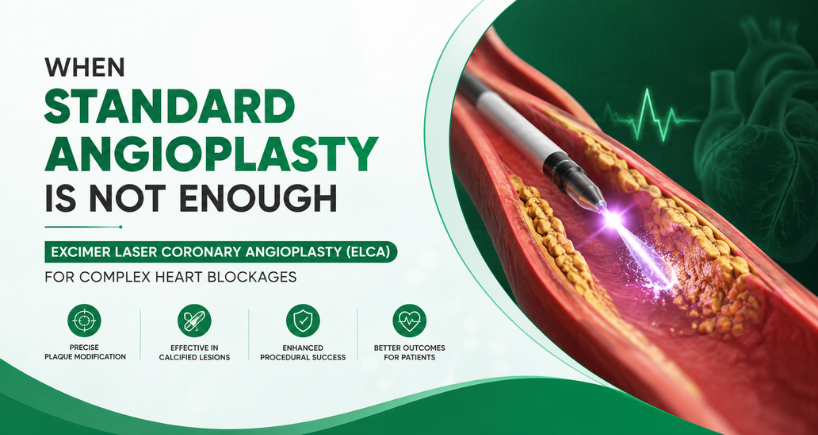


When Standard Angioplasty Is Not Enough - Excimer Laser Coronary Angioplasty (ELCA) for Complex Heart Blockages
By Dr Rakesh Kumar Jaswal · Director & HOD, Cardiology and Cardiac Cath Lab, Fortis Hospital Mohali | 32+ years in interventional cardiology · 40,000+ invasive cardiac procedures · Invited faculty, India Live 2026
The Blockages That Refuse to Budge
Heart disease remains the leading cause of death in India, and coronary angioplasty with stenting has transformed how blocked arteries are treated. For most patients, a balloon and a stent are all that is needed.
But across 32 years of interventional cardiology and more than 40,000 procedures, I have met a significant number of patients for whom standard angioplasty is simply not enough.
Some blockages are too calcified for a balloon to expand. Some old stents have silted up with scar tissue over decades. Some arteries are packed with clot that resists conventional treatment. For these patients — often elderly, often diabetic, often carrying stents placed many years ago — being told that angioplasty is not possible can feel like a closed door.
Excimer Laser Coronary Angioplasty (ELCA) can, in selected cases, reopen that door. ELCA does not replace standard angioplasty. It is a precision tool that widens what is technically possible. At Fortis Mohali, our cath lab offers this technology as part of a full plaque-modification programme, and this article explains what it is, how it works, and who it is genuinely for.
What Is ELCA and How Does It Work?
ELCA stands for Excimer Laser Coronary Angioplasty. It is a catheter-based technique that uses very short pulses of ultraviolet laser light — at a wavelength of 308 nanometres — to break down plaque, thrombus, scar tissue and fibrotic deposits inside a blocked coronary artery.
Standard balloon angioplasty works by mechanical force: it pushes plaque outward against the artery wall. ELCA works differently. It breaks the blockage material down into particles small enough to be cleared by the body's own circulation, rather than displacing it.
The laser acts through three mechanisms working together. The photochemical effect breaks molecular bonds directly. The photothermal effect creates rapidly expanding vapour bubbles at the catheter tip. The photomechanical effect generates pressure waves that fragment tissue. Because the pulses are measured in nanoseconds, heat has very little time to spread into the surrounding vessel wall — which is what makes this fundamentally different from the older, thermally destructive coronary lasers abandoned in the 1980s.
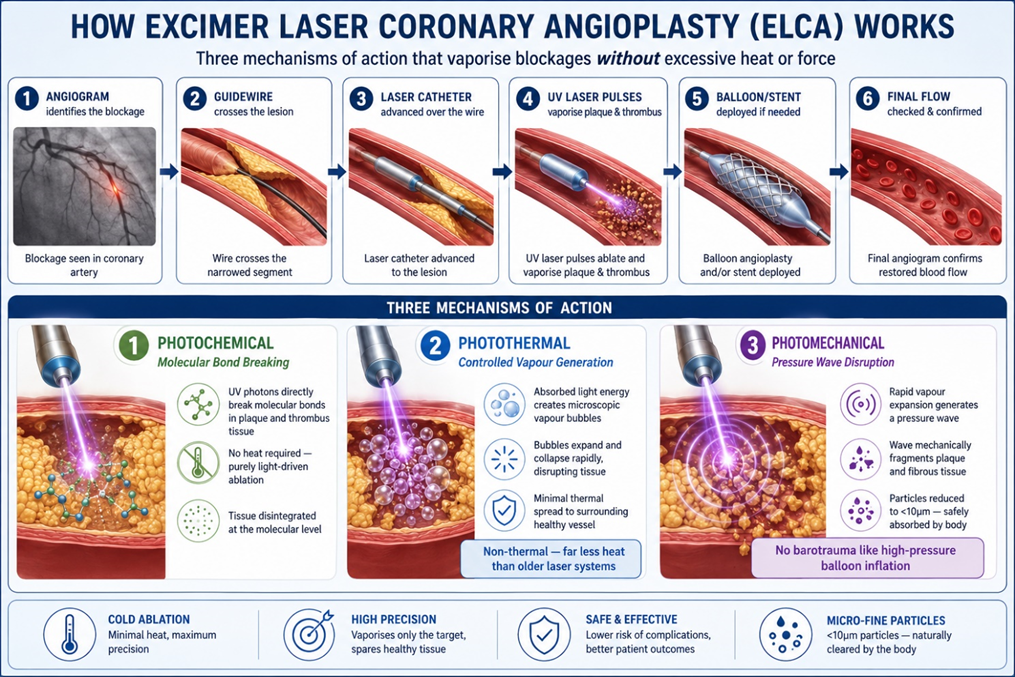
From the patient's side, the experience is close to a routine angioplasty. Access is through a small puncture at the wrist or the groin under local anaesthesia, using the same guidewire and guide catheter approach. There are no additional incisions. Most patients who remain stable are discharged the following day.
One practical advantage matters a great deal in the cath lab: the laser catheter runs over a standard 0.014-inch guidewire. No specialised wire needs to be exchanged in, which saves time in an unstable patient and avoids losing hard-won wire position across a difficult lesion.
When Is ELCA the Right Choice?
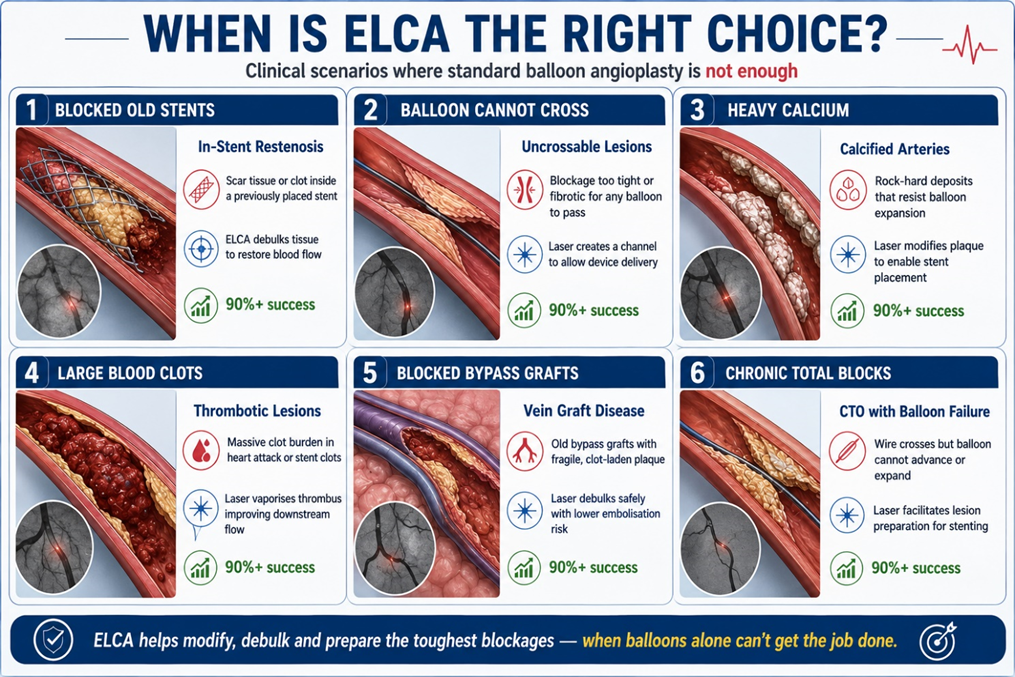
ELCA is not needed for most heart blockages. Routine lesions respond perfectly well to conventional balloon and stent techniques, and using a complex tool where a simple one suffices helps nobody. There are, however, specific scenarios where it changes what can be achieved:
Blocked old stents (in-stent restenosis)
When scar tissue, calcium or clot accumulates inside a stent placed years or decades earlier, ELCA can debulk that tissue and restore flow, where a balloon alone would simply compress it temporarily.
Balloon-uncrossable and balloon-undilatable lesions
Some blockages are so tight or so fibrotic that even a low-profile balloon cannot be advanced across them, or a high-pressure balloon cannot expand them. ELCA can create or modify a channel so that balloon and stent delivery becomes possible. In contemporary registry practice, these two indications together account for the majority of coronary laser use.
Heavy thrombus burden
In selected heart attack presentations and in acute stent thrombosis, where the artery is loaded with clot, laser energy can reduce thrombus and improve downstream flow — with the aim of limiting distal embolisation.
Degenerated bypass grafts
Old saphenous vein grafts often carry friable, clot-laden plaque that is hazardous to treat with balloons alone. ELCA offers a means of debulking this material with less mechanical disruption.
Chronic total occlusions (CTO)
When a guidewire has crossed a complete blockage but no balloon will follow, ELCA can modify the proximal cap and allow the procedure to continue.
What the Evidence Actually Shows
Patients and referring physicians deserve numbers rather than adjectives, so here is what the published literature reports.
- In the Laser Angioplasty of Restenosed Stents (LARS) multi-centre trial of 440 patients with restenosed or occluded stents, procedural success was 91%. Adjunctive balloon angioplasty was performed in 99% of cases — confirming that ELCA is a preparation step, not a standalone treatment. [1]
- In the Laser Veterans Affairs (LAVA) multi-centre registry, technical success was 90.0% and procedural success 88.8%, with a major adverse cardiac event rate of 3.45%. Balloon-uncrossable lesions were the commonest indication, followed by balloon-undilatable lesions and thrombotic lesions. [2]
- In a multi-centre registry of 126 uncrossable lesions, ELCA success was 81.8%. Severe calcification was identified as a predictor of laser failure — which is precisely why rotational atherectomy remains part of the toolkit rather than being displaced by it. [3]
- In the LEONARDO study of complex calcified and balloon-resistant lesions, laser success was 93.7% and procedural success 91.7%. [4]
Success rates in the 80–90% range in lesions that had already defeated conventional equipment is the honest way to describe this technology. It is not a guarantee, and it should not be presented as one.
The Toolbox Approach: ELCA, Rotablation and IVL
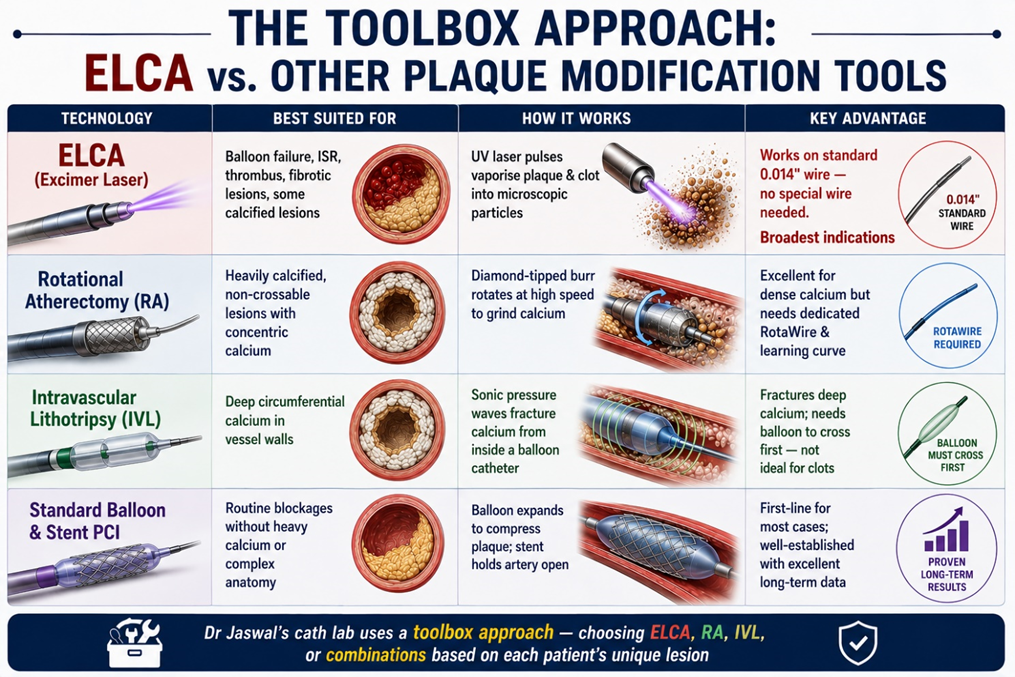
Modern interventional cardiology is not a matter of one device suiting every situation. Complex coronary disease is treated by selecting among excimer laser, rotational atherectomy, orbital atherectomy, intravascular lithotripsy, and cutting or scoring balloons — or by combining them — according to each patient's lesion anatomy and risk profile.
ELCA performs well in fibrotic, thrombotic and balloon-failure lesions, and carries the practical advantage of running on a standard guidewire. Rotational atherectomy is often preferred for dense, concentric calcium. Intravascular lithotripsy fractures deep calcium using sonic pressure waves, but requires the balloon to cross the lesion first and is less suited to heavy thrombus.
No single technology is superior across all cases. The right tool depends on the blockage in front of you. This is the substantive reason why complex coronary intervention benefits from being performed at centres holding the full range of plaque-modification devices, with operators who can change strategy in real time.
The Synergy Advantage: Why the Centre Matters as Much as the Device
Most of the challenging blockages treated at a tertiary cardiac centre do not yield to a single technology used in isolation. They require several advanced plaque-modification therapies in combination — laser to create the initial path, rotablation or orbital atherectomy to modify calcified plaque, intravascular lithotripsy for deep calcium, and intracoronary imaging with OCT or IVUS to guide each step. It is the synergy of these technologies, deployed in the right sequence by an experienced operator, that makes the impossible possible.
This carries a demanding operational implication. All of these therapy options, including intracoronary imaging, must be available 24×7, on the shelf, inside the hospital. You cannot know in advance which combination a complex blockage will demand — that decision is made in real time, on the table, based on what the imaging reveals. If a technology is not immediately at hand, the window may close.
Equally, the primary operator and the entire support team — junior cardiologists, cath lab nurses, technicians and paramedics — must be proficient and experienced in the application of each of these technologies. In the most challenging circumstances, it is the team's collective skill and preparedness that determines the outcome, not the equipment inventory.
The 2024 European Society of Cardiology guidelines for chronic coronary syndromes give intracoronary imaging guidance by IVUS or OCT a Class I, Level A recommendation for percutaneous intervention on anatomically complex lesions. Imaging is not an optional refinement in this setting. It is the standard of care. [5]
At Fortis Mohali, excimer laser, rotablation, orbital atherectomy, intravascular lithotripsy, cutting and scoring balloons, IVUS, OCT and FFR are maintained round the clock, with a team trained to deploy any combination at short notice. Owning the equipment and being able to use it well under pressure are two different things.
A Case From Our Cath Lab
An elderly diabetic gentleman was brought to us in critical condition with severe, unrelenting chest pain. He had undergone coronary angioplasty and stenting many years earlier. Over the intervening decades, that stent had become almost completely occluded by a combination of calcium and thrombus.
He had already been assessed elsewhere and judged too high-risk for intervention — the blockage too calcified, too clot-laden, and the patient too elderly and frail for conventional angioplasty. His family had been told there was nothing further to be done.
At Fortis Mohali we used ELCA to ablate the calcified thrombus within the old stent and restore flow, avoiding the aggressive balloon dilatation that would have carried substantial risk in so fragile a vessel. The procedure was completed without complication and he was discharged within days, pain-free.
Cases of this kind are the reason ELCA earns its place in the cath lab. It does not substitute for clinical judgment or for standard technique. It provides an option where the alternatives had run out.
Do not accept “no option” as the final answer. Modern interventional cardiology has tools that help where standard methods fall short. The key is being evaluated at a centre with the right expertise and technology. — Dr R.K. Jaswal
Safety, Risks and What Patients Should Know
Excimer laser has been used in coronary intervention since the early 1990s and carries more than two decades of registry and trial data. In experienced hands, complication rates are low and broadly comparable with other advanced coronary techniques.
The LARS trial reported perforation after laser treatment in 0.9% of patients, dissection visible after laser in 4.8%, Q-wave myocardial infarction in 0.5% and cardiac tamponade in 0.5%. For context within the same study, dissection after balloon angioplasty occurred in 9.3%. [1]
Honesty about limitation matters as much as honesty about capability. ELCA restores flow, but it does not abolish the tendency of a treated segment to re-narrow. Published six-month angiographic follow-up after laser treatment of in-stent restenosis has shown substantial recurrence rates, and treating restenosis of any kind remains one of the harder problems in interventional cardiology. [6] Patients should understand that a successful procedure is the beginning of long-term management, not the end of it.
Possible complications include arterial dissection, spasm, rare perforation and transient no-reflow. These risks are reduced by careful patient selection, adherence to established lasing protocols, stepwise energy escalation and intravascular imaging guidance.
After the procedure, recovery resembles that of standard angioplasty. Dual antiplatelet therapy, statin treatment, blood pressure and diabetes control, and lifestyle change all remain essential. ELCA treats the blockage; it does not treat the disease that produced it.
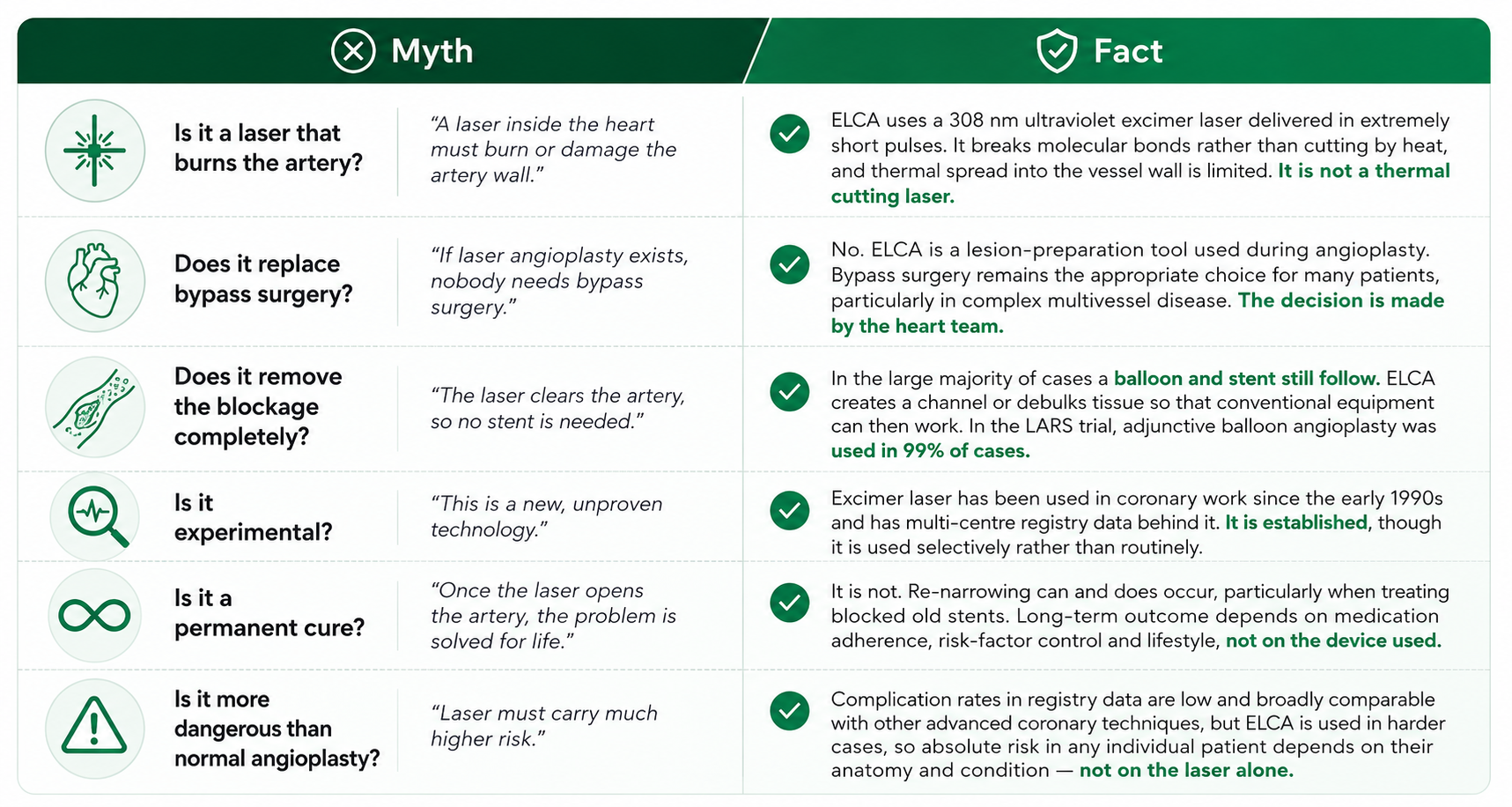
Myth vs Fact: ELCA
Should You Ask Your Doctor About ELCA?
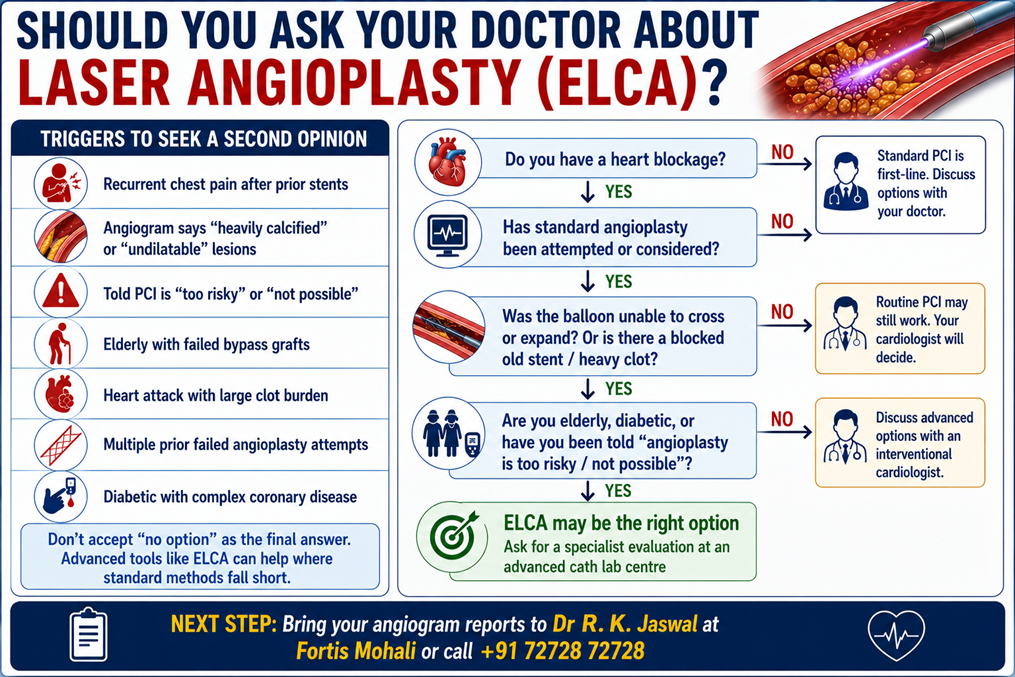
Not every patient needs laser angioplasty, and that is an important point to state plainly. ELCA is reserved for complex cases where standard techniques are insufficient or likely to fail. But if any of the following apply, a specialist evaluation may be worthwhile:
- Recurrent chest pain after previous stents, despite ongoing medical treatment.
- An angiography report describing “heavily calcified”, “undilatable” or “balloon failure” lesions.
- Having been told that angioplasty is “too risky” or “not possible” because of the complexity of your blockages.
- Elderly patients, or those with diabetes or kidney disease, who have failed bypass grafts.
- Heart attack patients with a large clot burden in whom conventional treatment gave a suboptimal result.
A Word on Prevention: The Best Treatment Is the One You Never Need
Advanced technology saves lives, but the best treatment for heart disease remains preventing it. Across my career I have run public awareness programs across Punjab, Haryana and Himachal Pradesh emphasising the fundamentals: a brisk 45-minute walk daily, avoiding tobacco in every form, eating fresh seasonal food, managing stress, and having regular cardiac check-ups after the age of 40 — particularly with diabetes, hypertension or a family history of heart disease.
ELCA is the safety net for when prevention has fallen short and standard treatment has reached its limits. The goal should always be never to need it.
ELCA at India Live 2026
In March 2026 I presented a lecture on Excimer Laser Coronary Angioplasty in the main arena, in the 'Learn from the Masters' session at India Live 2026 — the Fifteenth National Course on Cardiovascular Interventions, organised by the Interventional Cardiology Foundation of India at Bharat Mandapam, New Delhi, and attended by interventional cardiologists from across India and the SAARC region. [7]
Being invited to teach ELCA at that level reflects two things: the growing recognition of laser-assisted angioplasty as a serious tool in complex PCI, and the depth of case experience our team has accumulated at Fortis Mohali.
Do Not Accept “No Option” — Ask for a Second Opinion
If you or a family member has been told that a heart blockage is too complex for angioplasty, or that nothing further can be done, consider seeking a specialist evaluation at a centre equipped for complex coronary intervention. Modern tools, in experienced hands, can open doors that were previously closed.
About the Author
Dr Rakesh Kumar Jaswal is Director and Head of the Department of Cardiology and Cardiac Cath Lab at Fortis Hospital, Mohali. With over 32 years of experience and more than 40,000 invasive cardiac procedures, he is among the most experienced interventional cardiologists in North India. He was the first certified independent TAVR operator in the region, and has worked extensively in trans-radial intervention, complex PCI, rotational atherectomy and excimer laser angioplasty. He was invited faculty at India Live 2026, where he presented on Excimer Laser Coronary Angioplasty in the 'Learn from the Masters' session at Bharat Mandapam, New Delhi. He is an active advocate for cardiac disease prevention and regularly conducts public health awareness programs across Punjab, Haryana and Himachal Pradesh.
Contact Us – Fortis Hospital Mohali
For appointments, consultations, and diagnostic services, please contact:
📞 72728 72728
Our care team will assist you with:
Doctor appointments
Diagnostic and screening services
Health check-ups
Call now to book your appointment at Fortis Hospital, Mohali.
Categories
Clear allMeet the doctor

- Cardiac Sciences | Interventional Cardiology
-
 37 Years
-
 1550
1550
Related Blogs
View all





FAQs
Is ELCA painful?
No. The procedure is performed under local anaesthesia with conscious sedation, as with standard angioplasty. You may notice a brief warm sensation during laser activation, but the procedure itself is not painful.
Will I still need a stent after ELCA?
In most cases, yes. ELCA is used as a lesion-preparation tool — it clears or modifies the blockage so that a balloon can expand and a stent can be deployed properly. In selected cases a drug-coated balloon may be used instead of a stent.
How long does recovery take?
Recovery is similar to routine angioplasty. Most patients are discharged the next day and resume normal activities within a few days, following standard post-angioplasty precautions.
Is ELCA used for every blocked artery?
No. It is a specialised, case-by-case decision reserved for complex blockages that do not respond to standard techniques. Routine blockages are best treated with conventional balloon angioplasty and stenting.
How does a doctor decide between ELCA and rotablation?
It depends on the nature of the blockage. ELCA is particularly useful in in-stent restenosis, thrombotic lesions and balloon-failure cases. Rotational atherectomy is often preferred for dense, concentric calcification, and registry data show that severe calcification predicts laser failure. An experienced operator assesses each case using intravascular imaging and clinical judgment, and will often use both.
Is ELCA available in Punjab and the Chandigarh region?
Yes. The Cardiac Cath Lab at Fortis Hospital Mohali offers excimer laser coronary angioplasty alongside the full range of plaque-modification and intracoronary imaging technologies, available round the clock.
What should I bring to a second-opinion consultation?
Bring your previous angiogram images and reports, your discharge summaries, a current list of medications, and any recent blood tests including kidney function and HbA1c. Angiogram images matter most — a decision about complex intervention cannot properly be made from a written report alone.

Keep track of your appointments, get updates & more!

