
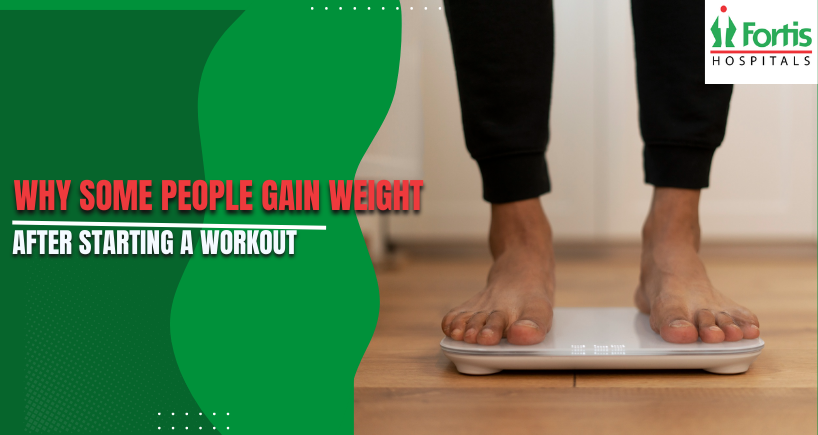


Why Some People Gain Weight After Starting a Workout
You have made the commitment. You bought new workout clothes, set your alarm for an early start, and pushed your way through that first week at the gym. You feel accomplished, you are sore in all the right places, and you are proud of your new routine. Then, you step on the bathroom scale, expecting a reward for your hard work. The number staring back at you is not lower. In fact, it is two or three pounds higher than when you started.
It is one of the most frustrating and demoralizing experiences in any new fitness journey. It is also the moment many people throw in the towel, believing that their efforts are not just failing, but actively working against them. This leads to the confused question, "can gym increase weight?"
The answer is a resounding yes, but it is absolutely critical to understand why. That extra weight is almost certainly not what you think it is. Before you abandon your new, healthy habit, here is a detailed, step-by-step explanation of what is happening inside your body when you are gaining weight after working out.
The Short-Term Shock: Inflammation and Water Retention
The most likely culprit for that sudden jump on the scale is not fat. It is water. This initial gain is a temporary and normal physiological response to a new physical demand, and it happens in two main ways.
1. The Healing Response (Inflammation)
When you perform an exercise you are not used to, especially strength training or high-intensity intervals, you create tiny, microscopic tears in your muscle fibers. This is not a bad thing; in fact, this process of damage and repair is precisely how muscles get stronger.
However, your body treats this damage like any other injury. It launches an acute inflammatory response to heal the micro-tears. Think of it as a biological construction site. Your immune system sends a flood of healing agents, repair cells, and, most importantly, plasma and water to the affected muscles. This healing fluid causes temporary inflammation and water retention in and around the muscle tissue. This is the same reason you feel sore, a state known as Delayed Onset Muscle Soreness (DOMS). This healing, water-heavy process can easily add a few pounds of "water weight" to the scale.
2. The New Fuel Storage (Glycogen)
This is the second, and equally important, part of the water weight equation. When you start a new exercise routine, your body's survival instincts kick in. It says, "This person is suddenly demanding a lot of energy. I had better be prepared for next time."
Your muscles store their preferred, quick-access fuel source in the form of glycogen (a stored form of carbohydrates). When you begin working out, your body adapts by increasing its glycogen storage capacity. It wants to have more fuel on hand for your next session. Here is the key: for every one gram of glycogen your muscles store, they must also pull in approximately three to four grams of water to store it with.
This is a fantastic sign of your body adapting and becoming more efficient, but it has an immediate and significant impact on the scale. Storing an extra 100 grams of glycogen means storing an extra 300-400 grams of water. This adds up very quickly and is a primary reason for gaining weight after working out.
The Long-Term Gain: The "Good" Weight You Want
While water and inflammation account for the sudden, short-term gain, there is another reason a weight gain workout routine can make the scale go up, and it is the one you should be striving for: lean muscle.
This is the most positive answer to the question "does gym increase weight?" Yes, it does, by building new, metabolically active tissue. A common misconception is that "muscle weighs more than fat." A pound is a pound. A more accurate way to say it is that muscle is significantly denser than fat. A pound of muscle takes up much less space than a pound of fat.
As you continue your strength training routine, your body will repair those micro-tears and build new muscle fibers. This process is much slower than water retention—you will not gain five pounds of muscle in a week. But over months, as you build two, five, or ten pounds of new muscle, the number on the scale may climb. This is the best possible reason for the scale to go up. This new muscle tissue boosts your metabolism (it burns more calories at rest), makes you stronger, and gives your body a leaner, more toned shape.
Other Potential Reasons for Weight Gain
Sometimes, the reasons are less about physiology and more about lifestyle adjustments.
Compensatory Eating: It is very easy to overestimate the number of calories you burn during a workout and "reward" yourself afterward. A 30-minute run might burn 300 calories, which can be instantly erased by a celebratory muffin or sugary sports drink.
Increased Appetite: Exercise, particularly intense cardio, can increase your appetite. If you are not mindful, it is easy to consume more calories than you are burning.
Better Hydration: Starting a new fitness routine often goes hand-in-hand with a new focus on drinking more water. This is excellent for your health, but more water in your system will, by definition, weigh more on the scale.
Why You Must Look Beyond the Scale
That number on the scale is just one data point, and it is a notoriously unreliable one. It measures everything: your bones, your organs, your muscle, your fat, your undigested food, and, of course, all that fluctuating water.
Instead of fixating on the scale, focus on Non-Scale Victories (NSVs). These are the true indicators of progress:
How do your clothes fit? Gaining dense muscle while losing bulky fat often means your pants feel looser, even if the scale is stubborn.
How do you feel? Do you have more energy? Are you sleeping better? Has your mood improved?
How are your performance metrics? Are you able to lift a heavier weight? Can you run that mile a little faster? Can you do five push-ups when you could only do one before?
How do you look? Take progress photos. Side-by-side pictures taken a month apart can reveal a dramatic change in body composition that the scale completely failed to capture.
A Proactive Partnership in Your Fitness Journey
That initial weight gain when starting a new workout is not just normal; it is often a sign that you are doing things right. It is a sign that your body is adapting, healing, and preparing itself to be stronger and more efficient.
Be patient with the process. Trust that the inflammation and water retention are temporary. Stay consistent with your workouts, focus on nourishing your body with high-quality foods, and celebrate the non-scale victories. The scale will eventually catch up, but by then, you will have already discovered that your progress is measured in so much more than just a number.
Frequently Asked Questions
Q1. How long does this temporary weight gain from water and inflammation last?
Ans. This initial phase of water retention and inflammation is typically temporary. For most people, it can last anywhere from a few days to a few weeks as your body adapts to the new routine. As your muscles become more conditioned, the inflammatory response will lessen.
Q2. Is it possible that I am gaining fat instead of muscle?
Ans. It is possible if your new workout routine is causing you to consume significantly more calories than you are burning (see compensatory eating). However, if you are in a calorie deficit or at maintenance and your weight suddenly jumps in the first 1-2 weeks, it is physically improbable that this is fat gain. Gaining a pound of fat requires consuming a surplus of 3,500 calories.
Q3. Does the gym increase weight for everyone who starts?
Ans. Not everyone, but it is extremely common. People who start with a more intense strength-training program are more likely to see this initial jump dueD to the muscle damage and glycogen storage. Those who start with very light, gentle exercise (like walking) may not experience it.
Q4. What is the real difference between muscle weight and fat weight?
Ans. A pound of muscle and a pound of fat both weigh one pound. The difference is density. A pound of muscle is firm, compact, and takes up very little space, like a small, heavy rock. A pound of fat is fluffy, bulky, and takes up much more space, like a large, lumpy pillow. This is why you can lose inches and look leaner even if your weight stays the same.
Categories
Clear allRelated Blogs
View all
Single Incision Laparoscopic Surgery (SILS) for Hernia Repair


Understanding Gallbladder Stones: Causes, Symptoms, and Treatment Options

Understanding Hernia - Causes, Symptoms, and Treatment Options

Gallstone Complications: When to Seek Medical Attention
Common Myths and Misconceptions About Bariatric Surgery

Understanding Appendicitis: Causes, Symptoms, Risk Factors & Treatment

Understanding Varicose Veins: Causes, Symptoms, Risk Factors & Treatment Options



Keep track of your appointments, get updates & more!

