
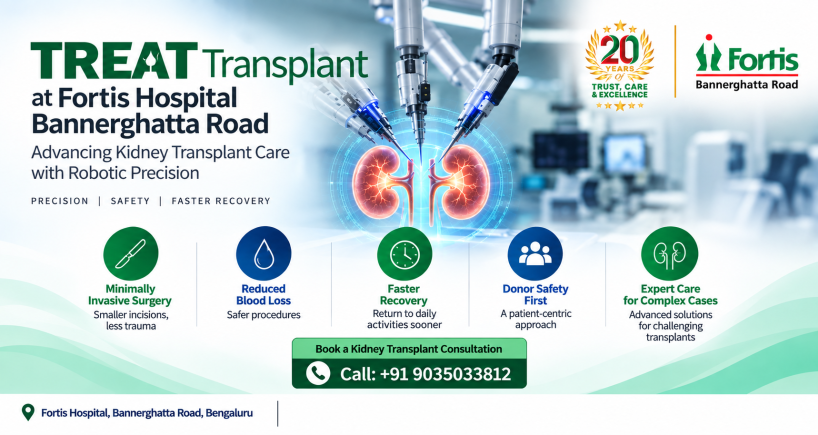


Advancing Robotic Kidney Transplant Care with Robotic Precision at Fortis Hospital Bannerghatta Road
TREAT Transplant at Fortis Hospital Bannerghatta Road: Advancing Kidney Transplant Care with Robotic Precision
For patients with advanced kidney disease, a kidney transplant can offer a new opportunity for a healthier and more active life. However, kidney transplantation is a complex procedure that requires surgical expertise, advanced technology, careful donor evaluation and comprehensive post-operative care.
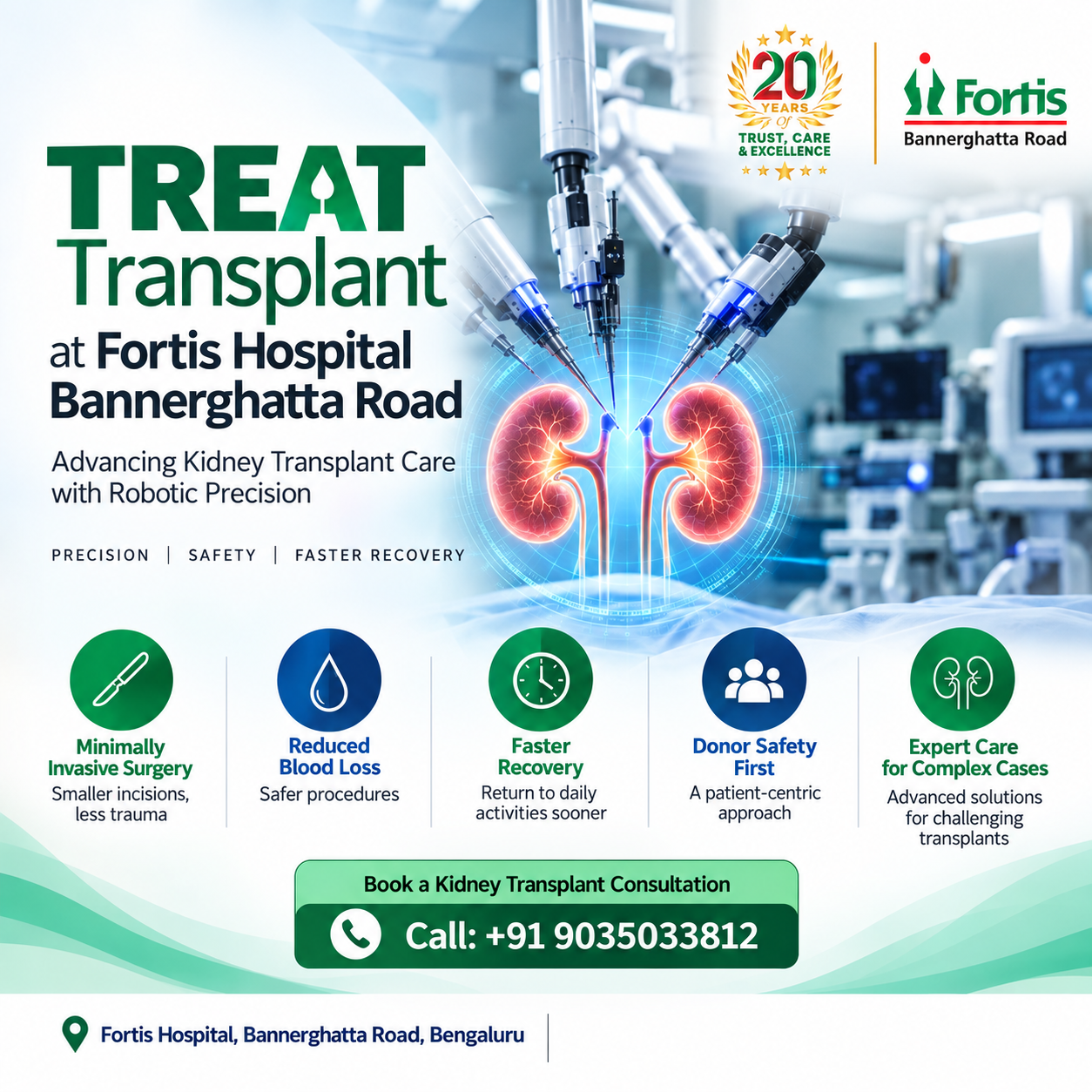
At Fortis Hospital, Bannerghatta Road, Bengaluru, the introduction of the TREAT – Total Robot Enabled and Assisted Transplant programme represents a significant advancement in kidney transplant care. The programme combines robotic surgical technology, transplant expertise and multidisciplinary care to support both kidney donors and recipients through their transplant journey.
What is TREAT Transplant?
TREAT stands for Total Robot Enabled and Assisted Transplant.
It is an advanced approach to kidney transplantation where robotic technology is used to assist surgeries for both the kidney donor and the recipient. At Fortis Hospital Bannerghatta Road, the programme has enabled simultaneous robot-assisted procedures for the donor and recipient, representing a major milestone in kidney transplant surgery in India.
Unlike conventional open surgery, robotic-assisted procedures use advanced instruments controlled by the surgical team to perform precise movements through smaller incisions. This minimally invasive approach can help reduce surgical trauma while supporting faster recovery.
Why Robotic Technology in Kidney Transplantation?
Kidney transplantation involves two important surgical procedures – removing the kidney from the donor and implanting it into the recipient.
Robotic assistance can provide the surgical team with enhanced precision, control and visualization during these procedures. Fortis describes robotic kidney transplantation as a minimally invasive approach that can offer benefits such as smaller incisions, reduced blood loss and faster recovery.
The potential advantages include:
- Smaller surgical incisions
- Reduced surgical trauma
- Less post-operative discomfort
- Reduced blood loss
- Faster mobilisation and recovery
- Shorter hospital stay in suitable cases
- Earlier return to routine activities
- Greater surgical precision
The suitability and benefits of robotic transplantation vary from patient to patient and are determined by the transplant team after detailed medical evaluation.
Putting the Donor at the Heart of Transplant Care
A kidney transplant involves not only the recipient but also an individual who voluntarily chooses to donate a kidney.
At Fortis, the TREAT programme places significant emphasis on donor safety and recovery, alongside recipient outcomes. This is particularly important because living kidney donors undergo major surgery despite not requiring treatment for kidney failure themselves.
The minimally invasive robotic approach may help reduce physical discomfort and support an earlier return to daily activities for appropriately selected donors. The programme has also been designed to address challenging donor situations, including certain anatomical variations and complex surgical considerations.
Advanced Options for Complex Kidney Transplant Cases
Not every kidney transplant is straightforward.
Some patients may have additional medical conditions, obesity, a history of previous transplantation or complex anatomical considerations that can make surgery more challenging.
TREAT has been developed to expand the possibilities of robotic-assisted transplantation for appropriately selected complex cases. Fortis has reported successful TREAT procedures involving patients with significant co-morbidities, incompatible blood groups and other complex clinical circumstances.
In 2026, Fortis Bannerghatta Road also reported performing a complex robot-assisted kidney transplant on a severely immunocompromised international patient with multiple high-risk medical conditions. The procedure was performed under the TREAT programme with robot-assisted surgery for both donor and recipient, followed by multidisciplinary post-operative care.
A Multidisciplinary Approach to Kidney Transplantation
Successful transplantation involves much more than the surgery itself.
Patients require comprehensive assessment before transplantation, careful surgical planning, appropriate immunological evaluation, post-operative monitoring and long-term follow-up.
At Fortis Hospital Bannerghatta Road, kidney transplant care brings together specialists from areas including:
- Transplant surgery
- Urology
- Nephrology
- Anaesthesiology
- Critical care
- Infectious disease
- Transplant coordination
- Other relevant medical specialties
This multidisciplinary approach helps the team address the individual needs and risks of every patient.
Why Choose Fortis Hospital Bannerghatta Road for Kidney Transplantation?
Fortis Hospital Bannerghatta Road is a tertiary-care hospital with dedicated expertise in organ transplantation, urology, nephrology and robotic surgery. The hospital has established capabilities for managing complex kidney transplant cases and advanced robotic procedures.
The TREAT programme further strengthens this ecosystem by combining:
Advanced Robotic Technology + Transplant Expertise + Multidisciplinary Care + Patient-Centric Approach
The hospital has also reported significant experience in kidney transplantation under the leadership of its renal sciences and transplant team.
Who May Be Considered for a Kidney Transplant?
A kidney transplant may be considered for patients with advanced or end-stage kidney disease when the kidneys are no longer able to adequately perform their functions.
Patients may be evaluated for transplantation in conditions such as:
- End-stage kidney disease
- Advanced chronic kidney disease
- Irreversible kidney failure
- Certain hereditary kidney disorders
- Other conditions resulting in irreversible loss of kidney function
Not every patient is automatically eligible for a transplant. A detailed evaluation is required to determine whether transplantation is medically appropriate.
Understanding the TREAT Transplant Journey
Every transplant journey is personalised, but it generally involves several stages:
1. Comprehensive Evaluation
The donor and recipient undergo detailed medical investigations to assess their overall health and transplant suitability.
2. Transplant Planning
The multidisciplinary team evaluates factors such as kidney function, donor-recipient compatibility, anatomy, previous surgeries and other medical conditions.
3. Robotic-Assisted Surgery
For suitable candidates, robotic technology may be used to assist donor nephrectomy and recipient kidney transplantation.
4. Post-Operative Monitoring
Following surgery, both donor and recipient are closely monitored by the transplant team to support recovery and identify any complications early.
5. Long-Term Follow-Up
Kidney transplant recipients require lifelong medical follow-up, including regular monitoring and prescribed anti-rejection medication.
TREAT: Where Innovation Meets Compassionate Transplant Care
Kidney transplantation is not simply a surgical procedure. It is a life-changing journey involving a patient, a donor and their families.
The TREAT programme at Fortis Hospital Bannerghatta Road brings together robotic technology and transplant expertise with a strong focus on the wellbeing of both donor and recipient.
By combining minimally invasive robotic surgery with comprehensive transplant care, TREAT aims to make complex kidney transplantation more precise, patient-centric and recovery-focused.
For patients and families exploring advanced kidney transplant options, a consultation with a qualified transplant specialist can help determine the most appropriate treatment pathway.
Explore Advanced Kidney Transplant Care at Fortis Hospital Bannerghatta Road
If you or your family member has been diagnosed with advanced kidney disease or is exploring kidney transplantation, consult the transplant team at Fortis Hospital, Bannerghatta Road, Bengaluru for a comprehensive evaluation.
Book a Kidney Transplant Consultation
Call: +91 6364931212 | 9035033812
Medical Disclaimer: Kidney transplantation and robotic-assisted surgery may not be suitable for every patient. Treatment decisions depend on individual medical evaluation, clinical condition and the assessment of the treating transplant team.
Categories
Clear allMeet the doctor

- Urology | Urology | Paediatric Urology | Uro-Oncology
- Organ Transplant | Kidney Transplant
-
 37 Years
-
 1800
1800
Related Blogs
View all



Adult Circumcision: Debunking Facts and Myths | Fortis Health Connect Blogs

Is Beer Good for Kidney Stones ? - Myths Vs Facts | Fortis Healthcare




FAQs

Keep track of your appointments, get updates & more!

