


Best Urinary Bladder and Prostrate Cancer Treatment and Doctor in Navi Mumbai
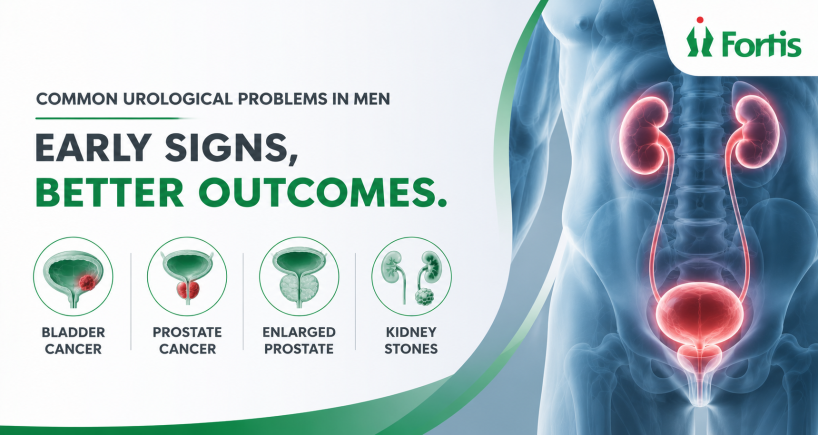
Common Urological Problems in Men: Early Signs of Bladder Cancer, Prostate Cancer, Enlarged Prostate and Kidney Stones
Many urological diseases develop silently and have only subtle warning signs in the early stages. Do not ignore a painless attack of blood in the urine, frequent urination at night and difficulty in passing urine or persistent pain due to kidney stones. Some urinary symptoms are caused by common conditions such as an enlarged prostate or urinary stones but these symptoms may also be the first sign of more serious diseases such as bladder cancer or prostate cancer. Knowing when to be screened and seeking timely evaluation from a urologist when these early signs are recognized can result in earlier diagnosis, more effective treatment and improved long-term outcomes.
Bladder cancer - early signs and red flags
- Most common early sign: visible blood in the urine (often painless).
- Other symptoms: increased urinary frequency, nocturia (especially new or worsening), intermittent bleeding that stops and recurs.
- Advanced disease: bone pain, weight loss, anemia, or local spread causing pain — these are less common at initial presentation.
Prostate cancer: screening and symptoms
- Symptoms: Often none in early stages. When present they can overlap with benign conditions urinary difficulty, weak stream, or retention. Advanced disease may cause bone pain or weakness from spinal involvement.
- Screening: PSA testing plus digital rectal exam (DRE) are used. Routine screening commonly starts around age 40 for average-risk men and continues until about age 80; screening beyond age 80 is typically not recommended.
- Higher risk: Men with a first-degree relative (father, brother, uncle) with prostate cancer should consider starting PSA screening earlier (around age 35).
- If PSA is elevated or DRE is abnormal: prostate MRI (with PI-RADS scoring) and targeted biopsy are next steps. PI-RADS 3–5 increases suspicion for cancer and often prompts biopsy; PI-RADS 1–2 usually does not.
Large prostate (benign prostatic enlargement) - symptoms and treatment
- Assessment: Symptom severity and objective measures, e.g., uroflowmetry, guide treatment decisions.
- Medical therapy: Alpha-blockers are first-line for most symptomatic men. 5-alpha-reductase inhibitors (like dutasteride) may be added if symptoms persist but can cause sexual side effects.
- When to operate: Persistent bothersome symptoms despite medication, recurrent urinary retention, recurrent infections, bladder stones, or hydronephrosis may warrant surgery.
- Surgical options:
- HoLEP (Holmium Laser Enucleation of the Prostate): Gold standard for large glands. It enucleates the adenoma en bloc, works for glands from 100 g to 300 g, typically with minimal bleeding, short hospitalization, and low long-term risk of incontinence when performed by experienced surgeons.
- Robotic simple prostatectomy: Considered for very large median lobes; longer recovery and catheter time than HoLEP. Choice depends on anatomy and surgeon expertise.
Passing kidney stones without surgery
Many stones can pass spontaneously, especially those that reach the ureter.
- Conservative management: Adequate hydration, medical expulsive therapy with alpha-blockers, and pain control.
- Likelihood of spontaneous passage by size: ~90% for 4 mm stones, ~50% for 7 mm stones, and about 20% for 8 mm stones. The larger the stone, the less likely it will pass.
- When to intervene: Ongoing severe pain, infection, impaired kidney function, or failure to pass after a reasonable observation period (commonly 3–4 weeks) suggests endoscopic removal.
For any urological issue, please consult a Urologist.
Categories
Clear allMeet the doctor

- Urology | Robotic Surgery | Urology | Uro-Oncology
-
 18 Years
-
 1800
1800
Related Blogs
View all



Adult Circumcision: Debunking Facts and Myths | Fortis Health Connect Blogs
Is Beer Good for Kidney Stones ? - Myths Vs Facts | Fortis Healthcare


FAQs

Keep track of your appointments, get updates & more!

