
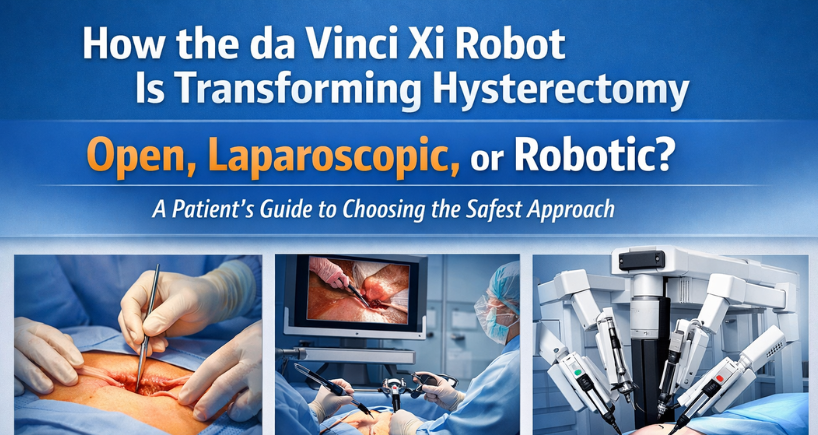


Beyond the Incision: How the da Vinci Xi Robot Is Transforming Hysterectomy
Open, Laparoscopic, or Robotic? A Patient’s Guide to Choosing the Safest Approach
Dr. Swapna Misra | Director, Robotic and Laparoscopic Gynaecology Surgery | Fortis Hospital Mohali
From Large Cuts to Tiny Keyholes: How Hysterectomy Surgery Has Changed
“Remember Meera from our previous article—the 45-year-old teacher who suffered for five years with heavy bleeding and fibroids? Three weeks after her da Vinci robotic hysterectomy at Fortis Mohali, she was back in her classroom, back at yoga, and back to living fully. That is the difference this technology makes.” — Dr. Swapna Misra
In our previous article, we explored the conditions that make hysterectomy (surgical removal of the uterus) necessary—fibroids (non-cancerous growths in the uterus), adenomyosis (a condition where the uterine lining grows into the muscle wall), endometriosis (tissue similar to the uterine lining growing outside the uterus), prolapse (when the uterus slips down from its normal position), and gynaecological cancers—and why surgery is always a last resort after other treatments have been tried. But once hysterectomy is the right path, the next important question is: what is the best way to perform it?
For decades, the only option was traditional open surgery—a large 15–20 cm cut across the abdomen, significant bleeding, and 4–6 weeks of recovery. Laparoscopic (keyhole) surgery improved things by using small cuts and a camera, but it has limits: the surgeon sees a flat two-dimensional image, operates with rigid straight instruments that cannot bend, and often experiences fatigue during long procedures.
Robotic surgery using the da Vinci Xi system is the next leap forward. It keeps the advantage of small incisions while giving the surgeon something laparoscopy cannot: a crystal-clear 3D view magnified up to 10 times, instruments that move like a human wrist, and software that removes natural hand tremor from every movement. This is not a new experiment—the da Vinci platform has been refined over four generations and 25 years, with more than 12 million surgeries performed worldwide since 1999.
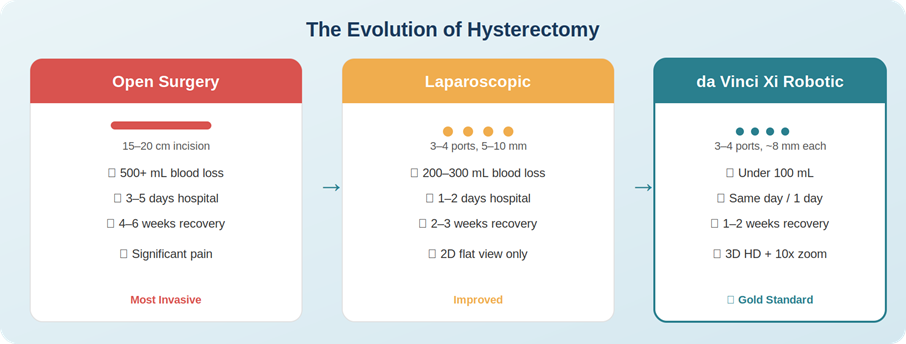
Comparing the Three Approaches: What the Differences Mean for You
For a patient, what matters most is straightforward: how much will it hurt, how long will I be in hospital, when can I get back to my family and work, and how safe is it? Here is what the evidence shows:
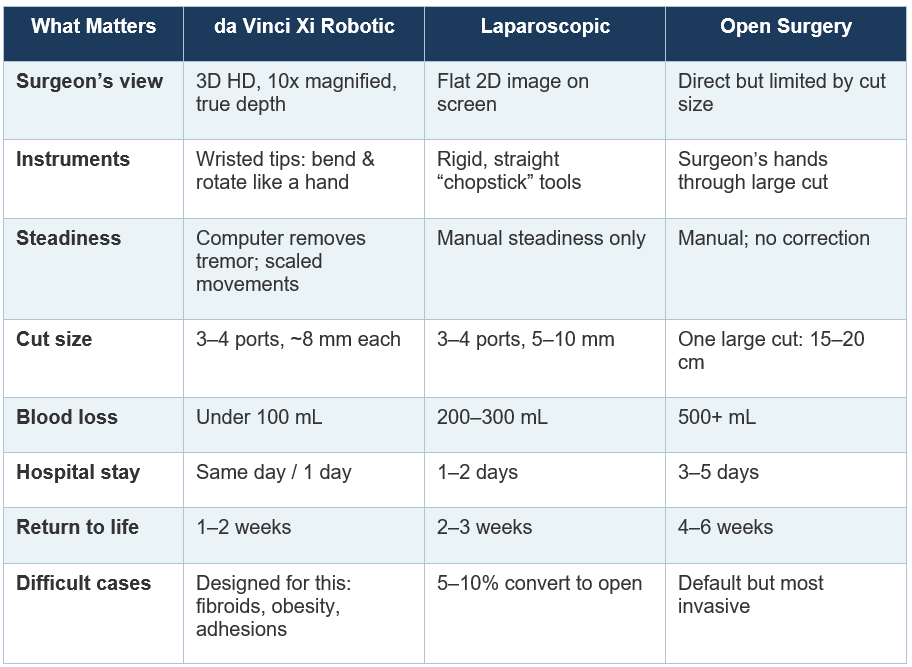
The takeaway is clear: for women facing a complex hysterectomy—large fibroids, severe endometriosis, obesity, or scarring from prior surgeries—the da Vinci Xi delivers outcomes that are measurably better than both open and conventional keyhole surgery.
Why the da Vinci Xi Specifically? Not All Surgical Robots Are the Same
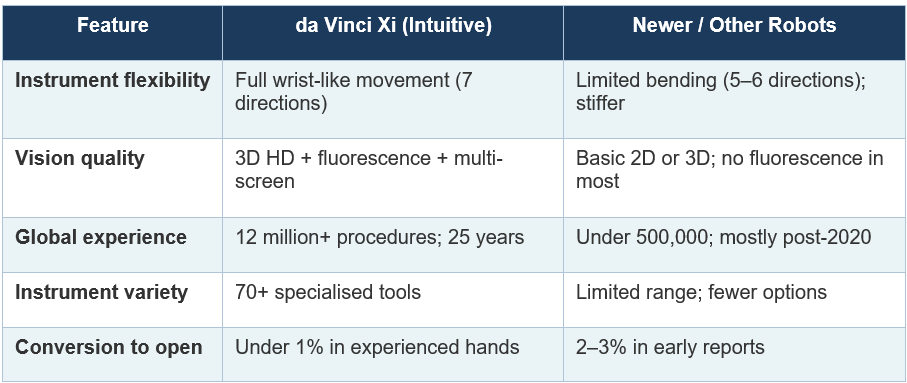
With robotic surgery becoming more popular, several newer robots have entered the market. You might assume they all work the same way. They don’t. The differences between the da Vinci Xi and these newer systems are real—and they affect your safety and recovery.
A 25-Year Track Record vs. Untested Newcomers
The da Vinci system, built by Intuitive Surgical (the world’s leading surgical robotics company), has been in clinical use since 2000 and is now in its fourth generation. It has the largest body of published safety evidence of any surgical robot in the world. Newer systems, most launched after 2020 with a fraction of the global experience, simply cannot offer this depth of proven reliability.
What Makes the da Vinci Xi Different — In Plain Terms
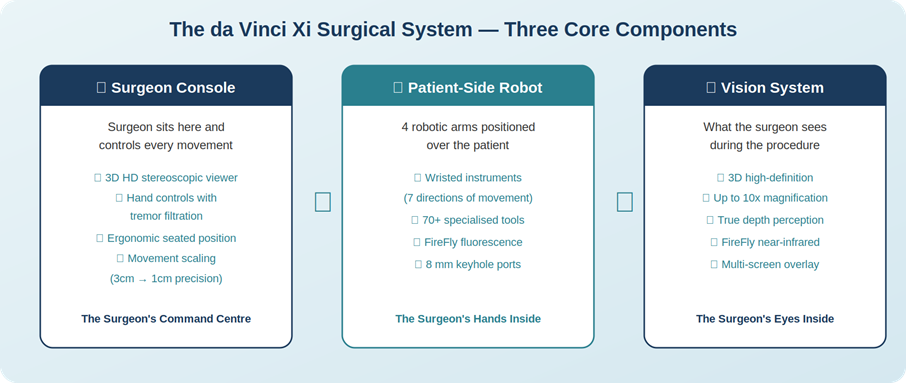
Instruments that move like your wrist: The da Vinci’s tiny surgical tools have built-in “wrists” that bend, rotate, and reach angles that straight laparoscopic instruments—and most competing robotic arms—simply cannot. For a hysterectomy, where the surgeon works millimetres away from the bladder and major blood vessels, this flexibility is essential.
A 3D view so clear, the surgeon sees what the naked eye cannot: Instead of a flat TV screen, the surgeon sees the surgical area in three dimensions, magnified up to 10 times. Tiny blood vessels, nerve fibres, and tissue layers become clearly visible.
Built-in fluorescence imaging: The da Vinci Xi has a special light mode called FireFly (a near-infrared camera that highlights blood flow and tissue health using a fluorescent dye) that helps spot hidden endometriosis, verify healing, and identify lymph nodes (small immune system glands checked during cancer staging) in cancer cases.
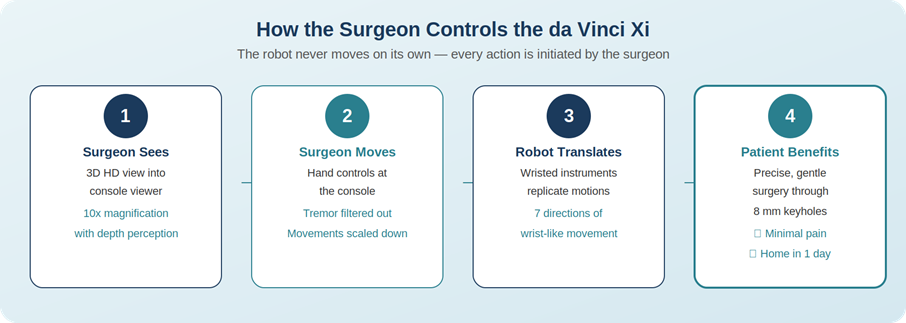
Rock-steady, tremor-free movements: The da Vinci filters out natural hand shake completely and scales down hand movements—so a 3 cm hand motion becomes a precise 1 cm instrument motion.
da Vinci Xi vs. Newer Robots: A Quick Comparison
“Not all robots are the same. The da Vinci Xi is an extension of the surgeon’s hands and eyes, with capabilities no other system can replicate today.” — Dr. Swapna Misra
What This Actually Means for You
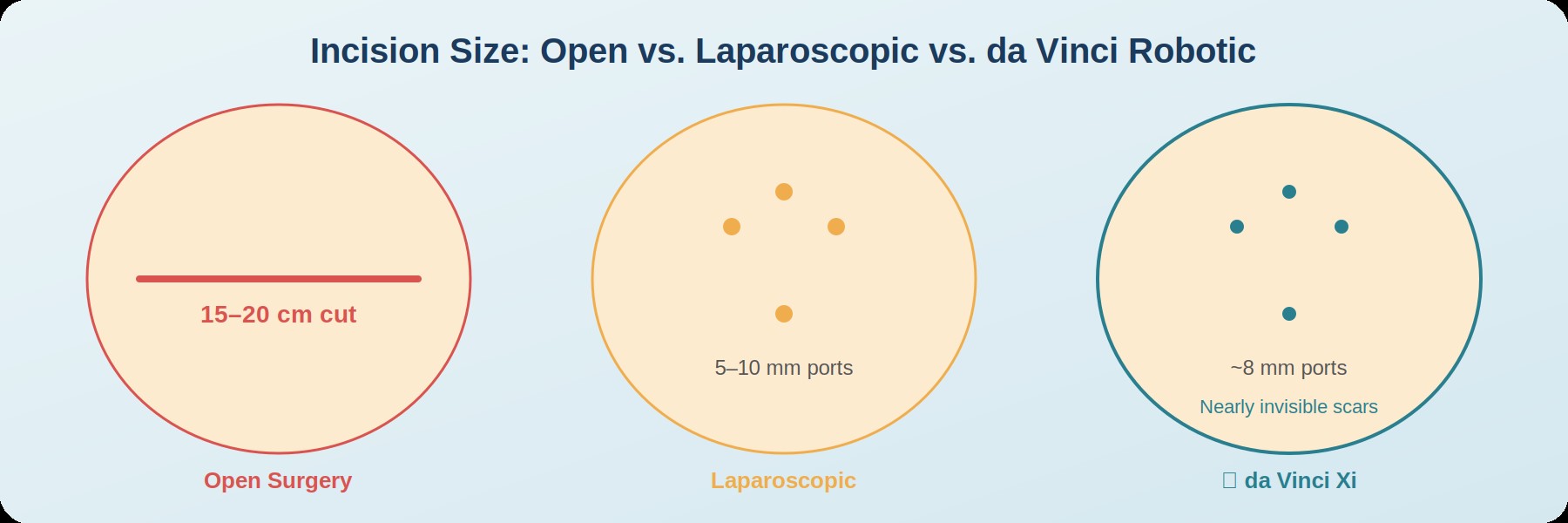
Nearly invisible scars: The entire surgery is done through 3–4 cuts, each about the size of a pencil eraser.
Much less pain: Post-operative pain drops by up to 50%. Many patients need little to no strong painkillers.
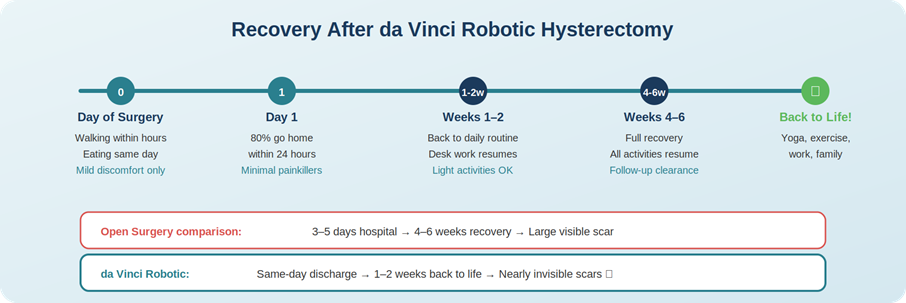
Home within a day: At Fortis Mohali, 80% of da Vinci patients go home within 24 hours.
Back to your life in 1–2 weeks: Most women return to household work, jobs, and daily routines within one to two weeks.
Fewer complications: Less risk of accidental injury to the bladder, ureter (the tube carrying urine from kidney to bladder), or bowel.
The Surgeon Matters as Much as the Robot
Let us be clear: the robot does not perform the surgery. The da Vinci Xi is a highly advanced tool—every movement is initiated, controlled, and guided entirely by the surgeon.
This is precisely why the surgeon’s track record matters. Dr. Swapna Misra, Director of Robotic and Laparoscopic Gynaecology Surgery at Fortis Hospital Mohali, has performed nearly 1,200 da Vinci robotic surgeries—the highest aggregate volume of robotic gynaecological surgeries by any surgeon in India. Across these nearly 1,200 procedures, she has never once needed to convert from robotic to open surgery—not even in the most challenging cases.
A zero-conversion rate across this volume is extraordinary. It means Dr. Misra can handle any challenge without abandoning the minimally invasive approach.
Fortis Hospital Mohali is not a centre that recently acquired a robot for its novelty. It is a mature, high-volume programme with a dedicated rapid-recovery care pathway (a structured plan designed to get patients home faster) designed around the da Vinci platform.
Who Benefits Most from da Vinci Robotic Hysterectomy?
- Women with large or multiple fibroids where the uterus has grown significantly.
- Severe endometriosis needing careful separation from bowel, bladder, and surrounding structures.
- Women with a higher body weight (higher BMI) where avoiding open surgery is important for healing.
- Women with scarring from prior surgeries where adhesions (scar tissue bands between organs) must be carefully separated.
- Gynaecological cancers where precise removal and staging (determining cancer spread) are critical.
Choosing the Right Robotic Gynaecologist
When women across Chandigarh, Mohali, and Punjab search for the best robotic gynaecologist, the decision comes down to the surgeon’s volume and track record on the da Vinci platform.
Dr. Swapna Misra has performed nearly 1,200 da Vinci robotic surgeries with a zero-conversion rate—never once needing to switch to open surgery. She has handled every type of challenging case: massive fibroids, severe endometriosis, high-BMI patients, dense adhesions from multiple C-sections, and gynaecological cancers.
For patients from Panchkula, Chandigarh, Punjab, Haryana, Himachal Pradesh, and across North India, Dr. Misra’s combination of volume, zero-conversion consistency, and da Vinci Xi expertise is unmatched.
Why Fortis Hospital Mohali for Robotic Hysterectomy?
India’s highest-volume robotic gynaecologist: Dr. Swapna Misra — nearly 1,200 da Vinci surgeries with zero conversions to open.
The da Vinci Xi platform (4th generation): 3D HD vision, FireFly fluorescence, wristed instruments, and tremor filtration — the world’s most proven surgical robot.
Dedicated rapid-recovery pathway: 80% of patients go home within 24 hours. Most return to normal life in 1–2 weeks.
Full-spectrum gynaecological care: From simple benign cases to complex cancer staging, endometriosis excision, and urogynecology — all under one roof.
Serving patients from across North India: Mohali, Chandigarh, Panchkula, Punjab, Haryana, Himachal Pradesh, and J&K — with dedicated pathways for women travelling from outside the Tricity.
Your Surgery, Your Choice
A hysterectomy is a major life event. But the recovery no longer has to be. The da Vinci Xi—backed by 25 years and 12 million procedures of proven excellence—has transformed a painful ordeal into a precise, gentle procedure with rapid recovery.
At Fortis Hospital Mohali, Dr. Swapna Misra’s record of nearly 1,200 da Vinci surgeries with zero conversions to open offers women across north India something invaluable: the confidence that when minimally invasive surgery is promised, it will be delivered.
“In the da Vinci’s hands, surgery becomes artistry—precise, proven, and unparalleled. Every woman deserves surgery that respects her body and her time.” — Dr. Swapna Misra
To find out if you are a candidate for da Vinci robotic hysterectomy, schedule a consultation with Dr. Swapna Misra at Fortis Hospital Mohali. Contact the Department of Gynaecology today.
Contact Us – Fortis Hospital Mohali
For appointments, consultations, and diagnostic services, please contact:
📞 72728 72728
Our care team will assist you with:
Doctor appointments
Diagnostic and screening services
Health check-ups
Call now to book your appointment at Fortis Hospital, Mohali.
Categories
Clear allMeet the doctor

- Obstetrics and Gynaecology | Obstetrics and Gynaecology | Gynaecologic Oncology
- Oncology | Surgical Oncology
-
 23 Years
-
 1250
1250
Related Blogs
View all

Bacterial Vaginosis: Causes, Symptoms And Treatment


Awareness, Breast Self-Examination And Regular Screening Examination Can Change The Life o...

Hormonal Imbalance: Symptoms, Causes And Treatment

Evolution of Gynae & Cancer Surgeries With Robotics


Know The Top 11 Benefits of Antenatal Exercises


FAQs
Is robotic hysterectomy painful?
The surgery itself is painless (under general anaesthesia). Post-operative pain is significantly less than open surgery—most patients need only mild painkillers for a few days.
How long is recovery after robotic hysterectomy?
Most women return to daily activities in 1–2 weeks and full recovery in 3–4 weeks. Open surgery takes 4–6 weeks.
Will I have a large scar?
No. Surgery is done through 3–4 tiny 8 mm cuts. Scars are nearly invisible once healed.
Does the robot perform the surgery by itself?
No. The surgeon controls every movement. The da Vinci Xi enhances vision, precision, and steadiness—it cannot move on its own.
Can it be done for very large fibroids?
Yes. Dr. Misra at Fortis Mohali has successfully operated on massively enlarged uteri without ever converting to open surgery.
Is it safe for overweight women?
Yes. The da Vinci’s precision makes it safer than open surgery for higher-BMI patients, with fewer wound complications.
Will I go through menopause after hysterectomy?
Only if your ovaries are also removed. If ovaries are preserved (common in non-cancer cases), you will not experience surgical menopause.
Is robotic hysterectomy available in the Chandigarh Tricity area?
Yes. Fortis Hospital Mohali has the da Vinci Xi with Dr. Swapna Misra—nearly 1,200 robotic gynaecological surgeries, the highest volume in India.

Keep track of your appointments, get updates & more!

