
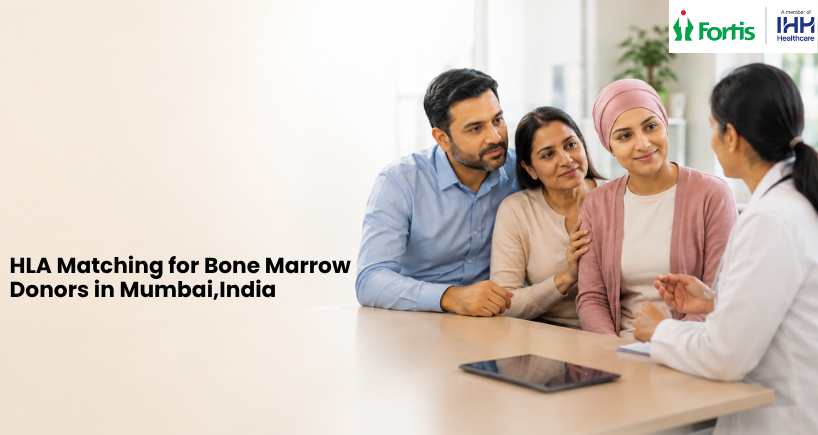


HLA Matching for Bone Marrow Donors in Mumbai
Bone Marrow Donor Matching for BMT
Selecting a suitable donor is an integral part of the treatment planning for patients receiving allogeneic bone marrow or stem cell transplantation. Doctors primarily assess compatibility using Human Leukocyte Antigen (HLA) matching, as well as the health of the donor and other clinical factors.
A donor can be a matched sibling, another family member, an unrelated donor or a haploidentical or half-matched relative. If a fully matched related donor cannot be identified, other donor sources may enable transplantation for selected patients.
BMT specialists can discuss donor selection, HLA testing and transplant options with patients being evaluated for bone marrow transplantation from Mumbai and across India.
What is a matched sibling donor transplant?
A matched sibling donor transplant is an allogeneic stem cell transplant where the stem cells are donated by a brother or sister (sibling) who is an HLA match for the patient.
The HLA markers are inherited from the biological parents. Each full sibling with the same biological parents has a 25% chance of being a full match for HLA. This is why siblings are often the first family members tested when an allogeneic transplant is being considered.
But being a sibling in itself does not guaranty that a person will make a good donor. Before transplantation, the donor must be evaluated medically and tested for HLA.
What is a matched unrelated donor transplant?
A matched unrelated donor transplant uses blood-forming stem cells from a donor who is not biologically related to the patient, but who has HLA markers that are considered suitably matched.
In the case that a related donor cannot be identified as suitable, the transplant team may search for an unrelated donor or a suitable cord blood unit in donor registries. Additional testing is performed if a potential donor is identified to determine that the donor is appropriate and safe.
Allogeneic stem cell transplantation may be an option for selected patients with leukemia, bone marrow failure and other diseases that require a matched unrelated donor transplantation.
How is a bone marrow donor selected?
Finding a bone marrow or stem cell donor is a multi-factorial process. The transplant team may think about:
• HLA typing
• Age of donor
• Overall health of the donor
• The donor is available.
• Diagnosis of the patient
• Planned type of transplantation
• Existence of certain antibodies
• Other clinical factors unique to donor and patient
While the closest HLA match is important, HLA is not the only factor taken into account in determining the most appropriate donor. Potential donors also get medically screened to confirm it is safe for the donor to donate and is appropriate for the patient.
HLA is short for Human Leukocyte Antigen. HLAs are markers or proteins on most cells of the body. They help the immune system to distinguish between self and non-self-cells.
The HLA type of the patient is matched to that of possible donors before an allogeneic bone marrow or stem cell transplant.
The closer the matching of the important HLA markers, the more compatible the donor and patient may be for transplantation. HLA matching is a key in minimizing the risk of rejection and other immune-related transplant complications.
How is an HLA test done?
HLA typing can be performed on a sample of blood or a swab taken from inside the cheek. The sample is tested in a specialist laboratory for the person's HLA markers.
Then the patient’s HLA profile is compared with potential family donors or other available donor sources.
If a first donor seems to be a suitable match, further tests are carried out before that donor is selected for transplantation.
Can parents donate bone marrow to their children?
Yes. A biological parent may be viewed as a possible donor of stem cells to their child.
The mother gives the child about half the HLA markers and the father the other half. Normally a biological parent and child share half of their HLA markers. They are called haploidentical or half-matched.
The choice of a parent as the best donor depends on the child's diagnosis, the transplant strategy, the donor's health and other clinical factors.
Can children donate stem cells to their parents?
Yes. An adult biological child may potentially be a stem cell donor for a parent.
Parent and biological child share roughly half of their HLA markers, making the child a potential haploidentical donor.
Before becoming a stem cell donor, the adult child must undergo extensive medical screening and donor evaluation.
What is a haploidentical or half-matched bone marrow donor?
An haplo-identical donor shares approximately half of the HLA markers with the patient.
Potentially haploidentical donors are typically a mother, father, biological child and some brothers or sisters.
Parents and offspring are usually matched at the half-match level, and siblings can also be haploidentical.
Haploidentical transplantation has expanded the donor options for patients without a well-matched sibling or unrelated donor. The transplant specialist will need to decide whether a half-matched transplant is appropriate for the patient, depending on the disease and the clinical situation.
What happens if there is no fully matched bone marrow donor?
If a patient does not have a sibling donor who is a complete match, other transplant options may exist.
In some cases, depending on the disease and clinical situation, physicians may also consider a matched unrelated donor, a partially matched donor, a haploidentical or half-matched family donor or an umbilical cord blood unit.
With modern transplantation techniques the number of possible donor sources for the patients has been increased. Therefore, not having a fully matched sibling does not necessarily rule out the possibility of a bone marrow transplant.
The donor choice options should be discussed with a BMT specialist before any conclusion is reached.
Is blood group matching necessary for bone marrow transplant?
No. In some cases, a stem cell transplant can be done when the donor and patient do not have the same ABO blood group.
Blood-group matching is different from HLA matching. HLA matching is one of the major criteria for selecting a donor for allogeneic stem cell transplantation. There are situations where a donor and recipient may have incompatible blood types and still proceed with the transplantation.
Any ABO blood group difference is taken into account by the transplant and transfusion teams in planning the blood product support and post-transplant monitoring.
Is HLA matching more important than blood-group matching in BMT?
For an allogeneic stem cell transplant, HLA compatibility is generally much more important than the same blood group for donor selection.
The HLA markers allow the patient’s immune system to identify the donor cells and vice versa. Blood type, however, does not need to be the same to go ahead with the transplant.
Other donor factors are also considered so that the selection of the donor must always be made by the transplant team and not only on the basis of HLA or blood group.
How are stem cells collected from a donor?
There are generally two methods of collecting donor stem cells.
Peripheral Blood Stem Cell Collection
The donor takes drugs for several days to increase the number of blood-forming stem cells in the bloodstream. The blood is then passed through an apheresis machine that separates out the stem cells. The remaining blood is returned to the donor.
Bone Marrow Collection
Under anesthesia, bone marrow is taken from the pelvic bones. It contains blood-forming stem cells. The transplant team makes the choice of collection method based on the patient’s transplant plan and other clinical factors.
Is stem-cell donation painful?
The experience varies depending on the collection method.
- Peripheral Blood Stem Cell Donation
Donors may temporarily experience:
- Bone or muscle aches
- Headache
- Fatigue
- Flu-like symptoms
These are often related to the medicines given before stem-cell collection.
- Bone Marrow Donation
Bone marrow is taken from the donor while they are sedated so they do not experience the harvesting process. You may have some temporary soreness, tiredness or discomfort around the collection area afterward.
Most side effects of the donor are temporary. However, all prospective donors should be counseled individually about the procedure and potential risks before donation.
Categories
Clear allMeet the doctor

- Haematology | Paediatric Haematology and BMT | Haematology
- Organ Transplant | Haematology and BMT
- Oncology | Hemato-Oncology
-
 14 Years
-
 2000
2000
 Available at 1 different locations

Related Blogs
View all







FAQs

Keep track of your appointments, get updates & more!

