
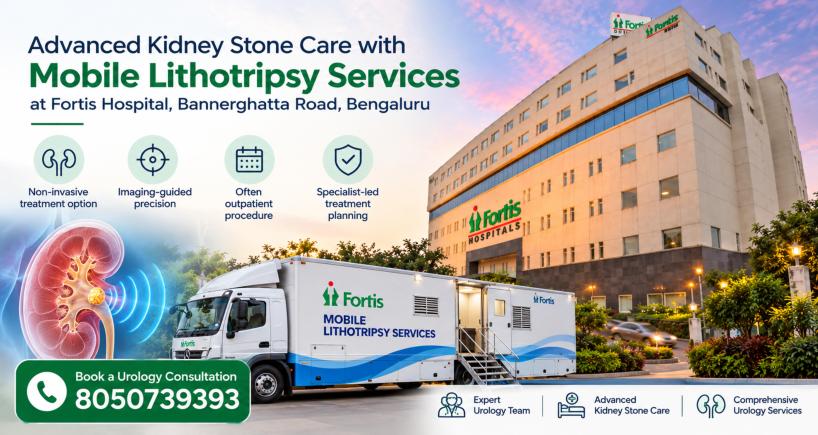


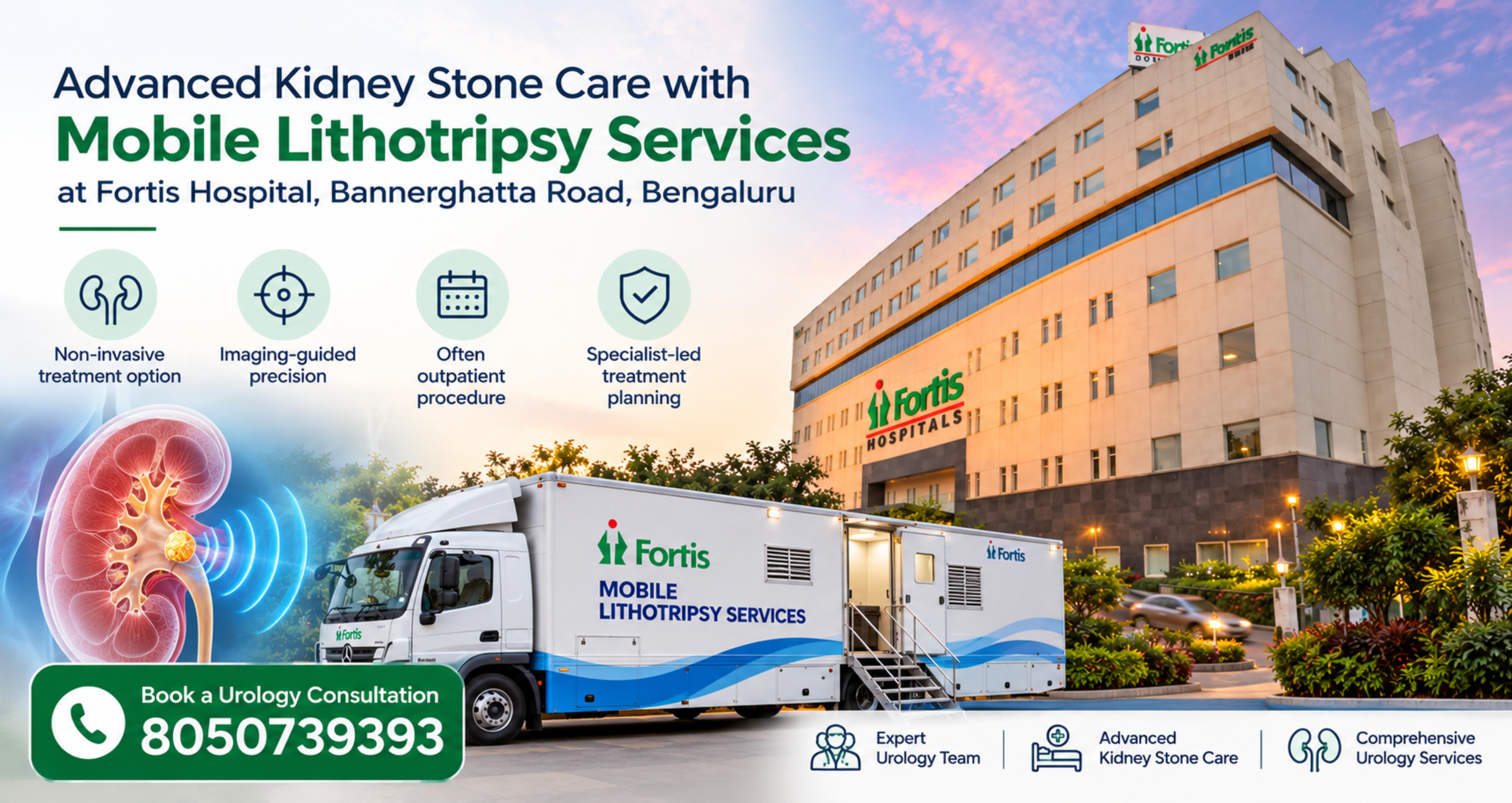
Mobile Lithotripsy Services kidney stone treatment at Fortis Hospital Bannerghatta Road
Mobile Lithotripsy Services at Fortis Hospital, Bannerghatta Road: An Advanced Approach to Kidney Stone Treatment
Introduction
Kidney stones are a common urological concern that can cause severe pain, discomfort during urination, blood in the urine and other complications. Depending on the size and location of the stone, patients may require medical management or a specialised procedure to break down or remove it.
With advancements in urological care, mobile lithotripsy services offer another approach to accessing kidney stone treatment. Fortis Hospital, Bannerghatta Road, Bengaluru, has introduced Mobile Lithotripsy Services to strengthen access to specialised kidney stone care.
For patients searching for kidney stone treatment in Bangalore, understanding how lithotripsy works, who may benefit from it and when to consult a urologist can help them make informed decisions about their treatment.
What Is Mobile Lithotripsy?
Mobile lithotripsy involves the use of specialised lithotripsy equipment through a mobile service model to support the treatment of kidney stones. Depending on the technology and treatment protocol, lithotripsy may use focused shock waves to break stones into smaller fragments that can pass through the urinary tract.
The mobile service model is intended to improve access to specialised kidney stone treatment. The exact arrangements, availability and suitability of treatment depend on the hospital's service model and clinical assessment.
At Fortis Hospital, Bannerghatta Road, Mobile Lithotripsy Services form part of the hospital's urological care offerings.
How Does Lithotripsy Help Treat Kidney Stones?
Extracorporeal Shock Wave Lithotripsy (ESWL) is a treatment that uses focused shock waves to break selected kidney or urinary tract stones into smaller fragments. Imaging guidance helps the treating team locate the stone during the procedure.
The fragments may then pass naturally through urine over time. Some patients may need additional treatment or a different procedure, depending on the stone's size, position, composition and response to treatment.
Lithotripsy is not suitable for every kidney stone. A urologist evaluates the patient's condition and investigations before recommending the appropriate treatment option.
Who May Need Kidney Stone Treatment?
Kidney stones can cause different symptoms depending on their size and location. Common symptoms include:
- Severe pain in the side, back or lower abdomen
- Pain that radiates towards the groin
- Blood in the urine
- Pain or burning while urinating
- Nausea or vomiting associated with pain
- Frequent or urgent urination
Some kidney stones may not cause noticeable symptoms initially and may be detected during imaging for another concern.
If you experience these symptoms, consult a qualified healthcare professional for an appropriate evaluation. Fever or chills with suspected kidney stones, difficulty passing urine or severe uncontrolled pain requires urgent medical attention.
What Are the Benefits of Lithotripsy?
For appropriately selected patients, shock wave lithotripsy may offer several advantages:
1. A less invasive treatment option
ESWL breaks selected stones without requiring an incision to reach the stone.
2. Imaging-guided treatment
X-ray or ultrasound guidance may be used to locate the stone and direct the treatment.
3. Potential for outpatient treatment
Many patients can undergo ESWL without an overnight hospital stay, depending on their clinical condition and the treatment protocol.
4. An alternative to certain surgical procedures
For suitable stones, lithotripsy may be considered instead of an endoscopic or surgical approach. However, larger, harder or difficult-to-access stones may require other procedures.
5. Specialist-led treatment planning
Consultation with a urologist helps determine the most appropriate treatment based on the patient's symptoms, scan findings and overall health.
Results vary between patients, and additional treatment may be required. Your treating doctor will explain the expected benefits and possible risks.
Lithotripsy vs Laser Kidney Stone Treatment: What Is the Difference?
Patients searching for the best kidney stone treatment in Bangalore may come across different procedures. The choice depends on individual clinical findings rather than a single treatment being best for everyone.
- ESWL (Shock Wave Lithotripsy): Uses externally generated shock waves to break selected stones into smaller fragments.
- RIRS (Retrograde Intrarenal Surgery): Uses a flexible endoscope passed through the urinary tract, with a laser to fragment stones inside the kidney.
- URS (Ureteroscopy): Uses an endoscope to access and treat stones in the ureter.
- PCNL (Percutaneous Nephrolithotomy): Uses a small access tract through the skin to remove selected larger or complex kidney stones.
Your urologist may recommend one of these approaches after reviewing the stone's size, location, composition, associated obstruction and other relevant factors.
What Should You Expect Before and After Lithotripsy?
Before treatment, the urologist may recommend imaging, urine tests and other investigations to understand the stone and check for infection or other concerns. Your doctor will also review your medications and medical history.
After ESWL, some patients may experience temporary discomfort while passing stone fragments or blood in the urine. Follow-up appointments and imaging may be necessary to assess the treatment response and confirm whether fragments remain.
Follow your doctor's instructions regarding hydration, medications, activity and follow-up care. Seek medical attention if you develop fever, chills, difficulty passing urine or severe or worsening pain.
Why Consider Fortis Hospital, Bannerghatta Road, for Kidney Stone Care?
Fortis Hospital, Bannerghatta Road, Bengaluru, offers urological services for the evaluation and management of kidney stones. Its kidney stone treatment offerings include shock wave therapy (ESWL), laser lithotripsy (RIRS), ureteroscopy (URS) and PCNL.
The Mobile Lithotripsy Services initiative further expands the hospital's kidney stone care services.
Patients seeking kidney stone treatment in Bannerghatta Road or consulting a urologist in Bangalore can discuss their symptoms, diagnostic findings and treatment options with the hospital's clinical team.
The recommended treatment and expected recovery will depend on individual assessment.
Consult a Urologist for Kidney Stone Treatment
Persistent flank pain, blood in the urine or recurring urinary symptoms should not be ignored. Early evaluation can help identify the cause and determine whether observation, medication or a procedure is appropriate.
If you are looking for kidney stone treatment in Bangalore, consult the urology team at Fortis Hospital, Bannerghatta Road, to understand the available treatment options, including Mobile Lithotripsy Services, where appropriate.
Book a urology consultation: Visit the Fortis Hospital, Bannerghatta Road kidney stone treatment to explore the hospital's services and consultation options.
Medical disclaimer: This article is for general educational purposes only and does not replace a medical consultation. Treatment decisions should be made by a qualified healthcare professional following an individual assessment.
Categories
Clear allMeet the doctor

- Urology | Paediatric Urology | Urology | Uro-Oncology
- Organ Transplant | Kidney Transplant
-
 37 Years
-
 1800
Related Blogs
View all



Adult Circumcision: Debunking Facts and Myths | Fortis Health Connect Blogs
Is Beer Good for Kidney Stones ? - Myths Vs Facts | Fortis Healthcare


FAQs
1. What is mobile lithotripsy for kidney stones?
Mobile lithotripsy is a service model that uses specialised lithotripsy equipment to support kidney stone treatment. The specific procedure and availability depend on the service provided and the patient's clinical requirements.
Is lithotripsy suitable for all kidney stones?
No. Suitability depends on the stone's size, location, composition and other patient-specific factors. A urologist can determine whether ESWL or another treatment is appropriate.
Is lithotripsy a surgical procedure?
ESWL is a non-invasive treatment that does not require an incision to reach the stone. Other procedures, such as RIRS, URS and PCNL, use different techniques and may involve anaesthesia.
How long does it take to recover after lithotripsy?
Recovery varies according to the procedure, the patient's health and how quickly stone fragments pass. Your doctor will advise you on activity, symptom management and follow-up.
Where can I consult for kidney stone treatment in Bangalore?
Patients can consult the urology team at Fortis Hospital, Bannerghatta Road, Bengaluru, to discuss their symptoms, diagnostic findings and available kidney stone treatment options.

Keep track of your appointments, get updates & more!

