
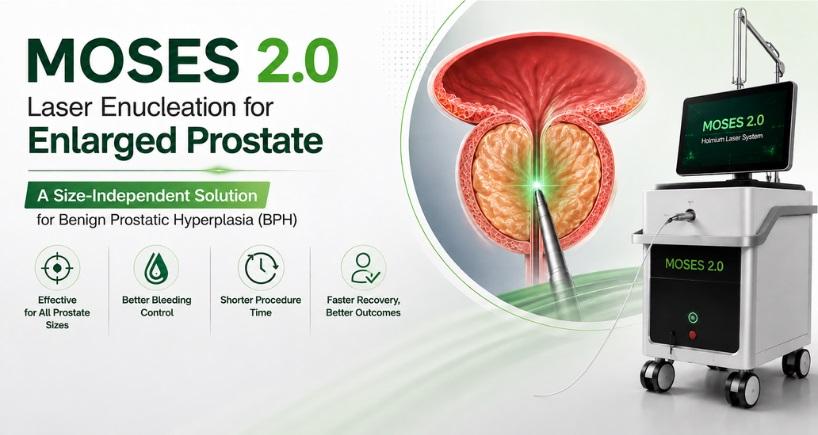


MOSES 2 Laser Enucleation for Enlarged Prostate - Size Independent Solution for BPH
Part 2 of our BPH Treatment Series | When the prostate is too large for steam, laser enucleation takes over
By Dr. Rohit Dadhwal - Senior Consultant, Urology, Andrology & Robotic Surgery | Fortis Hospital Mohali MCh (AIIMS) | Uro-Oncology Training, Mayo Clinic | Pioneer of Rezūm Water Vapour Therapy in India
Read Part 1 first: Rezūm Water Vapour Therapy for Enlarged Prostate — A Modern Solution for BPH
Introduction: One Diagnosis, Many Different Prostates
In Part 1 of this series, I wrote about Rezūm water vapour therapy — a treatment I have championed at Fortis Hospital Mohali and one that has transformed care for men with moderate prostate enlargement who want to preserve sexual function.
But Rezūm is not the answer for every man, and it would be dishonest of me to suggest otherwise.
After that blog was published, the single most common question in my OPD became a version of this: "Doctor, you have written about steam. My prostate is 120 grams. Is steam going to work for me?"
The honest answer is usually no. Rezūm works best in the 30–80 gram range. When the prostate crosses 80 grams — and in my practice at Fortis Mohali, seeing men from across Punjab, Haryana and Himachal, large glands are common — we need a technique whose effectiveness does not shrink as the prostate grows.
That technique is holmium laser enucleation of the prostate (HoLEP), and the platform that has made it faster, cleaner and more predictable is MOSES 2.0 pulse modulation technology.
This blog explains what MOSES 2.0 is, why "enucleation" is fundamentally different from every other prostate procedure, who it suits, and — just as importantly — who it does not. Towards the end, I will also place UroLift and robotic surgery in context, so you can see the full map of options rather than one technology in isolation.
Recap: Why an Enlarged Prostate Causes Trouble
For readers arriving here first, a brief recap.
The prostate is a walnut-sized gland sitting below the bladder, wrapped around the urethra — the tube carrying urine out of the body. With age, the gland enlarges. This is benign prostatic hyperplasia (BPH) — benign meaning non-cancerous. As it grows inward, it compresses the urethra, and urine flow suffers.
The symptoms are familiar to anyone living with them:
- Waking repeatedly at night to urinate (nocturia)
- A weak, slow or interrupted stream
- Straining or waiting for the stream to start
- A persistent sense that the bladder has not emptied
- Sudden urgency, and sometimes leakage before reaching a toilet
- Dribbling at the end
- In advanced cases, complete urinary retention requiring emergency catheterisation
What many men do not realise is that untreated, long-standing obstruction is not merely uncomfortable — it can lead to bladder wall thickening and loss of bladder muscle function, recurrent urinary infections, bladder stones, and in some cases kidney impairment from back-pressure. Some of this damage is not fully reversible even after the obstruction is relieved. This is precisely why I discourage men from postponing treatment indefinitely once symptoms are significant.
What Is MOSES 2.0 Laser Technology?
Let me separate two things that often get confused, because understanding the difference will help you ask better questions of any urologist you consult.
HoLEP is the operation. Holmium Laser Enucleation of the Prostate is a surgical technique in which the obstructing prostate tissue is peeled away from the outer shell of the gland along a natural anatomical plane, pushed into the bladder, and then removed.
MOSES 2.0 is the laser platform that performs it. MOSES is a pulse modulation technology built into the holmium laser system that changes how the laser energy is delivered.
The Physics, Made Simple
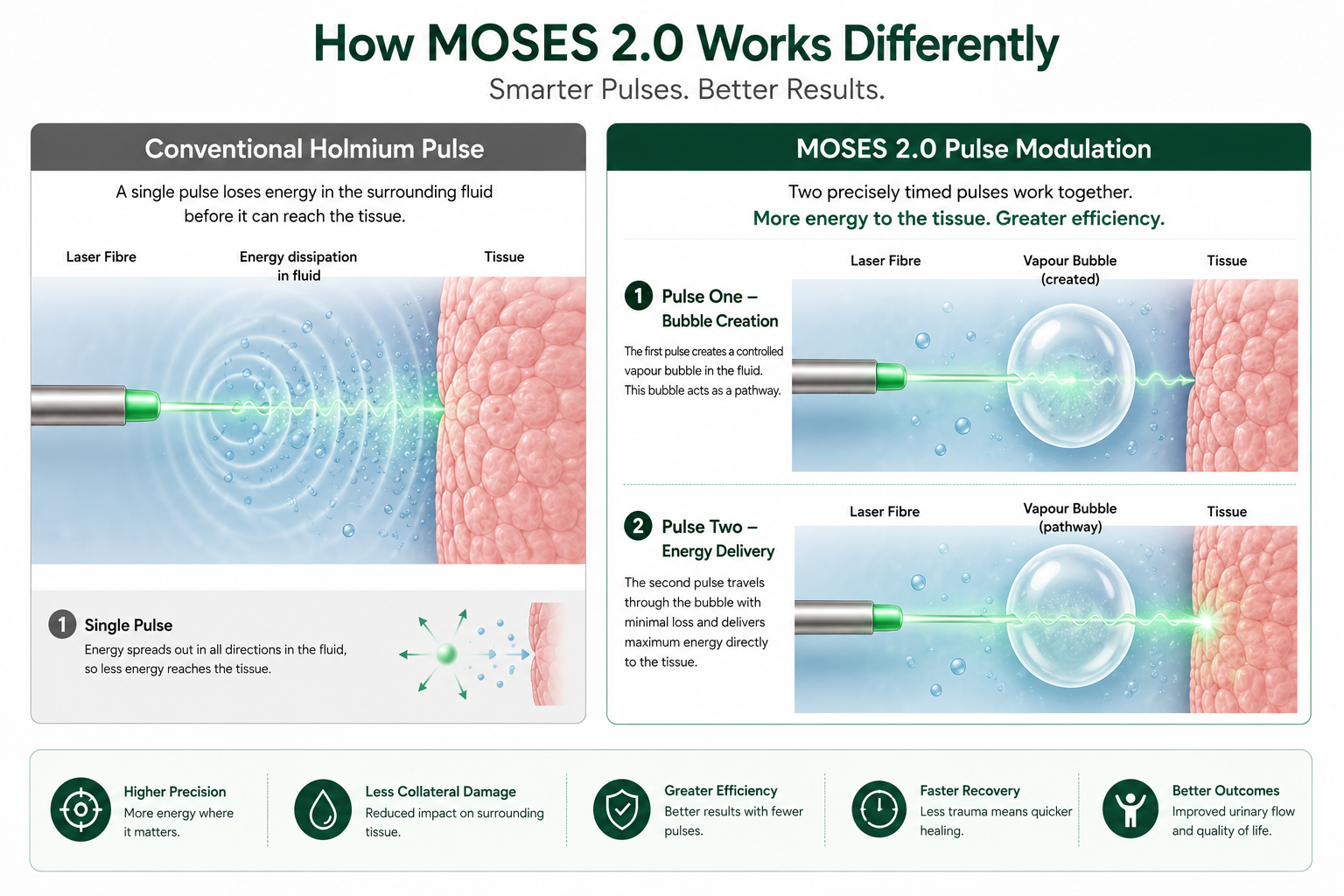
A holmium laser fires through fluid — we operate with continuous saline irrigation. Water absorbs holmium energy very efficiently, which is excellent for safety but means energy is lost travelling from the fibre tip to the tissue.
MOSES technology solves this by splitting each laser pulse in two:
- The first part of the pulse creates a vapour bubble in the fluid between the fibre and the tissue — effectively opening a channel.
- The second part travels through that channel and reaches the tissue with far less energy lost to the surrounding fluid.
The practical consequences in theatre are meaningful: more efficient tissue cutting, noticeably better haemostasis (bleeding control), less retropulsion of tissue away from the fibre, and shorter operating time. MOSES 2.0 refines this further with modes optimised specifically for enucleation and for lithotripsy.
Published comparative studies of Moses-enabled HoLEP against conventional HoLEP have reported reductions in enucleation and haemostasis time, with comparable safety profiles. For a patient, shorter operating time is not an abstract benefit — it means less anaesthetic exposure, less fluid absorption and less physiological stress, which matters most in exactly the elderly, comorbid population we are usually treating.
Why Enucleation Is Different From Every Other Prostate Procedure
This is the section I most want you to read carefully, because it is the concept that changes how you should think about your options.
Most prostate procedures remove or destroy tissue from the inside. TURP shaves tissue away in chips. Rezūm causes targeted tissue to die and be reabsorbed. Both work by reducing the volume of obstructing tissue.
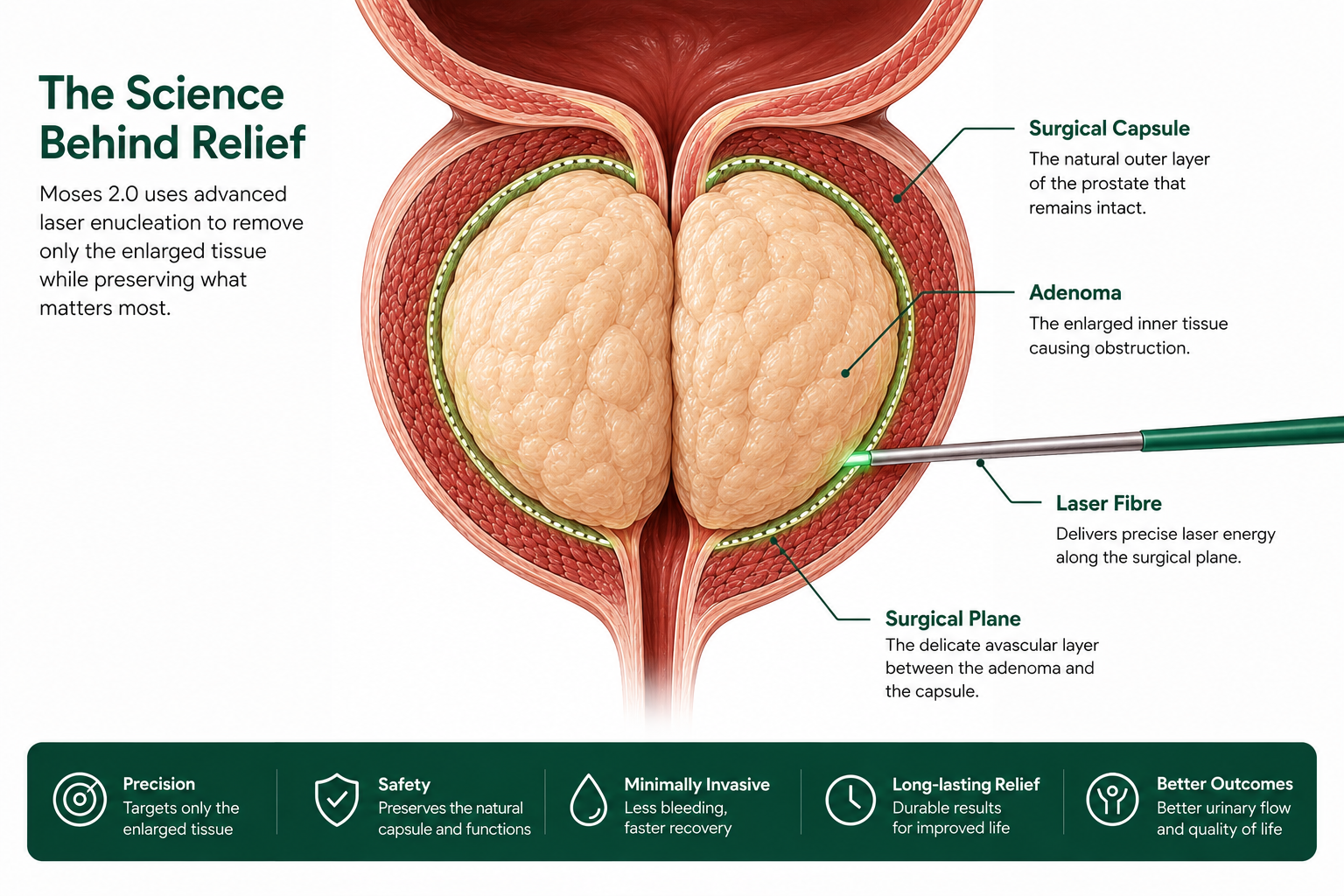
Enucleation does something structurally different. It identifies the natural plane between the overgrown inner tissue (the adenoma) and the outer shell of the gland (the surgical capsule), and separates the entire adenoma along that plane — the way you might separate the segments of an orange from the peel. The freed tissue is pushed into the bladder and removed with a morcellator, an instrument that breaks it into small fragments and suctions them out.
Three consequences follow, and they are the reason enucleation has earned its place in international guidelines:
1. It is size-independent. Because the technique follows an anatomical plane rather than removing tissue piecemeal, a 150-gram prostate is not fundamentally harder than an 80-gram one — it simply takes longer. This is why both European and American urological association guidelines recognise enucleation as an appropriate option across prostate sizes, including large glands where TURP becomes unsafe and open surgery was historically the only alternative.
2. It is more complete. Enucleation removes a substantially greater proportion of the adenoma than TURP typically achieves. This translates into greater and more durable flow improvement.
3. Retreatment rates are low. Long-term follow-up studies of HoLEP have reported low rates of re-operation for recurrent obstruction extending well beyond a decade. Because the adenoma has been removed rather than reduced, there is simply much less tissue left to regrow.
There is a fourth point worth mentioning: the enucleated tissue is sent for histopathology. In a small percentage of men, incidental prostate cancer is discovered in tissue that appeared entirely benign on pre-operative assessment. Procedures that vaporise or ablate tissue do not yield a specimen and cannot offer this.
The MOSES 2.0 Procedure at Fortis Mohali: What to Expect
Before the Procedure
The evaluation mirrors what I described in the Rezūm blog, with a few additions given that this is a more substantial operation:
- IPSS questionnaire (International Prostate Symptom Score) to quantify symptom burden
- Uroflowmetry and post-void residual measurement
- Ultrasound or MRI to measure prostate volume accurately — volume drives the treatment decision more than any other single factor
- PSA and, where indicated, prostate biopsy to exclude cancer
- Cystoscopy where anatomy needs direct assessment
- Urine culture — an untreated infection must be cleared before surgery
- Renal function tests, particularly where retention has been prolonged
- Pre-anaesthetic assessment, since HoLEP is performed under spinal or general anaesthesia
Where a man has been in retention for a long period, I sometimes recommend urodynamic studies to assess whether the bladder muscle itself has retained function. This matters enormously for setting expectations: if the bladder has been damaged by years of obstruction, relieving the blockage will improve flow, but some symptoms may persist. Telling a patient this beforehand is far better than explaining it afterwards.
On the Day
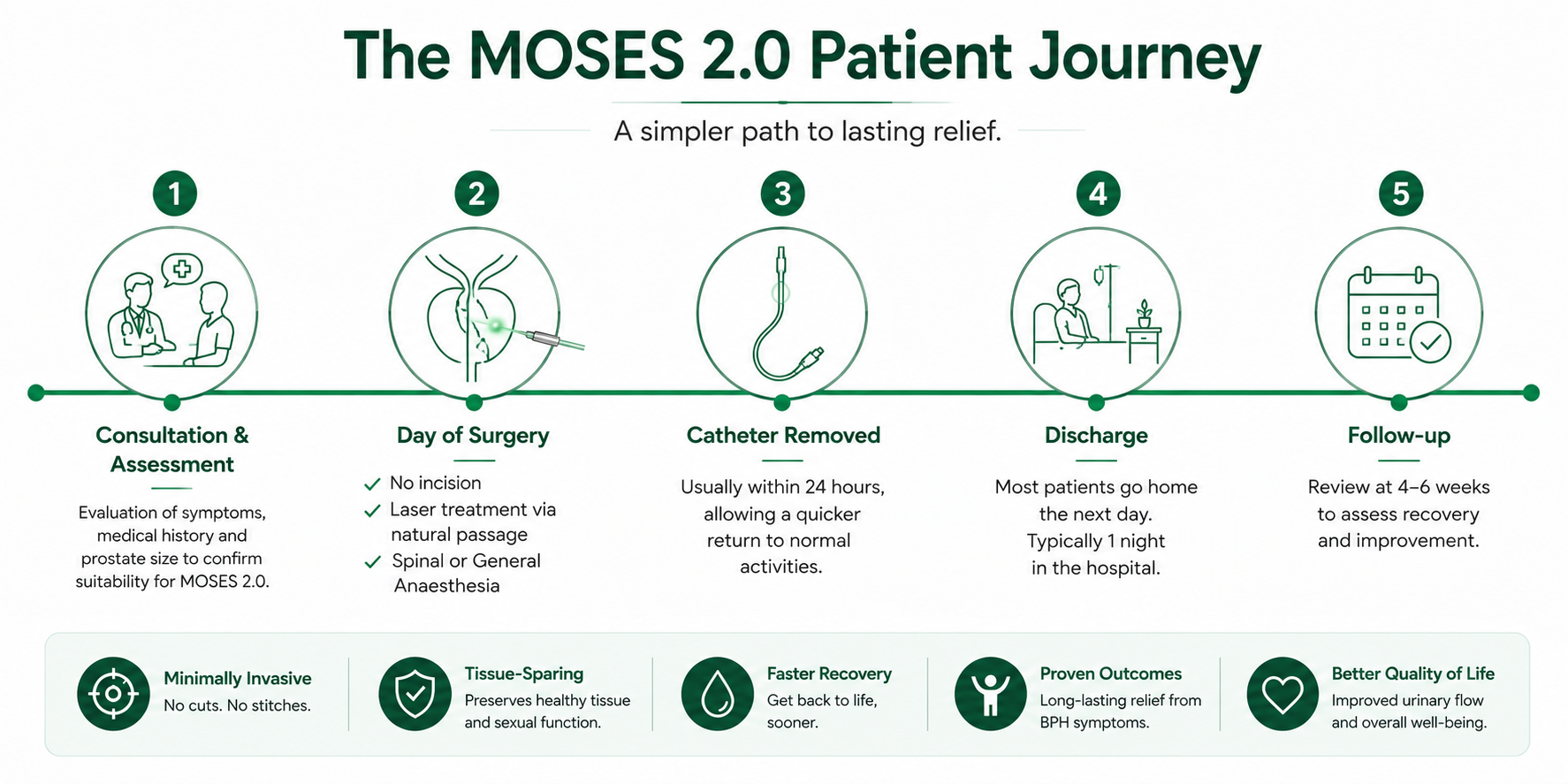
You will be admitted, having fasted, and taken to theatre. The procedure is performed entirely through the urethra — there is no incision anywhere on the body.
Working through a resectoscope with continuous saline irrigation, I identify the plane between adenoma and capsule and use the MOSES 2.0 laser fibre to develop it, lobe by lobe. Bleeding vessels are coagulated as I proceed. Once the lobes are freed into the bladder, the morcellator removes the tissue. A catheter is placed at the end.
Operating time depends primarily on gland size — a moderate prostate may take under an hour, a very large gland considerably longer.
After the Procedure
- Catheter: usually removed within 24 hours. In many patients the irrigation can be stopped early because bleeding is minimal.
- Hospital stay: typically one night. Some patients are suitable for same-day or next-morning discharge.
- Return to normal activity: most men resume light activity within a few days.
- Restrictions: avoid heavy lifting, straining and sexual activity for approximately 2–4 weeks, as advised.
- Flow improvement: unlike Rezūm, which takes 1–3 months to show full benefit, the improvement after enucleation is largely immediate once the catheter is out — the obstruction has been physically removed.
That last point is one of the genuine advantages of this approach for men who are in retention or severely symptomatic and cannot wait months for relief.
An Honest Account of the Trade-Offs
I said in Part 1 that I would always give you an honest comparison rather than promote one technology. Here is where I hold to that.
Retrograde Ejaculation Is Common After Enucleation
This is the most important trade-off and I raise it with every patient before consent.
Retrograde ejaculation means semen travels backwards into the bladder during orgasm instead of outward — often described as a "dry orgasm." The sensation of orgasm is preserved. It is not harmful. But it does affect fertility and, for some men, it matters a great deal psychologically.
After enucleation, retrograde ejaculation is common — reported in the majority of patients across published series, considerably higher than the 4–5% figure I quoted for Rezūm. This is not a complication of poor technique; it is an expected consequence of removing tissue around the bladder neck.
Erectile function, by contrast, is generally preserved — studies have not shown a meaningful deterioration in erectile function after HoLEP.
So the choice is genuinely a trade-off, not a hierarchy:
- A sexually active man in his fifties with a 60-gram prostate who is deeply concerned about ejaculatory function may be far better served by Rezūm or UroLift.
- A man in his seventies with a 130-gram prostate and recurrent retention needs definitive relief, and enucleation is the appropriate operation.
Neither answer is universally "better." The right answer is the one that fits your prostate, your symptoms and your priorities.
Temporary Stress Incontinence
Some men experience temporary urinary leakage on coughing, sneezing or exertion after enucleation. This occurs because the sphincter mechanism has been working against high resistance for years and needs time to readjust. In the large majority it settles within weeks to a few months, and pelvic floor exercises started early help considerably. Persistent significant incontinence is uncommon.
Other Considerations
- Transient burning and urgency during urination in the first weeks is normal.
- Some blood in the urine in the early weeks is expected and settles.
- Because saline irrigation is used rather than glycine, the fluid absorption syndrome historically associated with TURP is not a concern.
- HoLEP is technically demanding and has a real learning curve. Operator experience matters more with this procedure than with almost any other prostate operation — this is a fair question to ask any surgeon offering it to you.
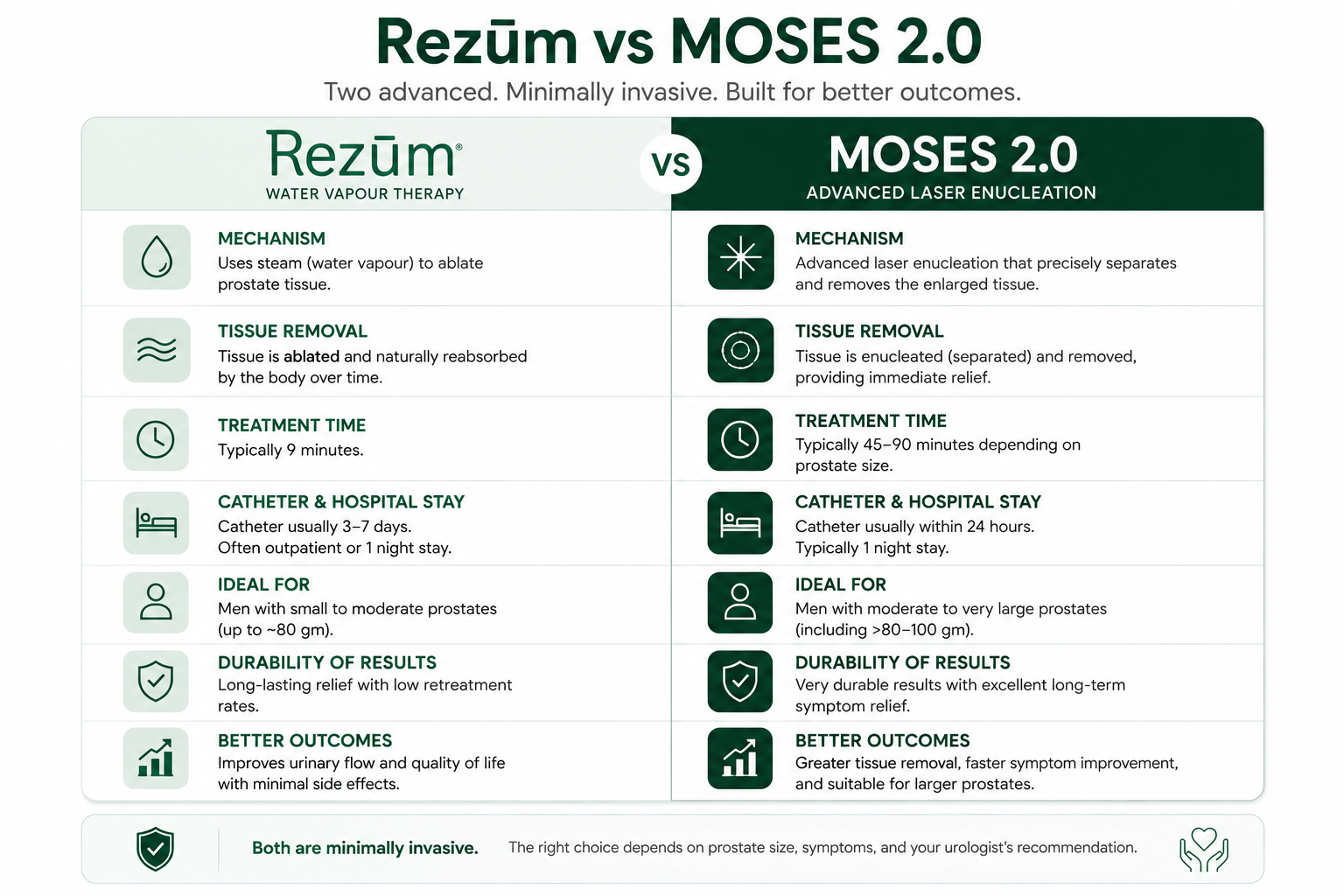
Rezūm or MOSES 2.0? A Practical Comparison
Myth vs. Fact
Myth: "Laser prostate surgery is always better than any other treatment."
Fact: "Laser" describes an energy source, not a single operation. Different laser procedures do very different things. What determines the right choice is your prostate size and anatomy, your symptom severity, your other medical conditions and your personal priorities — not the technology label.
Myth: "A very large prostate means I definitely need open surgery."
Fact: This was true for decades, but no longer. Enucleation is size-independent, and its recognition in international guidelines for large glands is precisely because it offers comparable tissue removal to open surgery without an abdominal incision.
Myth: "An enlarged prostate means I have or will develop prostate cancer."
Fact: BPH and prostate cancer are separate conditions. BPH is not a precursor to cancer and does not increase cancer risk. However, they can coexist, and because both cause overlapping symptoms, cancer must be excluded before treating BPH — which is exactly why PSA testing and, where indicated, biopsy come before any procedure.
Myth: "If I lose ejaculation, I have lost my sexual function."
Fact: Retrograde ejaculation and erectile dysfunction are entirely different. Erectile function is generally preserved after enucleation, and the sensation of orgasm is retained. What changes is the direction the semen travels. It matters for fertility, and it matters to some men emotionally — both are legitimate reasons to discuss it before deciding, and both are reasons to consider an ejaculation-preserving alternative if appropriate.
Myth: "I can just keep taking my tablets forever."
Fact: Medication is a reasonable first step and works well for many men. But it is not always durable, side effects can be limiting, and in men with significant obstruction, continuing to wait allows bladder damage that may not be fully reversible. Postponing is itself a decision with consequences.
Beyond Rezūm and MOSES: The Rest of the Map
I said at the beginning that I would show you the whole map. Two further options deserve mention, because for some men they are the better answer.
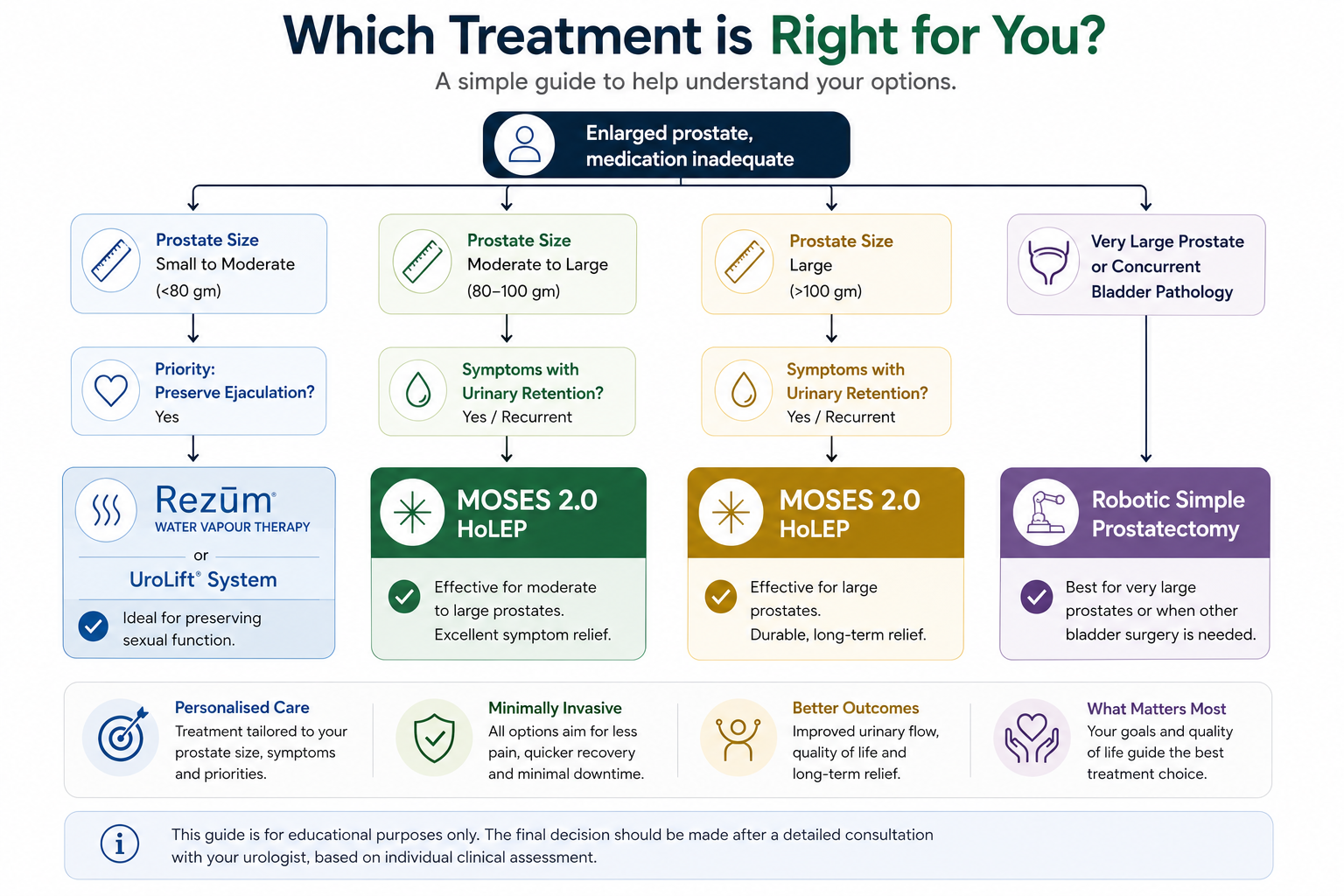
UroLift (Prostatic Urethral Lift)
UroLift takes a mechanical rather than a thermal approach. Instead of removing or destroying tissue, small permanent implants are placed to hold the enlarged lobes apart, opening the urethral channel — rather like tie-backs holding a pair of curtains open.
- Advantages: performed as a day-care procedure, very rapid recovery, and importantly, it is designed to preserve both erectile and ejaculatory function. Relief is immediate rather than gradual.
- Considerations: it is generally suited to smaller prostates without a large obstructing median lobe, and it leaves permanent implants in place. Retreatment rates over time are higher than those reported after enucleation.
- Who it suits: a younger, sexually active man with moderate enlargement and suitable anatomy, for whom preserving ejaculation is the overriding priority.
Robotic Simple Prostatectomy
For genuinely enormous glands — and I do see them — robotic simple prostatectomy remains an important option.
Here the adenoma is removed through small abdominal keyhole ports using the da Vinci Xi robotic platform, rather than through the urethra. It achieves the same goal as enucleation via a different route, and it is particularly useful in men who have concurrent bladder pathology, very large bladder stones or a large diverticulum needing simultaneous treatment.
At Fortis Hospital Mohali, our robotic surgery program has been running continuously for over nine years, and Urology is among its most established specialties. That continuity matters. Robotic surgery is a team discipline as much as a surgeon's, and a program that has been running for nine years has the anaesthetic, nursing and theatre experience to match.
An important clarification: robotic simple prostatectomy treats benign enlargement and removes only the inner adenoma. Robotic radical prostatectomy treats prostate cancer and removes the entire gland. They share a name and a platform but are entirely different operations for entirely different conditions. If prostate cancer is diagnosed during your assessment, the conversation changes completely, and we would discuss the uro-oncology pathway with you separately.
Why Breadth of Options Matters More Than Any Single Technology
I want to close Part 2 the same way I closed Part 1, because it is the point I believe most strongly.
A centre that offers only one procedure will find a reason to recommend that procedure. That is human nature, not bad intent.
At Fortis Hospital Mohali, our urology program offers medical management, Rezūm water vapour therapy, UroLift, MOSES 2.0 laser enucleation, conventional TURP and robotic simple prostatectomy — under one roof, within one team. This is precisely what allows me to sit across from you and give an unbiased recommendation, because I have nothing to sell you. If steam is right for you, I will say so. If your gland is too large for it, I will say that too.
Men across Mohali, Chandigarh, Panchkula and the wider Tricity region — and from across Punjab, Haryana and Himachal Pradesh — should not have to travel to a metro city for this range of options. They are available here.
If you have been managing your symptoms with tablets that no longer work as they once did, if you are waking through the night, or if you have been told your prostate is "too big" for the minimally invasive options you have read about — come and have the conversation. There is almost always a route forward.
Book a Consultation
If you are living with symptoms of an enlarged prostate, or have been told your prostate is too large for minimally invasive treatment, a proper assessment is the place to start.
Dr. Rohit Dadhwal
Senior Consultant — Urology, Andrology & Robotic Surgery
Fortis Hospital, Mohali
Call 72728 72728 to book an appointment
Book online at fortishealthcare.com
Categories
Clear allRelated Blogs
View all



Adult Circumcision: Debunking Facts and Myths | Fortis Health Connect Blogs
Is Beer Good for Kidney Stones ? - Myths Vs Facts | Fortis Healthcare



FAQs
Is MOSES 2.0 the same as ordinary laser prostate surgery?
It uses the same holmium laser energy but delivers it differently. The pulse modulation improves cutting efficiency and bleeding control, which translates to shorter operating time. The operation performed — enucleation — is what removes the obstruction; MOSES 2.0 is the technology that performs it more efficiently.
Will I need a catheter, and for how long?
Yes, a catheter is placed at the end of the procedure. It is usually removed within 24 hours. This is significantly shorter than the catheter duration typically needed after conventional TURP.
Is there any cut on my body?
No. The entire procedure is performed through the urethra. There is no external incision.
I am on blood thinners. Can I still have this procedure?
Holmium laser enucleation has a favourable bleeding profile and is often considered for patients on anticoagulants. However, decisions about stopping, continuing or bridging blood thinners must be made individually, in consultation with your cardiologist or physician, based on why you are on them. Please do not stop or alter any medication on your own.
How long before I can go back to work?
Most men with sedentary jobs return within one to two weeks. Physically demanding work needs longer. You will be given specific advice at discharge.
Will my prostate grow back?
Because the adenoma is removed rather than reduced, long-term re-operation rates after enucleation are low. Some residual tissue remains at the capsule, but significant regrowth requiring repeat surgery is uncommon.
Will this affect my sex life?
Erectile function is generally preserved. Retrograde ejaculation — semen travelling backwards into the bladder — is common after enucleation. If preserving ejaculation is your priority, tell me at the first consultation, because it may point us towards Rezūm or UroLift instead.
How do I know which procedure is right for me?
Prostate size, symptom severity, whether you have been in retention, your other medical conditions, your medications and your personal priorities all feed into the decision. It cannot be settled from a blog — it needs an assessment. But reading this means you will arrive at that consultation able to ask far better questions.

Keep track of your appointments, get updates & more!

