
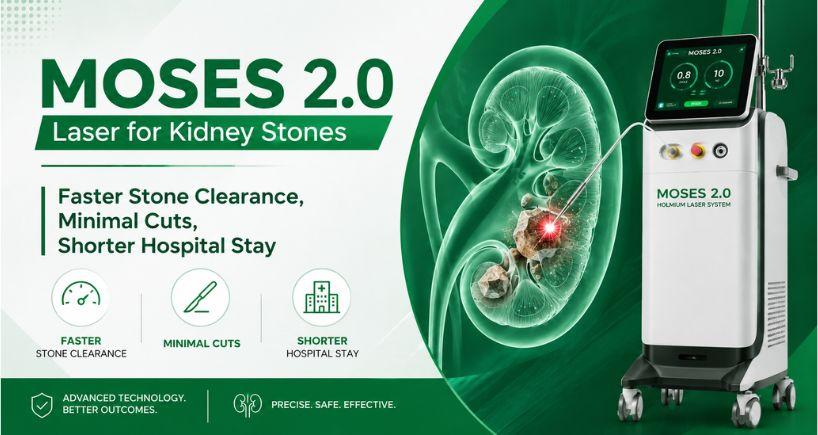


MOSES 2.0 Laser for Kidney Stones: Faster Stone Clearance, Minimal Cuts, Shorter Hospital Stay
By Dr Rohit Dadhwal Senior Consultant — Urology, Andrology & Robotic Surgery | Fortis Hospital, Mohali MCh Urology (AIIMS, New Delhi) | FRCS (Glasgow)
When a Kidney Stone Becomes an Emergency
Severe flank pain that radiates to the groin. Nausea and vomiting. Blood in urine. Burning urination. Fever. A kidney stone attack is one of the most painful experiences a person can have — and for many patients, it escalates into an emergency when the stone blocks the ureter, traps infected urine behind it, or causes the kidney to swell.
Some stones pass naturally with fluids and pain relief. Many do not. When a stone is too large to pass, causes persistent pain, triggers infection, or blocks kidney drainage, it needs to be treated — and the goal of modern stone treatment is not only to remove the stone. It is to remove it safely, quickly, with minimal pain, minimal hospital stay, and the least disruption to the patient’s life.
What Is MOSES 2.0 and How Does It Break Stones?
MOSES 2.0 is an advanced holmium laser platform (Boston Scientific) used during endoscopic stone surgery. A thin flexible scope is passed through the natural urinary passage — the urethra, bladder, and ureter — to reach the stone directly. The MOSES laser energy then breaks the stone into fine dust or small fragments that either pass naturally or are removed during the procedure. No large incision is needed. In most cases, the stone is treated entirely through the urinary tract.
The Moses Effect: Why This Laser Is Different
The problem with conventional holmium lasers is retropulsion — when the laser fires, it creates a shockwave in the surrounding fluid that pushes the stone away. The surgeon then has to chase the stone, wasting time and extending the procedure. MOSES technology solves this with a dual-pulse mechanism: the first pulse creates a vapour bubble that clears the fluid from the laser’s path. The second pulse travels through the bubble and delivers full energy directly to the stone surface. The stone stays still. The energy hits harder. The stone breaks faster.
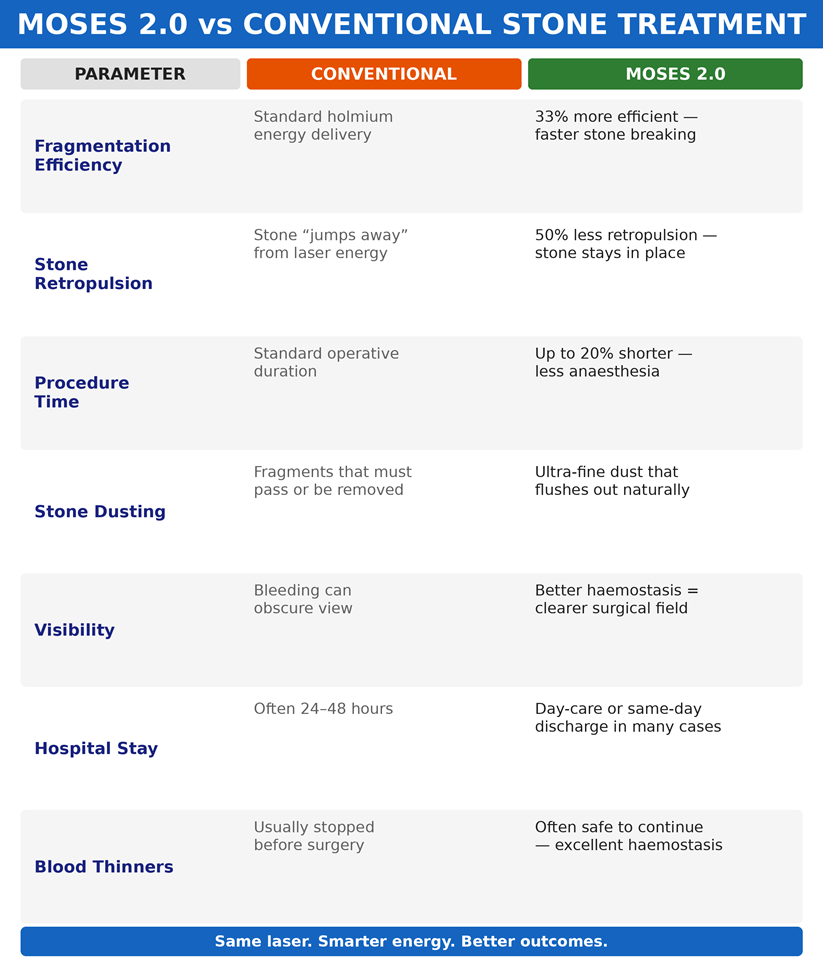
Boston Scientific reports up to 33% more efficient fragmentation, 50% reduction in stone retropulsion, and approximately 20% reduction in total procedure time compared with conventional holmium laser settings (Boston Scientific MOSES 2.0 clinical data). Published clinical studies, including Ibrahim et al. and Pietropaolo et al., confirm shorter operative times with MOSES technology in randomised and comparative settings.
Why MOSES 2.0 Is Better Than Conventional Stone Treatment
Ultra-Fine Dusting Instead of Fragmentation
Conventional lasers break stones into fragments that the patient must pass over days or weeks — sometimes painfully. MOSES 2.0 operates at up to 120 Hz, enabling ultra-speed dusting that pulverises stones into fine sand-like particles that flush out naturally. Less fragment pain. Fewer leftover pieces. Lower chance of repeat procedures.
The Stone Stays Still
With 50% less retropulsion, the surgeon maintains precise laser contact with the stone throughout the procedure. No chasing. No wasted energy. This translates directly into shorter operative time, less anaesthesia exposure, and a more controlled procedure.
Safe for Patients on Blood Thinners
The MOSES effect provides superior haemostasis — better bleeding control — during and after the procedure. For patients on anticoagulants (aspirin, clopidogrel, apixaban, warfarin) who cannot safely stop their blood thinners for conventional surgery, MOSES laser lithotripsy is often safe to perform without interrupting anticoagulation. This is particularly important for elderly patients and those with cardiac stents or atrial fibrillation.
Treats All Stone Locations
- Kidney stones — including lower-pole stones that are harder to clear with shockwave therapy
- Ureteric stones — where retropulsion is most problematic with conventional lasers
- Bladder stones — including those associated with BPH
- Hard stones (calcium oxalate monohydrate, brushite) that resist shockwave fragmentation
- Multiple stones — controlled endoscopic treatment in a single sitting
All Stone Treatment Options Compared
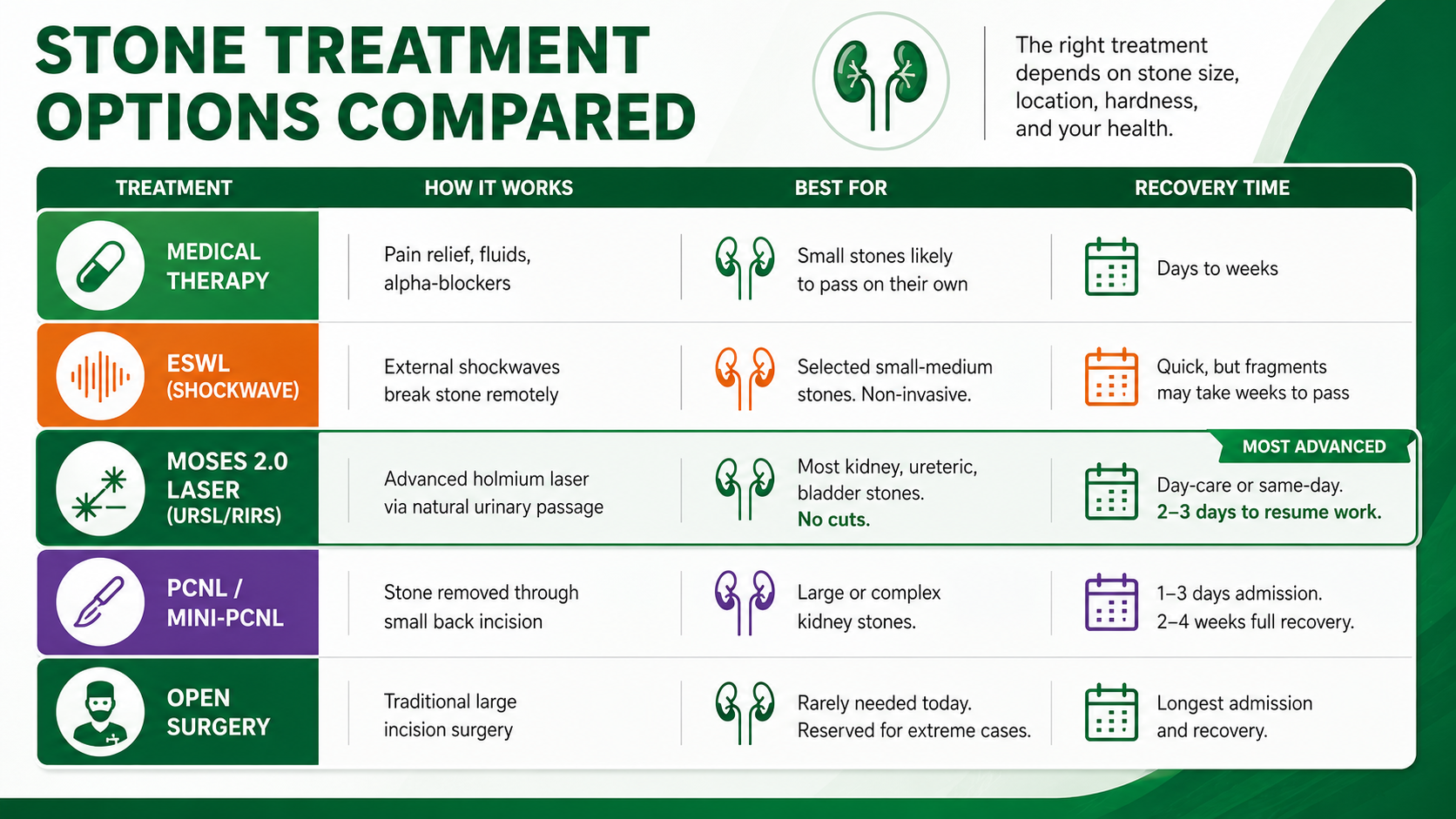
MOSES 2.0 is advanced, but it is not the answer for every stone. Very large stones, staghorn calculi, complex kidney anatomy, or infected obstructed systems may need staged treatment, PCNL, drainage first, or a different approach. The right treatment is decided after CT scan, urine tests, kidney function assessment, and expert urological evaluation.
Recovery: Faster Than You Expect
Because the procedure is performed through the natural urinary passage with no external incision, recovery is significantly faster than conventional or more invasive stone surgery.
- Hospital stay: Day-care or same-day discharge in most uncomplicated cases. Overnight stay only for complex, infected, or large stone cases
- Pain: Usually manageable with oral medications. The dusting technique means fewer sharp fragments passing through the ureter
- Return to light activity: Often within 2–3 days
- Return to work: Most patients resume desk work within 3–5 days
- DJ stent: A temporary ureteric stent may be placed in selected patients to keep the passage open while swelling settles. Duration is shortened with MOSES compared with conventional approaches
- Temporary symptoms: Mild burning urination, frequency, or blood-tinged urine may occur for a few days, especially with a stent in place
For working professionals, frequent travellers, pilots, drivers, and anyone who cannot afford extended downtime — MOSES 2.0 offers the fastest return to routine of any interventional stone treatment.
When a Stone Becomes an Emergency
Do not wait if you have:
- Fever with stone pain or chills/shivering — this may indicate infected urine trapped behind a stone (urosepsis risk)
- Severe, uncontrollable pain not responding to painkillers
- Reduced or absent urine output
- Stone in a single kidney with obstruction
- Pregnancy with stone symptoms
- Diabetes or immune suppression with fever and stone pain
These patients may need emergency drainage (ureteric stent or nephrostomy) before definitive stone removal. Fortis Mohali’s Emergency Department is equipped for 24×7 emergency stone care, including urgent decompression and same-admission laser treatment when safe.
MOSES 2.0 Stone Treatment at Fortis Mohali
- Advanced MOSES 2.0 holmium laser platform for kidney, ureteric, and bladder stones
- Complete stone evaluation: CT scan, metabolic workup, urine analysis, kidney function assessment — all in-house
- Endoscopic, flexible, and rigid ureteroscopy with laser lithotripsy
- PCNL and mini-PCNL for large or complex stones
- 24×7 emergency support for obstructed or infected stones
- Post-treatment stone prevention programme: stone analysis, dietary advice, metabolic evaluation
At Fortis Mohali, the focus is not just stone removal. It is complete stone care — diagnosis, laser treatment, faster recovery, prevention planning, and emergency support when the stone is causing obstruction or infection.
If you are suffering from kidney or ureteric stone pain and want to understand whether MOSES 2.0 laser treatment is right for your stone, schedule a consultation with Dr Rohit Dadhwal at Fortis Hospital Mohali. Bring your CT scan for a comprehensive assessment and a clear treatment plan.
About the Author
Dr Rohit Dadhwal is a Senior Consultant in Urology, Andrology & Robotic Surgery at Fortis Hospital, Mohali. He completed his MCh in Urology from AIIMS, New Delhi, and holds the FRCS (Glasgow) by invitation. Dr Dadhwal performs endoscopic, laser, and robotic urological procedures across the full spectrum of stone disease, BPH, and urological cancers. Dr Dadhwal is among handful of surgeons in India to get Moses 2.0 training and is the only one in North of Delhi to have expertise of this. With the addition of MOSES 2.0 to his practice, Fortis Mohali now offers the most advanced holmium laser platform available for both stone treatment and prostate surgery.
Categories
Clear allMeet the doctor

- Urology | Urology | Uro-Oncology | Paediatric Urology
-
 9 Years
-
 1100
1100
Related Blogs
View all


Adult Circumcision: Debunking Facts and Myths | Fortis Health Connect Blogs
Is Beer Good for Kidney Stones ? - Myths Vs Facts | Fortis Healthcare

FAQs
Is MOSES 2.0 laser treatment painful?
The procedure is performed under anaesthesia — you feel nothing during surgery. Afterwards, mild burning urination or stent-related discomfort may occur temporarily and is manageable with oral medications.
Will I need admission?
Many uncomplicated cases are managed as day-care or short-stay procedures. Admission depends on stone size, infection, kidney function, and overall health.
Is there any cut or incision?
In ureteroscopic laser lithotripsy, the scope passes through the natural urinary passage. No external cut is needed. PCNL is different and uses a small back incision for very large stones.
Can MOSES 2.0 treat very hard stones?
Yes. The improved energy delivery is particularly effective for hard calcium oxalate monohydrate and brushite stones that resist shockwave fragmentation.
Is MOSES better than ESWL (shockwave)?
It depends on the stone. ESWL is non-invasive and useful for selected smaller stones. MOSES laser may be better when direct visualisation, faster clearance, controlled fragmentation, hard stone composition, or failed ESWL are relevant factors. Your urologist will recommend the best option based on your CT findings.
Can stones come back after laser treatment?
Yes. Stones can recur unless the underlying metabolic cause is addressed. Prevention requires adequate hydration (2.5–3 litres daily), dietary modifications, stone composition analysis, and metabolic evaluation in recurrent cases. Stone treatment without prevention planning is incomplete.
Is it safe for elderly patients or those on blood thinners?
MOSES 2.0 is one of the safest options for anticoagulated and elderly patients because of its superior haemostasis. Published cases include patients treated without stopping blood thinners. However, suitability is always assessed individually.

Keep track of your appointments, get updates & more!

