


Self Breast Examination – A Comprehensive Quick Guide
Fortis Hospital Mohali
What is Self Breast Examination (SBE)?
Self Breast Examination (SBE) is a simple yet powerful monthly self-check that every individual — particularly women above the age of 20 — should incorporate into their personal health routine. It is a procedure that takes only about ten minutes of your time and requires no special equipment, training, or medical background to perform.
The fundamental purpose of SBE is to help you become intimately familiar with how your breasts normally look and feel. By examining yourself regularly each month, you build a baseline understanding of what is normal for your body. This heightened awareness means that if anything unusual develops — such as a new lump, a change in shape, skin irregularities, or nipple changes — you can notice it promptly.
Once an abnormality is detected through self-examination, the next and most critical step is to bring it to the immediate attention of your healthcare provider for breast cancer screening in Mohali. It is important to note that not every change is a cause for alarm. Many lumps and changes turn out to be benign — meaning they are non-cancerous and harmless. However, early identification of any potential issue gives medical professionals the best possible opportunity to evaluate and, if necessary, treat the condition effectively.
SBE is not a replacement for professional medical screenings; rather, it serves as a first line of personal vigilance that works hand-in-hand with professional medical care to protect your breast health.
2. When Should You Perform It?

Choosing the right time to perform your SBE can make a meaningful difference in the accuracy and comfort of the examination. Since breast tissue is influenced by hormonal changes throughout your menstrual cycle, timing your self-examination strategically allows you to feel and detect changes more reliably.
For women with a regular menstrual cycle
The optimal window is approximately 5 to 7 days after your period ends. At this point in your cycle, your breasts are at their softest, least tender, and least swollen state. This makes it easier to feel for any lumps or irregularities and reduces confusion caused by hormonal tenderness.
For menopausal women or those who are pregnant
Choose a specific, memorable date each month and commit to it. The key is consistency.
For breastfeeding mothers
The best time to examine yourself is immediately after a feeding session or after pumping out milk, when the breasts are softer and easier to assess.
How to Perform a Self Breast Examination

The self-breast examination is broken down into five clear, methodical steps. Each step targets a different aspect of your breast health — from visual inspection to physical palpation — and together they provide a thorough and comprehensive assessment. Set aside a quiet, private space and take your time.
Step 1: Visual inspection (standing, arms at sides)
Stand in front of a mirror and look for differences in size or shape, redness, rashes, puckering or dimpling of the skin, and any change in the appearance or position of the nipples.
Step 2: Visual inspection (standing, arms raised)
Raise both arms and repeat the inspection. Pay attention to the underside of the breasts and along the outer edges.
Step 3: Physical examination (lying down – the clock method)
Lie down and place a small pillow under one shoulder. Using the pads of the three middle fingers of the opposite hand, examine the breast by mentally dividing it into a clock face.
Move your fingers in small overlapping circles and use three levels of pressure — light, medium and deep — to feel all layers of tissue.
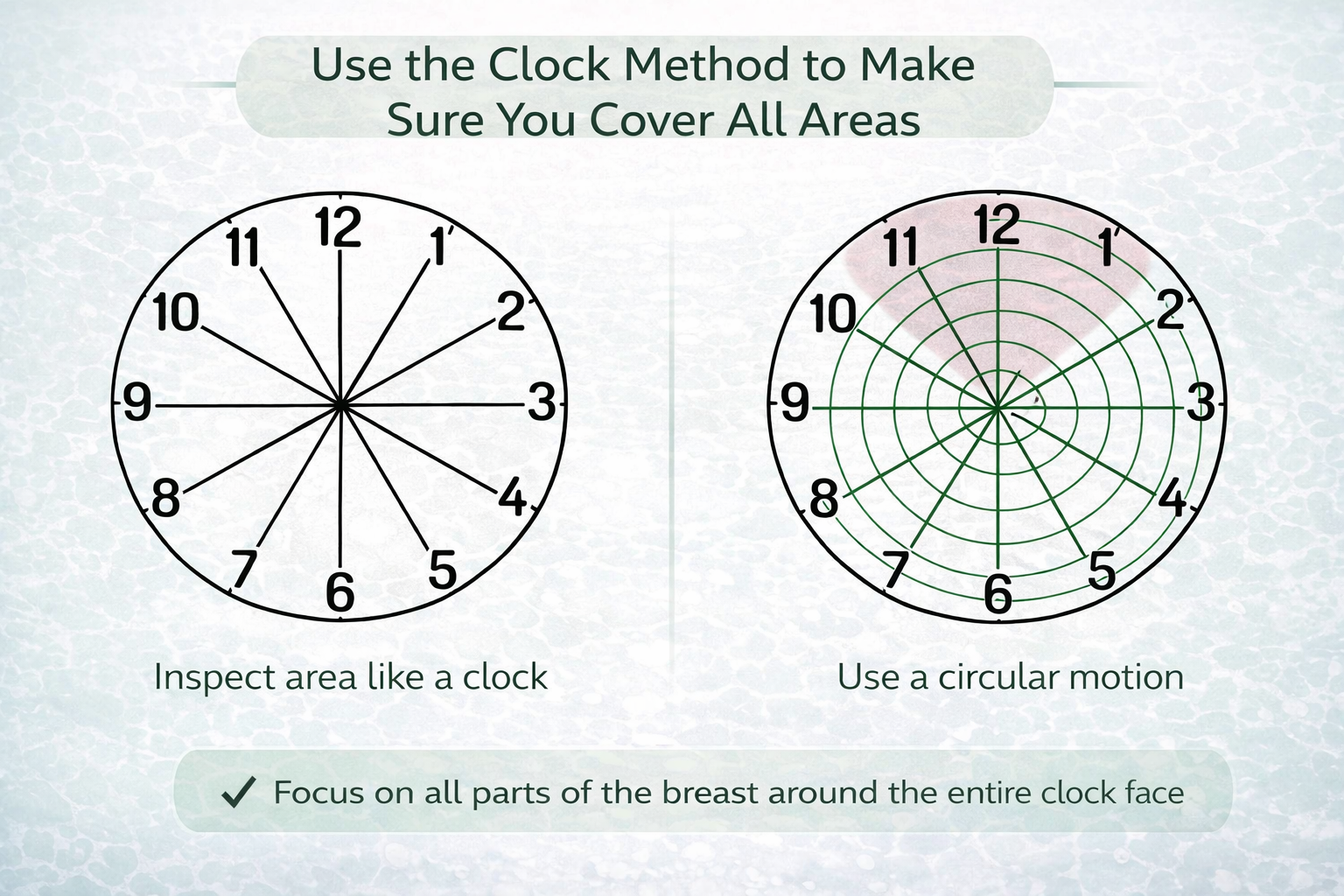
Feel for:
- any lump, even if small
- any thickened or hard area
- unusual tenderness or pain
- skin texture changes
- changes around the nipple or areola
Step 4: Nipple examination
Nipple discharge that occurs spontaneously — without squeezing — deserves attention, particularly if it comes from only one breast and from a single duct opening. The colour and character of the discharge matter: a clear or blood-stained discharge from one breast is the most clinically significant and should always be evaluated by a breast specialist, as it can occasionally be associated with an intraductal papilloma (a small benign growth inside the milk duct) or, less commonly, with an underlying ductal carcinoma in situ (DCIS) or invasive cancer.
Milky discharge from both breasts in a non-lactating woman may indicate elevated prolactin levels and warrants hormonal evaluation.
Green or brown discharge is usually related to duct ectasia — a benign condition where the milk ducts behind the nipple become dilated and sometimes inflamed — and is rarely a cause for concern.
If you notice any spontaneous, persistent, or blood-stained nipple discharge, do not ignore it. Bring it to your doctor's attention so that appropriate imaging (usually an ultrasound and/or mammogram) and, if needed, further evaluation can be arranged
Step 5: Underarm examination
While seated, gently examine the underarm area for any lumps, swellings or tenderness. Lymph nodes in this region are closely linked to the breast.
If you notice any concerning change during self-examination, timely evaluation with digital mammography in Mohali or breast ultrasound in Mohali may be advised by your doctor.
Why Is Self Breast Examination So Important?
The significance of regular SBE cannot be overstated. One of the most powerful tools in breast health is your own awareness and attentiveness to your body.
Breast cancer, when detected at an early stage, carries survival rates in excess of 90 percent. This demonstrates how dramatically outcomes improve when problems are identified early.
Beyond medical benefits, performing a monthly self-examination also empowers you psychologically. It encourages timely medical consultation rather than delay or denial and plays an important role in improving outcomes through breast cancer screening in Mohali when required.
Breast screening services at Fortis Hospital, Mohali
Fortis Hospital, Mohali provides comprehensive breast evaluation including clinical examination, digital mammography and breast ultrasound to support early detection and accurate diagnosis.
Is This Relevant to Men Too?
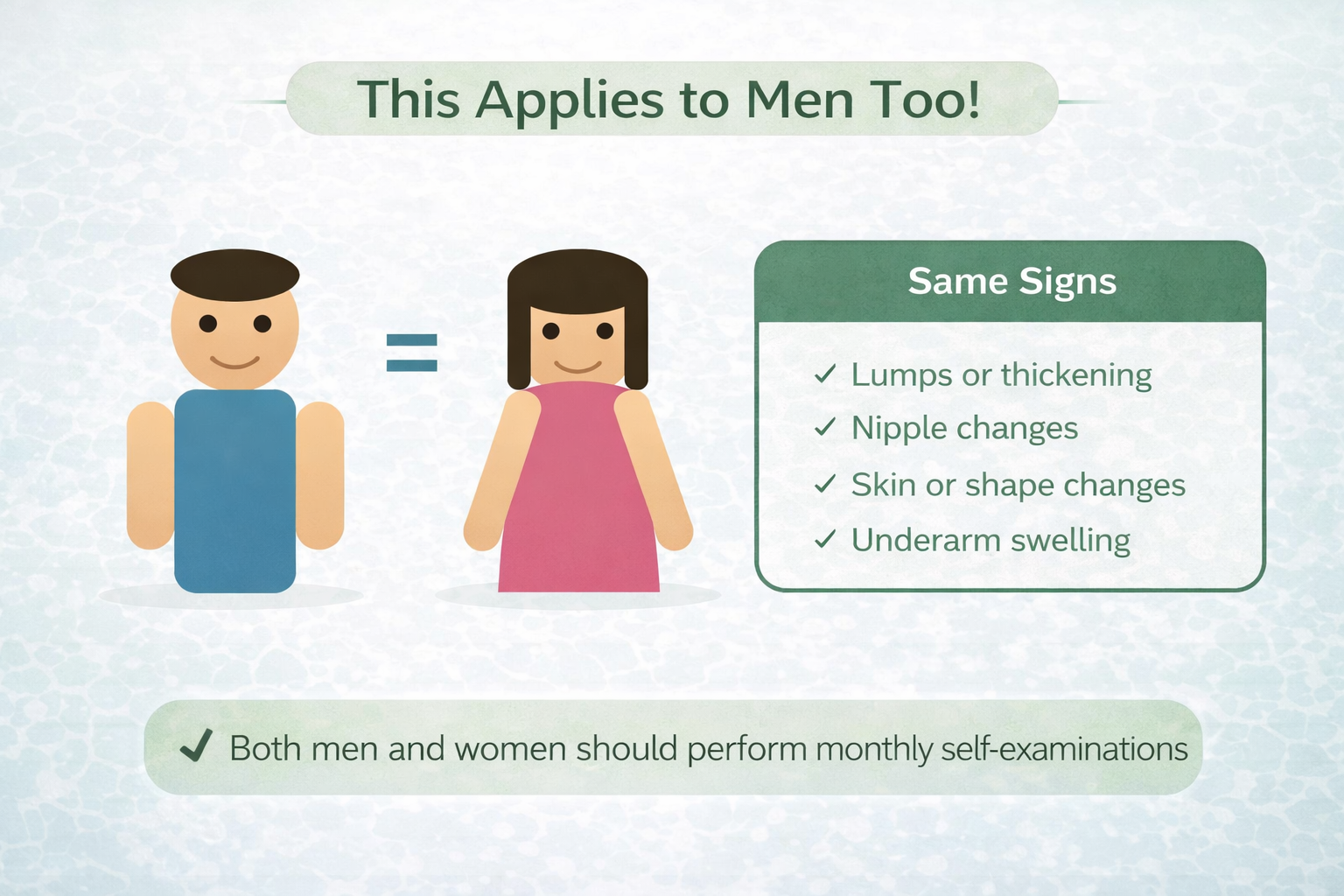
Absolutely. Breast health concerns are not limited to women. Men can also develop breast cancer, and the warning signs are largely the same.
Men should watch for:
- new lumps or thickened areas in the chest
- skin changes such as redness or dimpling
- nipple changes or discharge
- swelling or pain in the underarm area
Because male breast cancer is often diagnosed at a later stage, early self-checking and consultation with a breast specialist in Mohali can be crucial.
Contact Us – Fortis Hospital Mohali
For appointments, consultations, and diagnostic services, please contact:
📞 72728 72728
Our care team will assist you with:
- Doctor appointments
- Diagnostic and screening services
- Health check-ups
Call now to book your appointment at Fortis Hospital, Mohali.
Categories
Clear allMeet the doctor

- Endocrine Surgery | Breast and Endocrine Surgery
- General Surgery | General and Laparoscopic Surgery
-
 5 Years
-
 950
950
Related Blogs
View all





Keep track of your appointments, get updates & more!

