
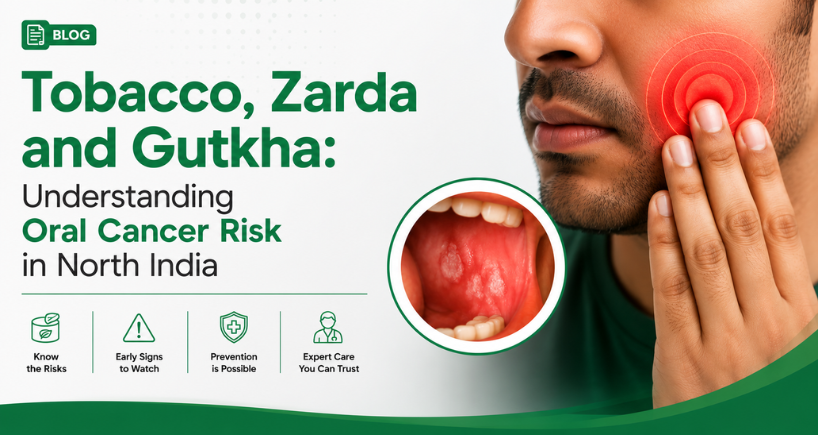


Tobacco Zarda and Gutkha - Understanding Oral Cancer Risk in North India
By Dr Kuldeep Thakur — Consultant, Head & Neck Oncology, Fortis Hospital, Mohali
Medically written and reviewed by Dr Kuldeep Thakur (MBBS; MCh Head & Neck Surgery and Oncology, AIIMS New Delhi).
I operate on oral cancer. My job is to remove cancers from the tongue, cheeks, jaw, and neck, and then reconstruct those areas so patients can eat, speak, and look as normal as possible. These operations are difficult and requires great skill, but most patients heal successfully and regain good function afterward. However, every time I perform one of these operations, I cannot ignore the fact that many of these cancers could have been prevented in the first place.
The main cause of oral cancer is tobacco, whether it is smoked or chewed. The connection is not just a general health warning—it is direct. The cancer often develops exactly where the tobacco is regularly kept or used in the mouth. The author is not trying to blame or criticize people who use tobacco because addiction is a real medical condition caused by nicotine, and quitting is very difficult. Instead, the purpose of the article is to help readers understand the risks, recognize the early warning signs of oral cancer, and seek treatment as soon as possible, since early diagnosis greatly improves outcomes.
The North India Picture — and Why It Is Often Misread
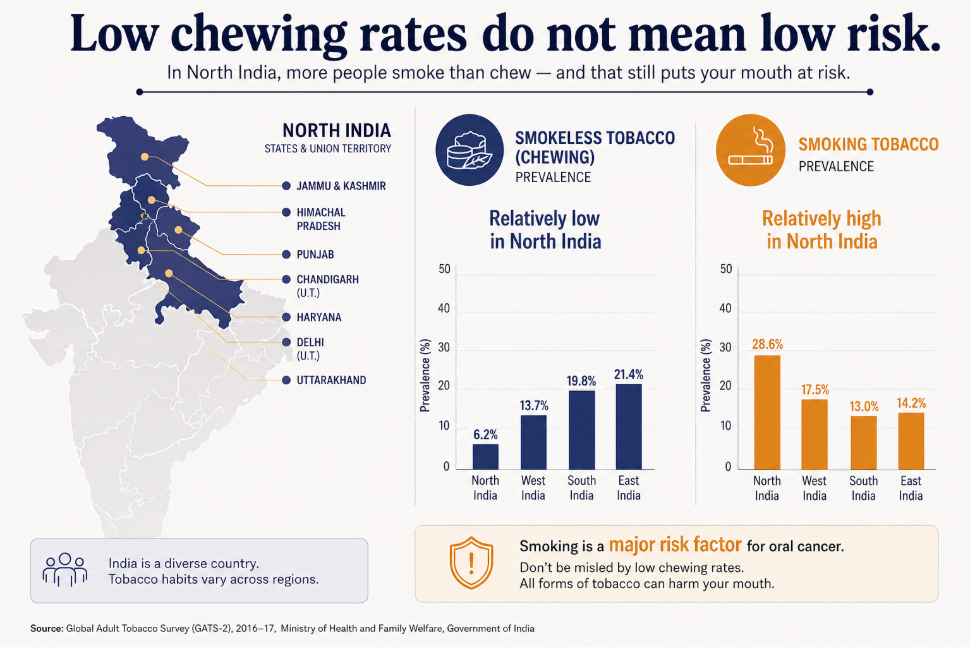
There is a common assumption in our region that oral cancer is somebody else's problem — a disease of states where chewing tobacco is far more widespread. The survey data does show that. In the Government of India's Global Adult Tobacco Survey, smokeless tobacco use across Indian states ranged from around 48% of adults in Tripura down to about 3% in Himachal Pradesh, with Punjab, Chandigarh and Haryana also sitting in the lower band nationally.
That statistic reassures the wrong people. Three things make it misleading if you take it as personal reassurance.
- State averages say nothing about you. Risk follows the individual habit, not the postal address. A daily khaini user in Ambala carries a daily khaini user's risk, regardless of what percentage of Haryana chews.
- In the north, the tobacco story is weighted towards smoking. In Himachal Pradesh, for example, roughly a quarter of men smoke, and bidi is the most commonly used product. Bidi smoke passes through the mouth and throat before it ever reaches the lungs — the oral cavity and oropharynx are exposed first, not last. Hookah, often treated as a social pastime rather than a tobacco habit, carries substantial exposure in a single sitting.
- Our catchment is not one population. Mohali draws patients from across Punjab, Haryana, Himachal Pradesh, Jammu & Kashmir, western Uttar Pradesh and Chandigarh, including a large working population originally from states where chewing tobacco is deeply established. They bring the habit, and the risk, with them.
India as a whole carries one of the highest oral cancer burdens in the world, and roughly one in five Indian adults uses some form of smokeless tobacco. Low regional prevalence lowers the population average. It does not lower any individual's risk by a single percentage point.
What Is Actually in These Products
Most people know that tobacco is harmful in a general way. Fewer know what the individual products contain, or that some of the most dangerous ingredients are not tobacco at all.
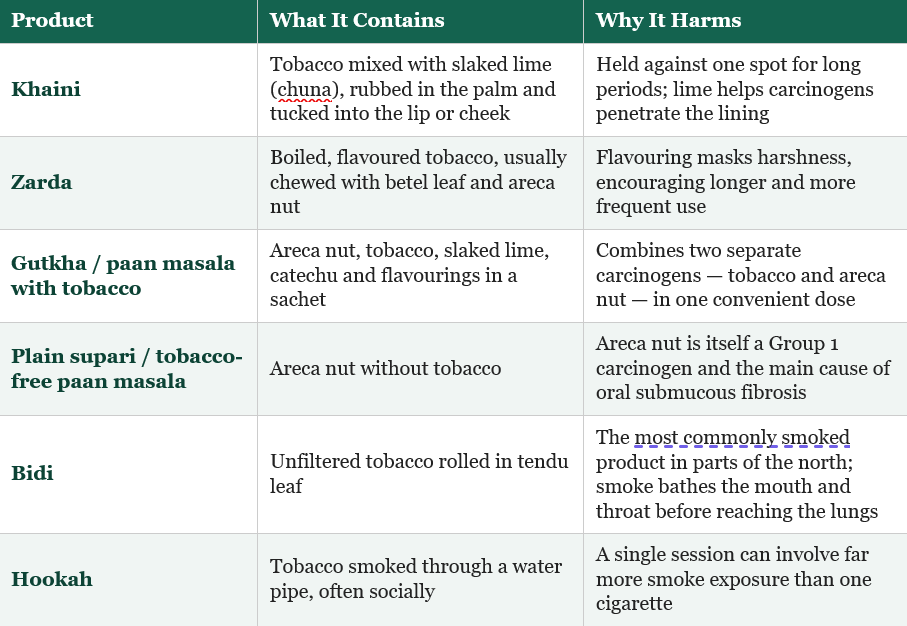
The single most important line in that table is the last-but-two. Areca nut — plain supari, and every “tobacco-free” paan masala sold as a mouth freshener — is classified by the International Agency for Research on Cancer as a Group 1 carcinogen. That is the same category as tobacco itself. “Tobacco-free” is a marketing claim, not a safety claim.
How a Habit Becomes a Tumour
The process is neither fast nor mysterious. It is repetition.
- Direct, prolonged contact. A pinch of khaini or a sachet of gutkha is held in the same place — usually the lower lip or the inside of the cheek — for many minutes, several times a day, for years. That one patch of tissue receives an enormous cumulative dose.
- Chemical injury. Tobacco-specific nitrosamines and related compounds damage the DNA of the cells lining the mouth. Slaked lime raises the pH and helps those chemicals cross into the tissue more readily.
- Mechanical injury. Coarse areca nut particles cause repeated microscopic abrasion, giving the chemicals easier access.
- Accumulation. Cells repair most damage. Over years, some mutations persist and accumulate. The tissue may first turn white or red, then thicken, then become malignant.
This is why the two questions I always ask are how much, and for how long. Risk climbs with frequency, with total years of use, and with starting young. It climbs further when habits are combined — someone who both smokes and chews, or who drinks heavily alongside either, does not simply add the two risks together. They multiply.
Oral Submucous Fibrosis: The Warning Most People Miss
If there is one condition I wish were better known in our region, it is this one. Oral submucous fibrosis is strongly linked to areca nut and gutkha use, and it is a potentially pre-malignant disorder — meaning it carries a real risk of turning into cancer over time.
It does not announce itself as a lump or an ulcer. It creeps.
- A burning sensation when eating spicy food — usually the first complaint, and almost always dismissed.
- The inner cheeks feeling stiff or leathery, sometimes looking pale or blanched rather than healthy pink.
- Slowly reducing mouth opening. People adapt without noticing — taking smaller bites, struggling with a whole roti or an apple, finding dental treatment increasingly difficult.
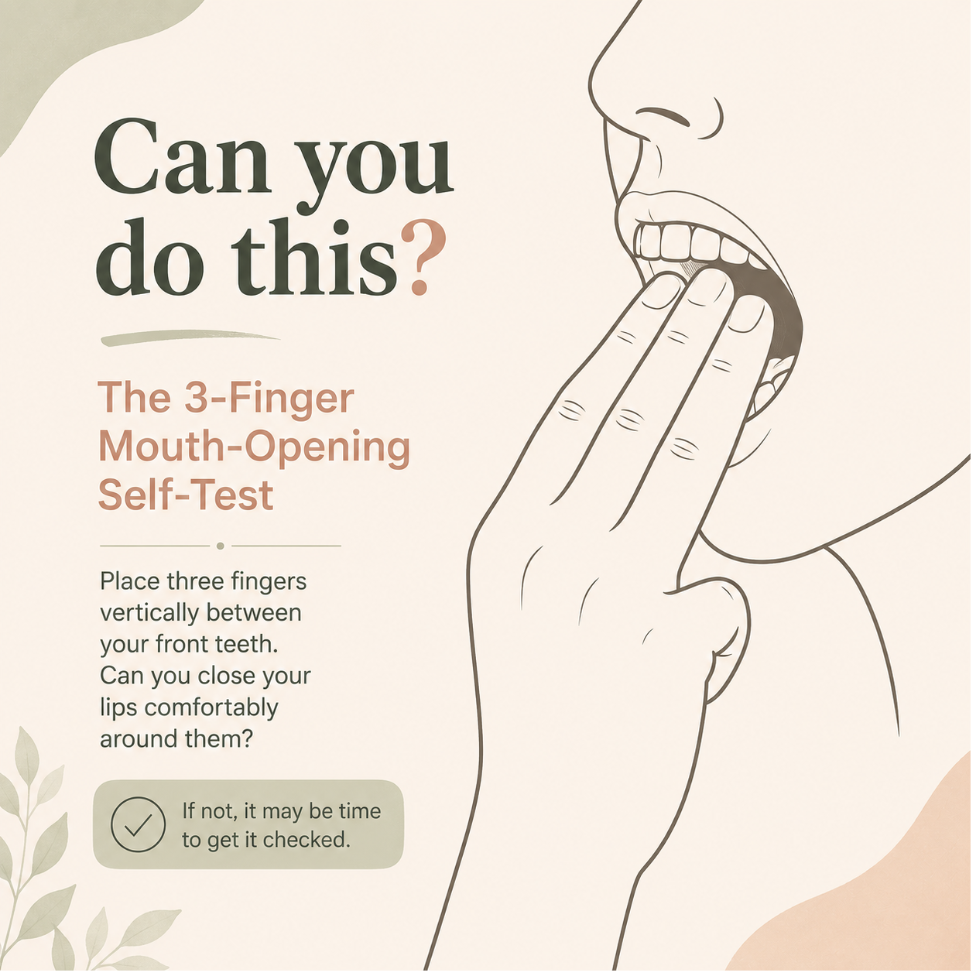
A simple test you can do now: try to fit three of your own fingers, stacked vertically, between your upper and lower front teeth. Most adults can. If you cannot — and particularly if you use supari or gutkha — that warrants an examination, even with no pain and no ulcer.
Caught early, and combined with stopping the habit, submucous fibrosis can often be halted and its symptoms improved. Left alone, it progresses, and the risk of malignant change persists.
Warning Signs That Need Examination
Any one of these, in someone who uses tobacco or areca nut in any form, is a reason to be examined — not a reason to wait and watch.
- A mouth ulcer or sore that has not healed within two weeks
- An ulcer that is painless, or one that is slowly getting larger
- A white patch (leukoplakia), a red patch (erythroplakia), or a mixed red-and-white area that will not scrape off
- A lump or thickening inside the cheek, on the tongue, or on the palate or in neck
- Burning in the mouth, or mouth opening that has reduced
- Bleeding from the mouth with no injury to explain it
- Difficulty chewing, swallowing, or moving the tongue
- Teeth loosening without gum disease, or dentures that suddenly stop fitting
- A lump in the neck, persistent one-sided ear pain with a normal ear, or hoarseness lasting more than two to three weeks
If you use gutkha and you notice a white patch, do not switch brands. Change the habit, and get the patch examined.
I have covered how to distinguish an ordinary mouth ulcer from a concerning one in more detail in the previous article in this series.
Myths I Hear Every Week
“I chew it and spit it out, so nothing is absorbed.” The lining of the mouth absorbs chemicals directly and quickly — that is why nicotine reaches the brain so fast and why the habit is addictive. Spitting removes the residue, not the exposure.
“I brush my teeth straight afterwards.” Brushing cleans the surface. It does not undo DNA damage already done to the cells beneath.
“Tobacco-free paan masala is safe.” Areca nut alone is a Group 1 carcinogen and the principal cause of oral submucous fibrosis. Removing the tobacco removes one hazard, not the main one for this condition.
“I only smoke bidi, I do not chew, so my mouth is fine.” Smoke passes through the mouth and throat first. Bidi and hookah are both associated with cancers of the oral cavity and oropharynx, not only the lung.
“It does not hurt, so it cannot be serious.” Early oral cancers are frequently painless. Pain arrives when the tumour reaches nerves — which is later, not earlier.
“A biopsy will make the cancer spread.” It will not. This belief causes some of the longest and most costly delays I see. A biopsy is how we find out whether there is anything to treat at all.
“I have used it for thirty years — the damage is done, so why stop now?” Risk begins falling from the day you stop, at any age and after any duration. And if you have already been treated for one head and neck cancer, continuing tobacco substantially raises the risk of a second one developing elsewhere in the mouth or throat.
Stopping: What Actually Works
Telling someone to quit is easy and largely useless. What helps is a plan.
- Stop completely rather than cutting down. With smokeless tobacco in particular, reducing quantity has not been shown to meaningfully reduce oral cancer risk.
- Do not substitute one product for another. Moving from gutkha to plain supari, or from khaini to paan masala, is a change of packaging, not a reduction in risk.
- Identify the triggers, not just the habit. For most people it is tied to specific moments — after a meal, with tea, while driving, during a work break. Those moments need something else to occupy them.
- Use the support that exists. India's National Tobacco Quitline is free on 1800-11-2356, and structured cessation counselling with medical support where appropriate roughly doubles the chance of success compared with willpower alone.
- Get examined at the point of quitting, not years later. Stopping does not undo an existing patch or an established fibrosis. Those still need to be looked at and monitored.
What a Screening Actually Involves
It is a conversation and an examination. I ask about the habit — what, how often, how many years. Then I examine the lips, gums, both inner cheeks, all surfaces of the tongue including underneath, the floor of the mouth and the palate, and check how far the mouth opens. Then I feel along the neck for enlarged lymph nodes. For most people it takes a few minutes and ends with reassurance and a date to come back.
If something looks suspicious, a biopsy is taken under local anaesthetic — a small sample, examined under a microscope. Imaging is arranged only if a diagnosis is confirmed and treatment needs planning. Where cancer is found, the case goes to a multidisciplinary tumour board so that surgery, radiation and medical oncology input are decided together rather than sequentially.
Anyone with a long-standing tobacco or areca nut habit should have this done once a year, symptoms or not. It is a short appointment set against a disease that, caught late, changes how a person eats and speaks for the rest of their life.
Book a Screening
If you use tobacco, khaini, zarda, gutkha, supari or paan in any form — or you have a mouth ulcer, patch, lump or reduced mouth opening — book an oral cancer screening at Fortis Hospital, Mohali. The examination takes only a few minutes. Appointments: 72728 72728. Free national tobacco cessation support is available on the Quitline: 1800-11-2356.
About the Author
Dr Kuldeep Thakur is Consultant, Head & Neck Oncology at Fortis Hospital, Mohali. He completed his MCh in Head & Neck Surgery and Oncology at the All India Institute of Medical Sciences (AIIMS), New Delhi, and trained in ENT before specialising in head and neck cancer surgery. His practice covers cancers of the oral cavity, throat, voice box, thyroid and salivary glands, including transoral and robotic approaches and reconstructive surgery. He has published in peer-reviewed journals including Laryngoscope and the Indian Journal of Surgical Oncology, contributed chapters to head and neck oncology textbooks, and speaks regularly as conference faculty on oral cancer and HPV-related throat cancers. This article was written and medically reviewed by Dr Thakur.
Contact Us – Fortis Hospital Mohali
For appointments, consultations, and diagnostic services, please contact:
📞 72728 72728
Our care team will assist you with:
Doctor appointments
Diagnostic and screening services
Health check-ups
Call now to book your appointment at Fortis Hospital, Mohali.
Categories
Clear allMeet the doctor

- Oncology | Surgical Oncology | Head and Neck Oncosurgery | ENT Oncology
- ENT | ENT (Ear, Nose and Throat)
-
 13 Years
-
 1250
1250
Related Blogs
View all







FAQs
Is gutkha safer than cigarettes because there is no smoke?
No. It is a different route of exposure, not a safer one. Smokeless products hold carcinogens directly against the lining of the mouth for long periods, which is why oral cancers are so strongly associated with them.
Can plain supari cause cancer without any tobacco?
Yes. Areca nut is classified as a Group 1 carcinogen in its own right and is the main cause of oral submucous fibrosis.
I have chewed for twenty years with no symptoms. Do I still need screening?
Yes, and particularly so. Precancerous changes such as white patches and early fibrosis are usually silent, and that is exactly the stage at which they are most treatable.
Does quitting actually reduce risk after many years of use?
Yes. Risk starts declining once exposure stops, and the earlier you stop the greater the benefit. It never becomes pointless to quit.
Can gutkha really reduce how far my mouth opens?
Yes — that is oral submucous fibrosis, and reduced mouth opening is one of its defining features. It is one of the clearest reasons to be examined.
Which doctor should I see?
A dentist, an ENT surgeon, or a head and neck oncologist. Any of them can perform the initial examination and refer onward if required.

Keep track of your appointments, get updates & more!

