
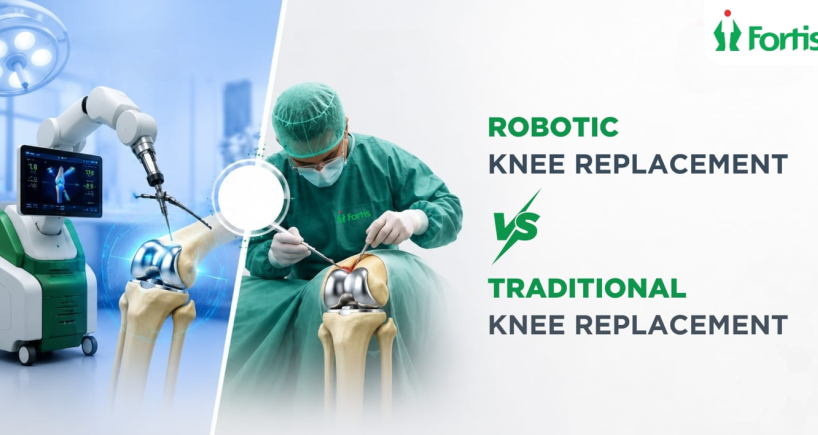


Traditional Knee Replacement vs Robotic Knee Replacement
Joint Replacement Hospital in Navi Mumbai
For patients suffering from advanced knee arthritis, knee replacement surgery can be a life-changing experience. It can help ease chronic pain, improve mobility and restore independence. Yet many patients who are exploring options for treatment often pose a critical question:
Do I Want a Traditional Knee Replacement or a Robotic Knee Replacement?
The response is not always clear. Both procedures are designed to replace a diseased knee joint with an artificial implant to improve function and reduce pain. The difference is in the organization and conduct of the surgery.
As a Robotic Joint Replacement Surgeon, I believe it is vital for patients to understand the advantages of each technique and to recognize that the best option depends on their individual condition, anatomy and treatment goals.
What does traditional knee replacement mean?
For decades, traditional knee replacement has been successfully performed, helping millions of patients around the world regain mobility and quality of life.
In a standard knee replacement procedure, the surgeon uses special instruments and preoperative planning to remove damaged bone and cartilage and to align the knee implant.
Success of traditional knee replacement largely depends on:
- Competency in surgery
- Selecting the ideal implant
- Exact alignment
- Soft tissue balancing
- Recovery from surgery
Modern conventional knee replacement continues to deliver exceptional results for a significant number of patients.
What is robotic knee replacement?
Robotic knee replacement is a sophisticated form of joint replacement surgery that integrates the expertise of a surgeon with robotic technology.
The robot does the surgery is a common misconception. The surgeon has total control during the entire procedure. The robotic platform is a very sophisticated tool that helps in the planning and accuracy of the operations.
The technology allows surgeons to:
- Create a surgical plan for the individual patient
- Analyze the individual's knee anatomy
- Improve the positioning of the implant
- Enhance the alignment precision
- Assessment of soft tissue balance in real time
The result is a surgical plan that is tailored to the unique knee anatomy of each individual.
Key Differences Between Traditional Knee Replacement and Robotic Knee Replacement
1. Planning for surgery
- Standard Knee Replacement - The planning process is based on the experience of the surgeon, standard imaging and measurements.
- Robotic Knee Replacement - Advanced technology enables detailed preoperative planning based on the individual anatomy of the patient.
2. Precision
- Traditional Knee Replacement - The procedure is very efficient when performed by skilled surgeons. However, accuracy depends on surgical judgment and manual tools.
- Knee Replacement by Robots - Provides further information and guidance to improve accuracy and consistency during surgery.
3. Insertion of the Implant
Proper placement of implants is one of the most important factors affecting knee function and long-term outcomes.
- Traditional Process - Implants are placed using conventional surgical instruments and guides.
- Methodology of Robotics - With the robotic platform, the surgeon is able to place the implant as planned in a very precise fashion along the intended axis of alignment.
4. Alignment Accuracy
Good alignment allows the forces to be spread evenly through the joint and may improve the function of implants.
- Surgery, Traditional: Standard surgical techniques are used to achieve alignment.
- Surgery, Robotic: The real-time feedback during the procedure allows optimizing position and alignment of the implants.
5. Personalizing
- Traditional Knee Replacement
Utilizes well-established surgical principles that work on most patients.
Robotic Knee Replacement VS Traditional Knee Replacement
Allows for a greater degree of customization based on the person’s body, movement patterns and joint characteristics.
Robotic Knee Replacement
- Feature: Robotic Knee Replacement
- Surgical Planning: Custom planning
- Implant Placement: Precision with robotics
- Alignment Evaluation: Data-driven real-time
- Personalisation: Methodology adjusted to the individual patient
- Surgeon supervision: Complete
- Objective: To reduce pain and improve mobility
- Outcome: Pain relief and increased mobility
Traditional Knee Replacement
- Feature: Standard Knee Replacement
- Surgical Planning: Regular Planning
- Implant Placement: Instruments that are operated manually
- Alignment Evaluation: Traditional techniques
- Personalisation: A common approach
- Surgeon supervision: Complete
- Objective: To reduce pain and improve mobility
- Outcome: Pain relief and increased mobility
The key is to understand that both methods are intended to achieve excellent clinical outcomes when applied correctly.
Does Robotic Knee Replacement mean a faster recovery?
Recovery depends on many variables including:
- Arthritis severity level
- Overall health
- Muscle strength
- Rehabilitation participation
- Surgical method
Many patients who have robotic-assisted knee replacements said they have been more confident and comfortable during the recovery process. However, the success of rehabilitation is essential, regardless of the surgical approach used, because the results of the procedure may vary significantly among individuals.
Is robotic knee replacement right for everyone?
Not exactly.
Robotic technology offers a lot of benefits, such as surgical planning, alignment and positioning of the implant. But the optimal treatment approach depends on:
- Severity of arthritis - The treatment planning is based on the severity of joint damage.
- Bone Anatomy and Quality - Each patient’s individual anatomy can affect the surgical decision-making process.
- Medical Fitness - It is important to consider a person's existing medical conditions and overall health.
Patient Expectations
The best treatment approach depends on lifestyle goals and activity levels.
A careful orthopedic assessment is helpful in choosing the best technique for each patient.
Benefits of Robotic Knee Replacement
Possible benefits are:
- Improved surgical accuracy
- Care tailored to the individual needs of each patient
- Correct implant placement
- Improvements to alignment evaluation
- Better soft tissue balance
- Performance of surgical procedures that are customized
Such features have made robotic-assisted knee replacement more popular around the world.
The Significance of Surgical Skill
Technology has come a long way in knee replacement surgery but the most critical factor is still the experience and expertise of the surgeon.
Robotic systems are complex instruments designed to enhance the surgeon’s skills, not supplant them.
Successful results depend on:
- Right diagnosis
- Correct patient selection
- Proficiency in surgery
- Implant choice
- Full rehabilitation
Surgical skill and technology together produce the best results.
Why should you opt for robotic knee replacement at Fortis Hiranandani Hospital, Vashi?
We offer personalized treatment for patients with knee arthritis and joint degeneration at Fortis Hiranandani Hospital, Vashi with the help of state-of-the-art robotic-assisted technology and evidence-based orthopedic care.
Our methodology is as follows:
- A complete evaluation of the patient
- Advanced robotic surgical planning
- Precise implant placement
- Individualized treatment strategies
- Rehabilitation programs tailored for
- Long term follow up care
The aim is to help patients return to an active, independent and pain-free lifestyle.
In summary
Conventional and robotic knee replacements are both effective treatments for advanced knee arthritis. Instead, traditional knee replacement continues to offer outstanding results for many patients, and robotic-assisted surgery provides benefits in individualized planning, alignment and implant placement.
The more critical inquiry is what technique is most appropriate for your particular circumstance, not which technique is universally superior. An experienced joint replacement surgeon can help determine the best treatment plan and improve long-term mobility and quality of life with a full evaluation.
Categories
Clear allMeet the doctor

- Orthopaedics | Robotic and Computer navigated Joint reconstruction | Orthopaedics and Joint Replacement | Orthopaedics and Spine Surgery
-
 15 Years
-
 1500
1500
Related Blogs
View all









FAQs
Robotic knee replacement safety versus traditional knee replacement
Both surgeries are safe in the hands of experienced surgeons. Robotic technology offers additional precision and planning tools that may increase the accuracy of surgical procedures.
Is the surgery done via a robot?
No. The operation is under the surgeon's full control. The robotic platform is an advanced guidance system.
Is robotic surgery more painful?
The experience of pain varies from person to person. Modern pain management protocols are used in both traditional and robotic knee replacement procedures.
Will robotic knee replacement last longer?
The experience of pain varies from person to person. Modern pain management protocols are used in both traditional and robotic knee replacement procedures.
Which knee replacement is best for me?
The best choice depends on your anatomy, the severity of your arthritis, your overall health and your treatment goals. It is important to have a complete orthopedic consultation to determine the best course of action.

Keep track of your appointments, get updates & more!

