
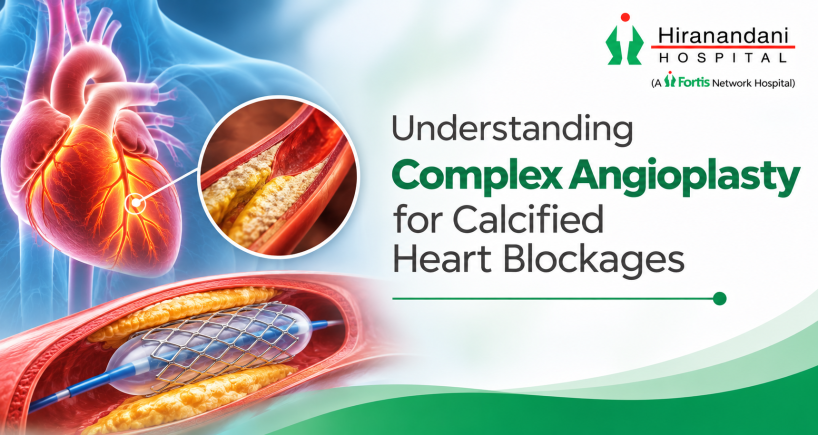


Understanding Complex Angioplasty for Calcified Heart Blockages
When Coronary Arteries Become Rock-Hard: Understanding Complex Angioplasty for Calcified Heart Blockages
Medical education article by Dr Nikhil Patil, Consultant Interventional Cardiologist
What Is Coronary Artery Calcification?
Coronary arteries supply oxygen-rich blood to the heart muscle. Over time, cholesterol-rich plaques may develop within these arteries. Some plaques also accumulate calcium, making the affected segments rigid and difficult to expand.
When a coronary blockage contains extensive calcium, angioplasty may become significantly more challenging.These are commonly described as heavily calcified coronary lesions.
Why Is Calcium a Problem During Angioplasty?
During conventional coronary angioplasty, a balloon is inflated to enlarge the narrowed artery, and a stent may be implanted to help maintain the opening.
However, severe calcium can resist balloon expansion. If the artery is not adequately prepared, the implanted stent may also remain incompletely expanded. Suboptimal stent expansion is associated with an increased risk of adverse outcomes, including restenosis and stent thrombosis.
Therefore, identifying and appropriately modifying resistant calcium is an important consideration during complex coronary intervention.
What Technologies Are Used for Heavily Calcified Blockages?
1. Specialised angioplasty balloons - Non-compliant balloons are designed to provide controlled expansion, while cutting balloons use small blades to create controlled incisions in resistant plaque.
These devices may assist with lesion preparation.
2. Intravascular lithotripsy - Coronary intravascular lithotripsy uses pressure waves delivered through a specialised balloon to modify calcium within the arterial wall.
This can create fractures in the calcium, allowing the artery to expand more effectively.
3. Intravascular ultrasound - Intravascular ultrasound, commonly called IVUS, provides detailed cross-sectional images from inside the coronary artery.
IVUS can help identify calcium, assess vessel dimensions, guide treatment selection and evaluate stent expansion following implantation.
Why Is Stent Optimisation Important?
Successfully delivering a coronary stent does not always mean that the procedure has achieved its intended mechanical result.
In heavily calcified arteries, the stent may require additional balloon expansion. Intravascular imaging helps cardiologists identify incomplete expansion and assess the final result.
Does Every Calcified Blockage Require These Technologies?
No. The management of coronary artery disease depends on several factors, including symptoms, the extent of myocardial ischaemia, coronary anatomy, overall cardiovascular risk and other medical conditions.
Some patients may be managed medically, while others may require angioplasty or coronary bypass surgery. Advanced calcium-modification techniques are generally reserved for selected situations where they are clinically appropriate.
The Takeaway
Severe coronary calcification can make angioplasty technically demanding.
Specialised balloons, intravascular lithotripsy and IVUS provide additional options for managing selected complex coronary lesions.The central principle remains careful assessment, appropriate treatment selection and adequate stent optimisation.
Dr Nikhil Patil
Consultant Interventional Cardiologist
Navi Mumbai
This article is intended for general health education and does not replace individual medical assessment.
Suggested references: SCAI Expert Consensus on Calcified Coronary Lesions (2024); EAPCI Clinical Consensus on Heavily Calcified Coronary Stenoses (2023).
Categories
Clear allMeet the doctor

- Cardiac Sciences | Interventional Cardiology
-
 15 Years
-
 1500
Related Blogs
View all







FAQs

Keep track of your appointments, get updates & more!

