
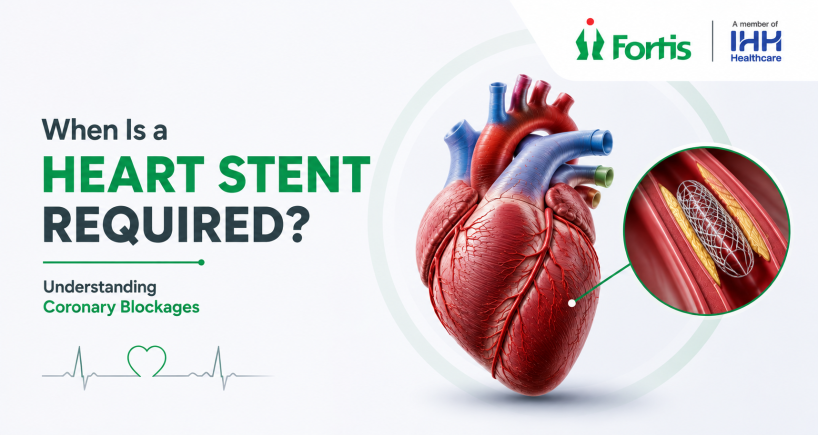


When Is a Heart Stent Required and Understanding Coronary Blockages
When Is a Heart Stent Actually Required? Understanding When Coronary Blockages Need Angioplasty.
One of the most common questions patients ask me after an angiography is:“Doctor, I have a 70% blockage. Does that mean I need a stent?”
My answer is that we should not decide about a stent only by looking at one percentage on an angiography report.
A coronary blockage has to be interpreted in the context of the patient why the angiography was done, whether the patient has had a heart attack, what symptoms are present, where the blockage is located, how severe it is, how much heart muscle is at risk, and whether that particular blockage is actually reducing blood flow to the heart.
The purpose of angioplasty is not simply to treat a number on an angiogram. It is to treat a blockage when there is a clear clinical reason to do so.
Does a 70% blockage always need a stent?
Not necessarily. This is probably one of the biggest misconceptions I see in clinical practice. Patients sometimes come to me with an angiography report showing a 70% blockage and assume that the next step has to be angioplasty. But some lesions are borderline or intermediate on angiography. In these situations, instead of relying only on how the blockage looks to the eye, we can sometimes use a test called Fractional Flow Reserve, or FFR, or another physiological assessment such as iFR.
I explain FFR to patients quite simply:
- It helps us understand whether that particular blockage is actually reducing blood flow enough to justify putting in a stent.
- If physiological assessment shows that the lesion is not significantly restricting blood flow, angioplasty may sometimes be safely deferred and the patient can be managed appropriately with medicines and risk-factor control.
On the other hand, if the lesion is physiologically significant and fits with the patient’s symptoms and overall clinical picture, angioplasty may be appropriate.
So the question is not simply:“Is the blockage 70% or 80%?”
The better question is: “Is this blockage clinically important, and will treating it benefit this patient?”
When is a stent clearly required?
The situation is very different when a patient presents with an acute heart attack.
If a coronary artery has suddenly become critically narrowed or completely blocked and is causing an acute myocardial infarction, restoring blood flow quickly can save heart muscle and, in appropriate situations, can be lifesaving. There are also patients with unstable symptoms or other high-risk features in whom an early invasive strategy and revascularisation may be necessary.
These emergency and high-risk situations should not be confused with a stable patient in whom a coronary blockage has been discovered during an elective evaluation.
“Doctor, can I avoid a stent?”
This is another question I hear very frequently. My answer is sometimes yes, and sometimes no.
If the patient is stable, symptoms are controlled, the coronary anatomy is not high-risk and testing suggests that a borderline lesion is not significantly restricting blood flow, then optimal medical treatment and aggressive risk-factor control may be appropriate. That means controlling cholesterol, blood pressure and diabetes, stopping smoking, improving lifestyle and taking appropriate cardiac medicines consistently.
But there are other patients in whom the severity and location of coronary disease, persistent symptoms, evidence of significant ischemia or the overall clinical situation makes revascularisation the better option.
The important point is that we should neither try to avoid a stent at all costs nor put in a stent simply because a blockage is visible.The right patient should receive the right treatment for the right reason.
Where do IVUS and OCT help?
Another major development in modern angioplasty is our ability to look at the coronary artery from inside using technologies such as IVUS — intravascular ultrasound — and OCT — optical coherence tomography.
I find intravascular imaging particularly useful in selected complex situations.
For example, it can be extremely helpful when we are dealing with:
* blockages involving the left main coronary artery;
* heavily calcified coronary blockages;
* complex or long lesions;
* problems occurring inside a previously implanted stent; or
* situations where angiography alone does not give us enough information about the vessel or stent.
Angiography gives us a two-dimensional outline of the coronary artery. IVUS and OCT can provide much more detailed information from inside the vessel. This can help us understand the lesion better, select the appropriate treatment strategy, choose the correct stent size and confirm that the stent has expanded and apposed properly. In complex angioplasty, these details can make an important difference to the quality of the final result. A blockage inside a previous stent is a different problem
When a patient develops narrowing inside a previously implanted stent, simply looking at the angiogram may not tell us why it has happened.
- Was the original stent under-expanded?
- Is there significant calcium behind it?
- Has new tissue developed inside the stent?
- Is there a mechanical problem with the previous stent?
Intravascular imaging with IVUS or OCT can help answer these questions.
Once we understand the mechanism, treatment can be planned more precisely rather than simply putting another stent inside the previous one without understanding why the problem occurred.
Does every severe blockage require angioplasty?
Even when coronary disease is severe, angioplasty is not automatically the best treatment for every patient.
Some patients have a pattern of disease where coronary artery bypass grafting (CABG) may provide a better long-term strategy. This can be particularly relevant in selected patients with complex multivessel disease, left-main disease, diabetes or diffuse coronary disease.
The decision between medicines, angioplasty and bypass surgery therefore needs to consider the complete coronary anatomy as well as the patient’s age, symptoms, heart function, other illnesses and individual circumstances.
For complex disease, a Heart Team discussion involving the interventional cardiologist and cardiac surgeon can sometimes be the best way to arrive at the appropriate treatment.
Should you take a second opinion before angioplasty?
If a patient is having an acute heart attack, treatment should not be unnecessarily delayed while seeking multiple opinions. But in a stable patient where there is uncertainty about whether a particular blockage needs angioplasty, seeking a second opinion can be reasonable.
A second opinion does not mean that the objective is to avoid a stent. Sometimes the second opinion confirms that angioplasty is clearly appropriate. In another patient, it may suggest further physiological assessment with FFR/iFR, optimization of medical therapy or consideration of bypass surgery.
The purpose is simply to make sure that the treatment decision is appropriate for that individual patient.
What should patients remember?
If you are told that you have a coronary blockage, don’t focus only on the percentage.
Ask your cardiologist:
- Is this blockage responsible for my symptoms?
- Is it significantly reducing blood flow?
- What happens if I treat it with medicines?
- What benefit should I expect from angioplasty in my particular case?
- Would FFR/iFR, IVUS or OCT provide useful additional information?
- Is bypass surgery a better option for my pattern of disease?
Modern interventional cardiology is increasingly about making these decisions more precisely.
A stent can be lifesaving in the right clinical situation and can provide substantial benefit to appropriately selected patients. But the presence of a coronary blockage alone does not automatically mean that every patient needs angioplasty.
Good interventional cardiology is not about putting in more stents or fewer stents. It is about putting in a stent when the patient genuinely needs one and avoiding an unnecessary procedure when they do not.
This article is intended for general health education and should not replace individual medical evaluation. Patients with sudden or severe chest pain, sweating, breathlessness, fainting or other symptoms suggestive of a heart attack should seek emergency medical care immediately.
By Dr. Nikhil Patil
Consultant Interventional Cardiologist
Fortis Hiranandani Hospital, Vashi, Navi Mumbai
Categories
Clear allMeet the doctor

- Cardiac Sciences | Interventional Cardiology
-
 15 Years
-
 1500
1500
Related Blogs
View all








FAQs

Keep track of your appointments, get updates & more!

