

Media coverage


Fortis In The News AV Eighteenth Edition
Jan 19, 2026
Dear Colleagues,
Team Corporate Communications is delighted to bring you Edition-18 of "Fortis in the News," our audio-visual news bulletin.
Click on the link for access the video: https://youtu.be/GGS9DgHZwTo
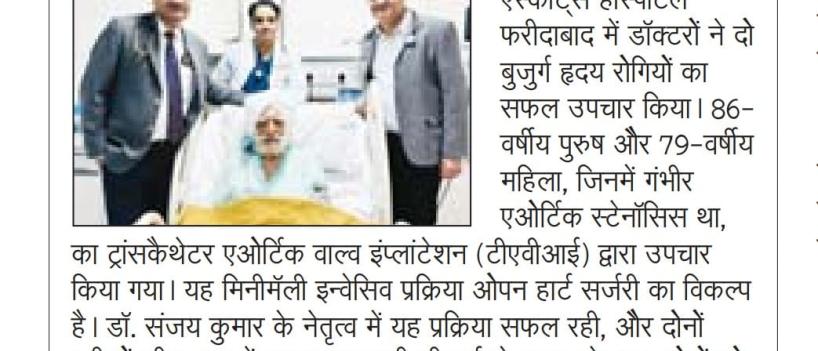
Successful Advanced TAVI Procedures at Fortis Escorts Faridabad Help Treat Two Critically High-Risk Elderly Cardiac Patients
Treated by:
Dr. Sanjay Kumar
Non-Invasive Cardiology
| Fortis Escorts Hospital, Faridabad
Jan 30, 2026
Faridabad, 14 January 2026: In a significant medical achievement, doctors at Fortis Escorts Hospital Faridabad have successfully treated two elderly, critically high-risk cardiac patients suffering from severe aortic stenosis, a potentially fatal heart valve condition, using Transcatheter Aortic Valve Implantation (TAVI) - a minimally invasive alternative to open-heart surgery. The procedures were performed by a multidisciplinary cardiology team led by Sanjay Kumar, Senior Director – Cardiology, Fortis Escorts Hospital Faridabad.
The patients - a 86-year-old man and a 79-year-old woman, were both considered extremely high risk for conventional surgical aortic valve replacement due to advanced age and multiple co-morbidities, including chronic obstructive pulmonary disease, diabetes, hypertension, and underlying coronary artery disease with prior stenting. Both the patients were admitted with progressive shortness of breath, giddiness, and exertion--symptoms that significantly impact quality of life and indicate advanced valve disease.
Diagnostic 2D echocardiography confirmed severe aortic stenosis in both the cases. They had high mortality rates - 15.8% for the 86-year-old male patient and 12.1% for the 79-year-old female patient -categorizing them as very high risk for open-heart surgery. If left untreated, the condition carries a poor prognosis, with survival expectancy reducing to mere 2 to 3 years.
Given the high surgical risk, the cardiology team opted for TAVI, a state-of-the-art, minimally invasive procedure that allows diseased aortic valve replacement without opening the chest. Both procedures were performed under conscious sedation, minimising anaesthesia-related risks in elderly patients. The 86-year-old male patient underwent TAVI procedure completed, which was done in approximately 2.5 hours. The 79-year-old female patient underwent a 3-hour-long TAVI procedure. Despite the complexity, both the procedures were executed successfully. Both the patients showed significant clinical improvement post-procedure and were discharged in a stable condition.
Giving details of the cases, Dr Sanjay Kumar, Senior Director, Cardiology, Fortis Escorts Hospital, Faridabad said, “Severe aortic stenosis in elderly patients with multiple co-morbidities presents an enormous challenge. Severe aortic stenosis affects nearly 8-9% of the elderly population and, if untreated, can rapidly become life-threatening. TAVI has emerged as a life-saving option for patients who are otherwise deemed inoperable. These cases demonstrate how advanced technology, careful patient selection, and a multidisciplinary approach can dramatically improve outcomes, even in very high-risk individuals.”
Dr Abhishek Sharma, Facility Director, Fortis Escorts Hospital, Faridabad said, “The complex cases highlight the advanced cardiac care infrastructure we have built at Fortis Escorts Hospital, Faridabad. These successful interventions reinforce Fortis Escorts Hospital, Faridabad’s commitment to offering cutting-edge, minimally invasive cardiac care, especially to elderly and high-risk patients who were previously considered unsuitable for surgery. We are proud of our clinicians for ensuring a safe outcome in a situation where conventional surgery was not an option. Our focus remains on providing timely, world-class care to every patient who walks through our doors.”
Meet the doctor

Dr. Sanjay Kumar
Senior Director Cardiology | Fortis Faridabad
- Cardiac Sciences | Non-Invasive Cardiology
-
 26 Years
-
 1000
1000
Treated at Hospital

Fortis Escorts Hospital, Faridabad
4.7

4.7


Read more about
Non-Invasive Cardiology
31 Doctor available at
19 locations
19 locations
Get Care You Can Trust
At Fortis, getting care means more than just undergoing tests — it means being guided, understood, and supported by some of India’s most trusted medical professionals.
- When you choose a Fortis Preventive Health Check, your care journey is led by experienced Fortis doctors, backed by advanced diagnostics and a patient-first approach. Every test, consultation, and recommendation is designed to give you clarity about your health and confidence in your future.
- Our preventive health programs focus on early detection and risk assessment, helping identify potential health concerns before they become serious. Whether it’s heart health, diabetes, liver function, kidney performance, or lifestyle-related conditions, Fortis ensures that your health is reviewed holistically — not in isolation.
- Care Led by Trusted Fortis Doctors
- Your reports are reviewed by qualified specialists and physicians with years of clinical expertise. These doctors don’t just interpret numbers — they explain what those results mean for you. You receive medical guidance that is practical, personalised, and actionable, helping you make informed decisions about your lifestyle, diet, and future care.
- Fortis doctors follow evidence-based medical protocols and global best practices, ensuring accuracy, safety, and transparency at every step. If further evaluation or follow-up is required, you are seamlessly guided through the next steps within the Fortis ecosystem.
- Advanced Diagnostics. Compassionate Care.
- All health checks are supported by state-of-the-art diagnostic infrastructure, delivering reliable and precise results. From blood investigations to imaging and clinical assessments, Fortis combines technology with human expertise to deliver care you can rely on.
- Equally important is the experience. Our teams are trained to ensure comfort, privacy, and efficiency, so your health check is smooth, respectful, and stress-free.
- Personalised Guidance for Long-Term Well-Being
- Preventive care at Fortis doesn’t end with a report. You receive clear health insights and preventive guidance tailored to your age, medical history, and risk profile. The goal is not just to detect illness, but to help you stay active, energetic, and confident in everyday life.
- Because good health isn’t about reacting to problems — it’s about staying ahead of them.
- Your Health. Our Commitment.
- With Fortis, you are choosing a healthcare partner trusted by millions across India. From preventive screenings to expert medical advice, every aspect of care is delivered with integrity, expertise, and empathy.
- Get care that protects today and prepares you for tomorrow — with Trusted Fortis Doctors by your side.
Why Choose Us
-
One of India’s most trusted healthcare networks
-
NABH-accredited hospitals and labs
-
Patient-first approach with ethical medical practices
-
Nationwide presence with consistent quality standards
Care led by trusted Fortis doctors with years of clinical expertise
-
Comprehensive preventive health checks for early risk detection
-
Advanced diagnostics backed by world-class medical technology
-
Personalised health insights, not just test reports
Sustainability at Fortis
At Fortis Healthcare, sustainability is at the heart of our commitment to protect the environment while delivering exceptional healthcare. We integrate Environmental, Social, and Governance (ESG) practices to minimize our ecological footprint, conserve resources, and promote a healthier planet alongside improving patient care and community well-being.
Our Purpose
Our purpose is to provide world-class healthcare that not only heals people but also sustains the environment for future generations. By embedding sustainable practices in every aspect of our operations, we strive to create a balance between advancing health outcomes and protecting natural ecosystems.
Our Values
- Environmental Stewardship: We prioritize eco-friendly initiatives to optimize energy use, optimize water use, responsibly manage biomedical waste and lower emissions.
- Sustainable Care: Delivering healthcare solutions that support long-term societal and environmental health.
- Integrity and Transparency: Conducting our business ethically with openness to stakeholders.
- Compassion and Respect: Caring for patients, communities, and the planet with empathy and dignity.
- Collaboration: Partnering with all stakeholders to drive sustainable impact beyond healthcare.
Business Responsibility and Sustainability Reports

WHAT IS PERITONEAL SURFACE ONCOLOGY?
Peritoneal surface oncology is an established subspecialty of surgical oncology that focuses on cancers affecting the peritoneum – the membrane lining your abdominal cavity and covering your organs. When cancer spreads to this lining (peritoneal metastases or carcinomatosis), it creates a challenging clinical situation that requires specialized expertise.
Cancers We Treat:
• Ovarian Cancer with peritoneal spread
• Colorectal Cancer with peritoneal metastases
• Gastric (Stomach) Cancer with peritoneal carcinomatosis
• Appendiceal Cancer (Pseudomyxoma Peritonei)
• Peritoneal Mesothelioma
• Primary Peritoneal Cancers
• Recurrent Abdominal Cancers with peritoneal involvement
HIPEC: HYPERTHERMIC INTRAPERITONEAL CHEMOTHERAPY
Overview
HIPEC (Hyperthermic Intraperitoneal Chemotherapy) is a powerful, two-step treatment for advanced abdominal cancers that have spread to the peritoneal surface. This procedure combines aggressive surgery with heated chemotherapy to improve outcomes in carefully selected patients.
How HIPEC Works
Step 1: Cytoreductive Surgery (CRS)
Removal of all visible tumors from the abdominal cavity, including:
• Tumor deposits from the peritoneal lining
• Involved organ segments (intestine, spleen, gallbladder, etc.)
• Tumor from diaphragm or abdominal wall
Goal: Complete removal of all visible disease
Step 2: Heated Intraperitoneal Chemotherapy
Immediately after CRS:
• Heated chemotherapy (41-43°C / 106-109°F) is circulated for 60–90 minutes
• Internal surfaces are bathed to kill microscopic cancer cells
• Heat is drained and incisions are closed
Why HIPEC Is Effective
- Direct Drug Delivery
• High-dose chemotherapy reaches tumor surfaces directly
• 20–1000x concentration vs. IV chemotherapy
• Low systemic toxicity - Heat Makes Chemotherapy More Potent
• Cancer cells become 2–4x more sensitive
• Heat damages membranes
• Better drug penetration - Proven Survival Benefits in Select Cancers
• Appendiceal Cancer
• Ovarian Cancer
• Colorectal Peritoneal Metastases
• Gastric Cancer (selected cases)
• Peritoneal Mesothelioma
HIPEC Candidate Profile
HIPEC benefits patients with:
• Limited peritoneal disease
• Good performance status
• No major disease outside the abdomen
• Responsive cancer types (appendiceal, ovarian, colorectal, mesothelioma)
HIPEC Patient Expectations
Surgery Duration: 6–12 hours
Hospital stay - 7 to 10 days
Recovery
Return to light activity = 2-3 weeks
Full recovery = 6 to 8 weeks
Side Effects: Temporary ileus, fluid accumulation, infection risk, chemotherapy-related effects
PIPAC: PRESSURIZED INTRAPERITONEAL AEROSOL CHEMOTHERAPY
Overview
PIPAC (Pressurized Intraperitoneal Aerosol Chemotherapy) is a minimally invasive technique for patients with peritoneal metastases where standard treatment is limited. It offers disease control with faster recovery.
How PIPAC Works
Performed laparoscopically:
- Small incisions (keyhole access)
- Chemotherapy converted into fine aerosol
- Aerosol sprayed under controlled pressure
- Pressure enables deeper tumor penetration
- Aerosol evacuated after 30 minutes
- Patients discharged same or next day
Why PIPAC Helps
Better Tumor Penetration
• Reaches hidden tumors 3–4x more effectively
• Penetrates avascular tumor tissue
• Covers surfaces conventional methods miss
Lower Physical Burden
• Low systemic toxicity
• Quick recovery
• No major incisions
• Suitable for frail patients
Repeatable Treatment
• Every 4–8 weeks
• Allows reassessment
• Improves quality of life
Clinical Evidence Shows
• Tumor shrinkage in ovarian, colorectal, gastric cancers
• Stabilization after failed systemic therapy
• Improved quality of life
• Possible bridge to HIPEC in selected patients
PIPAC Is Useful For:
• Unresectable peritoneal metastases
• Chemotherapy-resistant disease
• Frail patients unfit for major surgery
• Malignant ascites control
• Downstaging before curative surgery
• Ovarian, gastric, colorectal, appendiceal disease
PIPAC Patient Expectations
Procedure Duration: 60–90 minutes
Hospital Stay: Same day to 1 night
Recovery: 3–7 days
Course: 3–6 sessions based on response
Side Effects: Mild discomfort, nausea, low-grade fever
HIPEC vs. PIPAC: WHICH IS RIGHT FOR YOU?
Aspect HIPEC PIPAC
Best For Completely respectable disease Unresectable/extensive disease
Intent Curative in select cases Palliation/control or bridge
Invasiveness Major open surgery Minimally invasive
Hospital Stay 10–21 days Same day–1 night
Recovery 3–6 months 3–7 days
Repeatability One-time Multiple sessions
Patient Fitness Requires good status Suitable for frail patients
Treatment decisions are individualized by a multidisciplinary tumor board.
Why Choose Us
-
Advanced Technology. Expert Doctors. Compassionate Care.